BS EN 61009 Explained: What It Means for Your Residual Current Device (RCD)
If you've specified or replaced an RCD on a UK site recently, you've probably seen BS EN 61009 referenced on the datasheet alongside other standards like BS EN 60898. The two are often confused because they cover devices that look similar and sit in the same distribution board, but they protect against different things. This guide explains what BS EN 61009 actually covers, why it matters for compliance, and how to check a device meets it before you install.
Need help specifying or sourcing a compliant RCD for your site?
What BS EN 61009 Covers
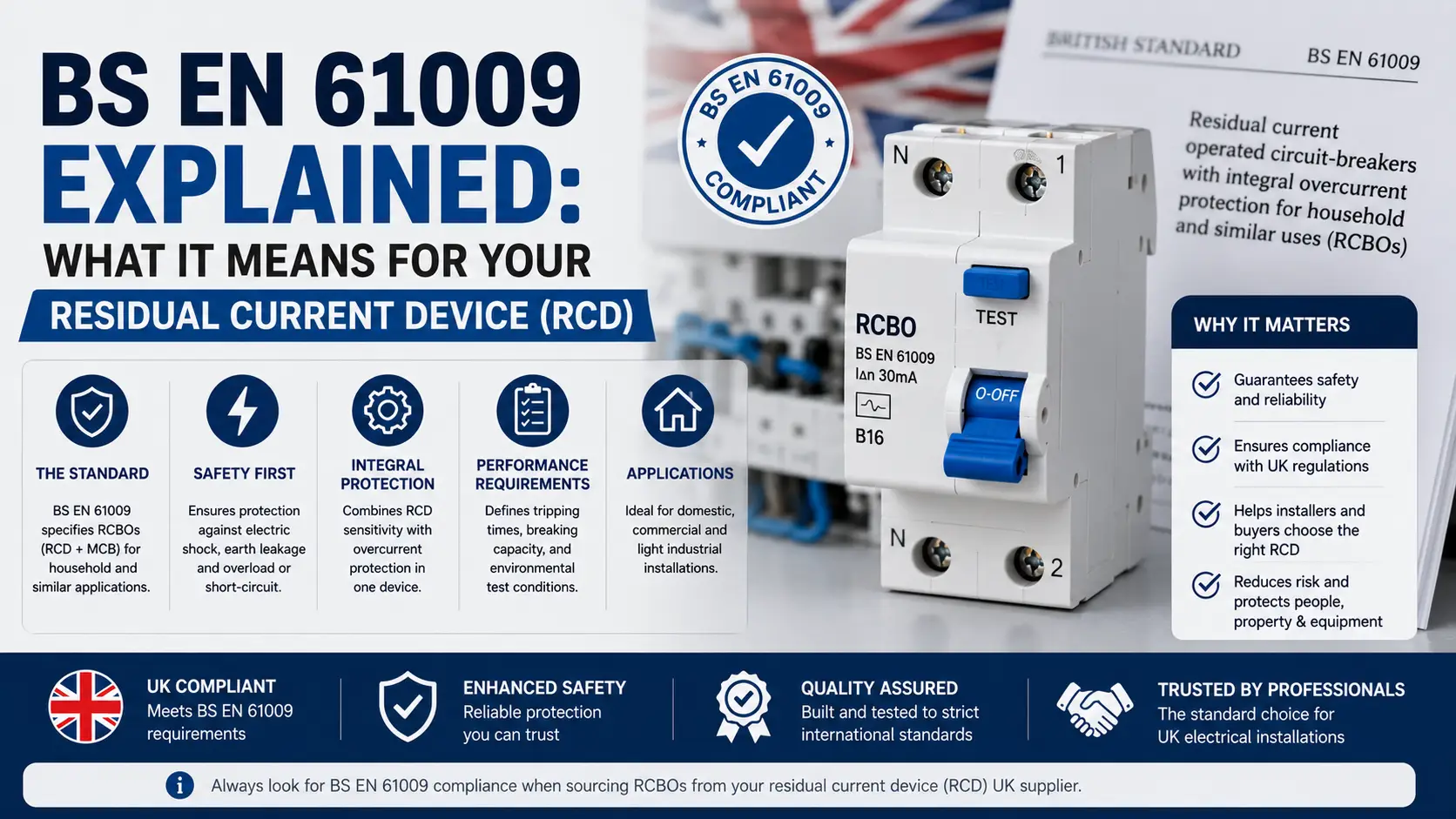
BS EN 61009 is the standard for RCBOs — residual current operated circuit breakers with integral overcurrent protection — meaning a single device that combines earth-fault (residual current) detection with the overload and short-circuit protection normally provided separately by an MCB. This is distinct from BS EN 61008, which covers a standalone RCCB with no overcurrent protection at all, and from BS EN 60898, which covers a standalone MCB with no earth-fault detection. Where a distribution board uses individual RCBOs per circuit, each one is independently BS EN 61009-tested for both functions; where a board instead uses a single upstream RCD (BS EN 61008) protecting several downstream MCBs (BS EN 60898), those two standards apply separately to each device.
Why Compliance Matters
Getting the standard wrong on a datasheet or spec sheet isn't just a paperwork issue — a device tested only to BS EN 61008 has no internal overcurrent protection, so if it's installed expecting RCBO-level (BS EN 61009) protection, a cable overload on that circuit won't trip the device at all. This is one of the more common installation errors found during periodic inspection under BS 7671, particularly on older boards that have had circuits added over time without re-checking what protection each new circuit actually has.
Standard | Device Type | Protects Against | Typical Application |
|---|---|---|---|
BS EN 60898 | MCB | Overload & short-circuit only | Standard circuit protection, no earth-fault detection |
BS EN 61008 | RCCB | Earth-fault (residual current) only | Upstream device covering several MCB-protected circuits |
BS EN 61009 | RCBO | Earth-fault, overload & short-circuit | Single device giving full protection per individual circuit |
How to Verify Compliance
Check the device markings and datasheet directly rather than assuming from the product name — a compliant RCBO will carry the BS EN 61009 designation along with its rated current, trip sensitivity (commonly 30mA for personal protection circuits), and RCD type letter (AC, A, or F, describing what fault waveform the device can detect). Type AC covers standard sinusoidal fault currents; Type A additionally covers pulsating DC fault currents increasingly common with electronic and variable-speed equipment, which is now the minimum most UK electricians specify for general use following updates to BS 7671.
Compliant Product Options
For most UK industrial and commercial boards, a 30mA Type A RCBO to BS EN 61009 is now the standard choice for individual final circuits, with Type AC reserved for older or purely resistive circuits, and higher-sensitivity or Type B devices specified only where the load itself generates smooth DC fault currents (certain VSDs and EV charging equipment).
Category | Relevance | Link |
Residual Current Devices | RCDs, RCCBs and RCBOs across current ratings and trip sensitivities | |
Switch Disconnectors | Manual isolation ahead of RCD/RCBO protected circuits for safe maintenance | |
Miniature Circuit Breakers | Standalone overcurrent-only protection, paired with an upstream RCCB |
Frequently Asked Questions
What is a residual current device (RCD) used for?
An RCD monitors for an imbalance between line and neutral current, which indicates current is leaking to earth, and disconnects the circuit rapidly to protect against electric shock and fire risk from earth faults.
How do I choose between Allen-Bradley and ABB RCD/RCBO devices?
Match the rated current and pole configuration to the circuit, confirm the RCD type letter (AC/A/F/B) suits the connected loads, and check physical width against the existing distribution board if replacing a like-for-like device.
What standards apply to residual current devices (BS EN 61009)?
Combined RCBOs are tested to BS EN 61009; standalone RCCBs to BS EN 61008; and the overcurrent-only MCBs they're sometimes paired with to BS EN 60898.
Can ZF Corporation source obsolete or discontinued RCD devices?
Yes — we regularly cross-reference discontinued RCD, RCCB and RCBO part numbers to current BS EN 61009-compliant equivalents for board upgrades and repairs.
What is the typical lead time for an RCD in the UK?
Common 30mA Type A ratings are typically available from stock; less common sensitivities, Type B devices and obsolete cross-references may carry a short lead time — contact us with the exact specification for a quote.
Conclusion
BS EN 61009 specifically covers RCBOs — devices giving combined earth-fault and overcurrent protection in one unit — and is not interchangeable with BS EN 61008 (RCCB, earth-fault only) or BS EN 60898 (MCB, overcurrent only). Check the datasheet designation directly rather than assuming from the device's physical appearance, and default to Type A, 30mA for general final circuits unless the connected load calls for something more sensitive.
Need help identifying the right RCD standard for your circuit?
Related guides: What Is an RCD? (Beginner's Guide) | More Industry Insights
Browse Our Certified Product Range
DISCLAIMER: Z&F Corporation is not affiliated with, authorized by, endorsed by, or acting as an official representative of any manufacturer, brand, or trademark owner referenced on this website. All product names, trademarks, brand names, logos, and manufacturer references are the property of their respective owners and are used solely for identification, reference, and compatibility purposes.