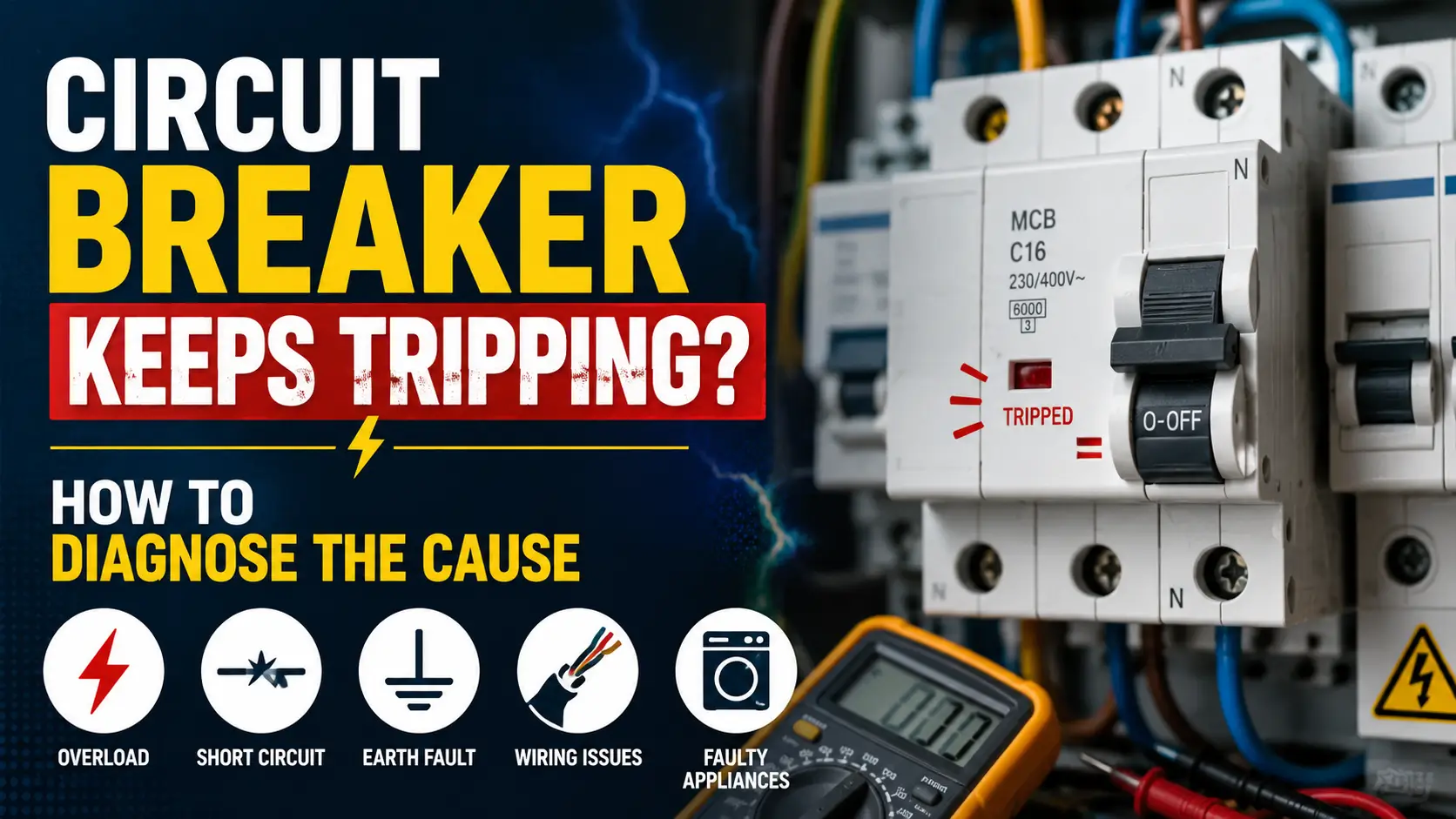
Circuit Breaker Keeps Tripping? How to Diagnose the Cause
A circuit breaker that keeps tripping is not being faulty for no reason — it's reporting a fault. The way it trips is the diagnosis: instantly with no run time points to a short circuit or earth fault, a delay of seconds to minutes points to overload or heat, and a trip the moment a motor starts points to inrush current outrunning the breaker's magnetic setting. Read the pattern correctly and you can usually name the cause before you've opened the panel.
This guide covers the eight most common reasons a breaker trips repeatedly, how each one actually presents, and the checks that confirm it — so you fix the real fault instead of resetting the same breaker every shift until something worse fails.
Don't just keep resetting it. A breaker that trips repeatedly is doing its job. Repeatedly forcing it closed against a real fault stresses the contacts and mechanism and, on a short circuit or earth fault, is a genuine shock and fire risk. Isolate, diagnose, and only re-energise once you know what tripped it.
How a Circuit Breaker Actually Decides to Trip
A standard thermal-magnetic breaker is watching the current through it in two completely different ways at once, and that's the key to reading its behaviour. A bimetal strip bends as it heats up, and enough sustained current bends it far enough to trip — slowly, over seconds to minutes, which is exactly what a real overload looks like. Separately, a small solenoid reacts to a sudden surge of current by physically snapping a plunger in, tripping in milliseconds — built to catch a short circuit before it does real damage. Both paths pull the same trip bar, which releases a spring-loaded latch and snaps the contacts open. Once you know which of the two paths fired, you already know roughly what kind of fault you're chasing.
Current flows through the breaker and is monitored by two parallel paths: a thermal bimetal element that trips slowly on sustained overload, and a magnetic solenoid that trips instantly on a current spike. Either path releases the trip bar and latch, snapping the contacts open. Current flows through the breaker Thermal element (bimetal) Bends under sustained overload — trips in seconds to minutes, faster the bigger the overload. Magnetic element (solenoid) Reacts to a sudden current spike — trips in milliseconds, built to catch a short circuit fast. Trip bar releases the latch Contacts snap open — circuit interrupted
Trip Mechanism Glossary
Element | What It Does |
|---|---|
Thermal element | Bimetal strip that bends with heat, providing the slow, inverse-time overload trip |
Magnetic element | Solenoid that reacts to a current spike, providing the near-instant short-circuit trip |
Trip bar | The shared linkage either the thermal or magnetic element can push to trigger a trip |
Latch | Spring-loaded catch that holds the contacts closed until the trip bar releases it |
Contacts | Open the instant the latch releases, physically interrupting the circuit |
Trip curve | The published time-vs-current graph (Type B/C/D) that sets how much overcurrent it tolerates before tripping, and how fast |
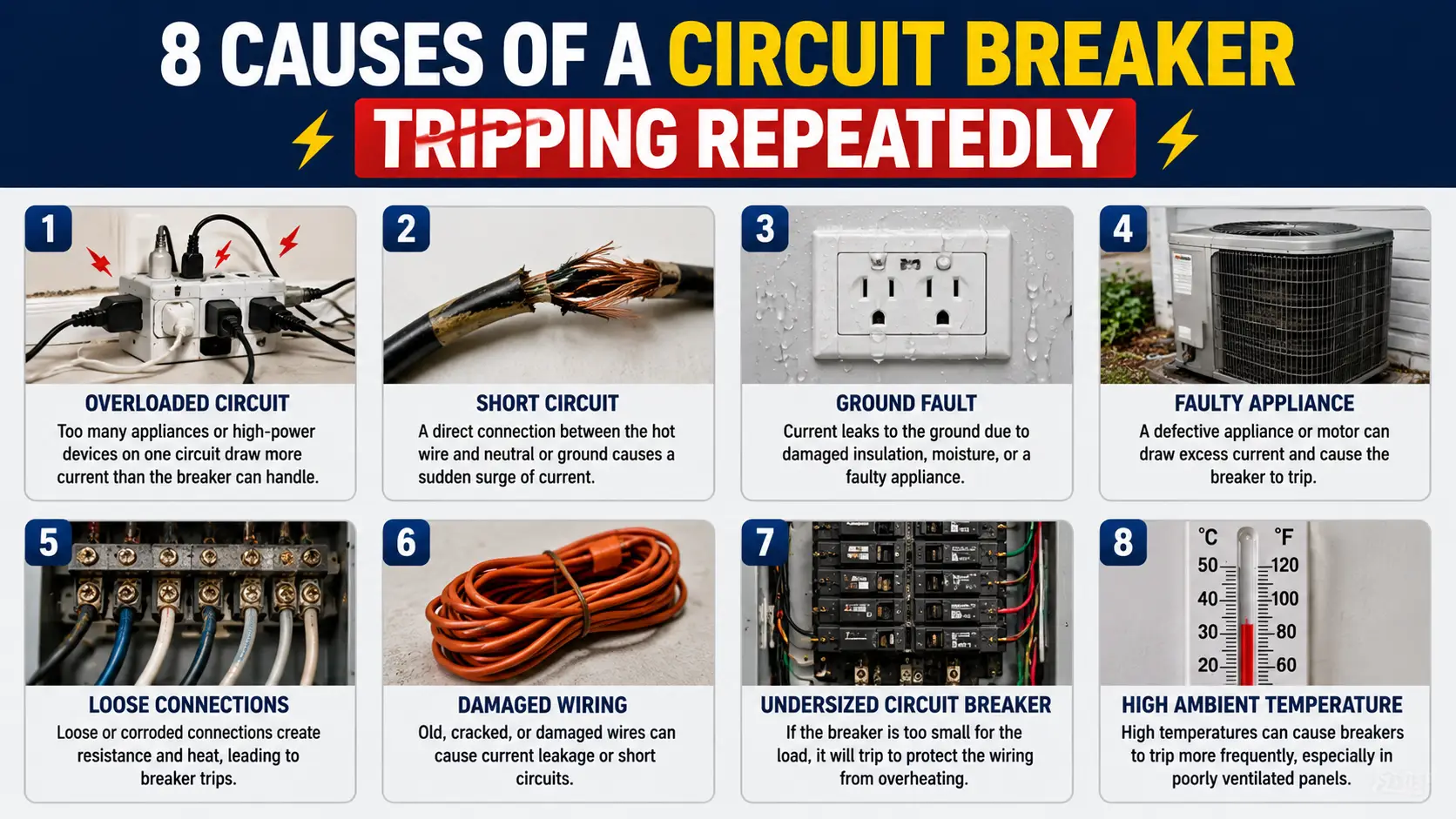
8 Causes of a Circuit Breaker Tripping Repeatedly
1
Overload — Current Draw Exceeds the Trip Curve
The single most common cause, and the easiest to confirm: too much genuine load is running on the circuit for its rated current. It typically trips after the circuit has been running fine for a while — minutes under a heavy overload, longer under a marginal one — because the thermal element has to heat up before it bends far enough to trip. Clamp-meter the actual current at the panel while the circuit is under its normal working load; if it's sitting above the breaker's rated current, you've found it, and the fix is either reducing the load or moving to a correctly sized circuit and breaker, not a bigger breaker on the same undersized cable.
2
Short Circuit — Line-to-Line or Line-to-Neutral Fault
This is the magnetic element doing exactly what it's designed for: an instant trip, with no run time at all, often the moment the breaker is reset. It means damaged insulation, a trapped or pinched cable, or a failed component is letting current jump between conductors it shouldn't. Don't keep resetting it — isolate the circuit and insulation-test (megger) it before re-energising, and inspect for obvious damage at recent work points, cable glands, and connection boxes first.
3
Earth Fault Tripping an RCD/RCBO, Not the Breaker Itself
If there's residual current protection on the circuit, check which device actually tripped before assuming it's the breaker — a leakage to earth from damp cabling, a failing heating element, or a compromised appliance will trip the RCD/RCBO while the breaker itself would happily carry the load all day. Isolate branches one at a time and retest to isolate which downstream circuit is leaking, rather than replacing the protective device that's correctly doing its job.
4
Motor or Transformer Inrush Exceeding the Magnetic Trip
Motors and transformers draw several times their running current for a brief moment at start-up, and if that inrush spike is high enough or lasts long enough, it can trigger the magnetic (instantaneous) element even though nothing is actually faulty. It trips the instant the load starts, then runs perfectly if you reset it — a strong tell. The fix is matching the breaker to the load: a Type C or D curve tolerates more inrush than Type B, and a genuinely motor-driven load is usually better served by a motor protection circuit breaker (MPCB) sized for its starting characteristics rather than a standard MCB.
5
Ambient Temperature De-Rating the Thermal Element
A bimetal strip trips on heat, and it doesn't know the difference between heat from the load current and heat from a hot enclosure around it. A breaker in a poorly ventilated panel, in direct sun, or stacked tightly against other heat-producing gear will trip at a lower actual current than its nameplate rating suggests. If tripping tracks with ambient temperature — worse on hot days, fine overnight or in winter — check panel ventilation and confirm the breaker's rating was chosen with the enclosure's real operating temperature in mind, not just the load.
6
Loose or High-Resistance Connections Generating Heat
A loose terminal, upstream or downstream of the breaker, generates its own heat at the joint under normal load current — heat that can conduct back into the breaker and add to what the thermal element sees, or cause nuisance tripping that has nothing to do with the actual load. It tends to show up as intermittent tripping with no obvious pattern, and the breaker or the terminal often feels noticeably warm to the touch. Torque-check every termination on the circuit and, if you have access to one, a thermal camera on the panel under load will usually show the hot joint immediately.
7
Trip Unit Wear or Drift on an Older Breaker
Bimetal strips and mechanical latches age. On a breaker that's been in service for years, the thermal element can drift and start tripping well below its rated current even under a genuinely normal load, or the mechanism can become sluggish or over-sensitive. This is the diagnosis of exclusion — confirm the load is within rating, the connections are sound, and the ambient temperature is normal first. If it still trips low, a primary injection or trip-unit test against a known-good breaker of the same rating will confirm drift, and the fix is replacement rather than repeated resetting.
8
Wrong Breaker Type or Curve for the Application
A newly installed breaker that trips on loads that should clearly be fine is usually a specification mismatch rather than a fault: a Type B curve fitted where the load's inrush needs Type C or D, a standard MCB used where an MPCB with adjustable overload and short-circuit settings is what the motor actually needs, or a breaker sized to the cable rather than the load's real starting characteristics. Re-check the load's datasheet for its actual inrush and duty cycle against the breaker's curve before assuming the installation itself is at fault.
Quick Reference: Symptom, Likely Cause & What to Check
Symptom | Most Likely Cause | Quick Check |
|---|---|---|
Trips instantly on reset, no run time at all | Short circuit fault | Isolate and insulation-test (megger) the circuit |
Only the RCD/RCBO trips, not the breaker | Earth leakage / earth fault | RCD-test and isolate branch circuits to find the leak |
Trips after running fine for minutes to hours | Overload — current exceeds rating | Clamp-meter the actual load current |
Trips the instant a motor/transformer starts | Inrush exceeding the magnetic trip | Compare start current to the breaker's curve type |
Trips more in summer or in a hot enclosure | Ambient temperature de-rating | Check panel ventilation and ambient-adjusted rating |
Intermittent, no clear pattern; breaker feels warm | Loose or high-resistance connection | Torque-check terminations; thermal-image under load |
Older breaker trips well below its rating | Trip unit wear or drift | Primary injection / trip-unit test vs. a known-good unit |
New install trips on loads that should be fine | Wrong breaker type/curve for the load | Check load's inrush/duty cycle against the curve |
Diagnostic Flow: From Trip to Cause
Start with a breaker that keeps tripping. If it trips instantly with no delay, suspect a short circuit or earth fault. If not, check whether it trips more in hot conditions, pointing to ambient de-rating. If not, measure the load current against the breaker rating to isolate overload, a loose connection, or a wrong trip curve. Breaker keeps tripping Trips instantly on reset, no run time at all? Yes Likely short circuit or earth fault — isolate and megger-test before re-energising No Trips more in hot conditions or a warm enclosure? Yes Ambient de-rating — check panel ventilation and rated temperature No
Still tripping? Clamp-meter the actual load current against the breaker's rating and curve — the remaining causes are overload, a loose connection, or the wrong breaker type for the job.
Frequently Asked Questions
Why does my circuit breaker keep tripping even after I reset it?
A breaker that trips again immediately or within a few resets is telling you the fault is still present — resetting it doesn't fix anything, it just gives the fault another chance to trip it. The pattern matters: instant tripping points to a short circuit or earth fault, while a delay of minutes points to overload or heat. Diagnose before you reset again.
Is it dangerous to keep resetting a tripping breaker?
Yes, if the cause is a short circuit or earth fault — repeatedly closing a breaker onto a live fault risks arcing, contact welding, and in the worst case fire or shock. A single reset to see whether it holds is normal practice; repeated resets against a breaker that won't hold is not.
What's the difference between a breaker tripping from overload and from a short circuit?
Overload trips are slow — the thermal element has to heat up, so the circuit usually runs fine for a while first. A short circuit trips the magnetic element almost instantly, often the moment you reset it, because the fault current is many times higher than any normal load.
Why does my breaker trip only when a specific motor or appliance starts?
This is a classic inrush current signature: the load draws a brief but very high starting current that trips the magnetic element, then would run perfectly normally if it could just get past that first moment. The fix is usually a breaker with a higher trip curve (Type C/D) or a purpose-built motor protection circuit breaker, not a bigger standard MCB.
Can a circuit breaker trip even if nothing seems overloaded?
Yes — ambient heat, a loose connection generating its own heat, an earth leakage picked up by an RCD/RCBO rather than the breaker, or a worn trip unit drifting below its rated current can all trip a breaker with no visible overload at all. Measured current is only one of several things worth checking.
When should I replace a breaker instead of just resetting it?
Once you've confirmed the load, wiring, and connections are sound and it's still tripping below its rated current, or a trip-unit test shows it's drifted from spec, the breaker itself is the fault and resetting it further only delays a proper replacement.
Related Reading
If the diagnosis above points to a sizing or specification issue rather than a fault, these guides go deeper on choosing the right protective device — and if the problem is actually downstream of the breaker, in the starter itself, our contactor guide covers that failure mode:
Shop the Parts
Product | Use | Link |
|---|---|---|
ABB System Pro M Compact S200 MCB, 4-Pole, 16A, Type C | Standard replacement for lighting and small power circuits | |
ABB SACE Tmax XT2N MCCB, 3-Pole, 160A, 10kA | Higher-current distribution and industrial feeder circuits | |
ABB TF65 Thermal Overload Relay, 690V AC | Motor overload protection paired with a contactor, sized to the motor's real starting current | |
Miniature circuit breakers (MCBs) | Browse by pole count, current rating and curve type (B/C/D) | |
Motor protection circuit breakers (MPCBs) | Adjustable overload and short-circuit settings matched to a motor's inrush | |
All genuine ABB switchgear | Breakers, contactors, relays and protection devices from the same manufacturer |
Disclaimer: ABB, and any other manufacturer or brand names referenced in this article, are used solely for identification and compatibility purposes. Z&F Corporation is not affiliated with, authorised by, or an official representative of these manufacturers; all trademarks are the property of their respective owners.