Contactor Procurement Guide: Defining Requirements & Evaluating Suppliers
Buying a contactor sounds simple until the wrong one turns up: the wrong coil voltage, an auxiliary contact configuration that doesn't match the panel, or a supplier that can't confirm genuine stock. For procurement teams specifying contactors across multiple sites — from oil & gas facilities to general manufacturing — a structured approach to requirements and supplier evaluation avoids costly re-orders and installation delays. This guide walks through how to define your contactor requirements properly and how to evaluate a UK contactor supplier before you commit to an order.
Need help specifying or sourcing a contactor for your site?
Defining Requirements
Before you send an RFQ to a contactor uk supplier, lock down the electrical basics: coil voltage (AC or DC, and the exact voltage — 24V DC, 110V AC and 230V AC coils are the most commonly mis-ordered), pole count (3-pole for standard three-phase motor circuits, 4-pole where a switched neutral is required), and current rating (AC-3 rating for motor duty, not just the nameplate thermal current). Confirm the auxiliary contact configuration you need (1 NO, 1 NC, or a combination) since retrofitting auxiliary blocks after installation adds cost and downtime. For oil & gas facilities and other hazardous or high-vibration environments, also confirm the enclosure and mounting requirements and whether a UL 489-rated or IEC 60947-4-1-rated device is specified by your site standard.
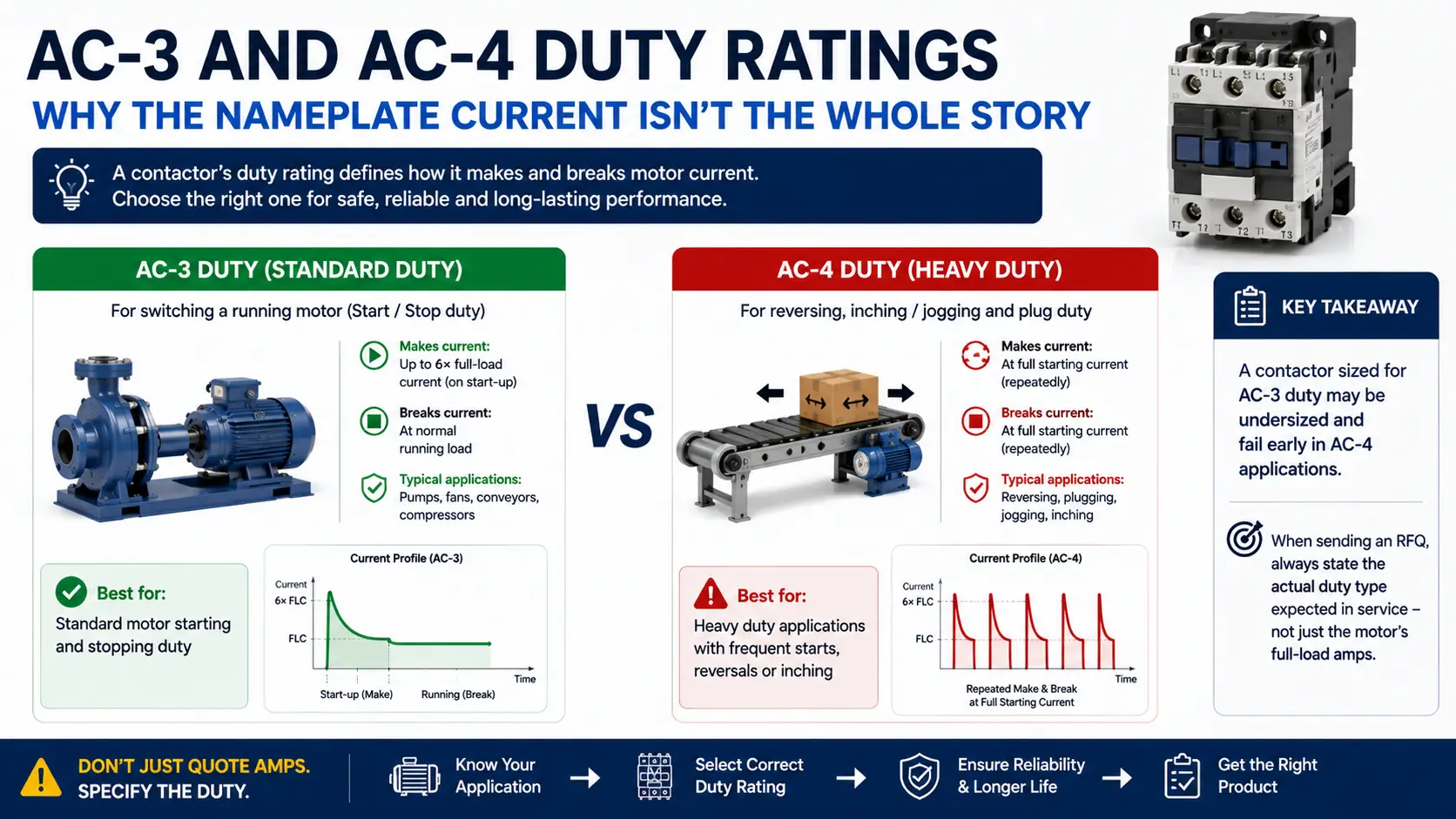
AC-3 and AC-4 Duty Ratings — Why the Nameplate Current Isn't the Whole Story
One of the most common specification errors on a contactor RFQ is quoting only a thermal current rating and ignoring the duty category. A contactor's AC-3 rating describes its suitability for switching a running motor — making current at up to six times full-load current on start-up, and breaking current at normal running load. This is the rating that matters for standard motor starting and stopping duty, such as pumps, fans and conveyors, where the motor is switched off while still running. An AC-4 rating is a harder duty: it covers plugging (reversing while running) and inching/jogging applications, where the contactor makes and breaks at full starting current repeatedly, generating significantly more contact wear and heat. A contactor sized correctly for AC-3 duty on a simple start/stop pump application may be undersized and short-lived if redeployed on an AC-4 jogging application without re-checking the rating. When you send an RFQ, state the actual duty type expected in service, not just the motor's full-load amps — a supplier who only asks for the latter isn't giving you a properly specified part.
Contactor vs Residual Current Device (RCD): Two Different Jobs
Procurement teams new to switchgear sometimes assume a contactor and an RCD are interchangeable or that one supersedes the other — they're not, and a panel typically needs both for different reasons. A contactor is a control device: it switches the motor or load circuit on and off, either manually via a control signal or automatically from a PLC or control system, and it has no built-in fault-sensing function of its own. An RCD (residual current device) is a protection device: it continuously monitors for earth leakage current and disconnects the supply if a fault to earth is detected, protecting personnel from electric shock. In a typical motor circuit, the contactor handles routine switching duty while upstream protection — an MCB, MCCB or RCD depending on the circuit design — handles fault conditions. Specifying one in place of the other is a design error that either leaves a circuit without shock protection or without proper switching control, so treat contactor and RCD requirements as separate line items on any panel build RFQ.
Where the Contactor Fits in a Motor Starter Circuit
A contactor rarely operates alone. In a direct-on-line (DOL) starter, the standard arrangement is an isolator or switch disconnector for safe isolation, a motor protection circuit breaker or fuse for short-circuit protection, the contactor itself for switching duty, and a thermal overload relay in series to protect the motor from sustained overload current. Getting the contactor's AC-3 current rating matched to the thermal overload relay's adjustment range is worth checking at RFQ stage — a contactor sized correctly for the motor but paired with a mismatched overload relay range will either nuisance-trip or fail to protect the motor as intended. If you're specifying a full starter assembly rather than a like-for-like contactor replacement, it's worth reviewing overload relay selection alongside the contactor order rather than as a separate purchase.
Supplier Evaluation Criteria
Not every contactor uk supplier operates to the same standard, and price alone is a poor way to differentiate between them. The criteria below are what we'd suggest scoring a shortlist of suppliers against before committing spend, particularly if you're setting up a new approved vendor for a multi-site contract.
Criterion | What to Check | Why It Matters |
|---|---|---|
Stock & traceability | Genuine Allen-Bradley/ABB stock with serial/date code traceability | Avoids counterfeit or grey-market parts on critical circuits |
Technical support | Can the supplier cross-reference an existing contactor by part number? | Speeds up like-for-like replacement on panel repairs |
Lead time transparency | Clear, confirmed lead times before order, not after | Prevents unplanned production downtime |
Obsolescence support | Ability to source discontinued or superseded contactors | Keeps legacy panels running without a full panel rebuild |
Export capability | Experience shipping internationally with correct documentation | Relevant for multi-site or overseas project procurement |
Warranty & returns | Clear warranty terms and a straightforward returns process | Protects you if a unit arrives faulty or mis-picked |
RFQ Checklist
Use this checklist before you send a contactor RFQ out to suppliers — it takes a few extra minutes and consistently avoids the re-order cycle that comes from a vague or incomplete enquiry.
# | RFQ Item | Confirmed? |
|---|---|---|
1 | Coil voltage & type (AC/DC) | ☐ |
2 | Pole count & current rating (AC-3) | ☐ |
3 | Auxiliary contact configuration | ☐ |
4 | Applicable standard (UL 489 / IEC 60947-4-1) | ☐ |
5 | Quantity & delivery date required | ☐ |
6 | Whether an existing part number needs cross-referencing | ☐ |
7 | Site environment (temperature, vibration, hazardous area) | ☐ |
8 | Export/shipping destination if applicable | ☐ |
Brands We Supply for Contactors & Distribution
Allen-Bradley and ABB form the core of our contactor and busbar stock, but panel builds frequently draw in accessories across both ranges for a single job. Here's what's genuinely available:
Brand | What We Stock | Brand Page |
|---|---|---|
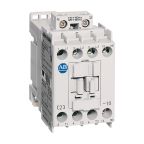
Allen Bradley | 100-C and 100-K series contactors across common coil voltages, pole counts and current ratings, including obsolete cross-references | |
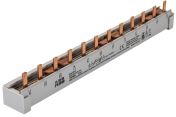
ABB | Busbar distribution systems, thermal overload relays and auxiliary contacts for the same panel build |
Contactor Maintenance & Troubleshooting Basics for Buyers
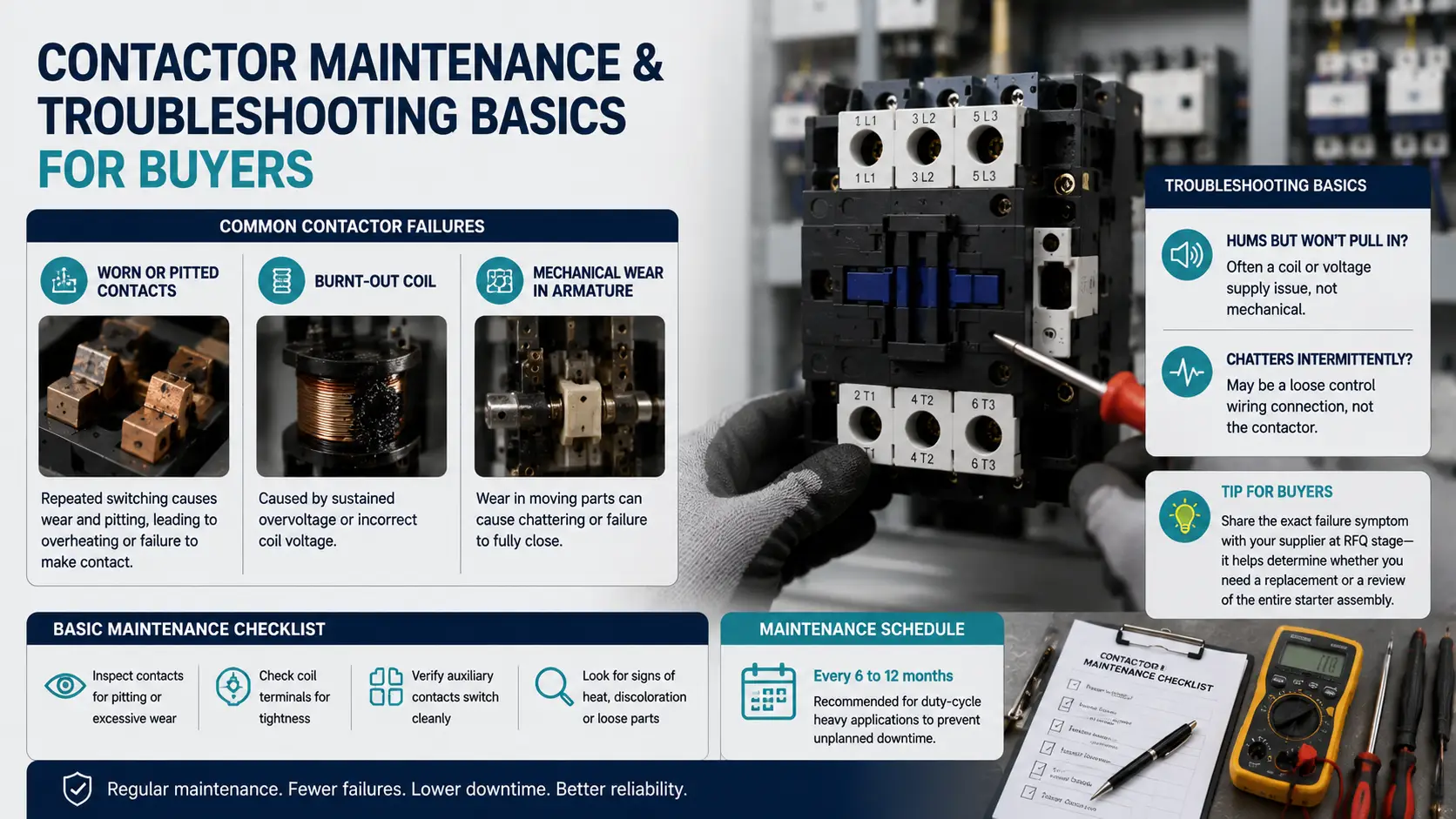
Understanding basic failure modes helps procurement teams tell the difference between a genuine replacement need and a fixable fault, which matters when an urgent RFQ lands on your desk. The most common contactor failures are worn or pitted contacts from repeated switching (eventually causing overheating or failure to make contact), a burnt-out coil from sustained overvoltage or incorrect coil voltage, and mechanical wear in the moving armature causing chattering or failure to fully close. A contactor that hums loudly but doesn't pull in is often a coil or voltage supply issue rather than a mechanical fault; one that chatters intermittently under load may be a loose control wiring connection rather than the contactor itself. A basic maintenance schedule — visually inspecting contacts for pitting, checking coil terminals for tightness, and confirming the auxiliary contacts still switch cleanly — at 6 to 12 month intervals for duty-cycle-heavy applications catches most of these issues before they cause an unplanned stoppage. If your maintenance team is reporting a specific failure symptom, it's worth passing that detail to your supplier at RFQ stage — it often narrows down whether you need a straight replacement or whether the wider starter assembly should be reviewed.
Related Categories
Category | Description | Link |
|---|---|---|
Contactors | Full range of Allen-Bradley and ABB contactors by coil voltage and pole count | |
Contactor Relays | Control relays used alongside contactors in motor starter circuits | |
Busbars | Busbar distribution systems for panel builds and upgrades |
Frequently Asked Questions
What is a contactor used for?
A contactor is an electrically controlled switch used to switch a power circuit on and off, most commonly for starting and stopping motors, but also for switching lighting, heating and capacitor bank loads.
How do I choose between Allen-Bradley and ABB contactors?
Both are widely specified across UK industry; the choice usually comes down to what's already installed on site (for like-for-like replacement) or your engineering standard's preferred manufacturer for new panel builds.
What standards apply to contactors (UL 489)?
UL 489 applies to circuit breakers used in North American-standard panels; most UK and European contactors are instead tested to IEC 60947-4-1, which covers making and breaking capacity under AC-3 and AC-4 duty.
Can ZF Corporation source obsolete or discontinued contactors?
Yes — we regularly cross-reference discontinued Allen-Bradley and ABB contactor part numbers to current equivalents for panel repairs where the original is no longer manufactured.
What is the typical lead time for a contactor in the UK?
Common coil voltages and current ratings are typically available from stock; less common combinations or obsolete cross-references may carry a short lead time — contact us with the exact specification for a quote.
Conclusion
A good contactor procurement outcome starts before the RFQ is sent: lock down the coil voltage, pole count, auxiliary contacts and applicable standard, then evaluate suppliers on traceability, technical support and lead time transparency rather than price alone.
Need a quote or help defining your contactor requirements?
Request a Quote
DISCLAIMER: Z&F Corporation is not affiliated with, authorized by, endorsed by, or acting as an official representative of any manufacturer, brand, or trademark owner referenced on this website. All product names, trademarks, brand names, logos, and manufacturer references are the property of their respective owners and are used solely for identification, reference, and compatibility purposes.