DIN Rail Terminal Block Selection Guide: Types, Ratings & How to Choose
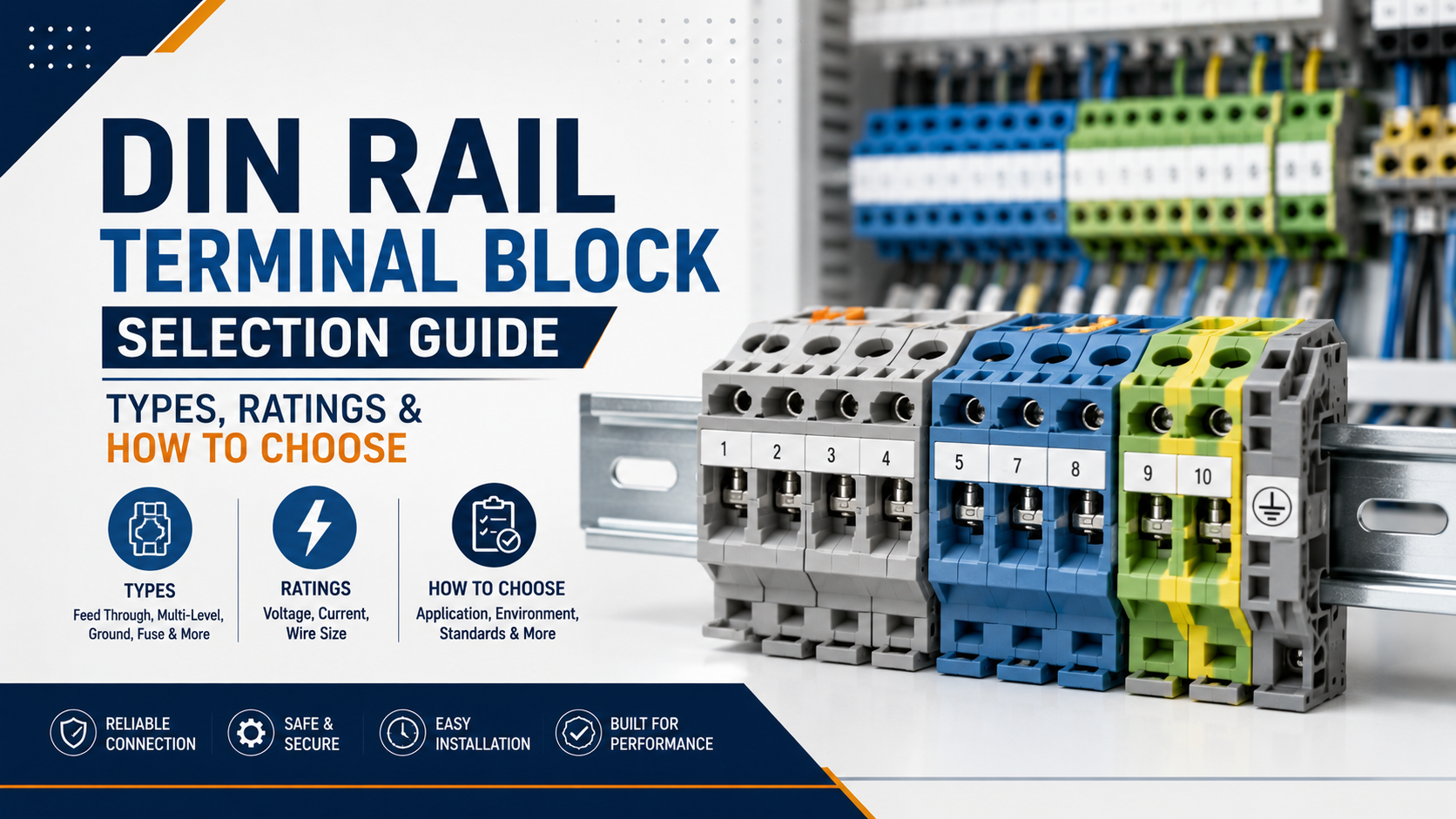
A terminal block is the least glamorous component in most control panels and one of the easiest to under-specify, because the failure mode isn't dramatic — it's a loose connection years later from a block rated too close to its current limit, or a wire that was never properly compatible with the terminal's clamping mechanism in the first place. Current rating, wire gauge compatibility, and connection type (screw, spring-cage, or push-in) are the three decisions that actually matter; everything else is largely accessories and panel-building convenience.
Here's how to work through those three decisions properly, plus where fused, disconnect, and earth terminal variants fit in.
Three Connection Mechanisms, Three Different Trade-Offs
Screw terminals clamp the wire under a threaded screw and are the traditional standard — reliable, but the clamping force can loosen slightly over time from vibration or thermal cycling, and they need periodic torque checking on critical circuits. Spring-cage terminals use a leaf spring to apply constant, vibration-resistant clamping pressure and don't loosen the way a screw can, at somewhat higher unit cost. Push-in terminals let a solid or ferruled wire be inserted directly without a tool, trading some flexibility on wire type for the fastest possible panel-building time — ideal for high-volume termination of solid-core wiring, less forgiving with fine-stranded wire unless it's ferruled first.
Terminal Block Variants Worth Knowing
| Variant | Purpose |
|---|---|
| Fused terminal | Built-in fuse holder for individual circuit protection at the terminal |
| Disconnect terminal | Knife-disconnect or plug link for isolating a circuit for testing without unwiring |
| Earth/PE terminal | Bonded directly to the DIN rail for protective earth continuity |
| Feed-through terminal | Simple two-sided connection with no built-in function beyond jointing |
Three Ratings to Confirm Before Ordering
Rated Current, With Headroom for Real Operating Conditions
A terminal's rated current is tested under specific lab conditions — packed tightly against neighbouring terminals in a warm panel, actual current-carrying capacity is lower than the headline figure. Selecting a terminal rated comfortably above the circuit's actual running current, not just equal to it, avoids the slow, invisible connection degradation that comes from a terminal running hot for years.
Wire Gauge Range Matching the Actual Cable
Every terminal specifies a minimum and maximum wire cross-section it accepts (in mm² for most of the world, AWG in North America). A wire at the very bottom or top of that range often clamps less reliably than one comfortably within it — and fine-stranded wire generally needs a ferrule fitted first for a secure, code-compliant termination in a screw or push-in terminal.
Rated Voltage and Compliance Standard
Confirm the terminal's rated insulation voltage against the actual circuit voltage, particularly on panels mixing control-voltage and mains-voltage wiring on adjacent terminal rows — and check the relevant compliance marking (UL, CSA, CE) required for the market the panel is destined for, since not every terminal range carries every certification.
Frequently Asked Questions
Do I need end stops and end plates on a terminal block run?
Yes — end stops mechanically secure the terminal block assembly to the DIN rail so it can't slide, and end plates protect the last terminal's live parts from accidental contact. Both are standard, low-cost accessories that shouldn't be omitted on a finished panel.
What are jumper bars used for?
Jumper (bridging) bars electrically link adjacent terminals together — commonly used to distribute a common supply or neutral across several terminal positions without running individual jumper wires between each one.
Can screw and spring-cage terminals be mixed on the same DIN rail row?
Physically, often yes within the same manufacturer's compatible width and rail system — but standardising on one connection type across a panel simplifies maintenance and avoids technicians needing different tools for what should be a consistent termination process.
Should I always use ferrules on stranded wire?
For screw and push-in terminals, yes in almost all cases — an unferruled stranded wire can fray, and individual strands can escape the clamp and create a short or high-resistance joint. Spring-cage terminals are somewhat more tolerant of bare stranded wire, but ferrules are still good practice.
When is a fused terminal a better choice than a separate fuse holder?
Fused terminals save panel space and simplify wiring where individual circuit protection is needed at many points — for example, protecting multiple sensor or output circuits fed from a common supply — compared with a separate discrete fuse holder for each one.
Related Reading
Shop the Parts
| Product | Use | Link |
|---|---|---|
| ABB MISTRAL65 Non-Fused Terminal Block, 6-Way, 100A Screw | Higher-current feed-through terminal runs | View product → |
| ABB SNA Series DIN Rail Terminal Block, Screw | General-purpose control panel wiring | View product → |
| ABB Jumper Bar for Terminal Blocks | Bridging common supply or neutral across terminal positions | View product → |
| Full terminal block range | Browse by connection type, current rating and wire gauge range | Browse terminal blocks → |
| All genuine ABB products | Terminal blocks, accessories and panel-building components from the same manufacturer | View all ABB products → |
Disclaimer: ABB, and any other manufacturer or brand names referenced in this article, are used solely for identification and compatibility purposes. Z&F Corporation is not affiliated with, authorised by, or an official representative of these manufacturers; all trademarks are the property of their respective owners.