Complete Guide to MRO Products for Fertilizer Plants
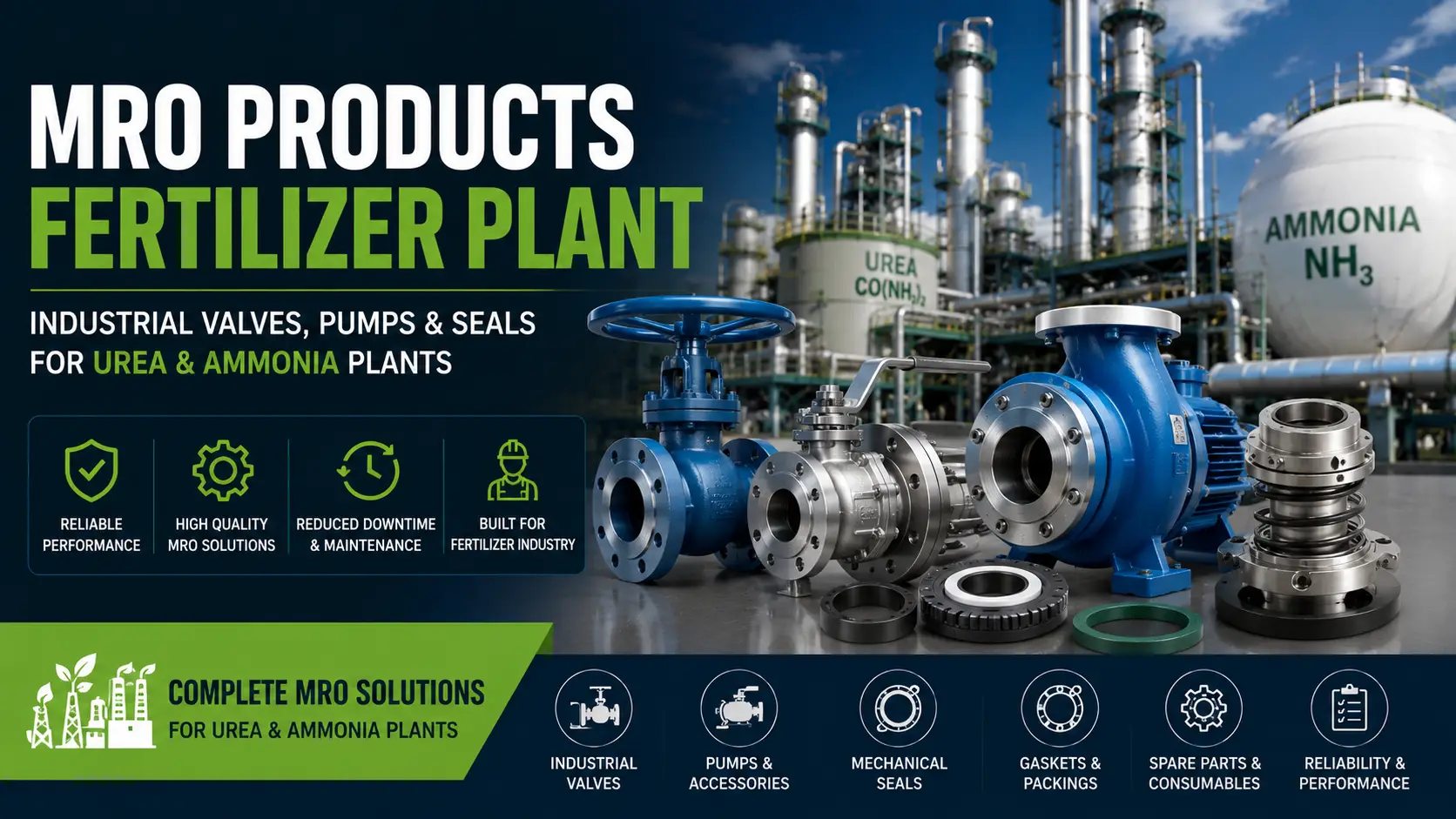
Fertilizer plant maintenance teams rely on a variety of properly specified MRO products to ensure safe, efficient production in corrosive, high-temperature processing environments found in ammonia synthesis units, urea granulation lines and NPK blending facilities. Generally speaking, when choosing the right MRO products fertilizer plant operators depend on material compatibility, standards compliance and lifecycle costs, and these aren't solely based on cost. This guide provides information about MRO products, applications, maintenance methods and standards, as well as methods for assessing suppliers based on objective, specification-based criteria.
Looking for a fertilizer plant quote for MRO?
What Are MRO Products for Fertilizer Plants?
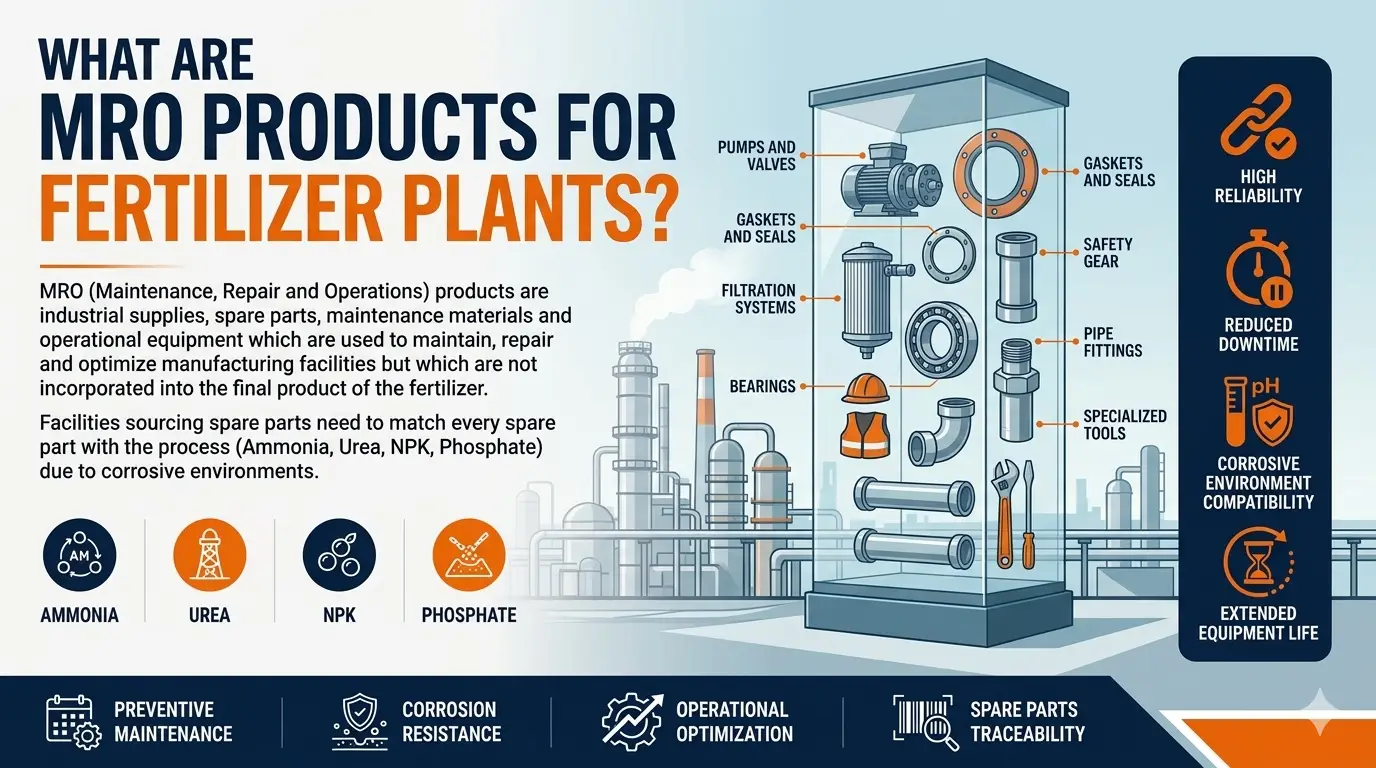
MRO (Maintenance, Repair and Operations) products are industrial supplies, spare parts, maintenance materials and operational equipment which are used to maintain, repair and optimize manufacturing facilities but which are not incorporated into the final product of the fertilizer. Other facilities that source fertilizer plant spare parts need to match every spare part with the process it will be used in for ammonia, urea, NPK or phosphate, as the environment of fertilizer processing can be very corrosive and challenging for parts.
Why MRO Products Matter in Fertilizer Manufacturing
The U.S. Department of Energy states that predictive maintenance programs can save between 25-30% in maintenance cost, 70-75% in equipment break down, and 35-45% in downtime when compared to reactive maintenance. In all fertilizer operations, MRO activities directly contribute to these reliability improvements because reliable production of ammonia and urea requires that the right parts are available before they fail.
Common Equipment Found in Fertilizer Plants
Fertilizer production involves ammonia synthesis, urea production, NPK blending, with each production process having specific rotating and static equipment categories:
Centrifugal pumps and compressors for process fluid ammonia and urea
Heat Exchangers for cooling and heating at various production phases
The aeration systems and bulk material handling equipment for granular product.
Rotary equipment such as granulators, dryers and coolers.
Distributed Control Systems (DCS) and process instrumentation.
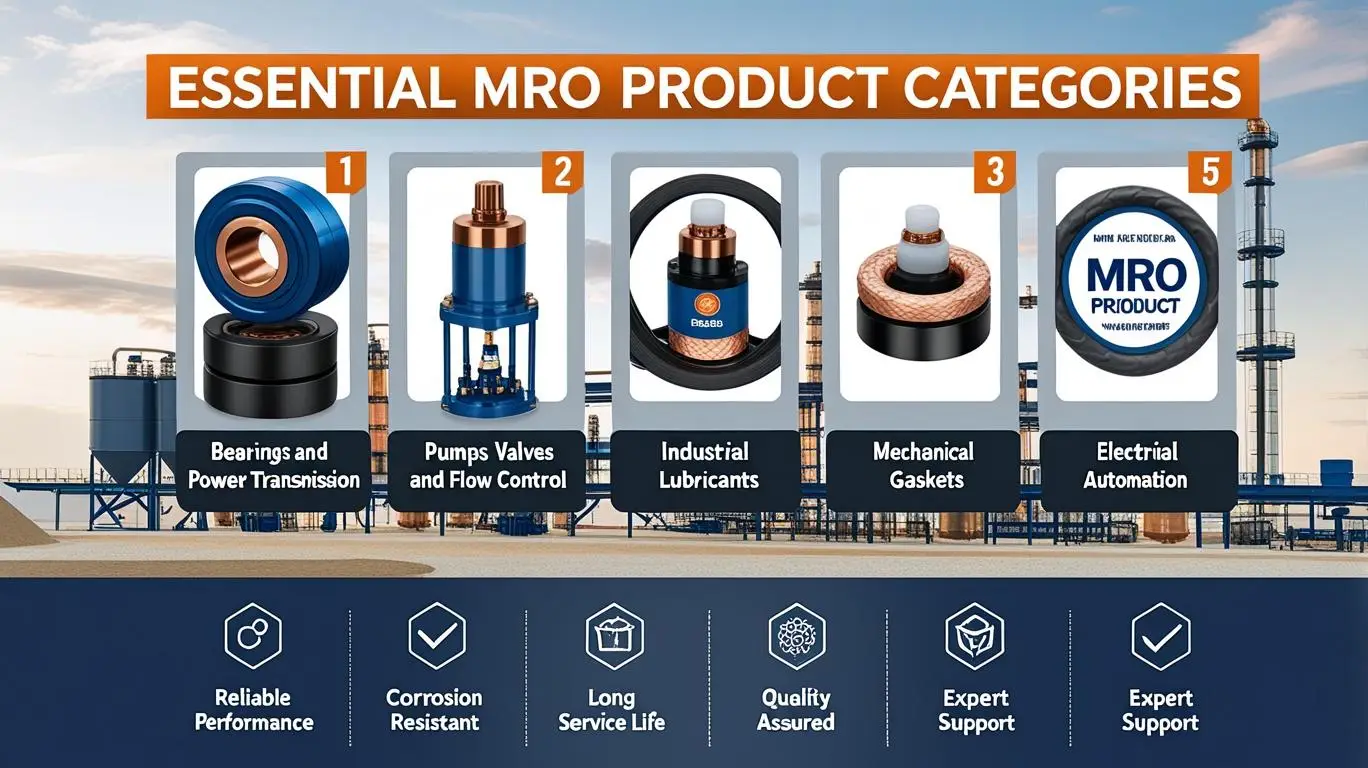
Essential MRO Product Categories
The first step in selecting MRO products for fertilizer plant facilities is to be familiar with the basic categories of supplies needed throughout the plant:
Bearings and Power Transmission Components
Ammonia and urea production units use pumps, compressors and conveyor drives that are supported by industrial bearings, gearboxes and couplings.
Pumps, Valves, and Flow Control Equipment
The centrifugal pumps are used for the process fluids, and the system valves are corrosion resistant for ammonia, urea and phosphoric acid service. The selection criteria of these essential flow control devices is discussed in greater depth in our Pumps Pillar and Valves Pillar resources.
Industrial Lubricants and Maintenance Chemicals
In the harsh conditions of dusty, corrosive environments in fertilizer plants, gear oils, hydraulic oils and specialty greases provide protection to rotating equipment.
Mechanical Seals, Gaskets, and Fasteners
Mechanical seals keep pumps tight on aggressive process fluids and gaskets keep flanges tight all around the plant. The material selection in corrosive fertilizer service is explained in our Gaskets & Seals Pillar resource.
Electrical, Automation, and Instrumentation Products
A range of diverse components for Variable Frequency Drives, PLC and DCS enable automated control of ammonia, urea and NPK production lines.
OEM vs Aftermarket MRO Products
Factor | OEM Parts | Aftermarket Parts |
Source | Original equipment manufacturer | Third-party compatible manufacturer |
Compatibility | Guaranteed fit and performance | Requires verification against specifications |
Cost | Typically higher | Often more cost-effective |
Best for | Critical, warranty-sensitive components | Non-critical, high-wear components |
Preventive Maintenance Best Practices
In consistent maintenance discipline, the first step in extending the service life of MRO products in fertilizer plant facilities is:
Follow manufacturer's recommendations for critical rotating equipment servicing intervals
Follow lubrication program in accordance with operating temperature and load
Regularly check for corrosion of parts in fertilizer manufacturing processes which are likely to be affected by it.
Maintain history of the documents involved in the failure and use it for root cause analysis.
Predictive Maintenance Technologies
According to the industry analyses done by McKinsey & Company, the predictive maintenance can cut down the machine downtimes by as much as 50% and can increase the equipment life by 20-40%. In addition to the traditional preventive schedules, vibration analysis, thermal imaging and oil analysis more and more are used in fertilizer plants to complement each other for critical pumps, compressors and rotating equipment.
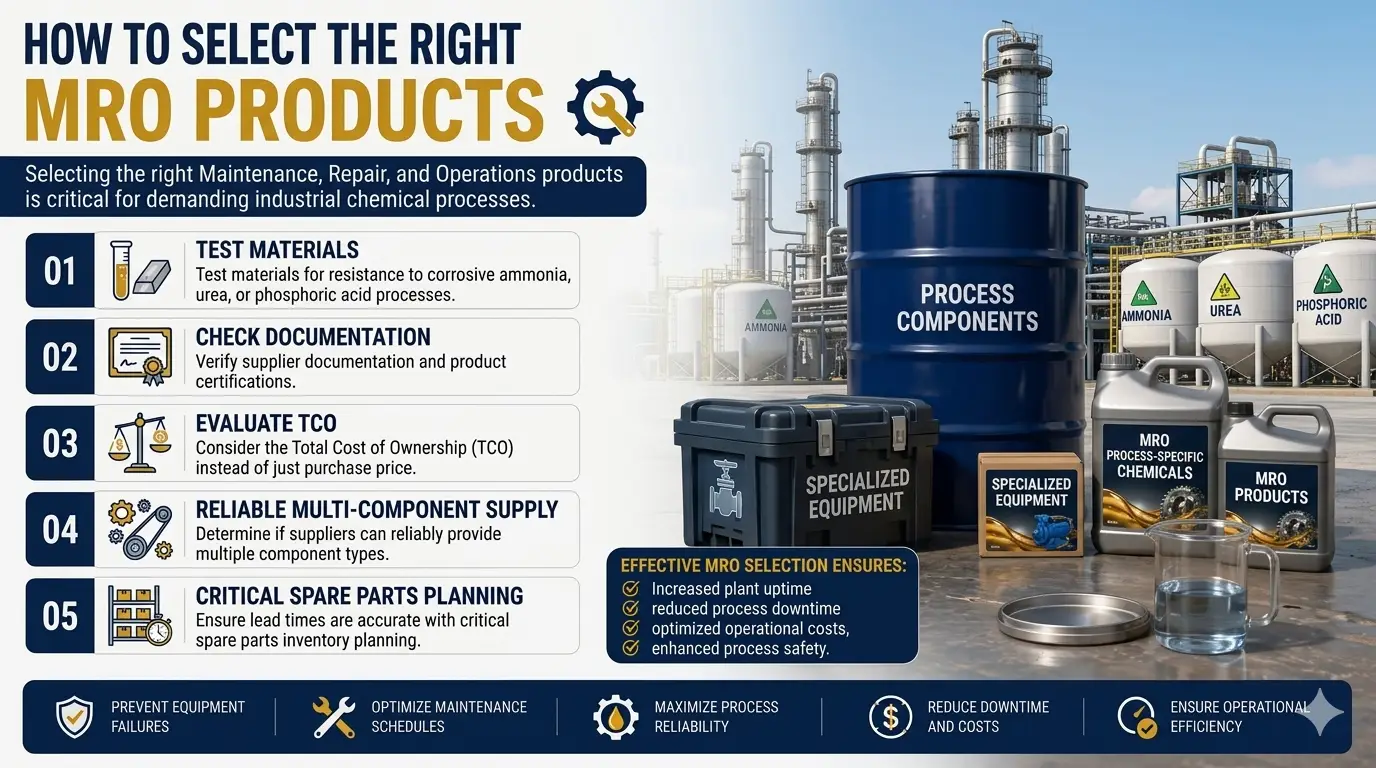
How to Select the Right MRO Products
Test materials for resistance to corrosive ammonia, urea or phosphoric acid processes
Check supplier documentation and certifications
Consider the total cost of ownership (TCO) instead of just price.
Determine if suppliers can reliably provide multiple types of components.
Ensure lead times are accurate with critical spare parts inventory planning
Procurement Best Practices for Fertilizer Plants
Standardize commonly used parts throughout the plant to ease inventory control
Ensure enough critical spare parts are stocked for high-impact rotating equipment.
Connect CMMS software to purchasing systems for enhanced planning
Review supplier performance on a regular basis in relation to lead times and quality.
Due to the harsh processing environment, a priority was given to corrosion-resistant materials.
Relevant Industry Standards
Standard / Organization | Relevance |
ISO | General equipment design and quality management standards |
ASTM International | Material specification and testing standards |
ASME | Mechanical equipment design standards |
API | Pump and valve standards for process industries |
IFA (International Fertilizer Association) | Industry-specific technical and safety guidance |
Common Maintenance Challenges
Even with proper management, MRO products fertilizer plant programs have unsolvable problems:
Corrosion-related early pump, valve and pipe failures
Long lead time for specialized corrosion resistant component
Compromising between cost constraints and reliability needs.
Ensuring availability of spares and turnaround fit outs in coordination with shutdown and turnaround plans
The physical differences in the technical details provided by suppliers. Physical variations in the technical details offered by suppliers.
Procurement Considerations
Having an organized supplier communication process is more advantageous than dealing with dozens of suppliers for bearings, pumps, valves, seals and instrumentation for industrial MRO supplies to fertilizer manufacturing. An independent sourcing partner will look for technically suitable products from a variety of manufacturers and be able to compare specifications and assist in sourcing difficult-to-find products for ammonia, urea, and NPK production lines.
Frequently Asked Questions
What are MRO products?
MRO products include a variety of industrial products, such as bearings, motors, valves, pumps, filters, seals, lubricants, electrical devices, instruments, PPE and spare parts used for maintenance of equipment for fertilizer manufacturing process.
Which spare parts are critical in fertilizer plants?
Spare parts can include, most importantly, electronics, electrical instruments, units for the control system, couplings, belts, pumps, motors, filters, seals, and bearings.
How often should maintenance be scheduled?
Facilities can maintain their MRO inventory levels by regularly reviewing critical spare parts once or twice every month, once every quarter, or some period, as deemed necessary to keep abreast with equipment failure rate, operating process, and expected lead times.
What products are considered consumables?
Certain MRO products such as lubricant, filters, some of the seals, gasket and fasteners must be replaced regularly to ensure the smooth functioning of the process, and they are, therefore, classified as consumables.
What's the difference between OEM and aftermarket parts?
OEM parts are made by the original equipment manufacturer, aftermarket is made by the third party designed to meet compatible specifications.
What standards should industrial components meet?
They must satisfy appropriate relevant standards for the specific product and for the process application such as ISO, ASTM, ASME, IEC, API, or the equipment manufacturers specifications.
How does predictive maintenance help to minimize downtime?
Sensors, vibrations monitoring systems, infrared imaging and oil analysis technologies can identify potential equipment failures earlier, thus avoiding catastrophic failures and reducing the overall downtime.
Which lubricants are used in fertilizer plants?
Industrial gear oil, hydraulic oil and special greases having corrosion and high-temperature properties are commonly used.
Conclusion
To ensure a reliable fertilizer plant operation you need to plan fertilizer plant procurement and not just reactively scramble when an equipment fails, treating it as a critical process by considering its importance. Using corrosion resistant materials, critical spare parts inventories for pumps, valves and rotating equipment, and implementing a combination of preventive and predictive maintenance can all help to minimize downtime and lifecycle costs. From bearings to mechanical seals, and process instrumentation, a disciplined and standards-based procurement process can help keep fertilizer manufacturers producing consistently and prolong equipment life when acquiring from a trustworthy sourcing partner.
Let the experts help you determine the best MRO product sourcing for your fertilizer plant.
DISCLAIMER: Z&F Corporation is not affiliated with, authorized by, endorsed by, or acting as an official representative of any manufacturer, brand, or trademark owner referenced on this website. All product names, trademarks, brand names, logos, and manufacturer references are the property of their respective owners and are used solely for identification, reference, and compatibility purposes.