Flow Meter Types: Working Principles, Applications and Selection Guide
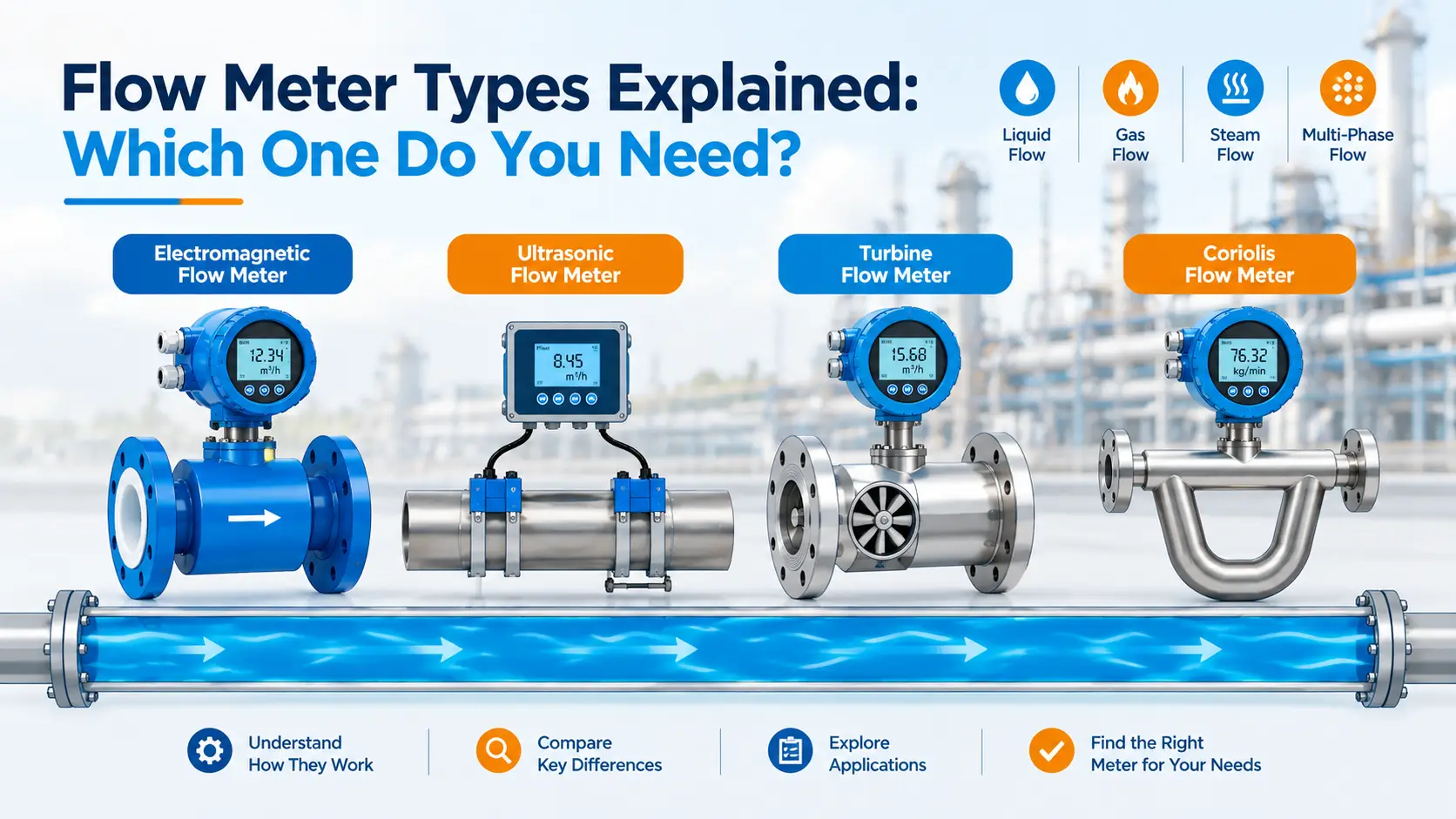
The main types of flow meters in use give engineers and industrial buyers the ability to measure liquids, gases or steam more accurately. Typical technologies are Coriolis, electromagnetic, ultrasonic, differential pressure, positive displacement, turbine, variable area and thermal mass meters. All are different and the choice depends on the fluid and flow range, accuracy, pipe size, temperature, pressure and installation conditions.
Need help sourcing an industrial flow meter?
Share your fluid, flow range, pipe size, pressure, temperature and output requirements with our independent sourcing team.
Request a Quote
Quick definition: An instrument used to measure the rate at which a fluid flows through a pipe or other system. The technology measures either volumetric flow, mass flow, velocity, displacement or a related physical property, depending on the technology.
Main Flow Meter Types at a Glance
There are several different types of flow meters which are based on various physical principles. A few instruments measure mass, others measure volumetric flow based on velocity, displacement or pressure difference. This comparison provides a practical introduction to their common uses.
Technology | Working principle | Typical application |
|---|---|---|
Coriolis | Measures tube movement caused by Coriolis forces | Direct mass flow and density measurement |
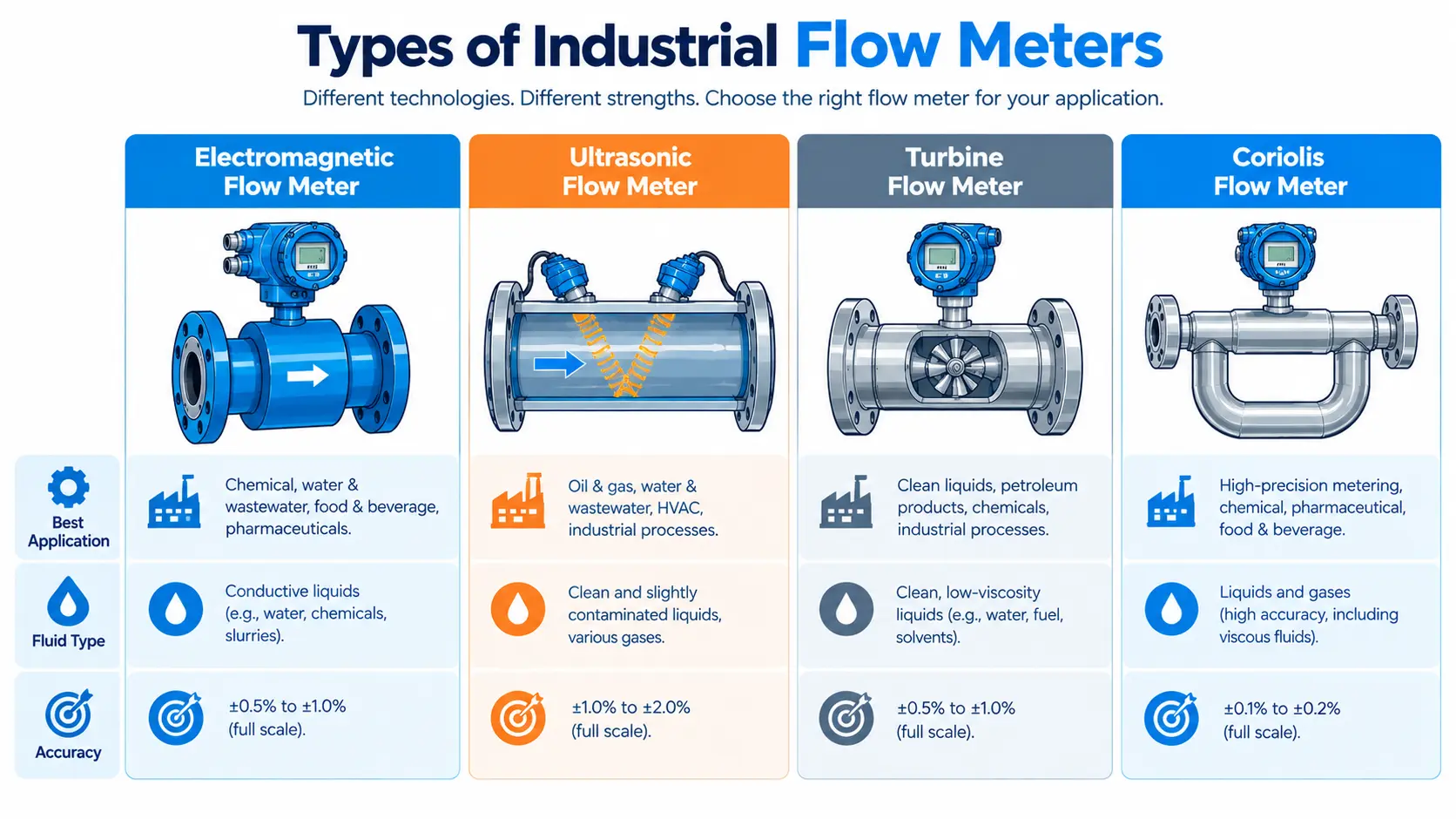
Electromagnetic | Uses electromagnetic induction in conductive liquids | Water, wastewater and conductive chemicals |
Ultrasonic | Uses acoustic transit time or Doppler shift | Inline or non-invasive liquid measurement |
Vortex | Detects vortices produced behind a bluff body | Suitable liquid, gas and steam services |
Differential pressure | Calculates flow from pressure drop across a restriction | Liquid, gas and steam pipelines |
Positive displacement | Counts repeated, known volumes of fluid | Viscous liquids and controlled transfer |
Variable area | A float rises inside a tapered tube | Simple local indication |
How Different Flow Measurement Technologies Work
Coriolis and Electromagnetic Meters
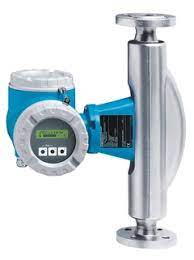
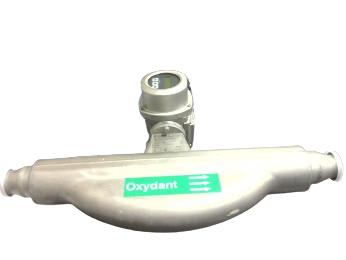
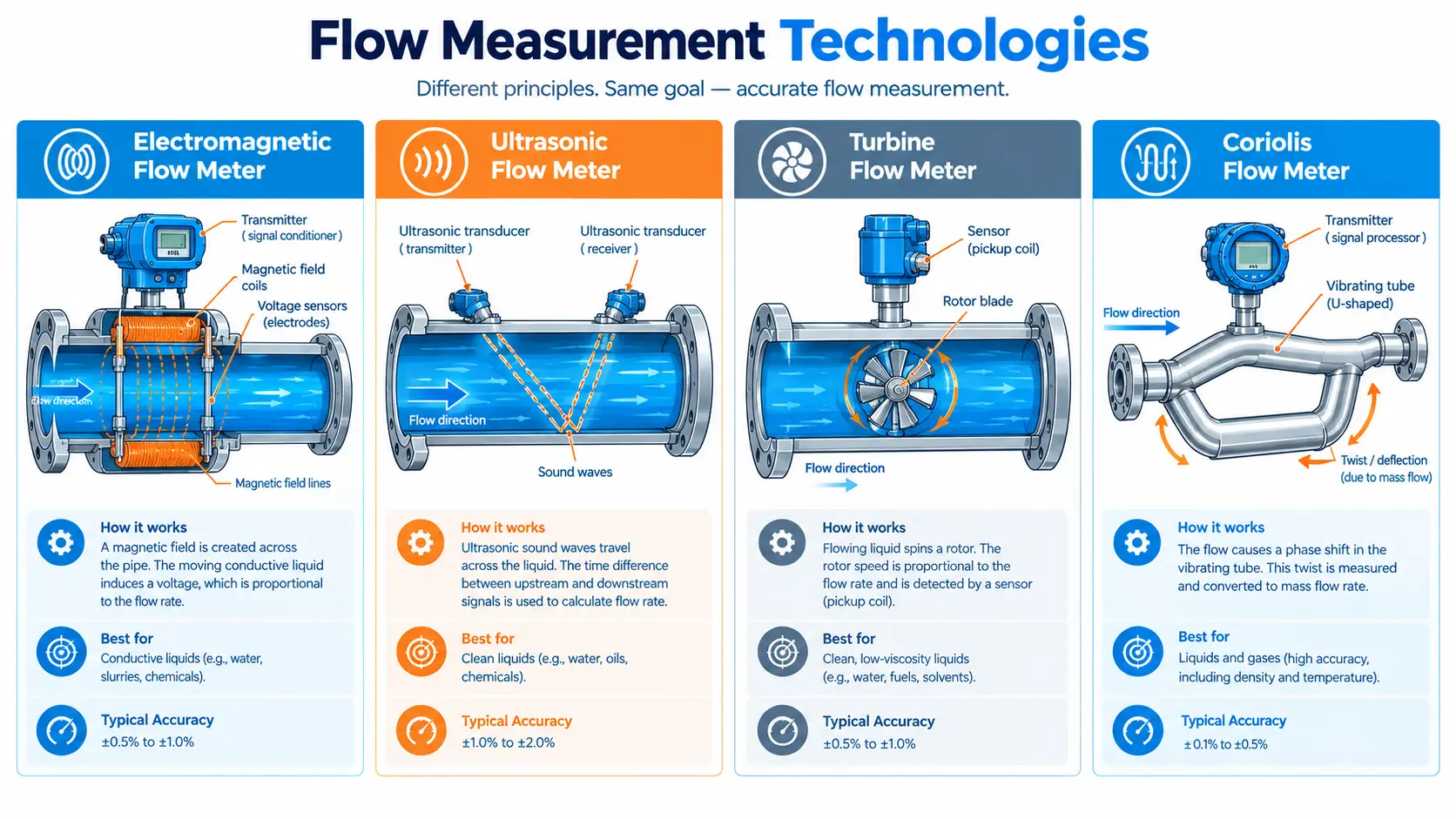
Coriolis meters are direct mass flow meters that track the flow of one or more vibrating tubes. They are also able to give density information. Their limitations may include higher cost, weight and pressure-loss considerations, depending on the meter design and application.
An electromagnetic meter generates a magnetic field across the measuring tube. A conductive liquid moving through that field produces a voltage related to velocity. Magnetic meters contain no obstruction in the flow path, but the fluid must have adequate electrical conductivity.
Ultrasonic, Vortex and Differential Pressure Meters
Ultrasonic meters use sound waves to determine velocity. Clamp-on versions can support non-invasive measurement, although pipe material, condition, fluid properties and installation quality affect performance. Vortex meters detect repeating vortices and may be considered for suitable liquid, gas or steam applications.
Differential pressure systems use a primary element, such as an orifice plate or Venturi tube, to create a measurable pressure difference. These established flow measurement types may require sufficient straight pipe and can introduce permanent pressure loss.
Turbine, Positive Displacement and Variable Area Meters
Turbine meters relate rotor speed to fluid velocity and generally perform best with clean fluids and a stable flow profile. Positive displacement meters trap and count known volumes, making them useful for certain viscous liquids. Variable-area meters, also called rotameters, provide simple local indication through the position of a float.
ZF Corporation lists practical measurement options such as a Parker flow meter rated from 5 to 55 L/min and a Parker S-Series variable-area liquid flow meter . Product suitability should always be verified using the complete datasheet.
Mass Flow Versus Volumetric Flow
Volumetric flow describes the volume passing a point per unit of time, such as litres per minute. Mass flow describes the mass passing that point, such as kilograms per hour. Because density changes with process conditions, temperature and pressure can affect the relationship between mass and volume.
Selection tip: Do not assume one technology is universally the most accurate. Accuracy depends on the specified operating conditions, installation, calibration, flow profile and properties of the measured fluid.
Industrial Applications and Product
Industrial flow meters support water treatment, chemical processing, oil and gas, compressed air, HVAC, food production and manufacturing. Application scale varies significantly. For example, ZF Corporation lists a Honeywell HAF bidirectional airflow sensor for low airflow and a Parker SCFTT-Series meter rated up to 150 L/min for a different operating requirement.
Buyers can browse the flow meters category and related flow indicators. The Flowserve brand page is provided for market and product research only and does not imply partnership, authorization or endorsement.
How to Choose Between Flow Meter Types
Learning how to choose the right flow meter begins with a complete process specification. Comparing types of flow meters by pipe size alone can lead to poor measurement or premature failure. Record:
Fluid: Liquid, gas, steam, slurry or chemical mixture.
Flow range: Minimum, normal and maximum expected flow.
Properties: Conductivity, viscosity, density and solids.
Conditions: Operating pressure and temperature.
Performance: Required accuracy, repeatability and turndown.
Installation: Pipe size, orientation and available straight run.
Materials: Compatibility of wetted components.
Output: Local display, pulse, 4–20 mA or digital communication.
A practical flow meter selection guide for industrial applications should also consider pressure drop, pipe-full requirements, entrained gas, vibration and calibration documentation. These factors help distinguish between apparently similar industrial flow meters.
Accuracy, Installation and Calibration
Incorrect installation can affect any of the main flow meter types. Bends, valves and pumps may distort the flow profile. Some technologies require straight pipe runs, while others need a completely full pipe. Calibration or verification intervals should reflect process risk, measurement importance, service conditions and quality procedures.
Standards depend on technology and application. ISO 5167 addresses specified differential-pressure arrangements, while ISO 10790 covers Coriolis meter selection, installation and operation. Review current standard edition and manufacturer documentation and project requirements prior to procurement
Frequently Asked Questions
What are the main flow meter types?
Common technologies are Coriolis, electromagnetic, ultrasonic, differential pressure, positive displacement, turbine, variable area and thermal mass meters.
Which meter is suitable for water?
The following are some examples of the technologies that are often considered: Electromagnetic and ultrasonic technologies, depending on the conductivity and pipe condition, flow range, accuracy, and installation.
Do flow meters require calibration?
Critical meters should have a calibration or verification program based on risk, operating conditions and measurement requirements.
Final Selection Advice
Before comparing flow meter types, define the fluid, complete flow range, pipe size, pressure, temperature, accuracy and available installation space. Confirm the proposed meter against its current datasheet and application requirements before ordering.
Have a flow measurement requirement?
Share your specifications, existing part number or process conditions with ZF Corporation’s independent sourcing team.
Talk to Our Specialist
Disclaimer: This article provides general educational information. Final product selection must be confirmed against current manufacturer documentation, applicable standards and site-specific requirements. Brand references do not imply partnership, authorization or endorsement.