What Is an Industrial Bearing? A Foundation Definition
A bearing is just a mechanical part that lets something spin without grinding itself to death. But "just a part" is doing a lot of heavy lifting.
Think about what a bearing is actually doing. It's supporting rotating parts. It's handling forces pushing down on it (radial loads) and forces pushing along the shaft (axial loads). It's reducing friction so the equipment doesn't overheat. And it's doing all of this for years without anyone thinking about it.
In manufacturing plants, water treatment facilities, mining operations, logistics centers everywhere bearings are the invisible workhorses. Pick the right one, and nobody calls you. Pick the wrong one, and everyone calls you.
Why Bearing Selection Matters
You're standing in front of a machine that costs six figures. It's going to run 24/7 for the next five years. And right now, you need to decide which bearing to install.
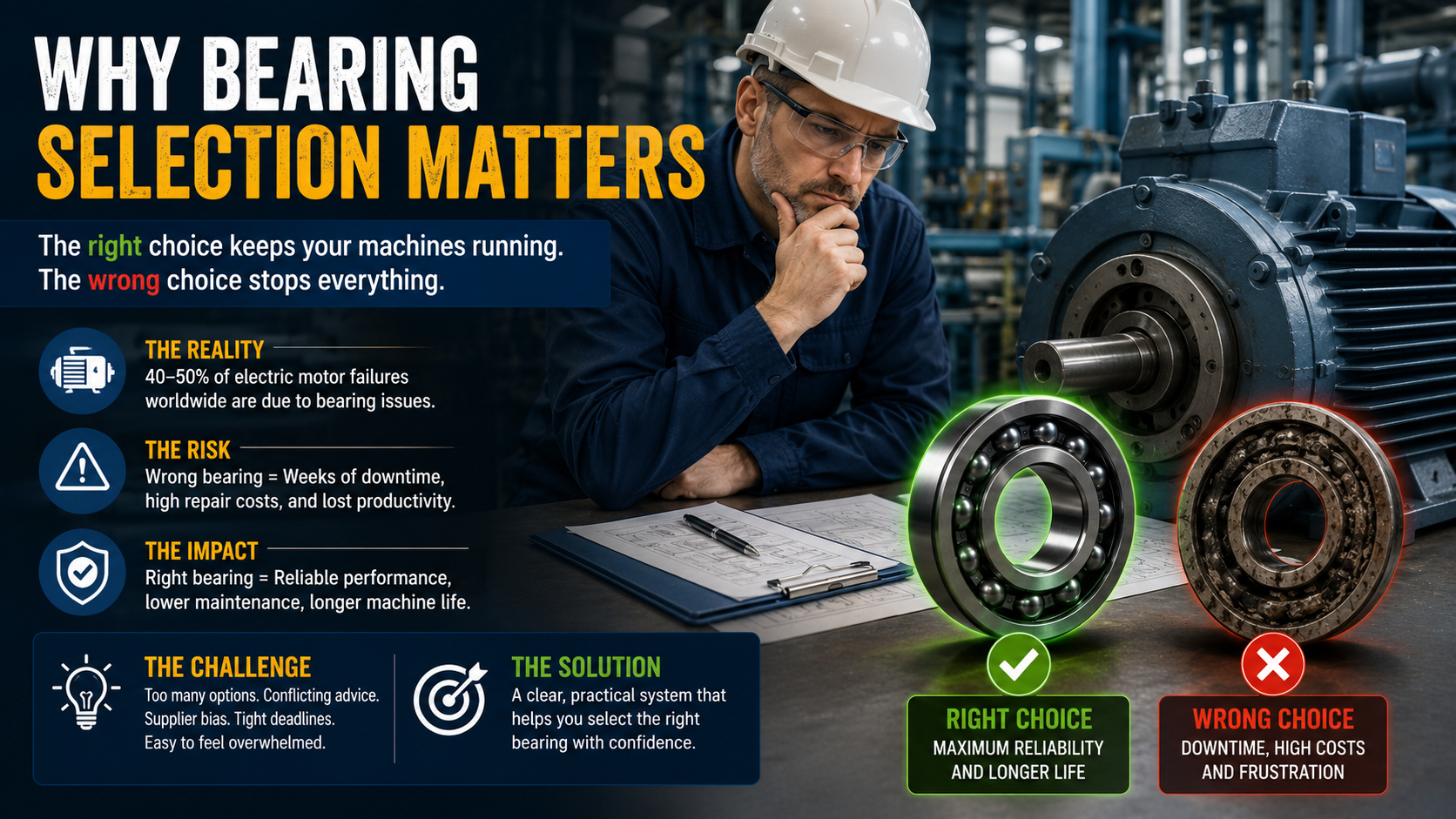
Get it wrong, and you're looking at weeks of downtime. Get it right, and nobody ever thinks about it again.
That's the reality of bearing selection. It's not glamorous work. But it's the kind of decision that separates reliable equipment from equipment that becomes your biggest headache.
Here's what the data says: about 40 to 50% of electric motor failures worldwide come down to bearing problems. That's not a small number. That's nearly half of all the motors that break down, they break down because someone didn't think carefully about which bearing to install.
The tricky part? Most engineers are drowning in options. There are dozens of bearing types. Load calculations don't always agree with each other. Suppliers push different solutions. And you're supposed to pick one before the project moves forward.
This is exactly where things go sideways. Engineers get overwhelmed and pick the cheapest option. Or they overthink it and delay the entire project. Both paths lead to problems.
What if there was a clearer way to think through this? A system that actually works instead of a checklist that leaves you second-guessing yourself?
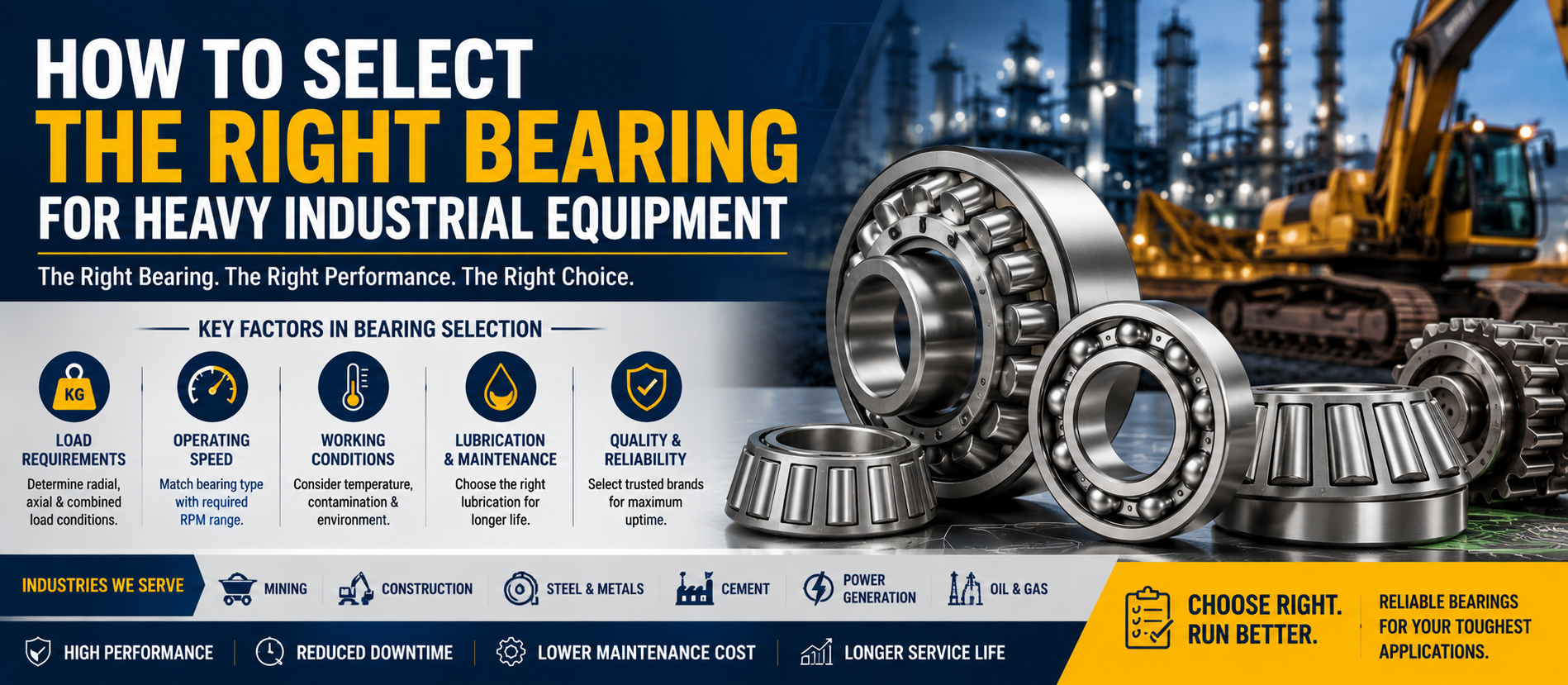
The Seven Critical Factors in Industrial Bearing Selection
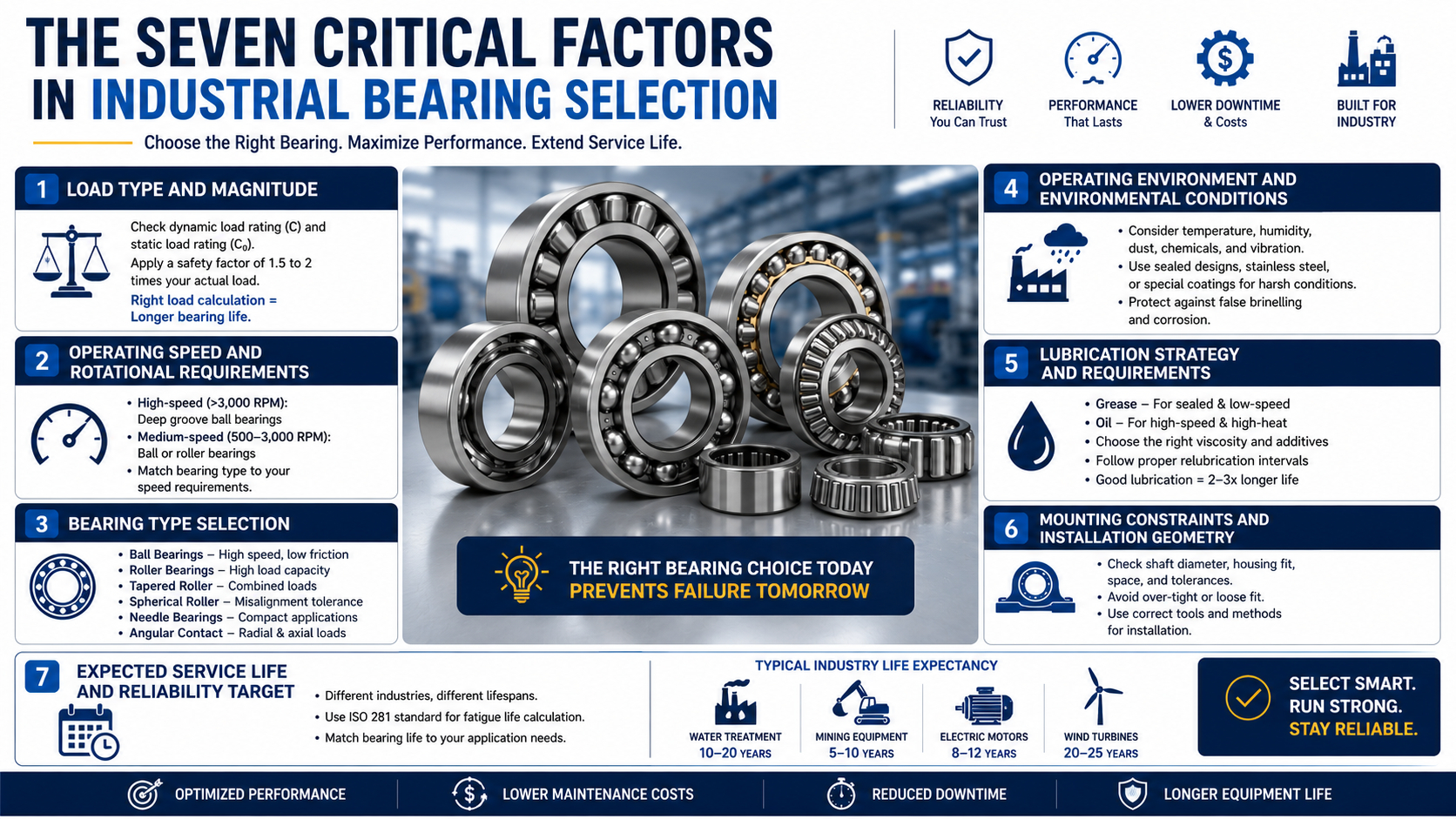
Load Type and Magnitude
The manufacturers give you two numbers for every bearing: a dynamic load rating (C) and a static load rating (C₀). These numbers tell you the maximum load the bearing can handle for a million rotations (dynamic) or standing still (static). Your actual load should stay below these numbers, usually with a safety cushion of 1.5 to 2 times.
Skip this calculation, and you'll probably end up replacing the bearing in three years instead of ten.
Operating Speed and Rotational Requirements
A bearing that's perfect for a high-speed spindle is terrible for a slow-moving heavy press. Speed matters.
High-speed applications (anything over 3,000 RPM) need deep groove ball bearings. Lower friction. Less heat. Simple design that won't shake itself apart. Most electric motors use these for exactly this reason. Medium-speed work (500 to 3,000 RPM) gives you options. Ball or roller bearings both works fine here.
Bearing Type Selection
Ball bearings work for speed. Roller bearings work for load. That's the simplest way to remember it.
Ball bearings roll easily, create less friction, cost less. Roller bearings spread the load across a bigger contact area, so they can handle more weight. Tapered rollers handle combined loads. Spherical rollers can bend a bit. Needle bearings fit in tight spaces. Angular contact bearings balance radial and axial loads. The type you need depends entirely on what the bearing has to do.
Operating Environment and Environmental Conditions
A bearing in a climate-controlled factory is in a much more luxurious environment than a bearing in a water treatment plant.
Lubricants' properties are affected by temperature variation. Metal surfaces are damaged by dust and moisture. Seals are destroyed by chemical exposure. False brinelling" – which is damage caused by vibration without bearing rotation – is one of the things that many people never expect it to happen.
Bearings do not last long in environments where corrosive elements are present unless there is some protection. This equates to sealed designs. Perhaps stainless steel rather than steel. Maybe special coatings. It is the cheapest that does not always work best in extreme environments.
Lubrication Strategy and Requirements
Good lubrication extends bearing life two to three times. Bad lubrication kills it in weeks.
Grease works for sealed bearings and slower speeds. Oil works for high-speed applications where heat is a problem. Some specialty situations use oil-air systems or even solid lubricants.
It's not just about putting something on there. The viscosity has to match the speed. The additive package matters. Relubrication intervals need to fit your maintenance schedule. Get any of this wrong and you're not just shortening the bearing's life—you're probably damaging other parts of the machine.
Mounting Constraints and Installation Geometry
If you install it crooked, it won't work out at all!
Shaft diameter, bore of the shaft, the amount of space you have, the fit tolerance that the bearing requires – these are not second thoughts. They determine whether the bearing actually works.
Bearing spins in the housing (creeping) and too tight (binding) are results of improper installation. Other installations require thermal methods (heat bearing and slide it on). Others require some mechanical presses. Some require hydraulic equipment. If done incorrectly, the bearing will fail prematurely.
Expected Service Life and Reliability Target
A bearing in a consumer product might only need to last a few years. A bearing in a wind turbine needs to keep spinning for 20 to 25 years.
Different industries have different requirements. Water treatment plants need 10-to-20-year lifespans. Mining equipment needs to go hard for years. Electric motors in factories need 8 to 12 years minimum.
The industry standard (ISO 281) lets you calculate fatigue life mathematically. Do this right and you pick a bearing that fits your actual timeline instead of guessing.
Understanding ISO 281 and UK Engineering Standards
Most engineers hear ISO 281 and their eyes glaze over. It sounds like bureaucratic nonsense. It's actually the formula that lets you make a real decision instead of rolling dice.
ISO 281 calculates the L₁₀ rating—how many million rotations a bearing can handle before 90% of identical bearings fail. The math is: L₁₀ = (C/P) ᵖ.
The C is the manufacturer's dynamic load rating. The P is your actual equivalent load. The p is 3 for ball bearings, 10/3 for roller bearings.
You don't need to memorize this. You just need to understand that it exists and that it works. It's the same formula every bearing manufacturer uses, which means you can actually compare apples to apples.
Ball vs. Roller Bearings: Head-to-Head Comparison
Factor | Ball Bearings | Roller Bearings |
Speed capability | High (DN > 300,000) | Medium to high |
Load capacity | Moderate | High, especially radial |
Friction and heat | Low | Moderate to high |
Cost | Lower | Higher |
Axial load handling | Limited | Better (tapered types) |
Misalignment tolerance | Poor | Fair (spherical very good) |
Noise and vibration | Quiet | Slightly noisier |
Best applications | Motors, pumps, fans | Gearboxes, heavy machinery |
The rule is simple. Ball bearings for speed and lighter loads. Roller bearings for heavy loads and slower speeds.
Common Causes of Premature Bearing Failure
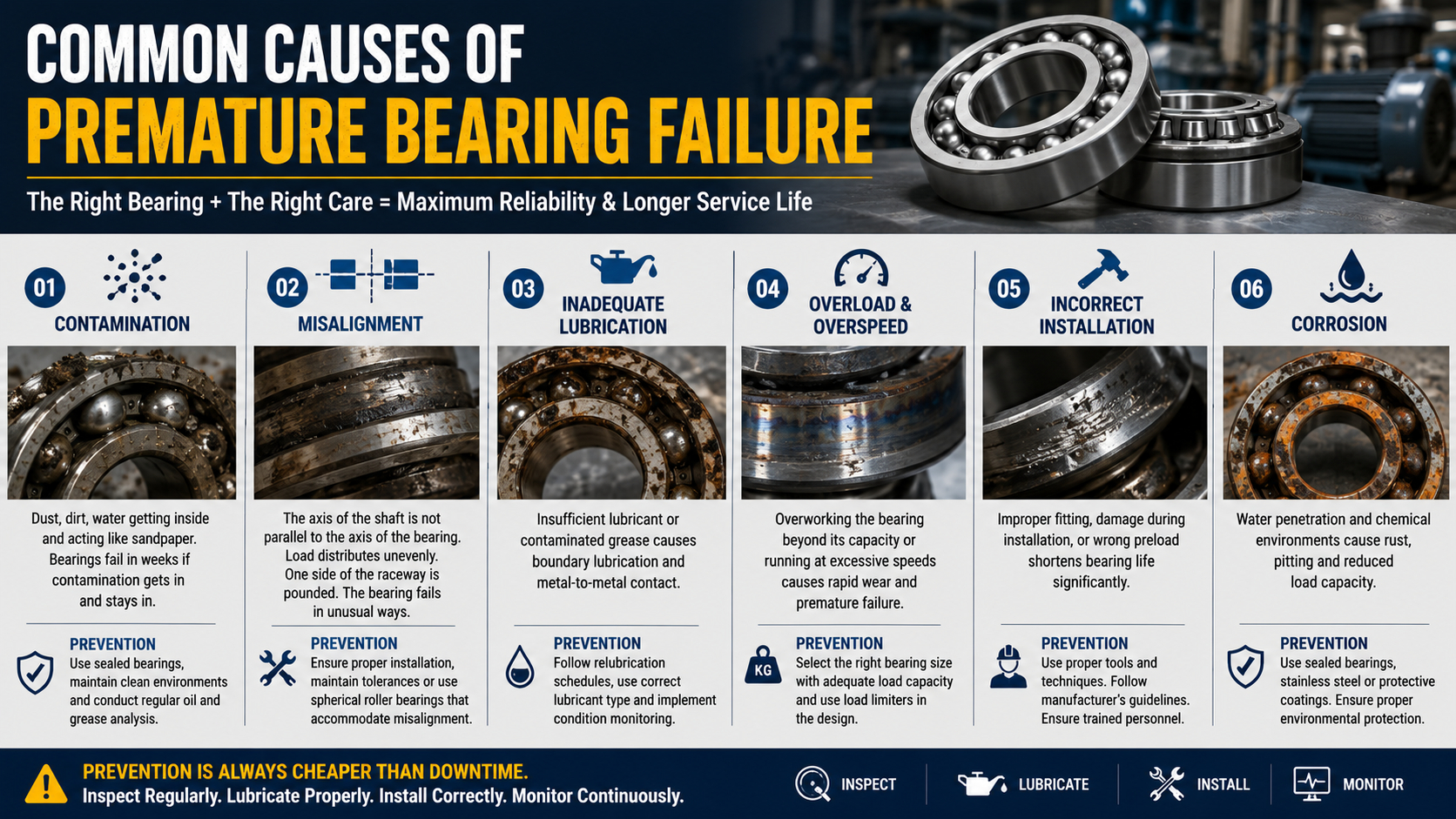
You can pick the right bearing and still end up replacing it in six months if you don't think about what kills bearings.
Contamination
Dust, dirt, water getting inside and acting like sandpaper. Bearings fail in weeks if contamination gets in and stays in. The solution is sealed bearings and clean environments. Regular oil and grease analysis tells you when things are getting dirty before catastrophic failure happens.
Misalignment
The axis of the shaft is not parallel to the axis of the bearing. Load distributes unevenly. One side of the racino is pounded. The bearing goes bad in unusual ways. Use care in installation, proper tolerances or use spherical roller bearings that don't require shaft deflection.
Inadequate Lubrication
Insufficient lubricant or contaminated grease; boundary lubrication causes metal-to-metal contact. Prevention: follow relubrication schedules, use correct lubricant type, implement condition monitoring.
Overload and Overspeed
Break bearings by overworking them. Oversizing during selection and using load limiters in the design solves this.
Incorrect Installation
Improper fitting. Damage during installation. Wrong preload. All of it shortens bearing life. Thermal or mechanical installation done by trained people following the manufacturer's guidelines prevents most of this.
Corrosion
The final common culprit is the water treatment and chemical environments. Water penetrates, metal begins to rust, load capacity decreases. Using sealed bearings, stainless steel and protective coatings all help.
Bearing Material Selection: Steel, Stainless, and Specialty Coatings
Material | Best For | Characteristics | Cost/Limitation |
Standard Chrome Steel (52100) | Standard industrial applications | Hardness 58–65 HRC, good fatigue resistance | Susceptible to corrosion |
Stainless Steel (440C) | Corrosive environments, water treatment | Corrosion-resistant, 52–58 HRC | 3–5× more expensive |
Ceramic Hybrid (Si3N4) | High-speed, high-temperature | Lower friction, better thermal | 10–15× more expensive |
Supplier Evaluation and Procurement Framework for UK Engineers
As important as the selection of the bearing, the selection of the bearing supplier is. When the suppliers are not good, it results in fake and counterfeit products, delayed delivery and bad technical support. SKF, Timken, NSK, NTN, Schaeffler, KOYO and other major brands are available from reputable distributors in the UK, who have the technical expertise to provide advice, stocking and installation assistance, condition monitoring services.
When choosing bearing quotes, consider more than just the price of the unit:
Product certification: Check to see that products are ISO/BS compliant and there are no counterfeiting products
Technical support: Will supplier provide installation instructions?
The difference between delivery speed (Next day or 4 week) has a direct effect on spare parts costs.
Reorder availability: Will they be able to reorder the same availability in 3 years?
The longer the warranty term the more confidence it is built to have.
Include installation, relubrication and downtime risk in the total cost of ownership.
Frequently Asked Questions __ Select Industrial Bearing
Q1: What factors should be considered when selecting an industrial bearing?
There are seven important factors: type and size of load, speed, bearing type, operating environment, lubrication method, installation restrictions and desired service life
Q2: How do I choose the correct bearing type?
The characteristics of your machine should match the strengths of the bearing Ball bearings are suitable for high speeds and medium loads, tapered roller bearings are robust against high combined loads and spherical roller bearings are resistant and equal to shaft misalignment
Q3: What is the difference between ball and roller bearings?
What is the difference between ball and roller bearings? Ball bearings rotate fast, have low friction and are cost-effective Roller bearings can withstand higher loads and are shock-resistant Ball bearings reach speeds above DN > 300000, roller bearings are usually limited to DN < 200000.
Q4: How do load ratings affect bearing selection?
The manufacturer specifies the dynamic load capacity C and the static load capacity C ₀. The actual load should be within a safety margin of 1.5 to 2 times these values. The calculation method for the influence of load on the service life is defined in ISO 281.
Final Thought
Here's what I know from doing this work: the bearing that fails early isn't usually the wrong type. It's the right type that wasn't selected systematically.
You pick a bearing because someone upstream thought they knew what would work. Or because you grabbed what was on the shelf. Or because the supplier pushed it. Not because you actually evaluated load, speed, environment, and expected lifespan.
Take an hour to think through those seven factors. Run the ISO 281 calculation. Talk to your supplier about installation. Plan for condition monitoring if it's critical equipment. That hour saves you months of headaches later.
The bearing nobody thinks about is the one that was chosen thoughtfully.
Disclaimer
ZFC Corporation is not affiliated with, authorized by, endorsed by, or acting as an official representative of any manufacturer, brand, or trademark owner referenced on this website. All product names, trademarks, brand names, logos, and manufacturer references are the property of their respective owners and are used solely for identification, reference, and compatibility purposes.