Industrial Armoured Cables UK: SWA Cable Types, Specifications & Industrial Applications
Industrial armoured cables UK experts use is one of the most critical components in any electrical system, especially when powering critical infrastructure in factories, utilities, and construction sites. These cables are tough, reliable, and able to withstand the harshest conditions, and they are a vital component of modern industrial power distribution. When installing new cables or replacing older ones, it is important to know about the various types, standards, and considerations for selecting the appropriate industrial armoured cables to guarantee safety, compliance, and cost-effectiveness.
Everything from how cables are constructed, to what they are typically used for, to BS 5467 armoured cable standards, and installation advice for different sectors are covered in this guide.
What Are Industrial Armoured Cables?
Industrial armoured cables are robust electrical cables that are reinforced with a protective layer of metallic armour (usually steel wire), which helps to resist any mechanical damage, crushing, impact or harsh environmental conditions to which the conductors may be exposed. They can be installed in exposed areas, in the ground, through cable trays and in areas where physical protection is essential in aggressive industrial environments, unlike standard unarmoured cables.
The metallic armour layer also offers an important earthing path, thus adding another layer of electrical safety to the installation.
How Armoured Cables Work
Cable Construction Explained
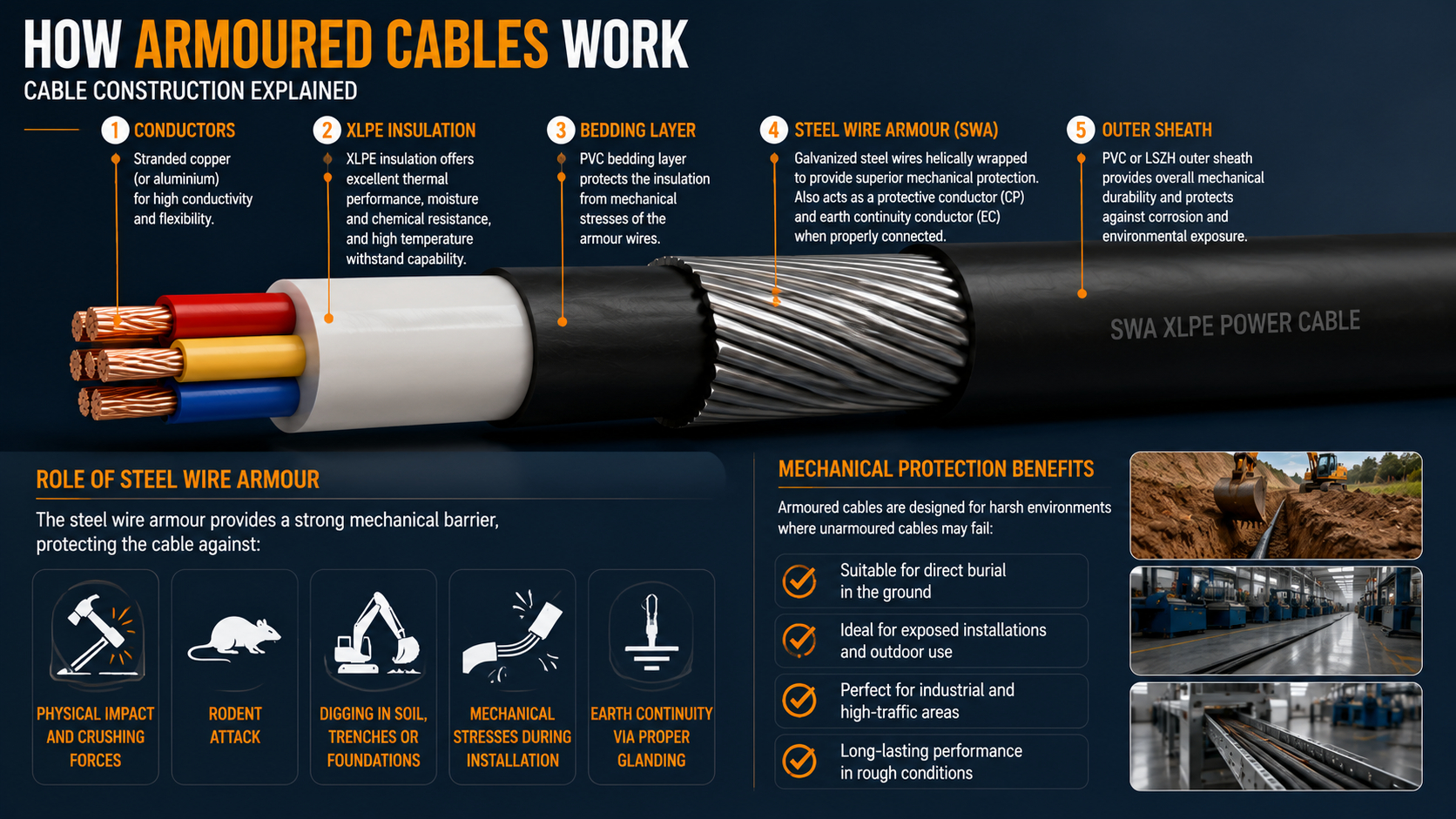
A standard armoured power cable UK installation features cables constructed in concentric layers with each one having its own purpose:
Conductors — The inside layer that conducts an electrical current. Conductors are typically stranded copper (or aluminium in certain designs) to offer flexibility while maintaining its conductivity.
XLPE Insulation — XLPE insulated armoured cables UK are the standard of the industry due to the better thermal characteristics of XLPE insulation, its resistance to moisture and chemicals, and its ability to withstand higher operating temperatures than PVC insulated cables.
Bedding Layer — A PVC layer to bedding between the insulated conductors and the armour, which protects the insulation from the mechanical stresses in the armour wires.
Steel Wire Armour (SWA) — The bedding is helically wrapped in steel wires coated with a layer of zinc to provide a strong mechanical barrier. It is this which is responsible for the name SWA cable UK and the most prominent feature of the product.
Outer Sheath — Overall mechanical durability is provided by the Outer Sheath which is a PVC (or LSZH) outer sheath to protect the armour from corrosion and environmental exposure.
Role of Steel Wire Armour
The difference between the industrial armoured cable UK layer and other lighter cables is the steel wire armoured cable UK layer. It covers the cable from:
The physical impact and crushing forces.
Rodent attack
Digging through the roof, walls or foundations of the house or garage
In addition to mechanical stresses, during installation, through conduits or through trays, etc. It is also a combined protective conductor (CP) and earth continuity conductor (EC) when properly connected to the appropriate cable glands.
Mechanical Protection Benefits
These cables provide mechanical protection against damage and can be constructed to be installed in conditions that would cause the failure of unarmoured cables over a short period, such as when installed in soil, exposed raceways in the outdoors, or where installed in machinery-intensive manufacturing areas.
Main Types of Industrial Armoured Cables
Steel Wire Armoured (SWA) Cables
SWA cable UK is the mainstay of industrial electrical installations. The product is the "must have" for multicore power distribution, sub-main power distribution and above ground power distribution. Steel wire armoured cable UK is manufactured to meet BS 5467 (XLPE insulated) or BS 6724 (LSZH sheathed) and will come in 2, 3, 4 and 5 core, voltages up to 600/1000V.
Aluminium Wire Armoured (AWA) Cables
If single-core cables are needed (such as high current power distribution) then Aluminium Wire Armoured (AWA) cable is used. If steel armour was to be used on a single core cable, the eddy current losses would be unacceptable, which is why aluminium wire is being used, although it will still provide mechanical protection.
Armoured Control Cables
Armoured control cables UK are multicore cables specifically designed for instrument and control circuits. They are normally sold in smaller sizes from 0.5mm² to 2.5mm2 and the cores in them are high. These are widely employed in manufacturing and utilities in process control panels, motor control centers and PLC wiring.
Armoured Instrumentation Cables
There are also armoured construction and whole cables or overall screening for protection of low-level signals from electromagnetic interference (EMI) in instrumentation cables. They play a vital role in oil and gas, chemical processing and other process industries where signal transmission accuracy is vital.
Fire Resistant Armoured Cables
Fire Resistant Armoured Cables are installed to ensure that circuits will remain intact in the event of a fire and continue to provide a protective function for emergency lighting, fire alarm and smoke extraction circuits. They meet extra requirements for fire integrity of circuits.
Low Smoke Zero Halogen (LSZH) Armoured Cables
Fire Resistant Armoured Cables are installed to ensure that circuits will remain intact in the event of a fire and continue to provide a protective function for emergency lighting, fire alarm and smoke extraction circuits. They meet extra requirements for fire integrity of circuits.
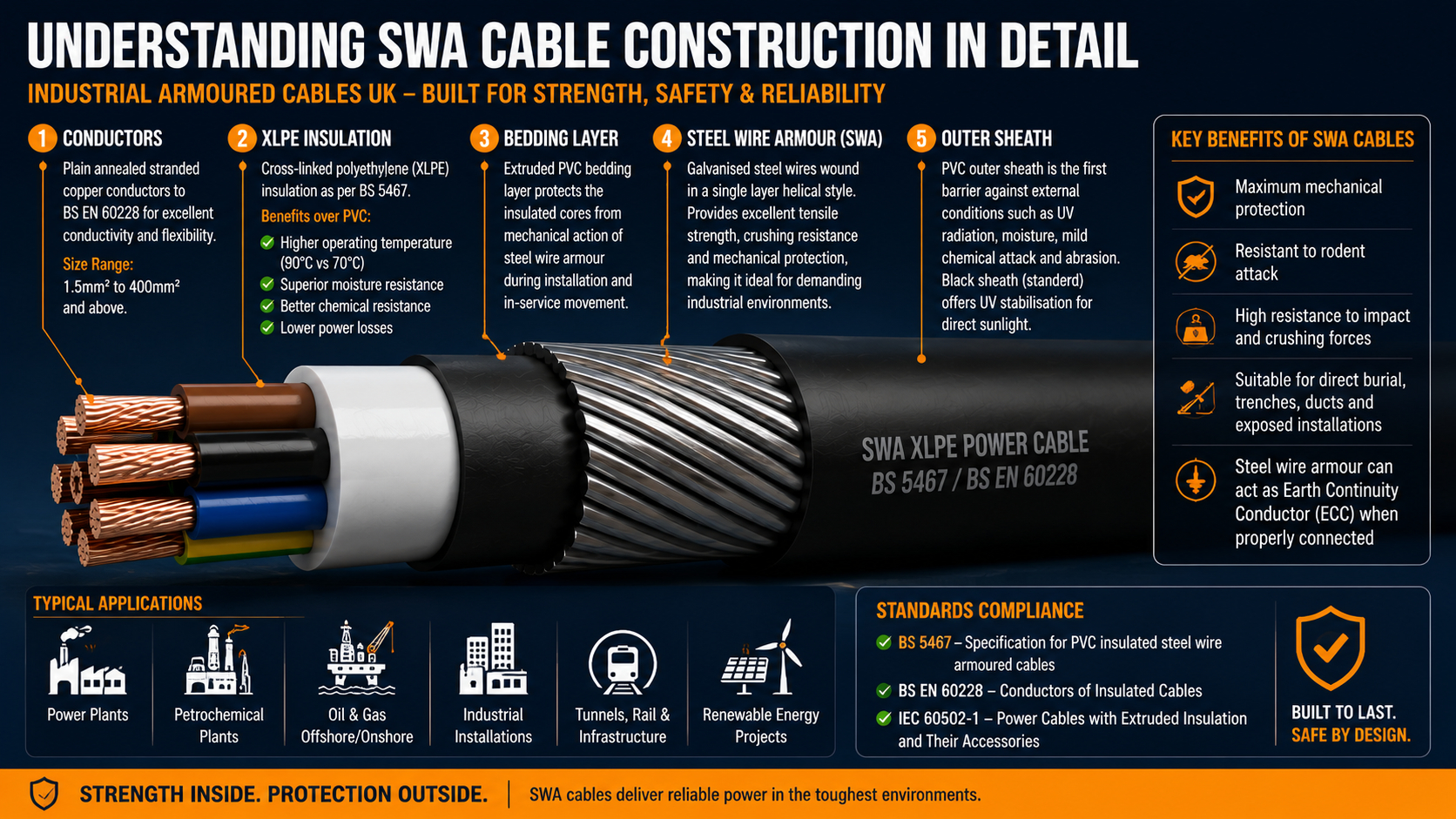
Understanding SWA Cable Construction in Detail
Conductors
The majority of industrial armoured cables UK are constructed with plain annealed stranded copper conductors to BS EN 60228. Conductor sizes used for industrial SWA cable UK are normally between 1.5mm² up to 400mm² or larger.
XLPE Insulation
The most common type of insulation used in modern industrial cables is a form of cross-linked polyethylene (XLPE) which is also used in the armoured cable standard BS 5467. The benefits to be gained against the older PVC insulation are:
Greater maximum operating temperature (conductor temperature of 90°C compared with 70°C for PVC).
The superior moisture ingress resistance is improved. The resistance to moisture ingress is enhanced.
Chemically aggressive environments are now easier to operate in. Now better operated in chemically aggressive environments.
Reduce the power loss in the transmission line at its higher operating voltage levels.
Bedding Layer
Extruded PVC bedding layer protects the insulated cores from mechanical action of the steel wire armour during the installation and in-service movement.
Steel Wire Armour
Galvanised steel wire used is wound in a single layer helical style. The strength in tension of the resulting armour is excellent, as is its resistance to crushing; the mechanical protection afforded by the armour makes UK installations of these types practical and safe.
Outer Sheath
The outer PVC sheath is the first barrier to the external environment, which is composed of UV radiation, moisture, mild chemical attack and abrasion. Color of the outer sheath (usually black for outdoor/underground use) gives UV stabilisation for direct sunlight.
Industrial Armoured Cable Standards in the UK
BS 5467
The main British Standard for XLPE insulated, armoured power cables up to 600/1000V is BS 5467. It defines conductor sizes, insulation thickness, bedding size, armour construction and sheath requirements. These dimensional and material requirements are for any cable which is designated for use as a BS 5467 armoured cable. BASEC approval marks that indicate third-party testing to this standard should be sought by the buyer.
BS 6724
BS 6724 applies to low smoke halogen free (LSZH) armoured cables, which is the BS 5467 version of cables which are required to perform reduced smoke and toxicity in fire conditions.
BS 7671 Wiring Regulations (IET Wiring Regulations)
The IET Wiring Regulations (17th Edition, BS 7671) regulate the design and installation of all electrical installations in the UK. It includes the selection of cables, current ratings, voltage drop allowance, protective conductor considerations and installation techniques. All industrial cable installation work should be carried out in accordance with BS 7671.
BASEC Certification
British Approval for Cables (BASEC) is an independent third party organization which certifies cables against the relevant British Standards. When you're considering cable for an industrial application, you can be sure the cable is BASEC approved when you specify it.
Voltage Ratings and Cable Specifications
Low Voltage Applications
The majority of industrial SWA cable installations are in low voltage; 600/1000V (Uo/U). This includes most industrial power distribution, sub-main wiring and manufacturing, construction and Utilities final circuit cables. To cover the full extent of our Read our Electrical Products pillar page to discover our full range of LV cables, switchgear and protection devices!
Medium Voltage Applications
Medium voltage armoured cables are used for higher voltages of distribution, usually 3.3kV, 6.6kV, 11kV and 33kV. These include the thicker XLPE insulation, the inclusion of metallic screens and reinforced armouring.
Current Carrying Capacity
The current carrying capacity of a specific cable will vary based on the size of the conductor, type of insulation, installation method, ambient temperature, proximity of other cables, and soil thermal resistivity (in the case of buried cables). In the UK practice, the reference tables are from BS 7671 Appendix 4.
Voltage Drop Considerations
BS 7671 specifies maximum voltage drop of 3% for lighting circuits and 5% for other applications in most industrial applications. In long cable runs, typical in large manufacturing locations or underground power distribution cable UK projects, voltage drop needs to be carefully calculated to prevent under-sized cables.
How to Select the Right Armoured Cable
Load Requirements
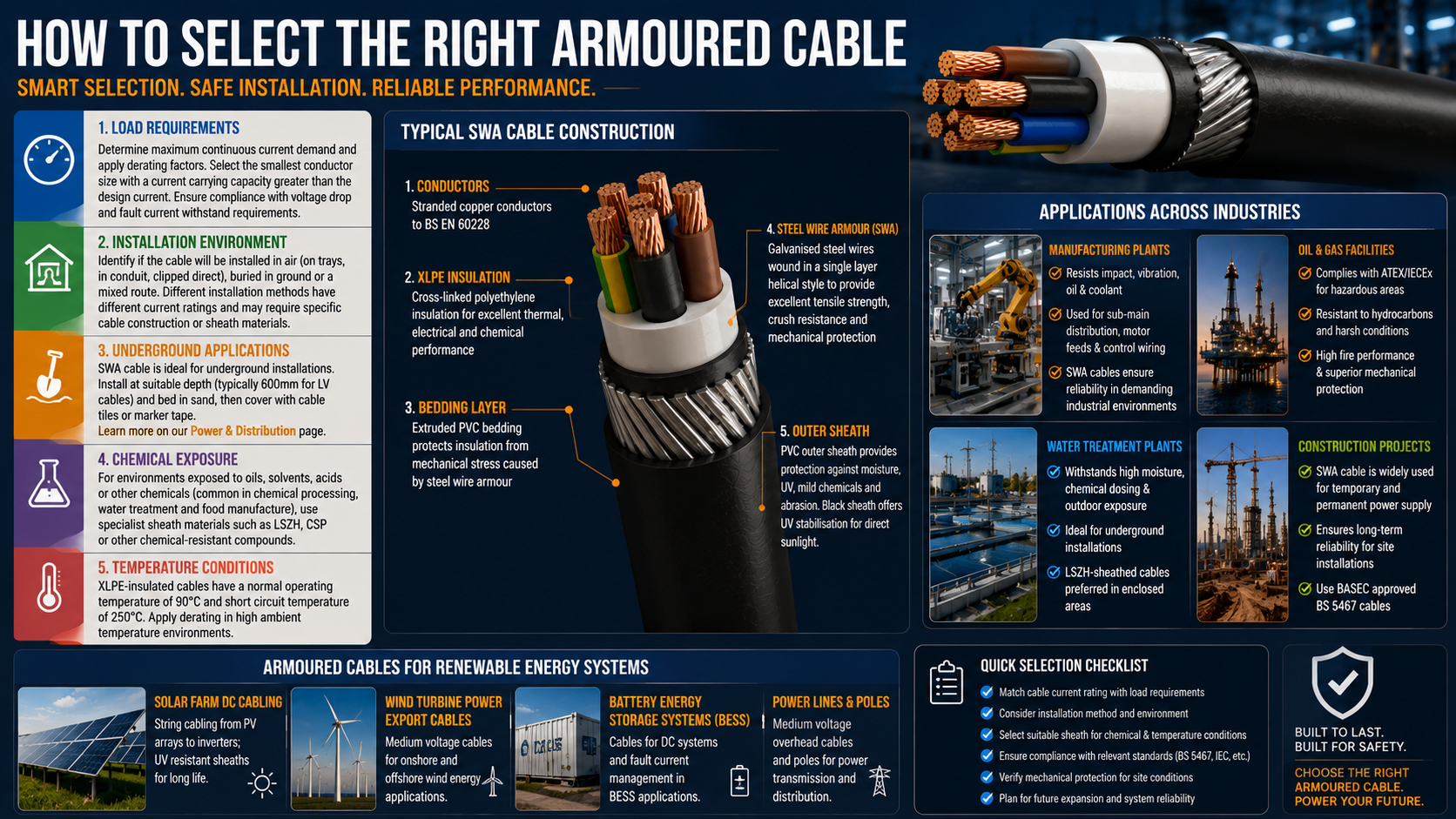
Take the maximum continuous current demand of the connected load and apply the required derating factors for the installation conditions, then choose the smallest conductor size with a current carrying capacity greater than the design current. Make sure that the cable that has been selected also meets the voltage drop and fault current withstand requirements.
Installation Environment
See if the cable is being installed in air (on trays, in conduit, clipped to direct), buried in ground or a mixed route. The different installation methods have different current ratings and may have certain requirements for the construction of the cable or sheath material.
Underground Applications
SWA cable is commonly used for underground armoured cable UK installations. It is best practice to install at a suitable depth (usually 600mm in depth for LV cables) and bedded in sand and covered with cable tiles or marker tape. For more detailed information on underground cabling solutions, refer to our Power and Distribution page.
Chemical Exposure
Specialist cable sheath materials, such as LSZH or CSP or other chemicals, are required where cables are exposed to oils, solvents, acids, or other chemicals, which are common in chemical processing, water treatment and food manufacture.
Temperature Conditions
XLPE-insulated cables have a normal operation temperature of 90°C, and a short circuit temperature of 250°C. Derating should be used in extremely warm areas.
Armoured Cables for Manufacturing Plants
One of the most challenging environments for electrical cables is manufacturing plant. Industrial armoured cables for manufacturing plants UK should be able to resist damage caused by fork-lift trucks and machines, oil and coolant contamination, high ambient temperatures and frequent vibration. In the UK, SWA cables are used in control systems and in the majority of manufacturing facilities for sub-main distribution, motor feeds and control system wiring.
Armoured Cables for Oil & Gas Facilities
In addition to the usual requirements for oil and gas facilities UK armoured cables must also conform to the following standards to suit the stringent operating conditions within hazardous areas: ATEX/IECEx standard for areas at risk, resistance to hydrocarbons, fire performance requirements and greater mechanical protection in high-risk areas.
Armoured Cables for Water Treatment Plants
Water and wastewater treatment plants have high moisture, continual chemical dosing requirements, outdoor/under cover design, and a requirement for 24/7 reliability. Armoured cable underground is installed at these types of sites. In enclosed pump houses and chemical storage buildings, LSZH-sheathed cables are more popular these days.
Armoured Cables for Construction Projects
SWA cable is the main product used for temporary and permanent power supply on large construction sites. Long-term reliability is normally ensured with permanent site installations that include the use of BASEC approved BS 5467 armoured cable.
Armoured Cables for Renewable Energy Systems
The UK is undergoing enormous growth in wind, solar and battery storage installations and these are key areas where specialist armoured cables are being used:
Solar farm DC cabling — string cabling from PV arrays to the inverters; UV resistant.
These are generally medium voltage wind turbine power export cables, both onshore and offshore.
For DC systems and fault current management, battery energy storage system (BESS) cabling.
Power lines and poles — medium voltage overhead cables and poles
Underground Installation Best Practices
Excavation and Bedding
Cables must be laid in a trench with a sand layer at least 75mm thick underneath and 75mm above (no sharp stones to be placed on top of any cables). Trench depths must meet the standards of BS 7671 and local distribution network operator.
Cable Separation
Keep LV and HV cables apart, and don't intermingle power and communications cables without causing electromagnetic interference or making it unsafe to excavate in the future.
Warning Tiles and Marker Tape
To communicate to future excavators that there is a cable buried in the area, plastic cable tiles or marker tape should be placed on top of the cable at the correct depth.
Duct Crossings
Cables crossing roads, driveways, heavy traffic areas, should be placed in durable ducting for extra mechanical protection.
Jointing and Termination
Underground cable joints should be made with the approved jointing kit and for the correct type of cable and voltage. All joints should be installed by competent jointers.
Cable Glands, Terminations & Accessories
As important as the selection of cables is the correct termination of industrial armoured cables UK. The cable gland connects the cable to the enclosure and offers mechanical support for the cable, strain relief, armour clamp for Earth continuity, environmental sealing (IP rated glands for outdoor/wet locations) and meets manufacturer's installation requirements.
The double-compression brass cable glands are the standard choice for industrial applications as they incorporate an armoured clamp and outer sheath seal in a single fitting.
To see all types of termination accessories, refer to our Connectors article on glands, lugs, heat shrink and jointing systems.
Common Installation Mistakes to Avoid
Incorrect bending radius — SWA cable's minimum bending radius (usually 6-8 times the total diameter of the cable). Going over it can lead to damage to the insulation or the armour may be distorted.
Armour not clamped in gland — Improper clamping of the armour will compromise earth continuity and cable will not have mechanical support.
Incorrect gland size — Glands should be sized for the appropriate outer diameter cable.
Sheath damage during installation — Dragging the cable over sharp edges may cut or score the PVC sheath and cause moistness to enter the cable.
Ignoring derating factors — Derating is not used and cables are undersized, which can cause them to run hot and become a fire hazard.
Maintenance and Inspection Guidelines
Industrial armoured cables UK can last for up to 30 years or more, provided that they are maintained properly. Some of the key maintenance activities are:
Visual Inspection — periodic inspection of accessible cable runs for damage to sheath and/or chemical attack or mechanical damage.
Insulation Resistance Testing — Periodic tests (usually made using a 500V or 1000V insulation tester) ensure the integrity of XLPE insulation.
Continuity Testing — Verification of the integrity of the armour earth path, and the proper connection of all protective conductors.
Thermal Imaging — Periodic thermal imaging surveys of accessible terminations and joints to detect high resistance connections.
Documentation — Document all inspection results to set a baseline and to be able to do trend analysis for the cable's life.
Frequently Asked Questions
What is an industrial armoured cable?
An industrial armoured cable is a power or control cable with metal wire armour or other metal protection that is used in harsh industrial environments to withstand the rigors of the operating environment as well as the mechanical force of the cable.
What is the meaning of SWA?
SWA is a steel wire armoured cable, the most commonly used type of armoured cable for use in UK industrial and infrastructure installations.
Is the installation of SWA cable in the ground possible?
Yes. SWA cable has been designed for underground applications. Extremely durable steel wire armour offers good mechanical protection from incidental damage in the future when soil is disturbed.
What is the difference between SWA and AWA cable?
SWA (Steel Wire Armoured) is a type of galvanised steel wires and is employed in multicore cables. Sub cables with aluminium wires are used in AWA to prevent the losses caused by the eddy currents.
Do armoured cables have a waterproof quality?
If the outer sheath is PVC or LSZH and properly installed, armoured cable will offer great moisture resistance; it depends on the construction of the cable, the condition of the outer sheath and the use of IP-rated cable glands to properly seal cable terminations.
In which industries are industrial armoured cables used?
The industrial armoured cables UK products play a vital role in various industries such as manufacturing, oil and gas, water treatment, construction, marine, infrastructure, renewable energy, and utilities, as well as in data center applications.
How to choose the right armoured cable?
The voltage rating, current load, installation environment, mechanical protection needed, cable routing distance, UK standards met, and any special environment features (chemical resistance, fire resistance, etc.) are all factors taken into account when making a selection.
How to buy industrial armoured cables in the UK?
Industrial armoured cables UK products can be found from cable distributors, electrical wholesalers and approved cable manufacturers. Place cables with Basic approval to make sure they meet the appropriate British Standards.
Conclusion
Choosing the right industrial armoured cables UK projects depend upon relies on the ability to match the voltage class, current rating, conductor cross-section, insulation type, and armour construction for the actual installation and not just the electrical load. The majority of industrial LV power distribution applications in the UK use SWA cable with XLPE insulation, but the right cable gland, burial depth, cable sizing method and armour bonding practice are equally crucial to the safe and reliable performance of the cable installation during its service life.
The source of your supplier of BASEC certified cable with full traceability documentation helps you avoid counterfeiting and substandard products in the cable supply market which lead to failure in compliance during electrical inspect and test. The cost of the difference between certified and uncertified cable is always outweighed by the cost of fixing an installation that doesn't comply.
Industrial armoured cables UK come with the reassurance of BS 5467 and BS 6724 compliance, are BASEC certified, and come with full material documentation and technical support for cable type and size selection. Call us today and talk with our team about your cable needs or get a quote for your next industrial project or maintenance purchase.
DISCLAIMER: Z&F Corporation is not affiliated with, authorized by, endorsed by, or acting as an official representative of any manufacturer, brand, or trademark owner referenced on this website. All product names, trademarks, brand names, logos, and manufacturer references are the property of their respective owners and are used solely for identification, reference, and compatibility purposes.