Industrial Bearings in Egypt: Complete Industrial Buyer’s Guide
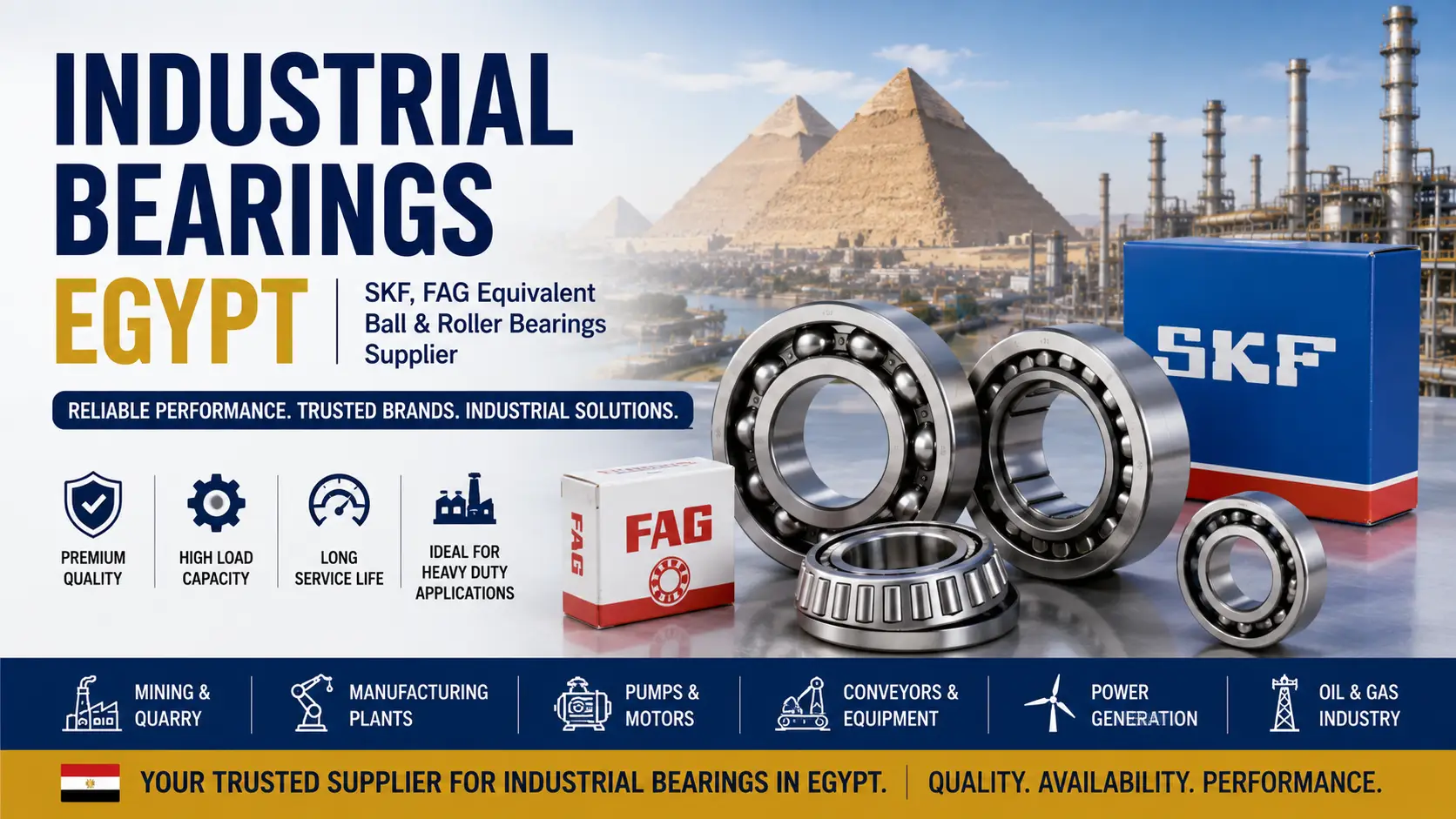
In the industrial bearings Egypt production and maintenance teams, the most vital parts of every rotating machine are the industrial bearings Egypt. These are utilized in every industry across Egypt ranging from the cement corridors of the city of Suez, the steel mills of Alexandria, the manufacturing clusters of the city of the 10th of Ramadan, and the refinery infrastructure of the Suez Canal Zone. Bearings are essential to every part of the pump, motor, gearbox, conveyor, compressor and kiln, all of which are used to minimize friction, carry loads and ensure accurate rotation to keep things moving. If the bearing fails, manufacturing comes to a halt. If the wrong bearing is specified then service life will be reduced and maintenance costs will be increased. This comprehensive guide provides the technical expertise and the practical structure for Egyptian industrial buyers, maintenance and procurement engineers to confidently source, select and manage industrial bearings.
Request a Quote → Order industrial bearings for Egypt from experts with technical assistance.
The manufacturing and industrial sector has seen a significant increase over the last few years, associated with the growth of the Suez Canal Economic Zone, the establishment of new industrial parks in El Sadat City and 6th of October City, and continued investment in cement, steel, food processing and power generation. All of these industries have unique and exacting specifications for bearings that must be met by the bearing solution Egypt procurement teams select: the food processing industry is renowned for its tight tolerances and quiet operation, while the cement crushing industry is known for its high shock loads. This guide covers all aspects of the challenge.
Ready to source industrial bearings for your Egyptian facility? Submit your bearing designation, quantity, application details, and required documentation standards and our procurement team will identify suitable supply options and provide a competitive quotation — typically within 24 hours for standard sizes. Request a Quote.
What Are Industrial Bearings?
Industrial bearings are mechanical devices that limit and control the movement of one part against another, usually a rotating shaft and a stationary housing, and are used to carry the loads created by the machinery. In a rotating piece of equipment, bearings minimize energy loss, wear and causing heat due to replacing sliding friction with rolling friction.
The main components of a rolling element bearing are the inner ring, which is usually attached to the shaft; the outer ring, which is normally anchored in the housing; the rolling elements (balls or rollers of accurately made geometry); and the cage to separate and guide the rolling elements around the raceway. These combine to form a low friction, load-bearing interface capable of many millions of revolutions under rigorous industrial conditions.
The International Standards Organization (ISO) has extensive rolling bearing technical standards, such as ISO 281 on dynamic load rating and life calculation for rolling bearings, ISO 15 on radial ball bearings and ISO 355 on tapered roller bearings. Meeting these standards guarantees that bearings made by any manufacturer with the same designation are dimensionally interchangeable with each other and have the same performance characteristics. The minimum expectation for quality assurance in Egypt procurement of industrial bearings is that they meet the ISO standard.
Why Industrial Bearings Matter in Egyptian Industries
The industrial sector in Egypt is wide, energy heavy. Egypt is one of the greatest producers of cement in Africa, and the production of cement is one of the most bearing intensive industries that currently exist, with hundreds of bearings being used in kilns, mills, conveyors, fans and drives in a single cement plant, many of which operate continuously for years without maintenance. The Alexandria and Suez Canal zone are the main production centers of the steel industry, where bearings are subjected to the most stressful conditions of high radial load, intermittent shock and extreme temperature of any industry. Corrosion-resistant, hygienically designed bearings that meet international food safety standards are required in the food processing and beverage manufacturing industry. Precise bearings are needed for turbine generators and gearboxes in power generation, including conventional and more recently renewable energy generation.
In each of these industries the cost of the problems Egypt has experienced with its bear procurement is high. The sudden loss of a bearing in a Cement Kiln Drive can cause days off production as replacement bearings are ordered and installed. The failure of the motor bearing on a critical pump can result in a shut down of a process line or a water treatment system. On the other hand, properly selected bearings, which are used in the specific application in accordance with the load, speed, environment and the ease of maintenance, increase reliability, prolong maintenance periods and even reduce operating costs significantly throughout the asset's service life.
Types of Industrial Bearings
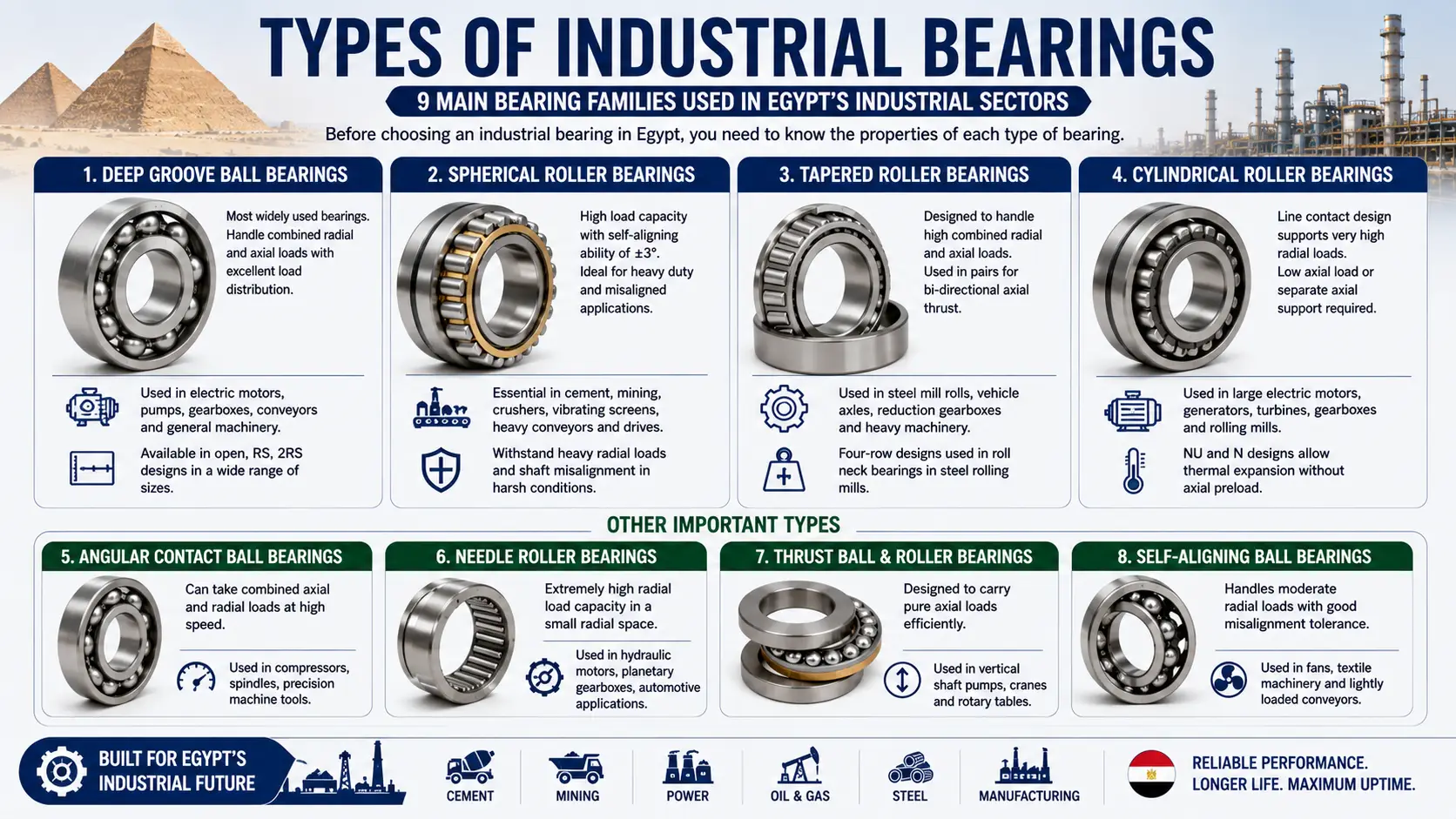
Before choosing an industrial bearing in Egypt, you need to know the properties of each type of bearing. The table below shows the 9 main bearing families, which are used in Egypt's industrial sectors.
Bearing Type | Load Direction | Speed Capability | Misalignment Tolerance | Primary Applications |
Deep Groove Ball Bearing | Radial + moderate axial | Very High | Very Low | Electric motors, pumps, gearboxes, fans |
Angular Contact Ball Bearing | Combined radial + axial | High | Very Low | Compressors, spindles, machine tools |
Spherical Roller Bearing | Heavy radial + some axial | Moderate | High (±3°) | Cement kilns, conveyors, crushers, mills |
Tapered Roller Bearing | High radial + high axial | Moderate | Very Low | Rolling mills, vehicle axles, gearboxes |
Cylindrical Roller Bearing | Very high radial only | High | Low | Steel mills, large motors, turbines |
Needle Roller Bearing | Very high radial (compact) | Moderate | Very Low | Hydraulic motors, automotive, gearboxes |
Thrust Ball Bearing | Axial only | Low–Moderate | None | Vertical pumps, cranes, rotary tables |
Spherical Thrust Roller Bearing | Heavy axial + some radial | Low | High | Extruders, vertical shaft machines |
Self-aligning Ball Bearing | Radial + minor axial | High | Moderate (±2°) | Textile machinery, fans, conveyors |
Deep Groove Ball Bearings
Deep groove ball bearings are the most widely used bearings around the world and the most common bearings in the industrial facilities in Egypt. They have a deep raceway groove, which makes them able to handle combined axial and radial loads with very good load distribution, suitable to a wide variety of applications from small electric motors to centrifugal pumps, gearboxes, and more. They are produced in open, single-sealed (RS) and double-sealed (2RS); and in diameters ranging from a few millimeters to more than one meter. Deep groove ball bearings are the most commonly used bearings in most industrial electric motors, ranging from water pumps to conveyor drives, in Egypt.
Spherical Roller Bearings
The heavy duty workhorse of the cement and mining industry in Egypt is the spherical roller bearings. These bearings feature double-row barrel-shaped rollers on a concave outer ring raceway, and enjoy an unusually high load capacity and self-aligning capacity of ±3° — ideal in situations where the shafts under load may be deflected, expand or move due to thermal effects, or structural movement causes shaft misalignment that affects the bearings. The spherical roller bearings are essential in heavy radial load applications as well as in a misaligned application in large rotating structures, such as drives, vibrating screens, heavy conveyors and crushers which are central to Egypt's large cement sector.
Tapered Roller Bearings
Tapered roller bearings are able to withstand the highest combined radial and axial loads of any type of bearing and feature tapered rollers that run on the tapered inner and outer ring raceways. They are generally used in pairs to cope with bi-directional axial thrust, such as in a steel mill neck roll, vehicle axles, reduction gearboxes and wherever a large axial thrust and a heavy radial load are required to be borne at one time. Tapered roller bearings, when used in four-row designs, are the regular order on roll neck bearings in the steel rolling mill operations in Egypt and their role is to withstand the huge forces encountered in Hot and Cold Rolling Operations.
Cylindrical Roller Bearings
Line contact between the roller and the raceway makes cylindrical roller bearings the most capable of supporting pure radial loads of any type of rolling bearings. They are applied in large electric motors, generators, turbines, gearboxes and rolling mill applications where the radial loads are quite high and axial loads are either very low or are taken up separately. They can be used as ‘floating’ bearings in shaft arrangements where it is necessary to allow for thermal expansion without causing axial preload between the inner and outer rings (NU and N designs).
Other Important Types
Angular contact ball bearings — Can take combined axial and radial loads at high speed; in compressors, spindles, precision machine tools
Needle roller bearings — Extremely high radial load capacity in a small radial space in hydraulic motors, planetary gearboxes, and automotive applications.
Thrust ball and roller bearings — Carry pure axial loads; in vertical shaft pumps, cranes and rotary tables
Self-aligning ball bearings — Moderate radial load with good misalignment tolerance: Fan, textile machinery, lightly loaded conveyor.
Ball Bearings vs Roller Bearings: Key Differences
The major decision between ball bearings Egypt and roller bearing variants relies on load size, pace and misalignment tolerability. The comparison below gives the comparison framework most relevant to Egyptian industrial applications.
Characteristic | Ball Bearings | Roller Bearings |
Load Capacity | Light to moderate radial + axial | Heavy radial (cylindrical) or combined (spherical, tapered) |
Speed Capability | Higher — lower friction | Moderate — line contact generates more heat |
Misalignment Tolerance | Very low (standard designs) | High (spherical roller types) |
Noise Level | Lower at typical speeds | Slightly higher |
Cost | Generally lower | Generally higher |
Maintenance Interval | Moderate | Longer in heavy duty service |
Typical Industry Use | Motors, pumps, fans, gearboxes | Cement, steel, mining, heavy conveyors |
ISO Standard | ISO 15 (radial ball bearings) | ISO 355 (tapered), ISO 5753 (cylindrical) |
Applications of Industrial Bearings Across Egyptian Industries
Due to the industrial geography of Egypt, there are different clusters of application with different heavy duty bearings Egypt needs. The following industry application matrix describes the correlation between the types of bearings and the most crucial industrial applications and locations.
Industry Sector | Typical Bearing Types | Key Requirements | Egypt Locations |
Cement Production | Spherical roller, cylindrical roller | Shock load, dust resistance, high temp | Suez, Beni Suef, Cairo environs |
Steel & Rolling Mills | Cylindrical roller, tapered roller | Very heavy radial load, high speed | Alexandria, Suez, 10th of Ramadan |
Electric Motors | Deep groove ball bearings | Low noise, high speed, long life | All industrial zones |
Pumps & Compressors | Deep groove ball, angular contact | Combined load, precision, low vibration | Cairo, Alexandria, Ain Sokhna |
Conveyors & Material Handling | Spherical roller, deep groove ball | Misalignment tolerance, continuous duty | Mining & logistics hubs |
Food & Beverage Processing | Stainless / food-grade bearings | Hygiene, corrosion resistance, washdown | 6th of October, El Sadat City |
Mining & Quarrying | Spherical roller, tapered roller | Shock, abrasion, contamination resistance | Sinai, Eastern Desert |
Power Generation | Cylindrical roller, angular contact | High speed, precision, low vibration | Suez, Ain Sokhna |
Oil & Gas | Spherical roller, deep groove ball | ATEX, corrosion, process compatibility | Suez Canal Zone, Western Desert |
Textile Machinery | Deep groove ball, self-aligning ball | High speed, precision, low noise | El Sadat, 10th of Ramadan |
Cement Industry — Egypt’s Most Bearing-Intensive Sector
The cement industry is one of the most important manufacturing industries in Egypt, with most of the plants located in Suez, Upper Egypt and is mainly owned by three companies: Arabian Cement, Suez Cement and Lafarge Holcim. Thousands of bearings are used on a single cement production line in raw material handling conveyors, ball mills and roller mills, kiln support rollers and drives, preheater fans, clinker cooler conveyors and cement mill drives. Spherical roller bearings feature in large bore sizes, and frequently are fitted with special heat stabilization (designation suffix S1 and S2 for kiln applications operating at temperatures exceeding 150°C). In modern cement plants, vibration and temperature monitoring of the kiln support (bearings) is normal practice and helps to perform condition based maintenance rather than stop production.
Steel and Rolling Mills
The heavy duty steel companies in Alexandria, such as the large establishments of Steel and other companies in the Suez zone apply the most severe loads, speed, temperature and contamination to roller bearings Egypt. Four-row cylindrical and tapered roller bearings for roll necks are the most expensive single bearings in any industrial plant, and may need custom engineering and specialized installation. Rolling mill stand bearing failures lead to immediate plant shutdown and huge amount of scrap generation, hence condition monitoring and predictive maintenance is vital investment for the plant operation.
For our complete range of industrial bearings and power transmission components, explore our Bearings page.
Electric Motors — The Universal Application
Almost all of the electric motors used in Egypt's industrial economy ranging from the fan motors of fractional kilowatts to the drive motors of the multi-megawatt cement kilns employ deep groove ball bearings. The selection of motor bearings is based on the IEC 60034 and the motor manufacturer's specification for bearing arrangement, size, tolerance class and lubrication requirements. Electrical fluting caused by variable frequency drives (VFDs), grease degradation caused by high temperatures and contamination caused by inadequate shaft sealing are common motor bearing failure modes and can be prevented by proper specification and maintenance.
See our Mechanical Seals page to learn more about mechanical seals which are installed with bearings in Pump and Rotating Equipment operations.
Food Processing and Pharmaceutical
Other food and pharmaceutical manufacturing units in El Sadat City, 6th of October City and the industrial periphery of Cairo demand bearings that are manufactured in stainless steel or with using food grade NSF H1 approved lubrication, which are able to withstand high pressure washdown and cleaning chemicals. Moisture or chemical contamination (from moisture or chemical ingression) can cause rapid bearing failure and contamination of food products from lubricant or bearing debris, which is a food safety violation, so conventional grease and standard carbon steel bearings are not suitable. Standard in food plants specification are hygienically designed bearing housings equipped with either labyrinth or contact seals with effective sealing.
How to Select the Right Industrial Bearing
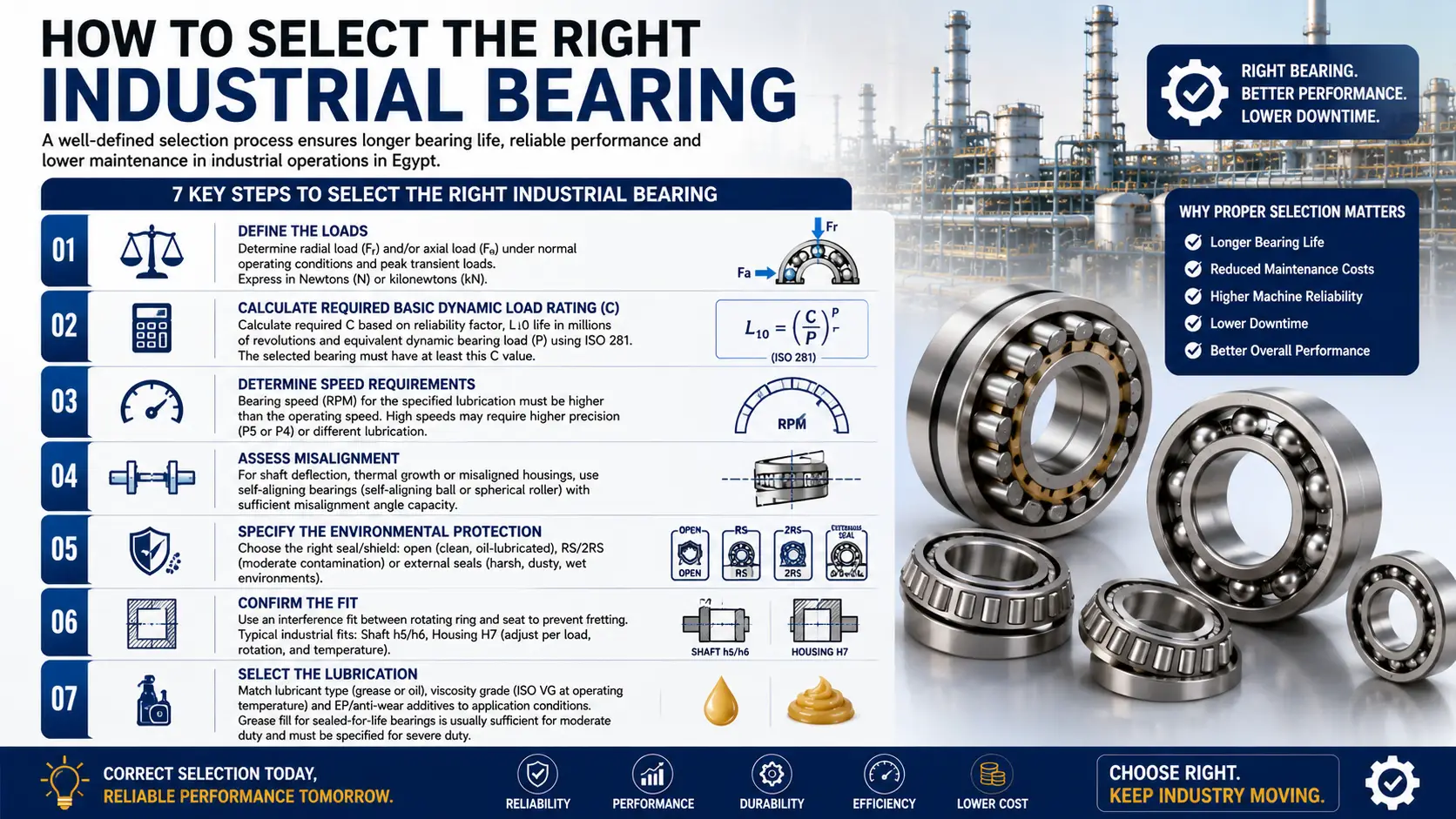
It is important to have a well-designed process for selecting industrial bearings for manufacturing operations in Egypt. One of the main causes of early bearing failure that can be avoided is incorrect bearing selection. This guide includes the ten parameters that need to be specified prior to finalizing a bearing specification.
Selection Parameter | What to Define | Impact on Bearing Choice |
Radial Load (Fr) | Maximum radial force on bearing in Newtons | Determines minimum dynamic load rating C required |
Axial Load (Fa) | Maximum thrust load on bearing | Decides if angular contact or thrust bearing is needed |
Speed (n) | Operating RPM and maximum intermittent speed | Determines allowable bearing type and precision class |
Operating Temperature | Ambient + process heat at bearing location | Determines heat stabilization, clearance, lubricant type |
Misalignment | Expected shaft / housing angular error (°) | Requires self-aligning ball or spherical roller if >0.5° |
Environmental Conditions | Dust, moisture, chemical exposure | Determines seal type (ZZ, RS, RS1) and material |
Life Requirement | Required L10 life in hours or millions of revolutions | Used in ISO 281 dynamic load calculation to select C |
Shaft and Housing Fit | Shaft diameter, housing bore, tolerance class | Determines interference fit for rotating inner / outer ring |
Lubrication Method | Grease, oil, oil mist, centralized system | Limits speed and determines viscosity and lubricant type |
Installation / Removal | Frequency of replacement, access constraints | May require adapter sleeve, withdrawal sleeve, or SKF-type fit |
Step-by-Step Selection Process
Define the loads. Determine or measure radial load (Fr) and/or axial load (Fa) on bearing in normal operating condition and peak transient load. Express in Newtons (N) or kilonewtons (kN). When there is no load data from the machine OEM documentation, it is possible to estimate the load based on the motor power and shaft diameter and geometry.
Calculate required basic dynamic load rating (C). The required C is determined based on the required reliability factor, L10 life in millions of revolutions and the equivalent dynamic bearing load (P) using ISO 281. This means that the selected bearing has to have at least this C value.
Determine speed requirements. The speed of the bearing (in the RPM for the specified lubrication mode) should be higher than the operating speed. At higher speeds centrifugal forces and heat production place limitations which could necessitate the use of a higher precision class (P5 or P4) or a different lubrication arrangement.
Assess misalignment. In applications that require deflection of the shaft, thermal growth or tolerances for misaligned housing, use a self-aligning type (self-aligning ball or spherical roller) with enough angle capacity — as is often the case in large industrial equipment on concrete foundations.
Specify the environmental protection. Depending on the contamination risk, choose the right seal/shield type: open bearings (clean oil-lubricated applications), single or double contact seals (RS, 2RS) (moderately contaminated environments) and external seals with adequate housing seal arrangement (harsh, dusty and wet environments).
Confirm the fit. Always an interference fit between rotating ring and seat to minimize the risk of fretting corrosion from micro-movement. A good rule of thumb is to use shaft tolerances of h5/h6 and housing tolerances of H7 for typical industrial applications, but the actual fit will depend on the magnitude of the load, whether it is rotary or not, and on the operating temperature.
Select the lubrication. Match lubricant type (grease or oil), viscosity grade (according to the ISO chart for viscosity grade at operating temperature) and EP or anti-wear additive specification with the application conditions. The grease fill for sealed-for-life bearings is usually adequate for moderate duty, and should be called out separately for severe duty.
Common Causes of Bearing Failure
To prevent recurring failures in bearing maintenance solutions Egypt, proper understanding and correct diagnosis of bearing failures are mandatory. Lubrication failures, contamination and misalignment are the top three causes of premature bearing failure, as consistently identified by the leading bearing manufacturer's industry data, and are all preventable through proper specification, installation and maintenance.
Failure Mode | Root Cause | Visual Indicators | Prevention |
Fatigue Spalling | Exceeding L10 design life or overload | Pitting and flaking on raceways | Correct load rating, reduce overload |
Lubrication Failure | Insufficient, degraded, or wrong lubricant | Discolouration, smearing, scoring | Correct lubricant type and quantity, scheduled relubrication |
Contamination | Ingress of dirt, water, or particles | Scoring, abrasion marks, corrosion pitting | Improved sealing, clean assembly, storage practices |
Misalignment | Shaft or housing misalignment exceeding tolerance | Uneven raceway wear patterns | Precision alignment, use of self-aligning types |
False Brinelling | Vibration while stationary (transport or storage) | Indentations at ball/roller spacing | Anti-vibration mounts during transport, rotate shaft periodically |
Electrical Damage | Stray currents through bearing | Fluting (washboard pattern on raceways) | Insulated bearings, shaft grounding rings |
Improper Installation | Incorrect fitting force or tools | Brinelling from impact, cage damage | Thermal or hydraulic fitting, never strike inner race via outer |
Overheating | Excessive preload, lubrication failure, overload | Discolouration, hardness reduction | Correct clearance, adequate lubrication, reduced preload |
Electrical Fluting from Variable Frequency Drives
Electrical bearing damage is becoming a common problem because of the many industrial facilities in Egypt which are using variable frequency drives (VFDs). The common mode voltage, generated by the high frequency switching in the VFD, discharges across the bearings to the frame, creating tiny craters (electrical discharge machining marks) that slowly form a characteristic washboard fluting pattern on the raceways. Depending on the motor size and VFD configuration, shaft grounding rings, insulated bearings on the non-drive end of the motor or insulated bearing housings are required for prevention.
Bearing Maintenance Best Practices
Properly maintaining bearings is the most effective step Egyptian industrial facilities can take to get the most life out of their bearings and minimize unplanned downtime. It is not the fault of the design if the bearings fail prematurely, it is because the bearings were not maintained properly.
Lubrication Best Practices
Bearing Type / Application | Lubricant Type | Relubrication Interval | Operating Temp Limit |
Deep groove ball — electric motor | Lithium grease NLGI 2–3 | 6–12 months or 2,000 hrs | Up to 120°C (standard grease) |
Spherical roller — cement kiln | High-temp EP grease or circulating oil | Weekly to monthly (site-specific) | Up to 150°C+ |
Cylindrical roller — steel mill | Circulating oil system (ISO VG 100–220) | Oil change per system schedule | Monitored continuously |
Tapered roller — gearbox | EP gear oil (ISO VG 150–320) | Per OEM oil change interval | Up to 100°C |
Deep groove ball — high speed pump | Low-viscosity grease or oil mist | 3–6 months or condition-based | Up to 80°C (standard) |
Food grade application | NSF H1 food-grade grease | Per HACCP maintenance schedule | Per grease specification |
Outdoor / exposed environment | High-water-resistance grease (NLGI 2–3) | 3–6 months | As specified |
The most frequently made lubrication mistakes are oversizing or under-sizing the lube, which both are detrimental to bearings. Excessive grease will lead to excess grease churning, heat buildup and damage to the seal. Starvation and surface damage caused by under-greasing. The appropriate quantity of relubrication is usually given in cm³ or grams per relubrication interval and is based on a standard formula supplied by the bearing manufacturer, based on the diameter of the bearing bore.
Correct Installation Practices
Never strike the outer ring to fit the inner ring. The fitting force should be applied to the ring on which it is being fitted: inner ring to shaft, outer ring to housing.
Use thermal fitting for large bearings. Bearings having bore diameters greater than about 80mm should be pre-heated in an induction heater or oil bath to a temperature of 80-100°C above ambient (max 120°C) before installing on the shaft. Never use a blowtorch.
Verify shaft and housing dimensions before fitting. Use calibrated instruments to measure shaft diameter and bore of housing to ensure that the shaft and housing are within the appropriate tolerances to ensure the desired interference fit.
Align shafts and couplings after installation. If the bearings are aligned accurately according to the principle of precision shaft alignment provided by the laser alignment equipment, the axial load caused by shaft eccentricity will be greatly reduced, and the working life of the bearings will be greatly extended.
Verify bearing end-float or preload after assembly. Verify tapered roller bearing pairs are assembled with the proper axial clearance or preload (as required).
Condition Monitoring and Predictive Maintenance
In Egypt, larger industrial facilities are increasingly using vibration analysis, thermographic imaging, and ultrasonic inspection to identify developing bearing problems before they cause failure, which is known as "predictive maintenance. The four characteristic bearing defect frequencies occur when a defect is present in the outer race, inner race, rolling elements and cage respectively, and vibration signature analysis can provide 2-8 weeks of warning before catastrophic failure before these frequencies occur. This warning window allows for planned and scheduled bearing replacement during a programmed stop, avoiding the loss of production and emergency procurement cost of unplanned failure.
OEM vs Aftermarket Bearings: Making the Right Decision
One of the most important and commercially sensitive choices for Egypt maintenance personnel when selecting the bearings for their operations is whether to use OEM or higher quality brand bearings or lower cost aftermarket or generic bearings. In order to make this decision, it is necessary to have a balanced matrix which takes into account technical and economic considerations as well as the price. The table below offers a balanced approach.
Factor | OEM / Premium Brand | Generic / Aftermarket |
Material Standards | Controlled alloy steel, heat treatment verified | Variable — may lack documentation |
Dimensional Accuracy | ISO tolerance class guaranteed | May vary, especially outer-band sourcing |
Documentation | EN 10204 3.1 MTCs, test reports available | Often unavailable or unverified |
Counterfeit Risk | Low (buy from authorized channels) | Higher — especially in grey market |
Service Life | Predictable L10 life per ISO 281 | Variable, often shorter |
Technical Support | Full engineering and failure analysis support | Limited or none |
Price | Higher initial cost | Lower initial cost |
Lifecycle Cost | Lower — fewer replacements and less downtime | Often higher — shorter service life |
Best Suited For | Critical equipment, high duty, long runs | Non-critical, low duty, short-term |
The important lesson to be learned from lifecycle cost analysis is that the cost of purchasing an item of bearing is only about 5-10% of the total cost of failure, when production downtime, overtime wages, collateral damage to other equipment, and emergency parts procurement premiums are all included. The premium specification, fully-traceable bearings' life cycle cost case is compelling for critical rotating equipment, such as kiln drives, compressors and main production motors. If the application is non-critical, accessible with ease and has a low duty, cost optimized alternatives may be suitable where a documented risk assessment has been carried out.
How to Avoid Counterfeit Industrial Bearings
It is well documented that there are counterfeit bearings in the MENA industrial supply chain, including Egypt. Visually, the look is the same as the true premium brand bearings, but the steel is lower grade, the heat treatment is not correct, the grinding is not accurate, and the cages are substandard, meaning that the life expectancy may be only a portion of the authentic bearings. If not conducted in a critical application, failure to prevent counterfeit bearings can result in safety incidents, production loss and equipment damage.
Identifying Counterfeit Bearings
Verify supplier credentials. Buy from suppliers that are approved distributors or from a verified direct supply line from the manufacturer. In most cases, manufacturer verification is available for those who are truly authorized distributors with the manufacturer's website.
Check packaging and marking. Genuine premium-brand bearings with a consistent, high quality packaging and clear laser or ink jet bearing designation, manufacturer logo and country of manufacture markings. Notations that are marked inconsistently or incorrectly can be red flags.
Request material traceability documentation. If critical, insist on the material test certificate by EN 10204 3.1 which will show the specific heat of steel used in the bearing rings back to the raw material source. It is possible to have material traceability only for genuine products.
Verify the physical bearing. Ensure that the stamped designation on the bearing ring is exactly as ordered. Check the dimensional tolerances against the ISO standard – Counterfeit bearings may have dimensional tolerances that are not within the standard and can be checked using calibrated instruments.
Be suspicious of unusually low prices. The market price range of genuine premium brand bearings is well known. Any price that is markedly lower than market price, particularly from unknown suppliers, is a key red flag that the product may be counterfeit or a 'grey-market item'.
Industrial Bearing Procurement in Egypt
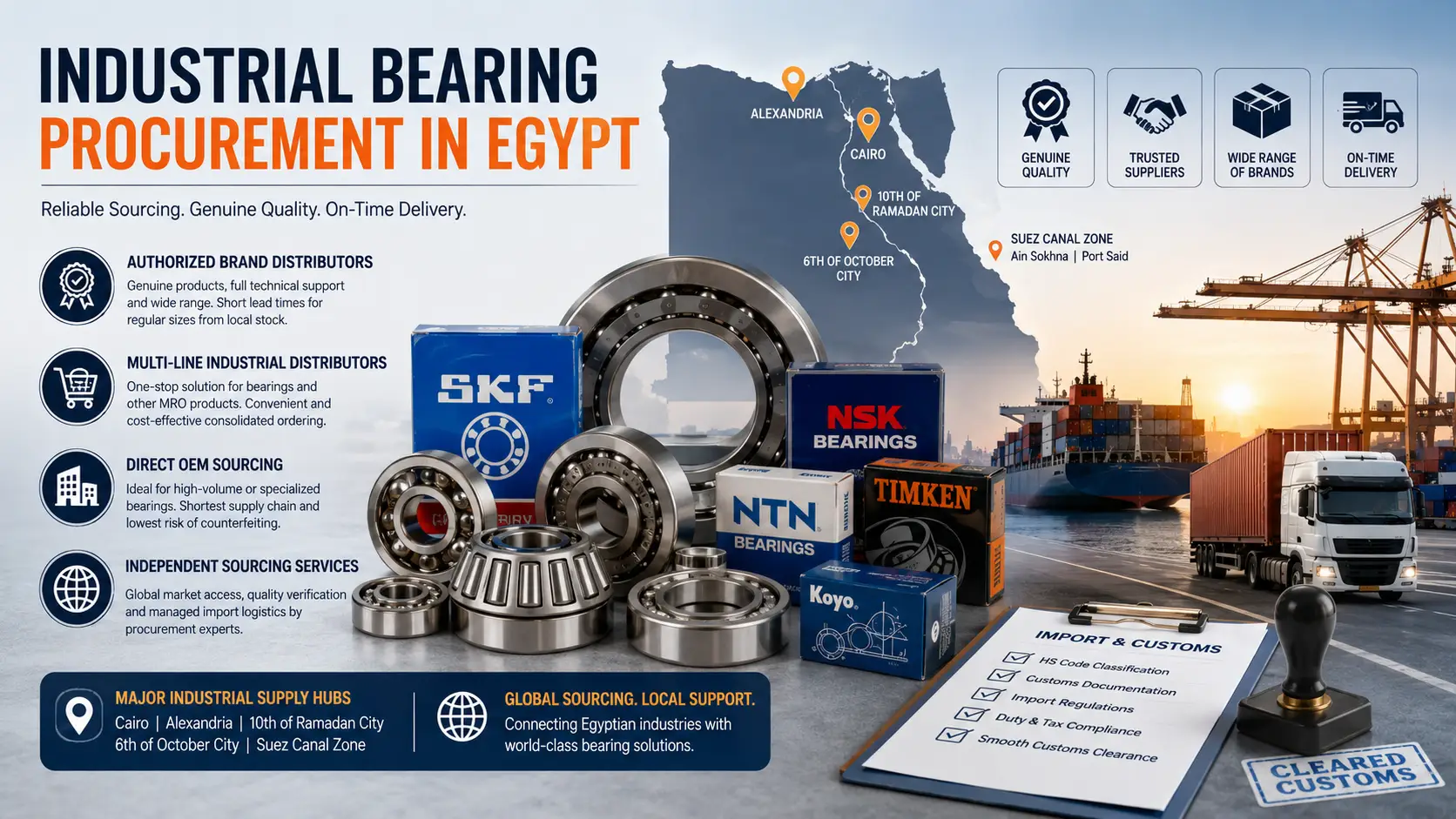
The industrial bearings supplier market in Egypt includes authorized distributors for top international brands, multi-line industrial distributors with a mixed portfolio, specialist bearing distributors and OEM spare parts channels. Knowledge of the terrain helps procurement teams to source appropriately for each application category.
Procurement Channels and Their Trade-offs
Authorized brand distributors — Guarantee genuine product, manufacturer full technical support, full range of products (non-standard sizes). Generally, in Cairo, Alexandria and in industrial areas. Typical lead time for regular sizes is typically short from local stock, specialist sizes may take 2–6 weeks to import.
Multi-line industrial distributors — Stock a variety of bearing products from several manufacturers and other MRO products. For ease of consolidated ordering of multiple product categories. Genuineness of a product is dependent upon the sourcing methods of the distributor.
Direct OEM sourcing — If the volume is high or the product is a specialist one, which is not available in the local market, then the direct import from the bearing manufacturer or his regional distribution center (usually Dubai for the MENA region) will have the shortest supply chain and the lowest risk of counterfeiting.
Independent sourcing services — If the organization does not have the procurement mechanism or import capacity to complete the process of complex bearing procurement, it can enter the global market with the independent industrial procurement service, have the quality confirmed and have the import logistics managed.
Where to Source Bearings in Egypt
The industrial supply districts of Cairo are the main concentration of industrial bearings suppliers while Alexandria's port area (for those bearing suppliers who deal with imports) and industrial areas of 10th of Ramadan City as well as 6th of October City, which provide services to the large manufacturing clusters of these cities, industrial bearings suppliers in Egypt are most concentrated. However, distributors in Suez Canal Zone can deliver faster than suppliers from Cairo for the operations of Suez Canal Zone for industrial and logistics activities in Ain Sokhna and Port Said areas. For standard size bearings, Cairo Egypt options for industrial bearing distributor are wide, but for a special or large bearing, the order is to be made from the stock of the region or direct from OEM.
Import and Customs Considerations
The customs and import regulations for bearings imported into Egypt will differ depending on the different types of bearings (HS code) and country of origin. If the buyer is a manufacturer or trading company who sources directly from overseas manufacturers or a regional hub, it is important that the buyer has a forwarder who is already familiar with the customs clearance system in Egypt, as the risk of delays can be minimized. There are numerous bearing distributors that stock their inventory from Egypt's free zones or bonded warehouses which benefit industrial buyers because of their ease of management from a tax and customs perspective.
Future Trends in Industrial Bearing Technology
Smart Bearings and Integrated Sensing
The bearing manufacturers are starting to place condition monitoring equipment and sensors directly in the bearing unit, miniaturizing accelerometers, temperature sensors and wireless data transmitters in the bearing housing. These ‘smart bearings' can continuously report performance data to plant monitoring systems, eliminating the need for separate external sensors to ensure truly continuous predictive maintenance. Due to the expected growth of Industry 4.0 capabilities in Egyptian industrial facilities, the number of smart bearings in use is expected to grow significantly, especially in cement, steel, and power generation, where bearing failure costs are the highest.
Ceramic and Hybrid Bearings
The steel-based inner and outer rings with silicon nitride ceramic rolling elements provide many benefits in high-speed and electrically demanding applications, including the following: Harder and lighter balls reduce centrifugal forces at high speed, and silicon nitride balls are electrically insulating, preventing electrical fluting damage from the VFD-driven motors. The use of hybrid bearings in motor applications is likely to grow as the use of VFD in Egyptian industry grows.
Sustainability and Extended Service Life
As Egyptian industrial operators seek to meet energy cost and sustainability goals, extended relubrication intervals, sealed-for-life designs and energy-efficient bearing designs that minimize friction and energy usage are becoming increasingly relevant. Bearing friction losses of 20–50% less than standard bearing designs can be realized in large facilities with hundreds of motors, which makes a significant contribution to the total motor system efficiency.
Frequently Asked Questions
What are industrial bearings used for?
The applications of industrial bearings in Egypt involve minimizing friction and load bearing in all types of rotating machinery such as Electric Motors, Pumps, Compressors, Gear Boxes, Conveyors, Fans, Kilns, Mills and Turbines. They are not only one of the most common and essential parts in any industrial equipment in all branches of Egypt's economy, but they are also used in the production of cement, steel, food processing and power generation.
What are the differences between ball bearings and roller bearings?
Spherical rolling elements are used in ball bearings to achieve point contact with the raceways and to increase the speed capacity and decrease the friction, but with limited load capacity. Roller bearings have cylindrical, tapered or needle, and spherical rollers that are loaded in the line contact mode with the raceways, providing higher load capacity (radial, and in some designs, axial) at the expense of slightly higher friction and lower speed limits. Roller bearings are used on heavy-duty industrial applications, including motors, pumps and fans at high speeds and light loading, and steel and cement manufacturing.
How to select the right industrial bearing?
The selection of the correct industrial bearing solution for manufacturing Egypt requires the following to be determined: Radial and axial loads (in N), operating and maximum speed (RPM), L10 life (in hours or millions of revolutions), shaft and housing dimensions and tolerances, operating temperature, environmental conditions (contamination, moisture), and method of lubrication. The dynamic load calculations carried out according to ISO 281 and the catalogues supplied by the bearing manufacturers are used for this purpose to select the minimum allowable bearing. In special or unknown applications, the advice of a bearing engineer or technical specialist should be obtained.
How long do industrial bearings last?
For typical industrial applications, the ISO L10 calculated life is designed to be 25,000 to 100,000 hours or more, and this will be achieved if the bearings are properly specified, correctly installed, and well maintained. The actual service life is greatly influenced by the following: accuracy of the load calculation which has been made during selection, quality and consistency of lubrication, environmental contamination control, quality of shaft alignment, and correctness of installation. If bearings are failing before the calculated L10 life, it will likely be a root cause problem — very rarely a manufacturing defect.
What are the reasons for bearing failures?
The most common root causes for premature failure of industrial bearings are: Incorrect or inadequate lubrication (about 36% in most industrial surveys), Particles, moisture or chemicals entering the bearings, Incorrect alignment of fitting to shaft, Exceeding the dynamic load capacity of the bearing, Electrical damage caused by currents generated by the VFD on the shaft. All these causes can be prevented by proper specification, installation, lubrication and condition monitoring practices.
What are the ways of identifying fake bearings?
The following are signs of counterfeit industrial bearings Egypt: Buying bearings from a supplier who has a documented, traceable supply chain from the manufacturer, checking consistency and quality in bearings' packaging and markings, requesting and verifying material test certificates, checking dimensions against ISO standards using calibrated instruments and being appropriately Suspicious if pricing is below market levels. Include third-party inspection at supplier's plant for higher value and critical applications for added verification.
What are some practices that extend the life of bearings?
The most effective maintenance practices for achieving the longest service life for bearing solutions in Egypt are as follows: Correct Relubrication Practice (using the right lubricant type, quantity and interval) Precision Fitting Practice (after installation or after fitting the coupling components — do not hit the bearing with a hammer or drift); Regular Vibration Monitoring and Thermographic Inspection (to detect any developing faults); Clean and Controlled Stock Storage (storage temperature 15–25°C, relative humidity 40–60%, away from vibration sources); Correct Fitting Practice (thermal fitting for bigger bearing, hydraulic nut for adapter sleeve designs and never hit at the bearing with a hammer or drift).
What type of bearing is suitable for the cement plant in Egypt?
Spherical roller bearings are commonly used in cement plants to support the kiln, drive the ball/roller mills, in heavy conveyors, crushers, and raw meal and clinker handling equipment. Their ability to take radial load, shock load and self-aligning properties are very suitable for the large and heavy rotating structure and non-alignment mounting of the cement plant's equipment. If continuous high temperatures are used in the kiln, heat-stabilized variants (S1 or S2 suffix) with the necessary clearance class (C3 or C4) should be used. Bearing suppliers in Egypt in the cement industry should be able to quote and deliver all cement plant bearing needs such as large bore spherical roller bearings (bore>200mm).
How We Support Industrial Bearing Procurement in Egypt
We are an independent industrial sourcing and procurement company, assisting maintenance managers, procurement engineers and plant operators in Egypt to find and order the appropriate industrial bearings for their equipment and facilities. It is technically neutral: No branding, no promotion, but technical selection Strictness and supplier qualification for sourcing from the global market on behalf of our clients, ensuring that the product delivered is in accordance to specification, is truly certified and arrives fully documented.
We offer a wide variety of bearings, from deep groove ball bearings, spherical roller bearings, tapered roller bearings, cylindrical roller bearings to specialist bearings for cement, steel, food processing and power generation applications, in both standard and large bore sizes, with full material traceability and certification packages included.
Not certain which bearing is the proper choice for the application, or need to locate an alternate part number to the OEM? Before you buy, our technical experts can assist you in selecting the right bearing, applying an analysis of the application, investigating failure, and performing an analysis of bearing life costs. Talk to Our Specialist
DISCLAIMER: Z&F Corporation is not affiliated with, authorized by, endorsed by, or acting as an official representative of any manufacturer, brand, or trademark owner referenced on this website. All product names, trademarks, brand names, logos, and manufacturer references are the property of their respective owners and are used solely for identification, reference, and compatibility purposes.