Industrial Cables in Yemen: Complete Guide to Industrial Electrical Cable Solutions
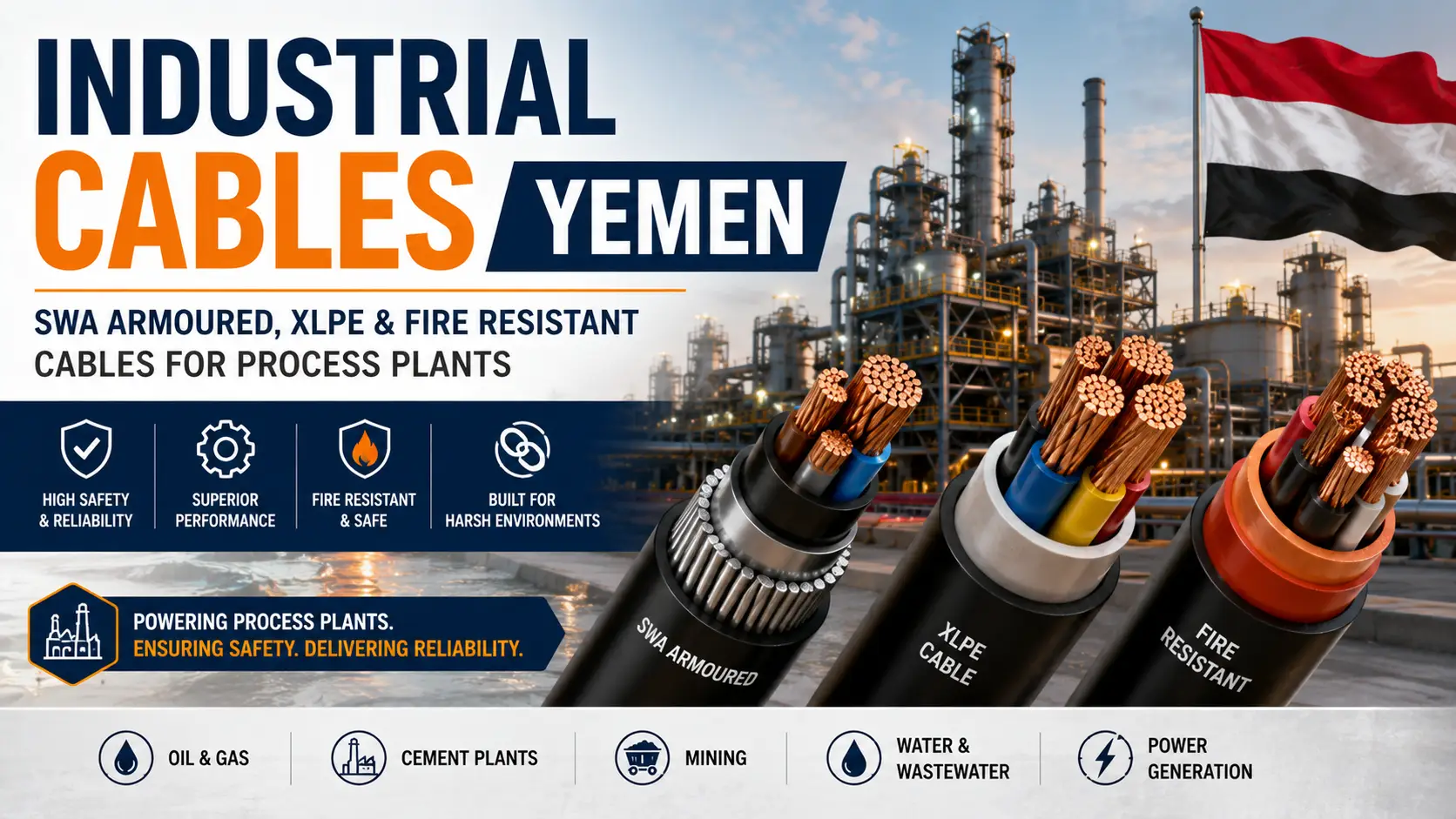
Yemen suppliers can provide the right industrial cables for safe and reliable power distribution to all infrastructures in Sana'a, Aden, power substations near Marib and oil and gas facilities in Hadhramaut. Industrial cables for Yemen projects are not just about the price; their selection depends on factors such as voltage, insulation, and adherence to standards in the context of load automation. Here you will find a guide to what cable type is involved, IEC standards, applications, selection criteria and how to assess the suppliers objectively based on their cable specifications.
Are you looking to hire industrial electrical cables for your project and need pricing?
What Are Industrial Electrical Cables?
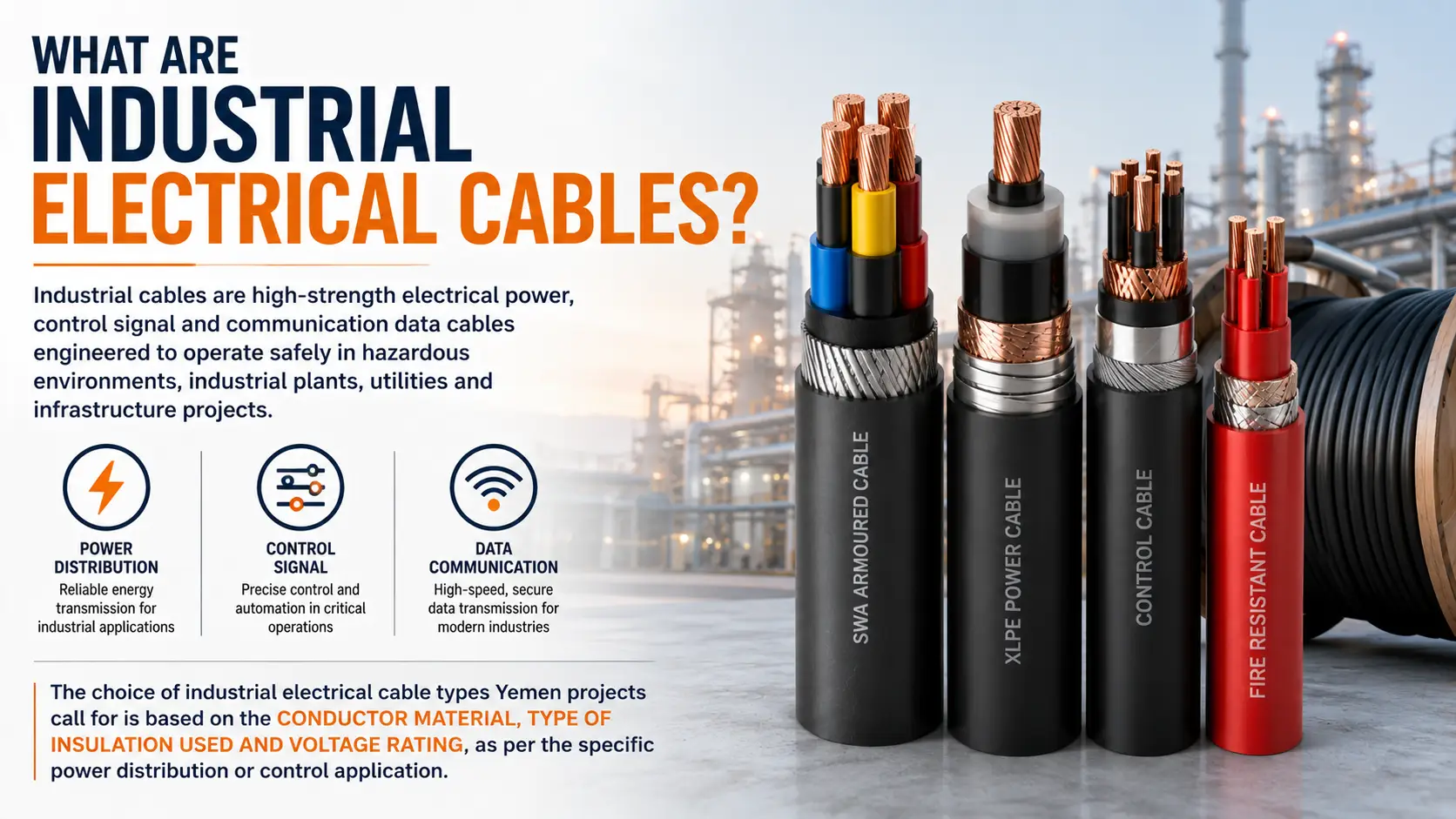
Industrial cables are high-strength electrical power, control signal and communication data cables engineered to operate safely in hazardous environments, industrial plants, utilities and infrastructure projects. The choice of industrial electrical cable types Yemen projects call for is based on the conductor material, type of insulation used and voltage rating, as per the specific power distribution or control application.
Types of Industrial Cables
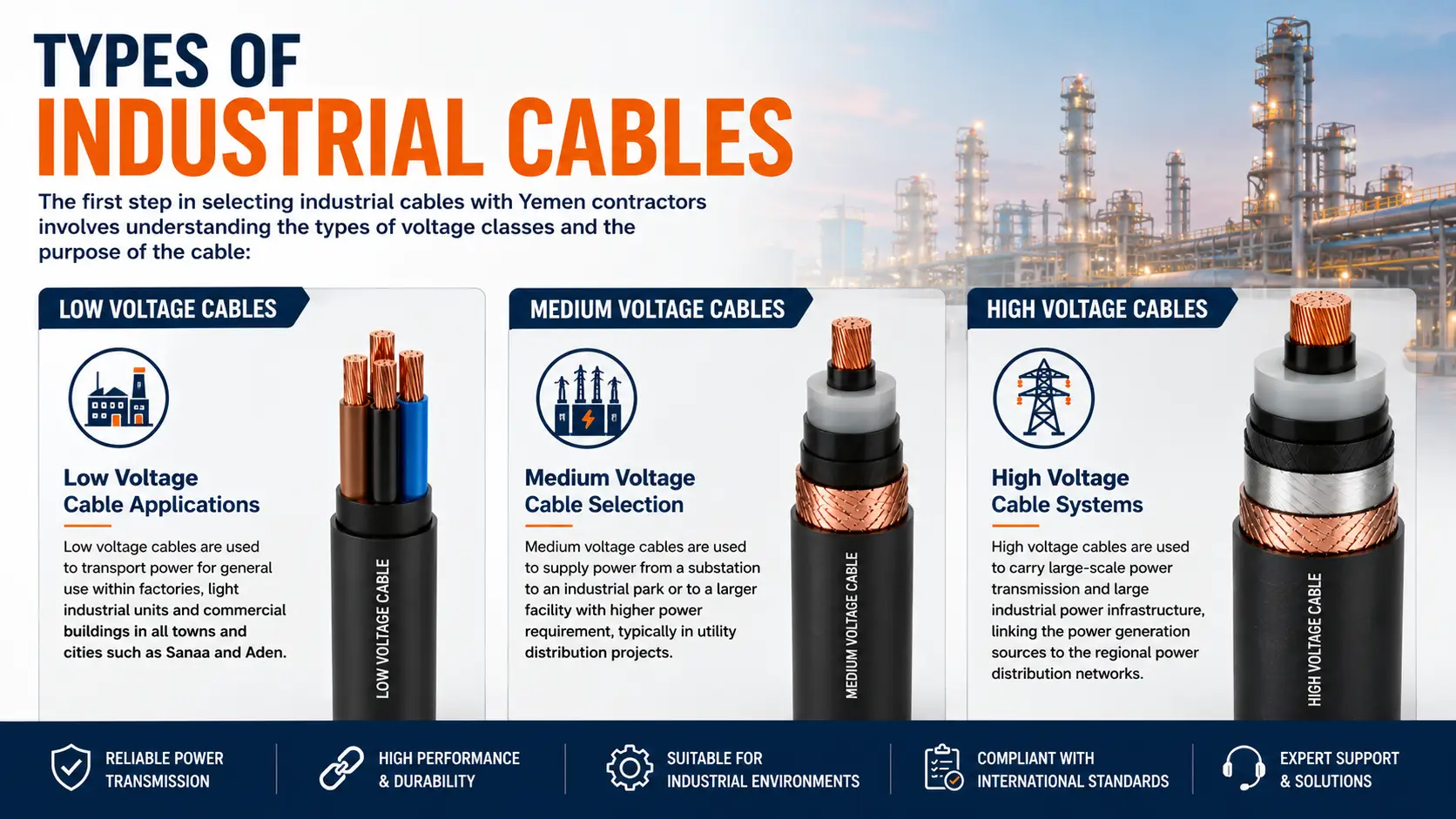
The first step in selecting industrial cables with Yemen contractors involves understanding the types of voltage classes and the purpose of the cable:
Low Voltage Cable Applications
Low voltage cables are used to transport power for general use within factories, light industrial units and commercial buildings in all towns and cities such as Sanaa and Aden.
Medium Voltage Cable Selection
Medium voltage cables are used to supply power from a substation to an industrial park or to a larger facility with higher power requirement, typically in utility distribution projects.
High Voltage Cable Systems
High voltage cables are used to carry large-scale power transmission and large industrial power infrastructure, linking the power generation sources to the regional power distribution networks.
Power Cables for Industrial Applications
Electrical power cables are used for delivering electrical power to equipment and distribution panels. power cables Yemen projects specify are typically copper or aluminum conductor cables based on the length of the installation, cost, and the current that is needed for the installation.
Control and Instrumentation Cables
In industrial automation, or in process facilities, control cables transmit low-voltage signals for operating and monitoring electrical systems, and instrumentation cables carry low-level signals between field instruments and control systems, and reduce electrical interference.
Cable Type | Function | Typical Application |
Power cables | Carry electrical energy to equipment | Distribution panels, motors, main feeders |
Control cables | Transmit low-voltage control signals | Automation systems, equipment interlocks |
Instrumentation cables | Carry low-level signals with interference protection | Sensors, transmitters, PLC connections |
Armored vs Unarmored Cables
Armorized cable Yemen specifications include a protective metallic outer layer to shield the cable from mechanical impact, crushing and moisture, and are recommended for use in underground, industrial and outdoor cables. Unarmored cables are less expensive and are used for installations where there is little risk of mechanical damage, such as inside, protected locations.
XLPE vs PVC Insulation
The performance and service life of the cable is closely related to the performance of the insulation material:
Factor | XLPE Insulation | PVC Insulation |
Temperature resistance | Higher, suited to demanding environments | Lower, general-purpose applications |
Electrical performance | Better dielectric properties | Adequate for standard applications |
Service life | Longer under continuous service | Shorter under demanding conditions |
Typical use | MV/HV power distribution, industrial plants | LV wiring, general commercial use |
Industrial Cable Applications
In the power substations area near Marib, the site teams are installing medium-voltage power cables. Medium-voltage power cables are being installed in the power substations site near Marib.
In industrial manufacturing plants, XLPE power cables are used.
Armored cables and underground contractors' ducting for utility distribution in Aden and Al Hudaydah.
Located in oil and gas processing facilities in Hadhramaut, instrumentation cables are employed in these facilities.
Control cables for industrial automation systems.
Solar panels for powering green energy initiatives in the port area
International Cable Standards
When assessing electrical cable supplier Yemen options consumers need to ensure compliance with recognised frameworks. All over the world, IEC standards apply to cable design, testing and performance and IEEE and BS standards are often cited in project specifications in addition to GSO requirements for compliance in the region.
Standard / Organization | Relevance |
IEC (International Electrotechnical Commission) | Core international cable design and testing standards |
IEEE | Engineering standards referenced in power system specifications |
BS (British Standards Institution) | Commonly referenced alongside IEC in project specs |
GSO (Gulf Standardization Organization) | Regional compliance reference for Gulf and Middle East projects |
NFPA | Fire safety standards for fire-resistant cable applications |
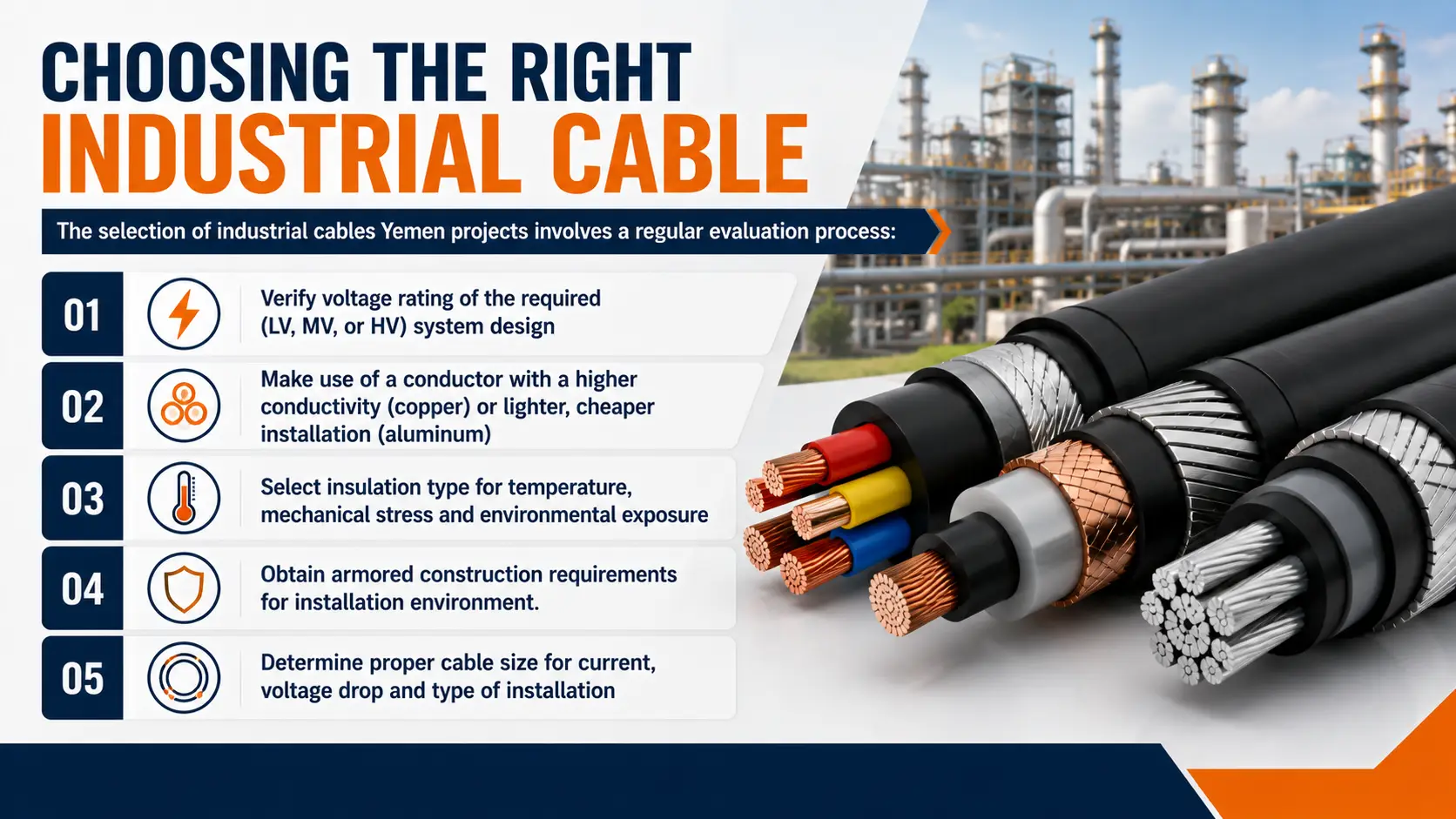
Choosing the Right Industrial Cable
The selection of industrial cables Yemen projects involves a regular evaluation process:
Verify voltage rating of the required (LV, MV, or HV) system design
Make use of a conductor with a higher conductivity (copper) or lighter, cheaper installation (aluminum)
Select insulation type for temperature, mechanical stress and environmental exposure
Obtain armored construction requirements for installation environment.
Determine proper cable size for current, voltage drop and type of installation
Cable Installation Best Practices
The reliability and safety of industrial cables Yemen facilities depend directly on the proper installation:
Avoid bending the insulation beyond the manufacturer's bend radius recommendations
Install cable glands and termination kits in an appropriate manner depending on the installation environment
Install cables so they are not located near heat or mechanical stress points
Check correct earthing and shielding of instrumentation and control cables
Maintenance and Inspection
Sourcing reliable industrial cable distributor Yemen teams can depend on is only the first step; ongoing maintenance protects the investment:
Make periodic inspections for damage in insulation or bare conductors a habit.
Check the termination points of cables for overheating and/or corrosion.
On critical circuits periodically test for insulation resistance
Ensure proper cable routing and record of checks for infrastructure projects
Procurement Considerations
Beyond catalog pricing, sourcing industrial cables Yemen infrastructure projects requires looking beyond. When ordering in bulk, buyers should check IEC testing reports, conductor specifications and third party certifications. Cable installations are often deployed in combination with automation equipment, and our Control Systems resource provides information on compatible Control Systems and Instrumentation equipment, and our Electrical Pillar resource provides information on Cable types, Standards and accessories, in all Industrial Electrical applications.
Frequently Asked Questions
What industrial cables are commonly used in Yemen?
Low voltage, medium voltage, control, instrumentation, armored and XLPE insulated power cables are widely used in industrial, utility and infrastructure applications.
Which cable insulation is better, XLPE or PVC?
XLPE is more temperature resistant and has better electrical properties than PVC which has a more low cost general purpose application.
What is the difference between control and instrumentation cables?
Control cables are used for operating equipment and operating low voltage signals, instrumentation cables are used to transfer low level signals between field instruments and control systems.
Are armored cables necessary for industrial projects?
Armoured cables are recommended where mechanical protection is required, e.g. in harsh industrial environments or if the cable is exposed to the outside or underground.
Which IEC standards apply to industrial cables?
Cable design, testing and performance are regulated by IEC standards, which are frequently used in conjunction with IEEE, BS, and GSO (regional) standards.
How long do industrial electrical cables last?
With proper selection, installation and maintenance, industrial cables are expected to perform reliably for 20-40 years or more depending on the operating conditions.
What industries require industrial cables?
Industrial Cables are used in Oil and Gas, Utilities, Manufacturing, Mining, Construction, Marine, Renewable Energy and Telecommunication Industries.
How should industrial cables be stored?
Keep cables in a dry, clean, out of direct sun, out of chemicals, away from excess moisture and keep cable ends protected.
Request Industrial Cable Sourcing Assistance
Looking for industrial cables in Yemen for projects in the utilities, oil and gas or infrastructure sector? We are an independent sourcing partner that sows you power, control and instrumentation cables from a variety of manufacturers that comply with the standards you need, insulation and voltage. For more information on Electrical Pillar and Control Systems, refer to our resources.
Consult with experts to understand what cables are required and how to order them for your project.
Visit our Specialist for advice.
DISCLAIMER: Z&F Corporation is not affiliated with, authorized by, endorsed by, or acting as an official representative of any manufacturer, brand, or trademark owner referenced on this website. All product names, trademarks, brand names, logos, and manufacturer references are the property of their respective owners and are used solely for identification, reference, and compatibility purposes.