Industrial Lubricants in Thailand: Complete Selection & Industrial Sourcing Guide
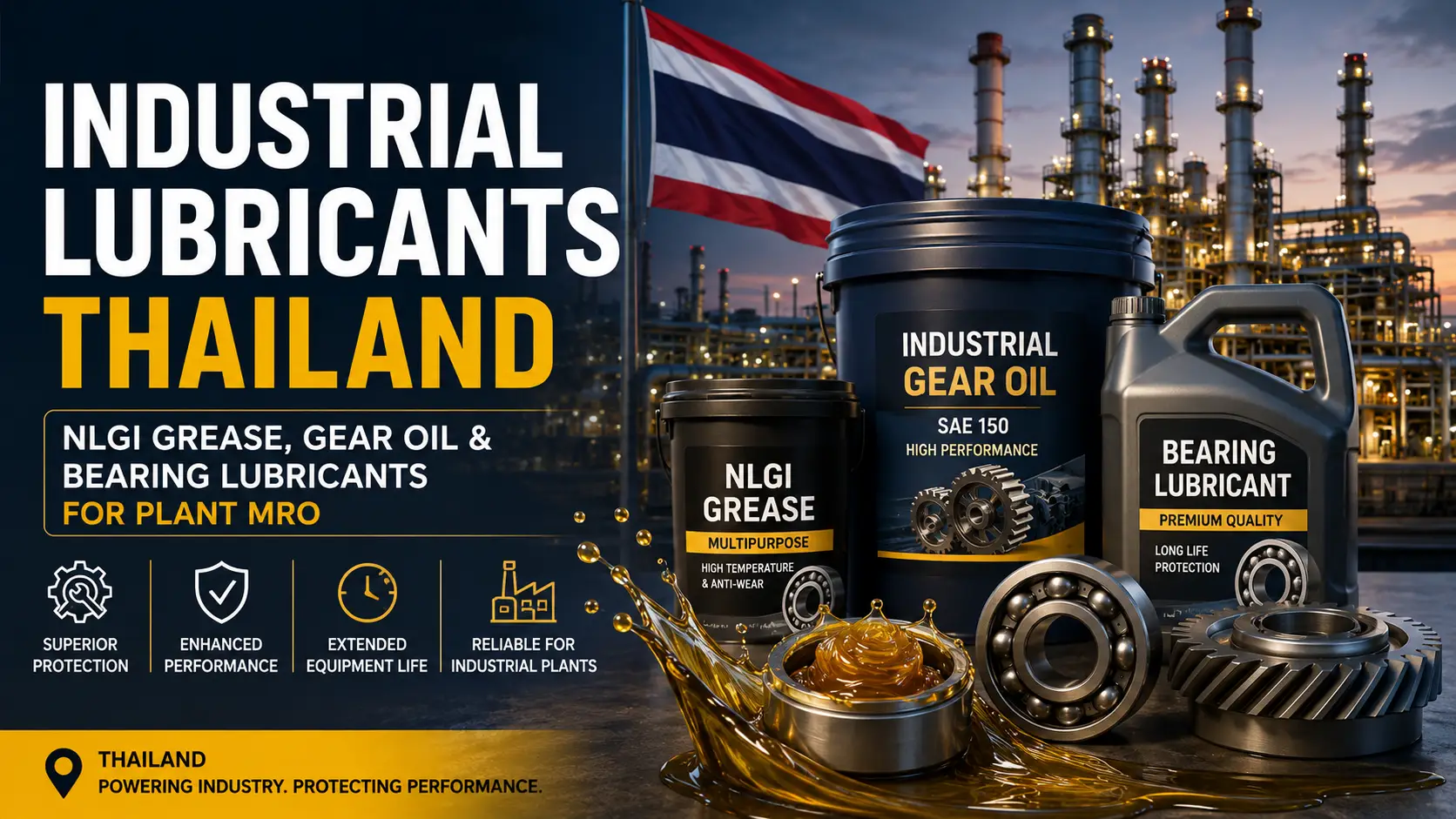
The hot and humid environment in which the manufacturing industry operates in Thailand relies on a correct specification of industrial lubricants which minimizes friction and helps to prevent damage to machinery and prolong the life of equipment at plants located throughout the Eastern Economic Corridor, Rayong, and Chonburi. The main concerns for using a range of industrial lubricants thailand manufacturers use are viscosity grade, base oil type, and OEM compatibility, not necessarily the price. This guide deals with types of lubricants, selection criteria, standards, applications, and evaluation of suppliers on objective and specification based criteria.
Looking for industrial oil prices?
What Are Industrial Lubricants?
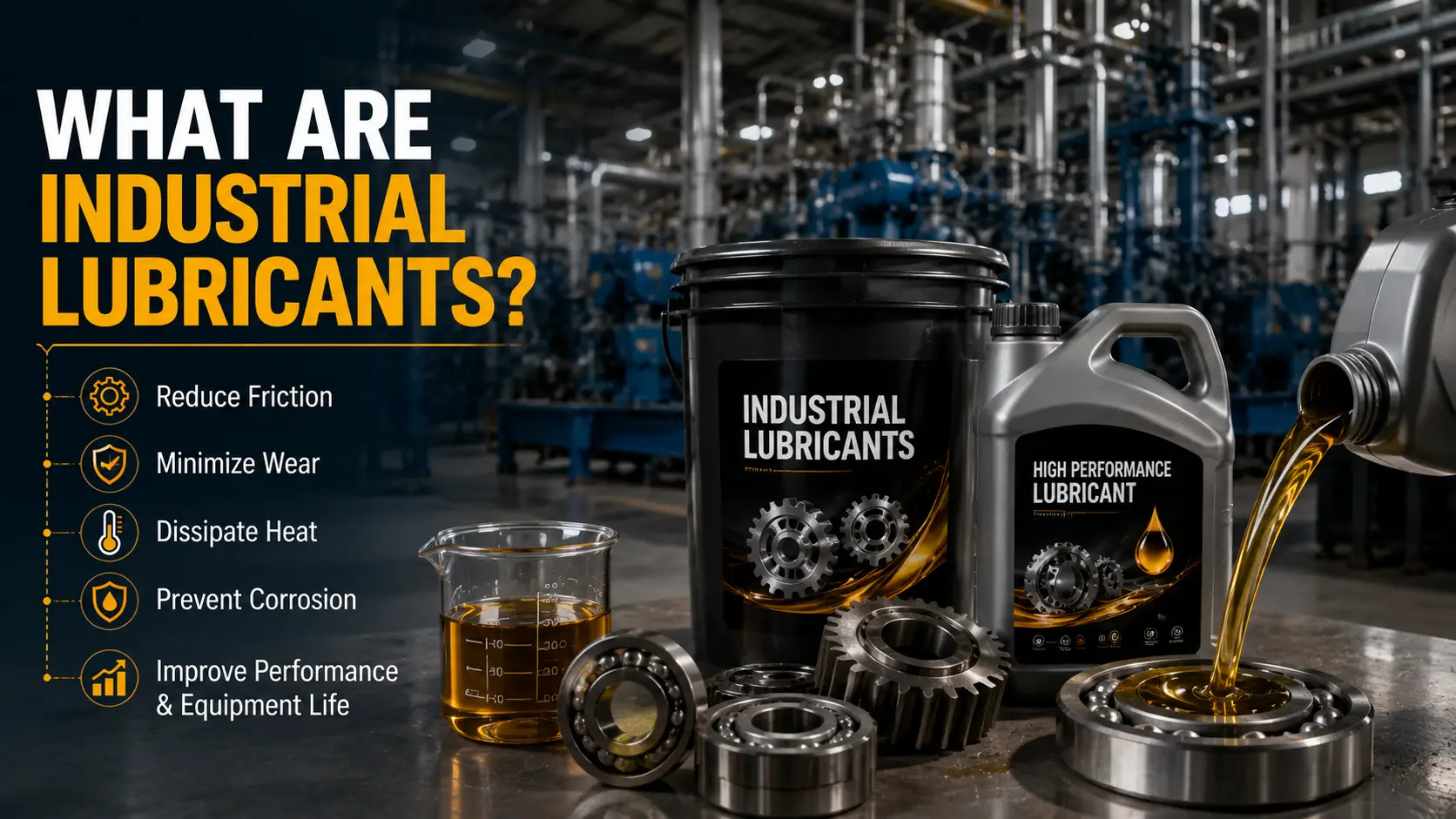
Industrial lubricants include specialized oils, greases and fluids used for lubricating industrial machinery and equipment to reduce friction, wear and corrosion and, therefore, improve the performance and lifespan of the machinery and equipment. Choosing an industrial lubricants supplier Thailand plants can rely on involves finding base oil chemistry, additives, and viscosity that matches the type of equipment and operating conditions in the various industrial plants throughout the country.
Why Industrial Lubrication Matters
The International Energy Agency also estimates that electric motors consume about 45% of the world's electricity; therefore, correct lubrication is one of the best maintenance practices to increase energy efficiency and prolong equipment life. Industrial lubricants in Thailand, in the hot and humid climate of Thailand, are required to be moisture-proof and viscosity stable over a broad temperature range as well.
Types of Industrial Lubricants
Choosing industrial lubricants for Thailand facilities begins by grasping the fundamental lubricant types utilized in industrial manufacturing and heavy industry:
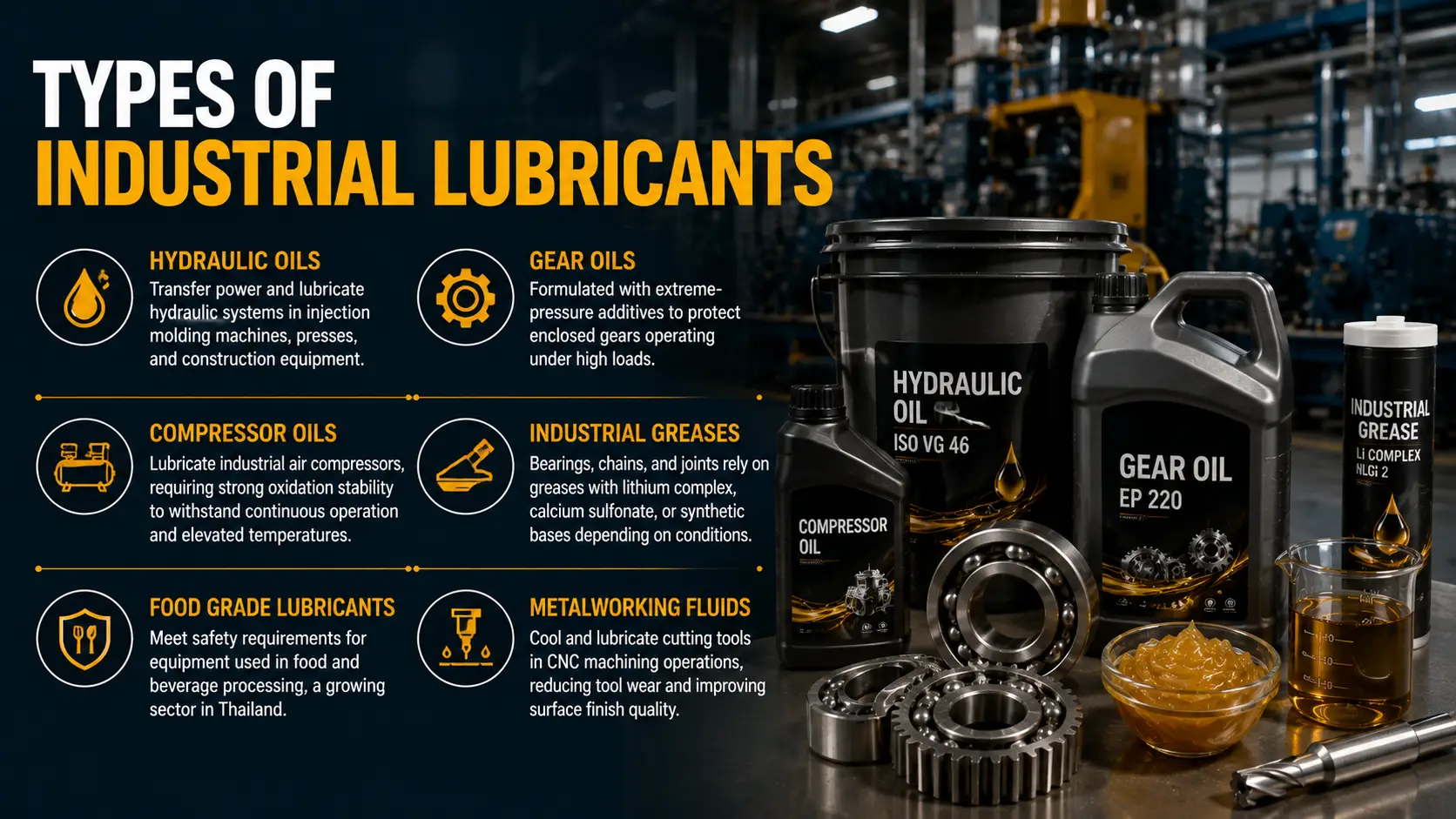
Hydraulic Oils
Classified according to ISO Viscosity Grade to fit certain hydraulic system requirements, hydraulic oil is used for power transmission and lubrication in injection molding machines, presses, and construction equipment.
Gear Oils
Gear oil contains extreme-pressure additives for use in enclosed gears in heavy-duty drives such as those in cement plants and industrial gearboxes.
Compressor Oils
Compressor oil is used for lubricating industrial air compressors, which need to be stable against oxidation to run under high operating temperatures and for long periods.
Industrial Greases
For loads, speeds and temperatures where liquid lubricants are not suitable, different types of greases are used, such as lithium complex, calcium sulfonate, or synthetic bases.
Food Grade Lubricants
In the context of food and beverage processing equipment, food grade lubricants are used to meet the safety requirements of the fast-growing industry in Thailand's manufacturing economy.
Metalworking Fluids
The CNC machining fluids provide cooling and lubrication for cutting tools, which can help to reduce the wear of the cutting tools and improve the surface quality of the materials.
Synthetic vs Mineral Lubricants
Synthetic lubricants often offer superior thermal stability and oxidation resistance, longer service life and better protection in severe operating conditions than do conventional mineral oils.
Factor | Synthetic Lubricants | Mineral Lubricants |
Thermal stability | Higher, suited to extreme temperatures | Lower, general-purpose use |
Oxidation resistance | Superior, longer service intervals | Moderate, shorter service intervals |
Initial cost | Higher upfront cost | Lower upfront cost |
Best suited for | High-temp, extended-interval applications | General equipment, moderate conditions |
Industries Using Industrial Lubricants in Thailand
Auto-manufacturing and assembly factories in the Eastern Economic Corridor
Food processing plants that need lubricants for the food environment.
This will be of particular interest to cement manufacturers such as those that use kilns or bearings.
The hydraulic systems used in injection molding and plastics manufacturing. Hydraulic systems in injection molding and plastics manufacturing.
Lubrication of electric power generation turbine and compressor.
Lubrication for steel manufacturing bearing and rolling equipment
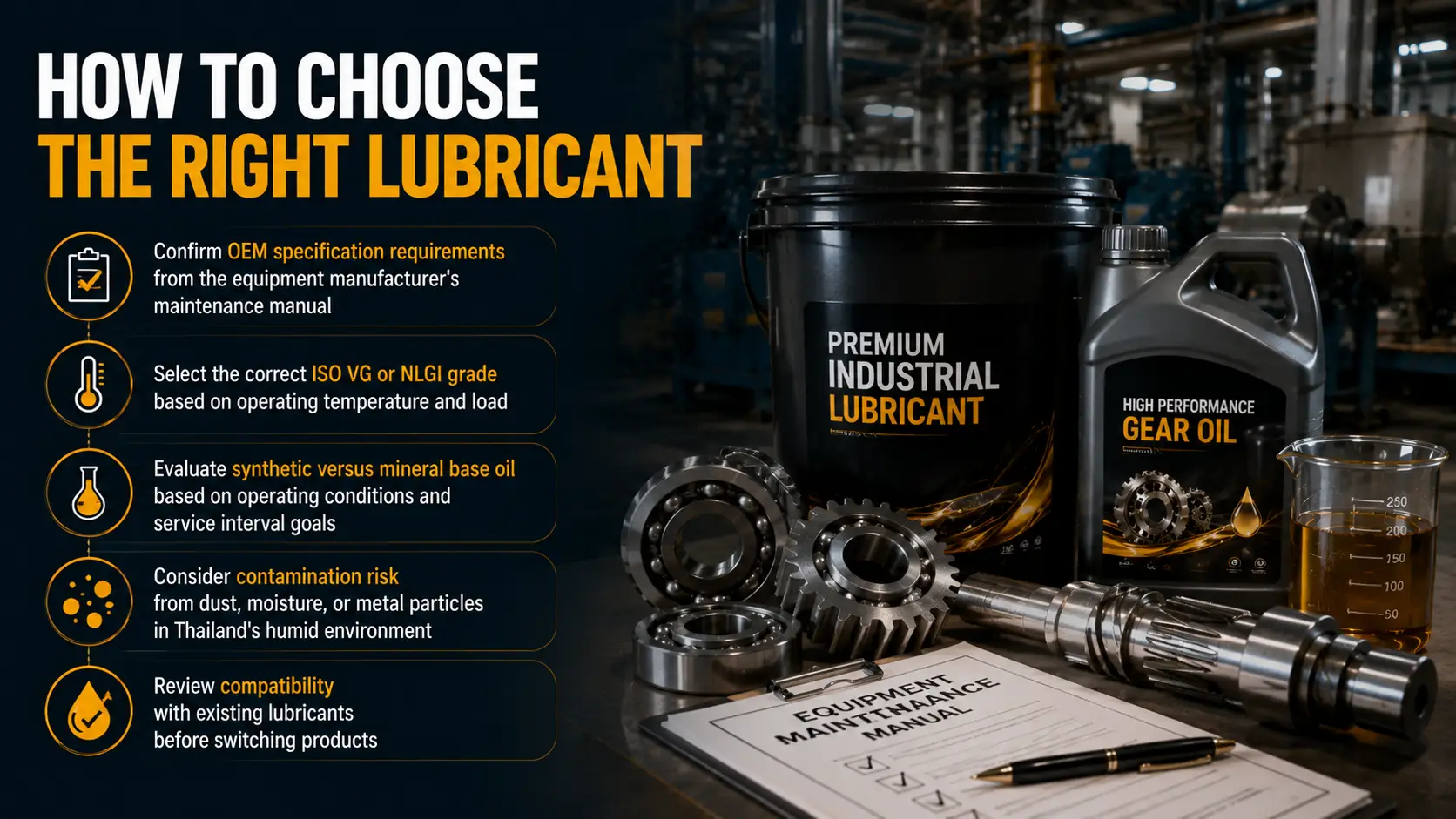
How to Choose the Right Lubricant
Ensure OEM specification requirements are confirmed from the equipment manufacturer's maintenance manual
Choose the appropriate ISO VG or NLGI grade for the operating temperature and load.
Compare synthetic oil versus mineral oil for operating conditions and desired service life.
In the humid climate of Thailand, think of the contamination that can occur from dust, moisture or metal particles.
Prior to changing lubricants, check for compatibility with the current lubricant.
ISO VG Viscosity Grades Explained
ISO VG (Viscosity Grade) is an internationally recognized classification system used to identify industrial lubricants by their viscosity at 40°C to enable the selection of an appropriate oil for a particular piece of equipment and operating temperature range. One of the most frequent reasons for early equipment failure is the wrong viscosity grade.
Lubrication Best Practices
The first step to extending the service life of industrial lubricants in Thailand plants is to maintain proper handling and storage practices:
Do not follow fixed lubrication intervals only; follow OEM-recommended intervals.
Keep lubricants in clean, controlled, dry conditions.
Do not use incompatible lubricants together without checking compatibility using technical data sheets
Rotate oil filters regularly to prevent oil contamination and the presence of wear metals in the system.
Common Lubrication Problems
Despite the fact that the quality industrial lubricants thailand plants buy, there can be still avoidable mistakes that leads to premature wear of the equipment:
Using incorrect viscosity grade for the operating temperature and load
Degrading lubricant additive performance, mixing incompatible lubricants
Failing to adhere to the manufacturer's instructions and using generics
Failure to store properly causing moisture contamination
Poor lubrication resulting in excessive wear of components
Industrial Lubricant Procurement Guide
When considering sourcing hydraulic oil thailand plants specify, or the matching gear oil supplier in Thailand partners for rotating equipment, the basic due diligence consistency includes verified technical data sheets, OEM approvals paperwork, and reliable delivery throughout thailand industrial areas. Lubrication programs are related to bearing performance, and our Bearings Article addresses both aspects of bearing selection and lubrication strategies. Handling of lubricant is also an issue of workplace safety — our Safety Pillar resource has information on PPE and handling of industrial fluids and chemicals.
Frequently Asked Questions
What are industrial lubricants?
Industrial lubricants are the fluids and semi-solids which are made with oils and greases and use to protect your machinery from corrosion and degradation, keeping your machinery clean, friction reduction, improving performance and prevent wear from parts and machinery.
Which lubricant is suitable for hydraulic systems?
Hydraulic oil of required ISO VG grade is fit for the hydraulic system according to operating temperature and pressures on the machines.
What is ISO VG?
ISO VG is a system used to classify industrial lubricants for viscosity at 40°C that is international.
How often should industrial lubricants be replaced?
Replacement intervals are based on operating conditions, OEM-recommended intervals, type of oil, and oil analysis results, and are not based on a fixed schedule.
Can synthetic lubricants improve equipment life?
Synthetic lubricant is normally much more resistant to high-temperature degradation and oil oxidation than mineral oil and typically offers extended service life.
Which industries require industrial lubricants?
Other industrial lubricants are found in the manufacture of vehicles, food processing, mining, cement, steel, petrochemicals, steel plants, oil and gas sector, power generation and the marine sector.
How should industrial lubricants be stored?
Lubricants should be stored in areas that are clean, dry, well-ventilated, temperature-controlled, and shielded from potential contamination sources.
Why is oil analysis important?
The analysis of oil is valuable because it reports lubricant degradation, oil oxidation, and the occurrence of wear particles before component failure can occurs.
Conclusion
When deciding to purchase industrial lubricants thailand, do not go for the cheapest one, nor the most familiar one. In fact, selecting the most proper viscosity grade, base oil and additive technology is very important. Whatever your industrial lubricants in Thailand –hydraulic oils, food-grade lubricants, metalworking fluid, gear oil- the most effective oil, along with proper storage and analysis of oil can result in lower friction and wear, and longer useful life for your equipment in Thailand for automotive and other industries like heavy industry and food processing.
Ask for consultation on selecting lubrication oil.
DISCLAIMER: Z&F Corporation is not affiliated with, authorized by, endorsed by, or acting as an official representative of any manufacturer, brand, or trademark owner referenced on this website. All product names, trademarks, brand names, logos, and manufacturer references are the property of their respective owners and are used solely for identification, reference, and compatibility purposes.