Industrial Lubricants for Cement and Mining Industries in the Middle East & Asia
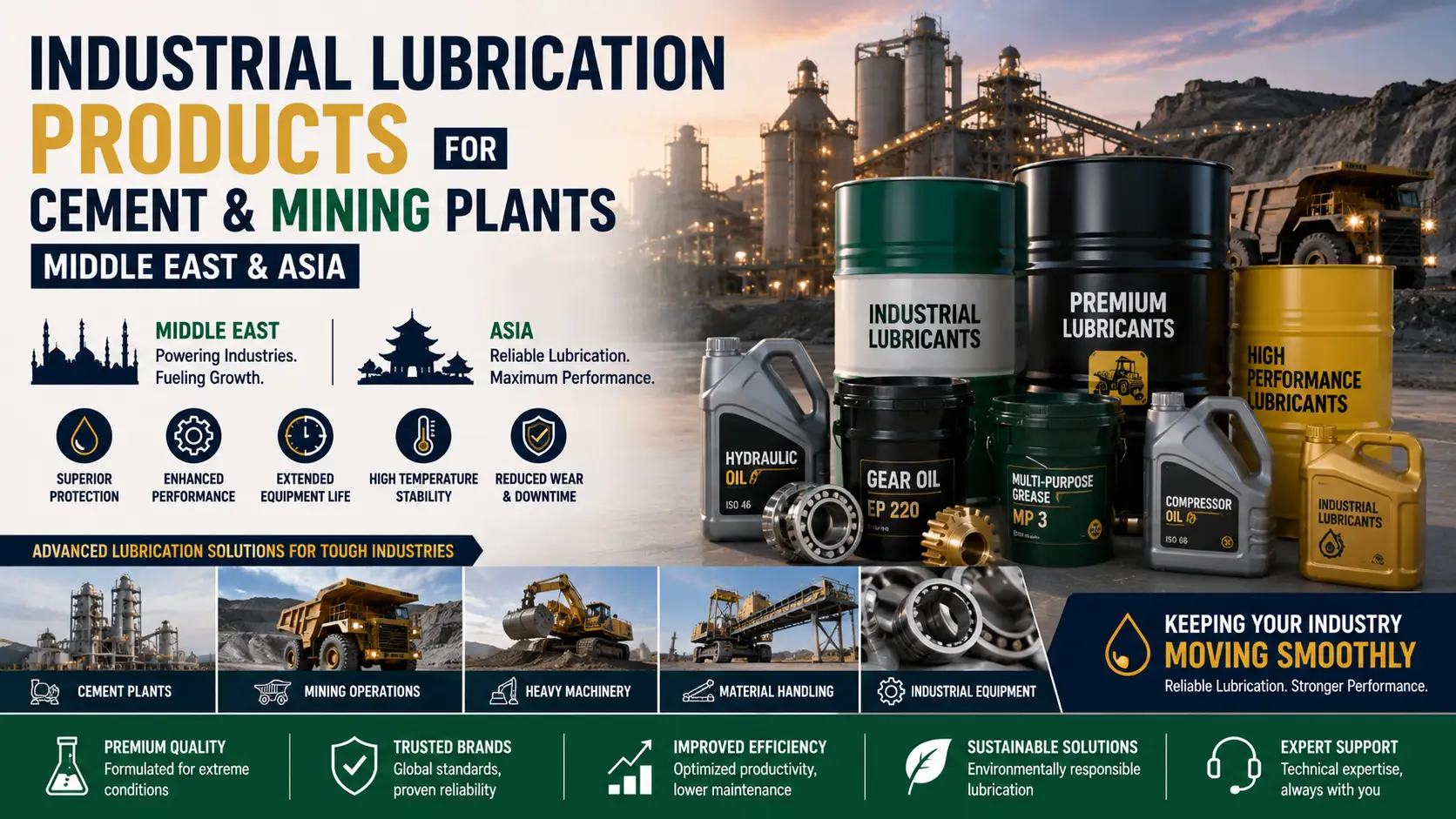
Cement mining Middle East Asia operators rely on the right specification of industrial lubricant to ensure safe operation of their cement kilns and open pit mines in extreme load, heat and dust. While choosing the best industrial lubricants for cement mining Middle East Asia equipment, it's important to consider viscosity grade, base oil type and OEM compatibility, not price. This guide includes information on lubricants, standards, applications, selection and supplier evaluation on objective and specification based criteria.
Looking for the price of industrial lubricants for your plant or fleet?
What Are Industrial Lubricants?
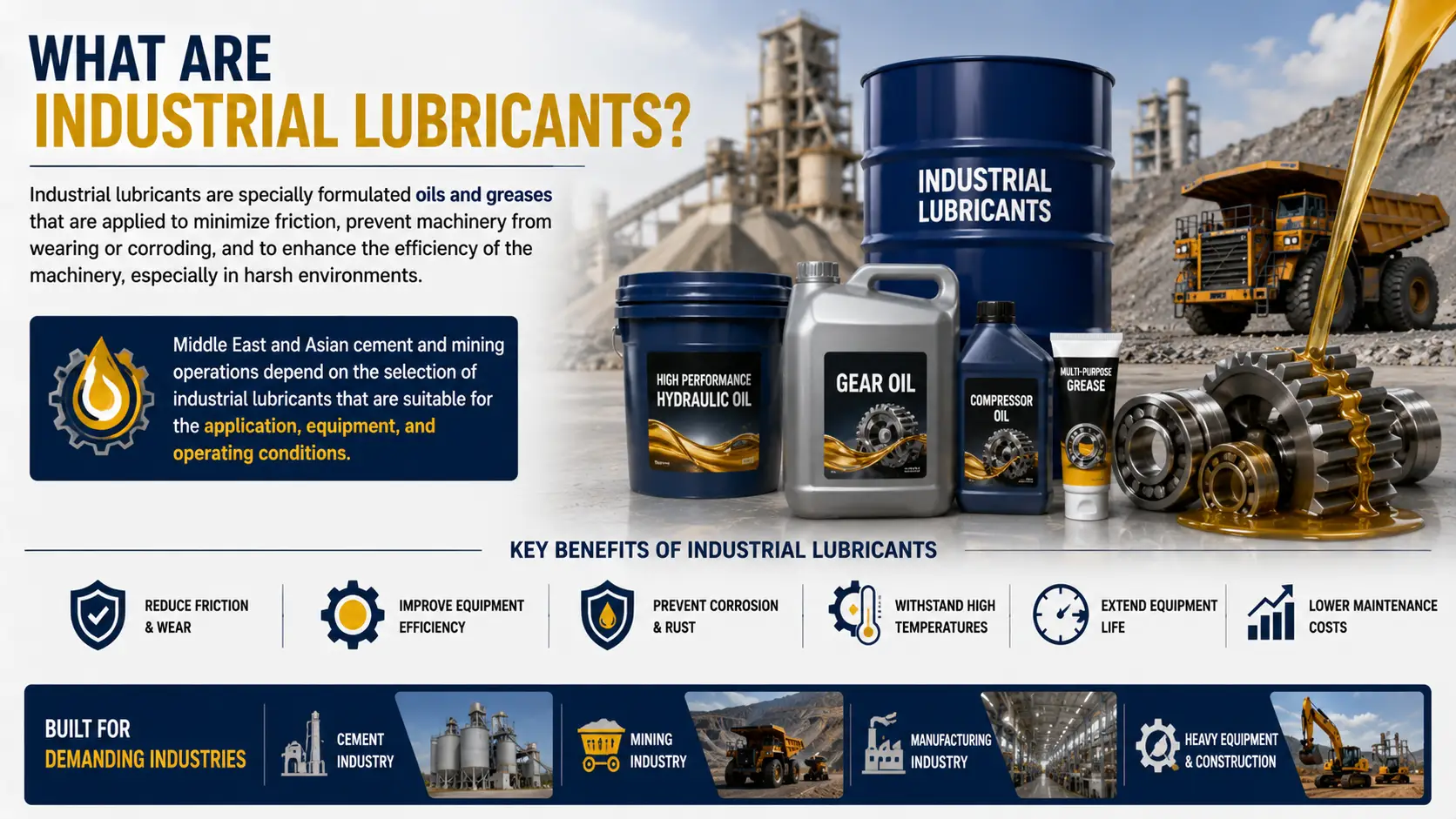
Industrial lubricants are specially formulated oils and greases that are applied to minimize friction, prevent machinery from wearing or corroding, and to enhance the efficiency of the machinery, especially in harsh environments. Middle East and Asian cement and mining operations depend on the selection of industrial lubricants that are suitable for the application, equipment, and operating conditions.
Why Proper Lubrication Matters in Cement and Mining Operations
In the cement production process, the system of continuous operation is exposed to extreme loads, high temperatures and heavy dust. The cement production process is a continuous operation system, which is continuously exposed to extreme loads, high temperatures and heavy dust. Reliability engineers in the industrial sector in the Middle East and Asia choose reliability-grade industrial lubricants based on OEM specifications and international standards—and not just for convenience or cost.
Types of Industrial Lubricants Used in Heavy Industry
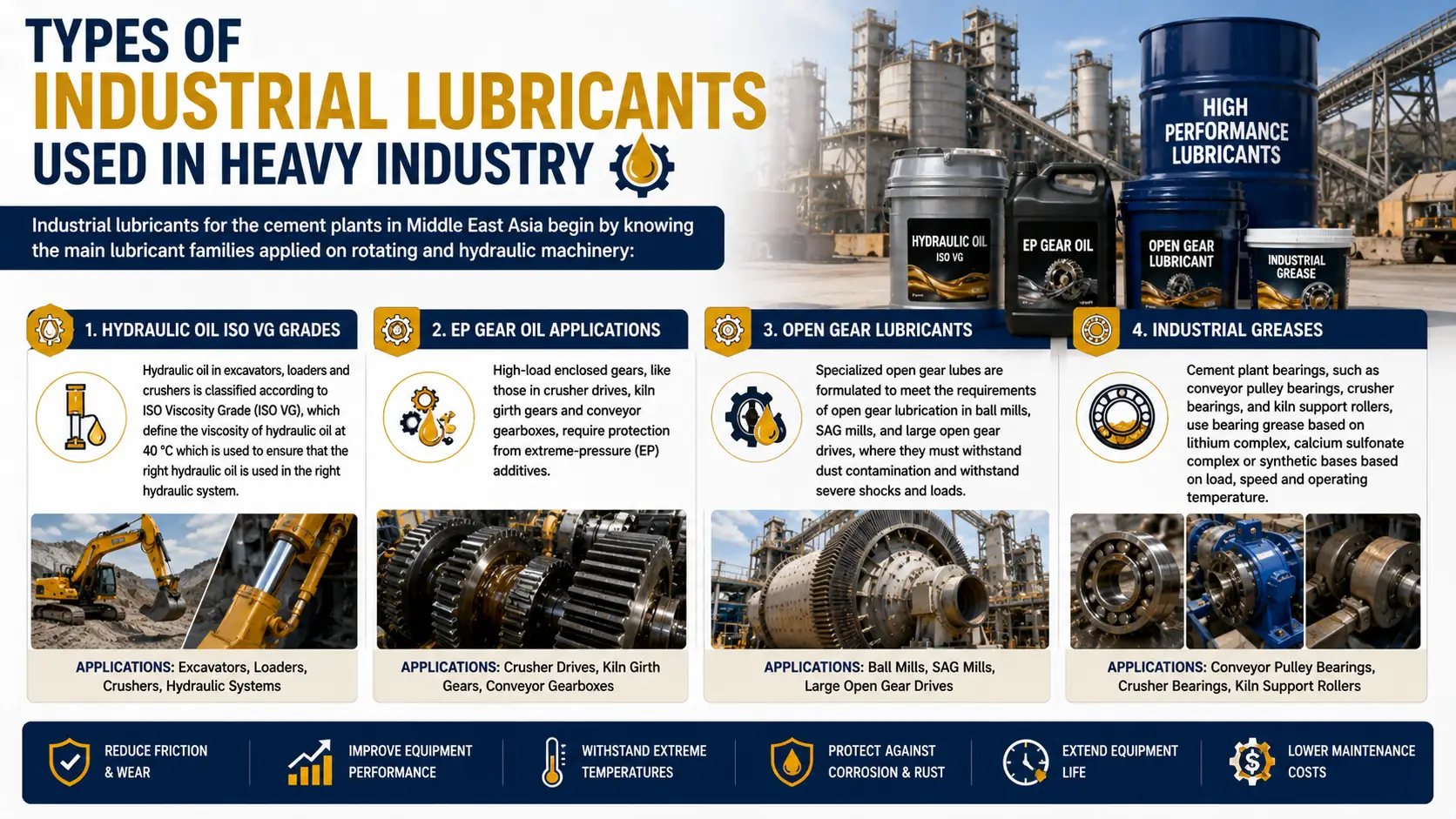
Industrial lubricants for the cement plants in Middle East Asia begin by knowing the main lubricant families applied on rotating and hydraulic machinery:
Hydraulic Oil ISO VG Grades
Hydraulic oil in excavators, loaders and crushers is classified according to ISO Viscosity Grade (ISO VG), which define the viscosity of hydraulic oil at 40 C which is used to ensure that the right hydraulic oil is used in the right hydraulic system.
EP Gear Oil Applications
High-load enclosed gears, like those in crusher drives, kiln girth gears and conveyor gearboxes, require protection from extreme-pressure (EP) additives.
Open Gear Lubricants
Specialized open gear lubes are formulated to meet the requirements of open gear lubrication in ball mills, SAG mills, and large open gear drives, where they must withstand dust contamination and withstand severe shocks and loads.
Industrial Greases
Cement plant bearings, such as conveyor pulley bearings, crusher bearings, and kiln support rollers, use bearing grease based on lithium complex, calcium sulfonate complex or synthetic bases based on load, speed and operating temperature.
Synthetic vs Mineral Industrial Lubricants
When comparing synthetic industrial lubricants to a traditional mineral oil, buyers should consider performance and costs. In the cement plant, particularly in rotary kilns, synthetic lubricants are suitable because of their excellent thermal stability, oxidation resistance, long service life and superior ability to protect against wear under high loads and high temperatures.
Factor | Synthetic Lubricants | Mineral Lubricants |
Thermal stability | Higher, suited to extreme temperatures | Lower, general-purpose use |
Oxidation resistance | Superior, longer service intervals | Moderate, shorter service intervals |
Initial cost | Higher upfront cost | Lower upfront cost |
Best suited for | Rotary kilns, high-temp bearings, extended intervals | General equipment, moderate conditions |
Lubricants for Cement Plant Equipment
High temperature synthetic lubricants for rotary kiln bearings and support rollers.
The gear oils to be used in the clinker cooler drives and the crusher gearboxes are EP gear oils.
Avoid using oil for any ball mill or raw mill drive that is provided with open gear.
Compressed air in cement plant is the most essential requirement. The compressor oil for compressed air in cement plant is an excellent air purifying medium.
Lithium complex grease for mechanical bearings such as conveyor pulley bearings, idler bearings
Lubrication Solutions for Mining Equipment
Heavier, more potent hydraulic fluids for excavators and hydraulic shovels. More powerful hydraulic fluids for excavators and hydraulic shovels.
Open gear lubricants for SAG and ball mills
Mining haul truck lubrication systems that automatically lubricate the truck.
Synthetic greases for crusher and screening equipment bearings
Conveyors lubrication system in large scale quarry operation
How to Select the Right Industrial Lubricant
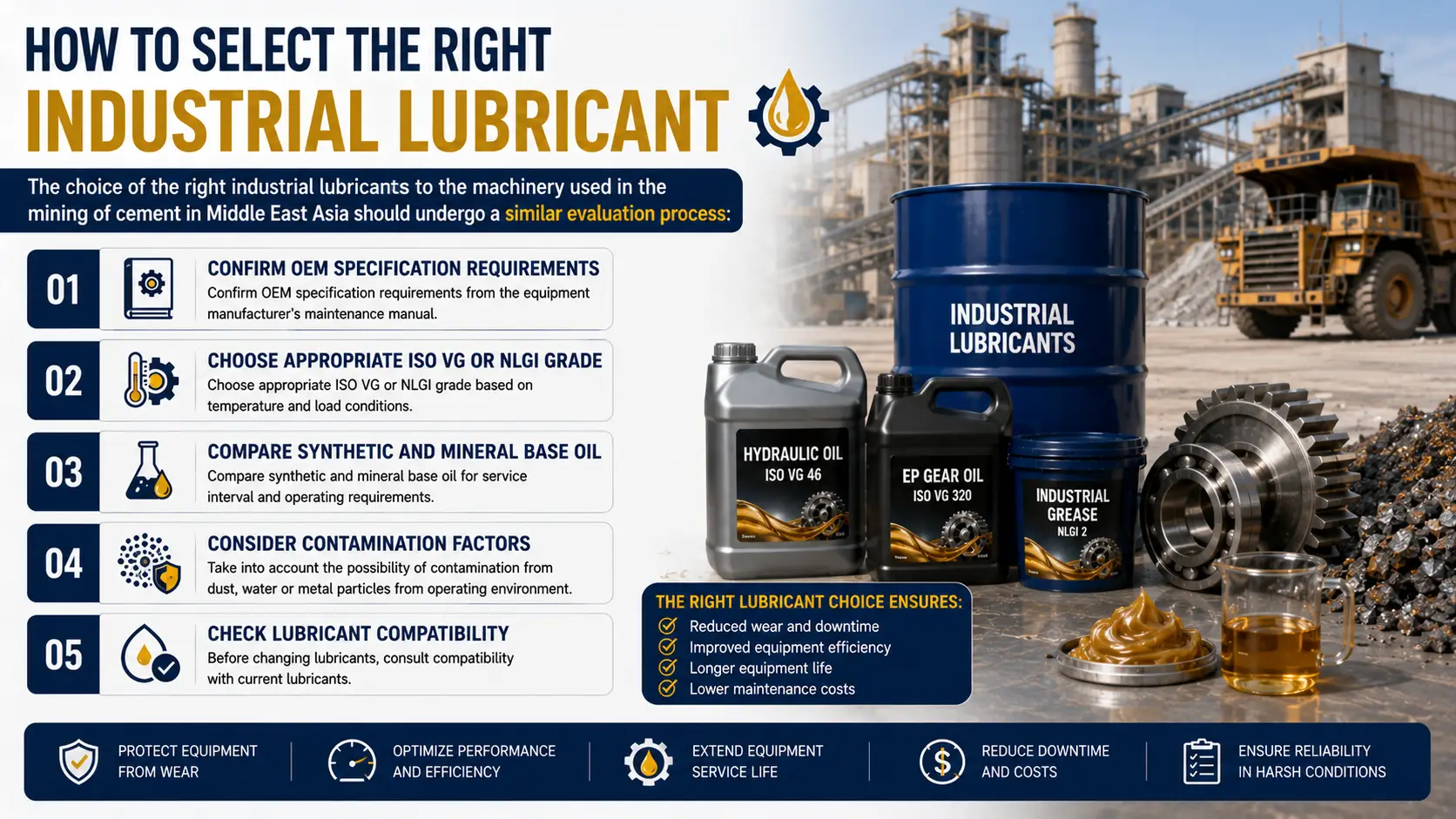
The choice of the right industrial lubricants to the machinery used in the mining of cement in Middle East Asia should undergo a similar evaluation process:
Confirm OEM specification requirements from the equipment manufacturer's maintenance manual
Choose appropriate ISO VG or NLGI grade based on temperature and load conditions
Compare synthetic and mineral base oil for service interval and operating requirements
Take into account the possibility of contamination from dust, water or metal particles from operating environment.
Before changing lubricants, consult compatibility with current lubricants.
Industrial Lubricant Standards and Specifications
There are recognized frameworks in existence that regulate lubricant classification, testing and compliance from OEMs in cement and mining applications:
Standard / Organization | Relevance |
ISO VG | Viscosity classification for industrial oils at 40°C |
NLGI | Consistency grading system for industrial greases |
ASTM International | Testing methods for lubricant performance properties |
API | Base oil and additive classification standards |
OEM specifications | Manufacturer-specific approval requirements (Caterpillar, Komatsu, FLSmidth, etc.) |
Oil Analysis and Predictive Maintenance
Correct initial selection is not enough to maintain industrial lubricants cement mining Middle East Asia plants. Oil analysis can detect contaminants, wear metals, oxidation and lubricant degradation, enabling predictive maintenance and reducing unscheduled downtime:
Take samples of oil regularly from the main hydraulic systems and gearboxes.
Monitor the presence and rate of wear metals to help detect potential component problems in the early stages.
Extend oil drain intervals as per analysis results provided appropriate conditions
Record and document the history of the analysis to assist warranty and reliability programs.
Lubricant Storage and Handling Best Practices
Store lubricants in clean, dust-free, well ventilated, temperature-controlled locations
Clearly mark containers to avoid cross-contamination of lubricants
Use separate transfer equipment for different grades of lubricants
Turn inventory to ensure that products are not stored for extended periods beyond the manufacturer's recommended shelf life.
Procurement Considerations
When it comes time to find an industrial gear oil supplier and grease partners in the Middle East and Asia, catalog pricing is not the only thing you should consider. It is crucial that buyers confirm the OEM approval paperwork, batch traceability and technical support details. Lubrication programs are closely coupled to the performance of bearings, therefore our Bearings Pillar includes information on the selection of the correct bearing for application, in addition to compatible lubrication programs; and our Cement Industry Page provides information on application specific solutions for the kilns, mills and conveyors. For more information on all categories and standards of lubricants, consult our Lubrication Pillar resource.
Frequently Asked Questions
What kind of lubricants are used in cement plants?
Typical hydraulic oils. Gear oils. Compressor oils. Turbine oils. Circulating oils. Open gear lubricants. High temperature greases. Cement Plants.
What is the best lubricant for mining equipment?
Depending on equipment and OEM specifications, it can be either heavy duty hydraulic oils, EP gear oils, or either of the synthetic greases or open gear lubricants.
What is ISO VG in industrial lubricants?
International Standard ISO VG (Viscosity Grade) is a standard system which categorizes lubricants for industry based on the viscosity of the oil at 40°C, enabling users to choose the right oil for the right piece of equipment.
How often should industrial oil be changed?
Maintenance should be determined by the type of machine, operating conditions, level of contamination, manufacturer’s recommendations and oil analysis results, not a schedule.
What is the difference between synthetic and mineral lubricants?
Synthetic lubricants are more thermally stable, more resistant to oxidation and will last longer than mineral lubricants but mineral lubricants are more economical for general purposes.
Which grease is suitable for high-temperature applications?
Typically, one of the following compounds is used: lithium complex, calcium sulfonate complex and synthetic high temperature greases, which are chosen based on the load, speed, and temperature of the bearings.
Why is oil analysis important?
Oil analysis is an effective method of identifying contamination, wear metals and oxidation to help avoid unexpected equipment failures and for predictive maintenance.
Can one lubricant be used for all industrial equipment?
No, each machine requires a specific formulation of lubricant, depending on the operating conditions, material, speed, temperatures and manufacturer requirements.
Request Industrial Lubricant Sourcing Assistance
Looking for industrial lubricants that can withstand the operations of kilns, mills, excavators or haul truck for cement making in Middle East Asia? We act as a completely independent industrial sourcing partner that assists you in choosing lubricants that comply with the OEM's specifications and are available from various manufacturers that are suitable to your current equipment, operating conditions, and maintenance goal. Check out our Lubrication Pillar, Bearings Pillar and Cement Industry Page for related procurement resources.
Let experienced help you with the selection of lubricant for your equipment.
DISCLAIMER: Z&F Corporation is not affiliated with, authorized by, endorsed by, or acting as an official representative of any manufacturer, brand, or trademark owner referenced on this website. All product names, trademarks, brand names, logos, and manufacturer references are the property of their respective owners and are used solely for identification, reference, and compatibility purposes.