Industrial Safety Equipment Supplier in the Middle East: Complete PPE Buying Guide
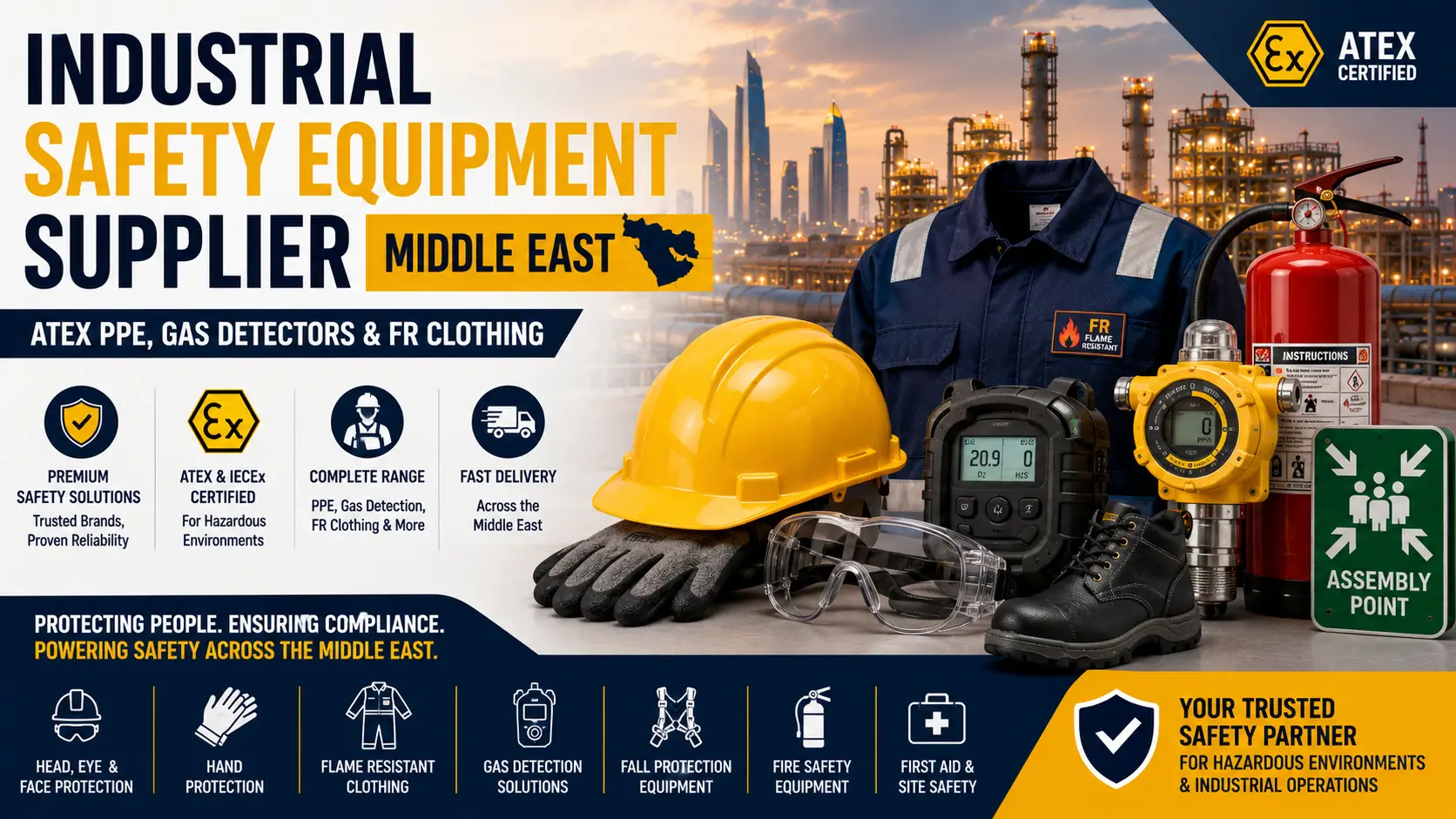
Throughout the GCC, oil and gas fields, construction sites and manufacturing plants rely on certified protective equipment to safeguard their employees and ensure adherence to regulations. A certified supplier of safety equipment in the Middle East businesses can count on has a wide variety of PPE, including for head protection, respiratory equipment, fall protection, and fire safety products all in one procurement experience. Working with trusted safety equipment suppliers in the Middle East helps HSE managers to minimize compliance risk, ensure uniform PPE on all sites and receive technical guidance on product selection.
Request a Quote — Send a request to a contractor for a custom quote for certified industrial safety equipment and PPE solutions.
This guide explains the types of PPE, international certification and a practical checklist for procurement and HSE teams to help them assess industrial safety equipment that can be relied upon by the industry in the Middle East for everyday use and for specific projects.
What Is an Industrial Safety Equipment Supplier?
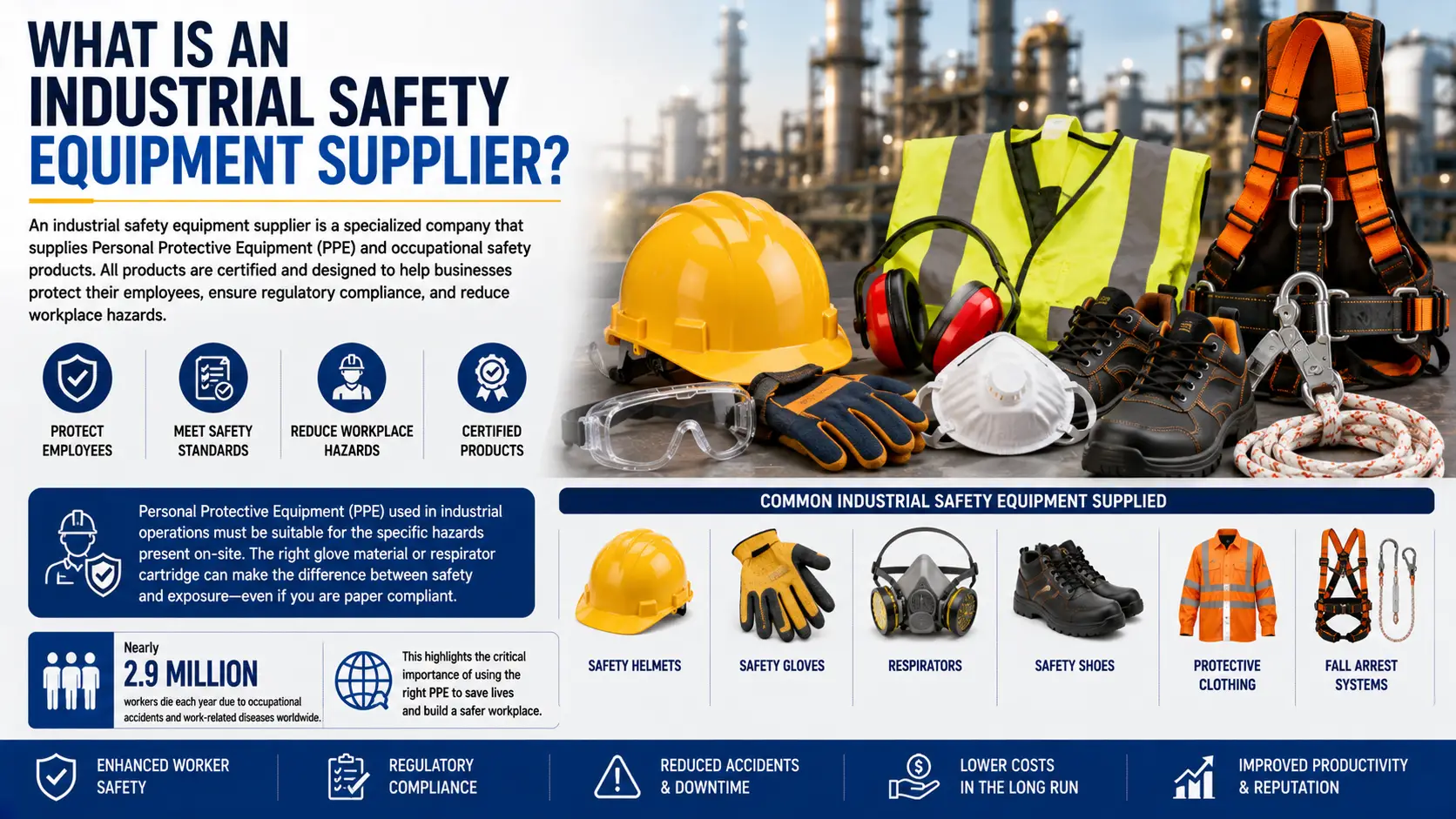
A specific company distributes personal protective equipment (PPE) and occupational safety items All products are certified They are used to help companies protect their employees, meet safety standards and significantly reduce workplace hazards These include, in particular, helmets, gloves, respirators, safety shoes, protective clothing and fall arrest systems
Personal Protective Equipment (PPE) that's provided for industrial operations has to be suitable for the specific hazard found on site: the right glove material or the right respirator cartridge can leave workers exposed on the job, even though they are paper compliant. In the world almost 2.9 million workers per year die as a result of occupational accidents and work-related diseases, showing the importance of using the right personal protective equipment (PPE).
Why Workplace Safety Matters Across the Middle East
There are four key considerations when choosing a reliable PPE supplier UAE businesses or any other GCC-based operation works with: certification compliance, product range, technical support, and logistics. If a supplier only offers a specific product range, it is likely that procurement teams will need to have to deal with several vendors in Dubai, Abu Dhabi, Riyadh and Doha, which will lead to complexity and high costs.
A comparison of the major safety standards referenced in industries throughout the Middle East is provided in the table below.
Standard | Region of Use | Focus Area | Typical Application |
EN Standards | Europe & Middle East | Product design & testing | Helmets, gloves, footwear, eyewear |
ANSI Standards | North America (referenced globally) | Performance & impact ratings | Eye, head, and fall protection |
OSHA Compliance | US-based, widely referenced by EPCs | Workplace safety regulation | General industry & construction |
GSO Standards | GCC member states | Regional product conformity | PPE imported into GCC markets |
Complete Range of Industrial PPE From a Safety Equipment Supplier in the Middle East
PPE suppliers carry standard items such as helmets, face shields, earplugs or earmuffs, gloves and safety shoes for comprehensive head-to-toe protection In addition, they offer specialized PPE tailored to specific risks in industries such as oil and gas, construction and manufacturing industries In the Gulf Middle East
GCC region fire protection equipment such as fire extinguishers, emergency showers, Eye showers and leak arrester kits is required. Compliance with NFPA guidelines and local fire safety regulations is also required.
Harnesses, lanyards, anchors and lifelines are a vital component of fall protection equipment, which can impact the safety of workers working in heights, during construction and maintenance activities in particular, where product selection and inspection is dependent on the requirements of the manufacturer and the EN standard.
Industry Applications
Where there are workplace hazards, industrial PPE will be used. Typical sectors include:
Offshore and onshore oil & gas facilities that need flame-resistant clothing.
Construction sites where fall protection and head protection is required
Chemical plants with confined space and gas detection systems
Manufacturing facilities (where such protection is required)
Workers at work in areas with high visibility needs
Utility maintenance personnel from all over Saudi Arabia, Qatar, Oman, Bahrain, and Kuwait.
International Safety Standards
EN standards are used throughout the European Union and Middle East to specify product design and test requirements for helmets, gloves, footwear and eyewear and are referenced extensively in North America in project specifications; ANSI standards are used more in North America than elsewhere and are regularly referenced in project specifications in Europe. OSHA guidance is widely used by EPC contractors in the region and the GCC Standardization Organization (GSO) sets conformity standards for the region as they pertain to PPE products entering the GCC markets.
How to Choose the Right Safety Equipment Supplier
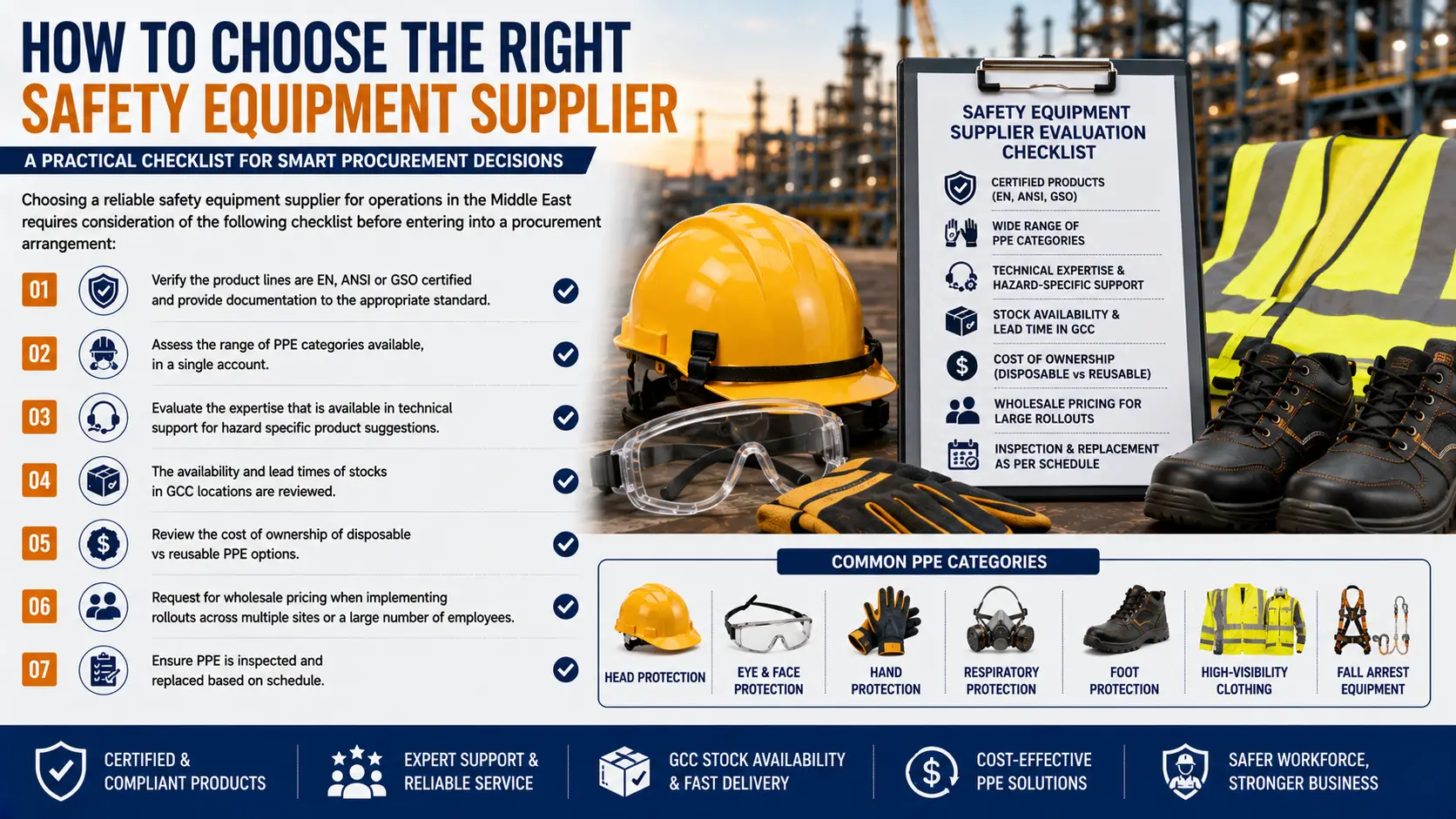
Choosing a reliable safety equipment supplier for operations in the Middle East requires consideration of a brief checklist for evaluation before entering in a procurement arrangement:
Verify the product lines are EN, ANSI or GSO certified and provide documentation to the appropriate standard.
Assess the range of PPE categories available, in a single account.
Evaluate the expertise that is available in technical support for hazard specific product suggestions.
The availability and lead times of stocks in GCC locations are reviewed.
Review the cost of ownership of disposable vs reusable PPE options.
Request for wholesale pricing when implementing rollouts across multiple sites or a large number of employees.
Ensure PPE is inspected and replaced based on schedule.
Fire Safety and Gas Detection Equipment
When procurement teams are looking for industrial safety products projects in the Middle East, they need to look for gas detectors in addition to the normal PPE working in confined spaces and petrochemical work represents a major hazard when it comes to gas exposure. Gas detectors help to detect hazardous gases prior to worker exposure, preventing potential explosions, poisoning, and oxygen deficiency, and should be chosen depending on the gases found at each site.
A typical workplace safety program covers most of the equipment mentioned in this Gas Detection article, so it is recommended that buyers review a larger article on Safety, as well as the Oil & Gas industry page and the page dedicated to Safety.
Frequently Asked Questions
what does a safety equipment supplier do?
A safety equipment supplier offers certified PPE and workplace safety products for organizations to help ensure the safety of their employees and adherence to occupational safety regulations.
Which industries need PPE?
Industrial PPE is used in a variety of industries including oil and Gas, construction, manufacturing, petrochemical, logistics, public works, mining, shipping, pharmaceuticals, aerospace and food processing
What certifications should PPE have?
Typical certifications include ISO, NFPA, application-specific and international standards, and ANI and EN compliance.
What is the difference between EN and ANSI standards?
Mostly used in European countries and the Middle East, EN standards are also used on international projects, and ANSI standards are mostly used in North America.
Is it possible for one supplier to offer 100% work place safety?
For facilities that require comprehensive coverage, many industrial suppliers provide integrated PPE, fire safety, gas detection and safety management products that ease the process of procurement.
Conclusion
The first step to protecting a workforce is to work with a supplier who can provide helmets, gloves, respiratory protection, fall protection and fire safety in one package. Whatever the need may be, whether it's regular orders from safety gear supplier Saudi Arabia or a one-off sourcing project, having an experienced safety equipment supplier Middle East companies can help minimize compliance risks and budget uncertainty when it comes to procurement. One of the easiest ways to safeguard workers for the long haul is by sourcing from a safety equipment supplier in the Middle East that has the technical capability.
Discuss with our Specialists – Complete the workplace PPE selection and compliance checklist and consult with a safety procurement specialist about your needs.
DISCLAIMER: Z&F Corporation is not affiliated with, authorized by, endorsed by, or acting as an official representative of any manufacturer, brand, or trademark owner referenced on this website. All product names, trademarks, brand names, logos, and manufacturer references are the property of their respective owners and are used solely for identification, reference, and compatibility purposes.