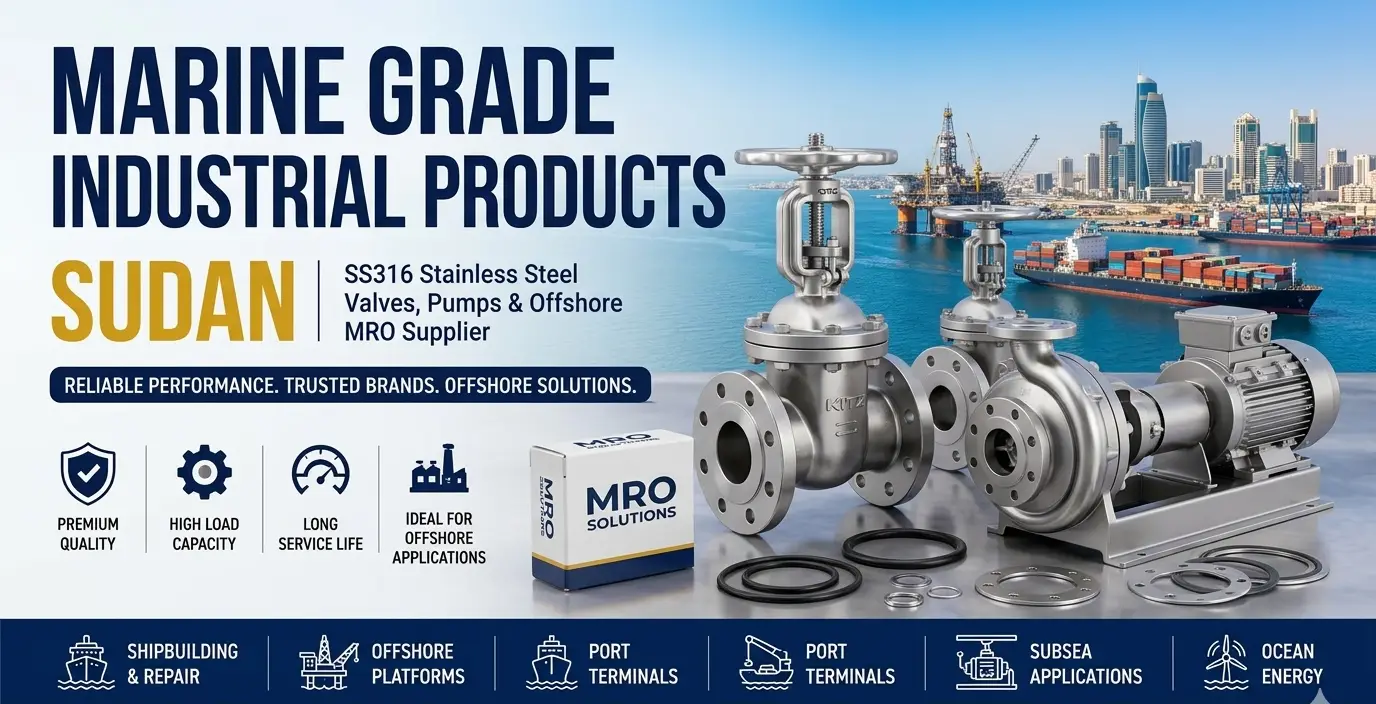
Marine Grade Industrial Products Sudan: Complete Guide for Ports, Offshore & Coastal Industries
Sudan operators rely on marine-grade industrial products correctly specified to deliver the continuous protection required from saltwater and the rigor of coastal operations, all of which impact Port Sudan's cargo terminals, offshore facilities in the Red Sea, and coastal desalination plants. When replacing corroded valves on a port pipeline or buying marine-grade seawater pumps for a ship repair yard, it's not just the price that matters, but the material, certification and lifecycle cost of marine-grade industrial products Sudan projects require. This guide deals with materials that are suitable for use in marine applications, as well as various types of valves used in marine pumps, marine standards and applications, and methods for assessing suppliers based on their objective specifications.
Looking for marine-grade industrial products cost estimates for a project?
What Are Marine Grade Industrial Products?
A marine-grade industrial product is an industrial product that's made using corrosion-resistant materials and is used in marine, offshore, coastal, and seawater environments over a long time. When choosing marine industrial supplies to meet Sudan projects' needs, the material composition, coating and certification must be identical to the environment and pressures of the sea along the Red Sea coast.
Why Marine Grade Equipment Matters in Sudan
UNCTAD's Review of Maritime Transport shows that around 80-90% of the world's merchandise trade by volume is carried by sea, highlighting the need for long-lasting marine infrastructure and industrial equipment. Marine-grade industrial products in Sudan are subject to a continuous environment of extreme temperatures, humidity, and salt spray along the country's Red Sea coast that would rapidly degrade standard carbon steel components.
Industries That Use Marine-Grade Industrial Products
Port Sudan port operations and port infrastructure for cargo
Offshore loading terminals and facilities for oil and gas.
Areas along the Red Sea coast for ship repair facilities
Offshore seawater desalination plants that are not suitable for using seawater due to harsh environmental conditions
Handling and firewater systems for marine fuels
Sea Water Cooled Power Generation Plants
Types of Marine Industrial Products
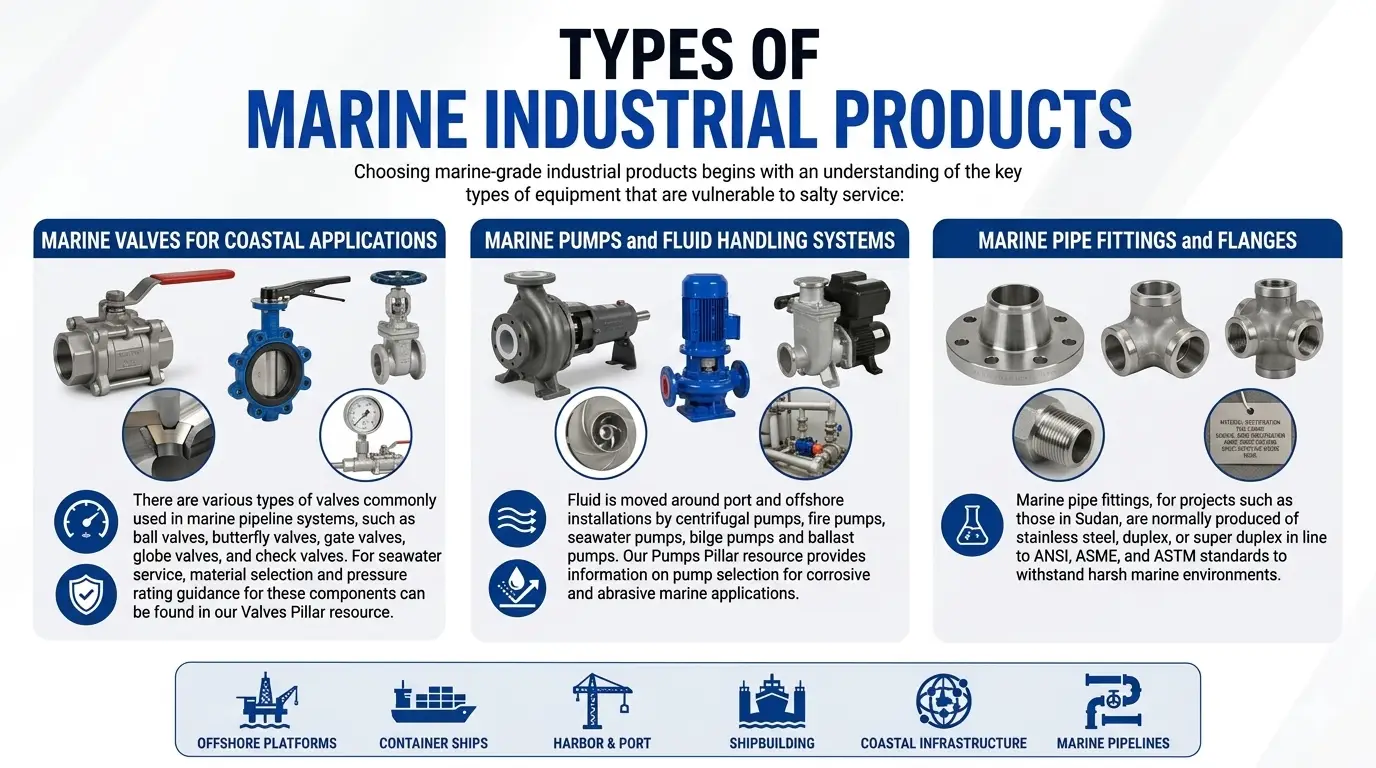
Choosing marine-grade industrial products begins with an understanding of the key types of equipment that are vulnerable to salty service:
Marine Valves for Coastal Applications
There are various types of valves commonly used in marine pipeline systems, such as ball valves, butterfly valves, gate valves, globe valves, and check valves. For seawater service, material selection and pressure rating guidance for these components can be found in our Valves Pillar resource.
Marine Pumps and Fluid Handling Systems
Fluid is moved around port and offshore installations by centrifugal pumps, fire pumps, seawater pumps, bilge pumps and ballast pumps. Our Pumps Pillar resource provides information on pump selection for corrosive and abrasive marine applications.
Marine Pipe Fittings and Flanges
marine pipe fittings Sudan projects are normally produced of stainless steel, duplex or super duplex in line to ANSI, ASME and ASTM standards to withstand harsh marine environments.
Materials Used in Marine Equipment
The key to long-lasting marine equipment is the material:
Material | Corrosion Resistance | Best Suited For |
316/316L Stainless Steel | Good general seawater resistance | Moderate exposure, general marine components |
Duplex Stainless Steel | Higher resistance, greater strength | Aggressive seawater, high-pressure applications |
Super Duplex Stainless Steel | Excellent resistance to pitting and crevice corrosion | Extreme marine environments, offshore service |
Bronze / Monel / Nickel Alloys | Specialized corrosion resistance | Specific marine hardware and fittings |
International Standards and Certifications
Purchasing people considering marine equipment suppliers Sudan should verify the compliance with acknowledged frameworks. Valves and pressure equipment are designed to meet API and ASME standards, materials are specified by ASTM, and IMO standards and DNV / Lloyd's Register classification requirements are reassuring for suitability in marine service.
Standard / Organization | Relevance |
API | Valve, pump, and pressure equipment design standards |
ASME | Mechanical equipment and pressure vessel design standards |
ASTM International | Material composition and testing specifications |
ISO 9001 / 14001 | Quality and environmental management certification |
IMO / DNV / Lloyd's Register | Marine regulatory and classification society requirements |
How to Choose the Right Marine Industrial Products
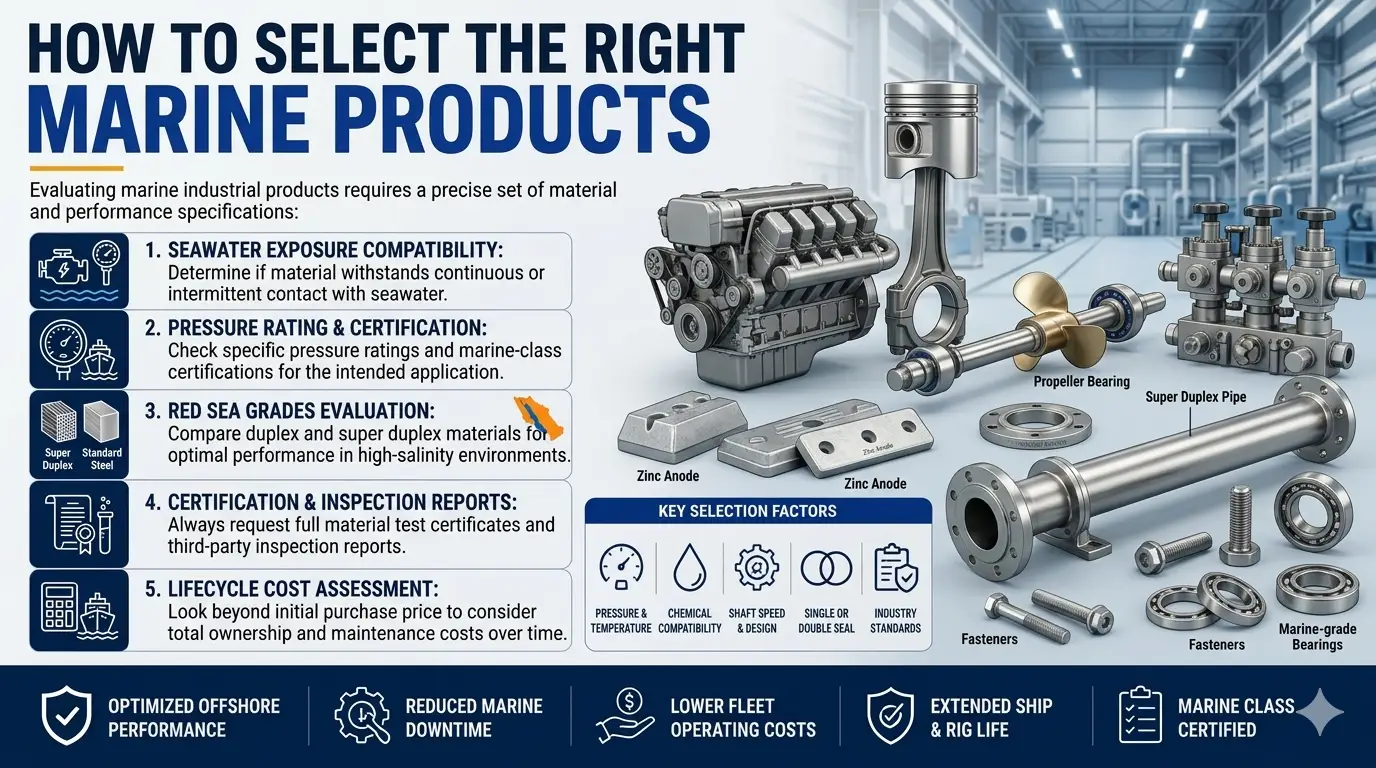
The evaluation process for choosing marine-grade industrial products projects is the same:
Determine if the material will be compatible with continuous or intermittent exposure to seawater
Check pressure rating and certification for the application
Compare duplex or super duplex grades in the Red Sea environment.
Ask for material test certificates and third-party inspection reports
Think beyond the product cost when considering the lifecycle costs.
Common Marine Equipment Maintenance Practices
To extend the service life of marine-grade industrial products that Sudan facilities install, consistent maintenance discipline is required:
Perform regular inspection for pitting and crevice corrosion and/or coating failure.
Install cathodic protection systems for submerged parts, as needed
Ensure the right lubrication for pumps and valves in humid and salty environments.
Record review history for record of lifecycle planning and warranty claims
Marine Procurement Checklist
Check material certificates and corrosion resistance grade
Obtain API, ASME, ASTM or IMO certification (where applicable)
Check pressure ratings to the system design conditions
Ask to see the third party inspection records prior to shipment.
Verify logistics and lead time for supply to Port Sudan
Procurement Considerations
Corrosion resistant industrial products sourced by Sudan facilities cannot be done by relying on catalog pricing. Buyers should confirm material certification, inspection report and reliable logistics of the delivery through the Red Sea coast. An independent sourcing partner can find technically appropriate marine-grade valves, pumps and fittings from several different manufacturing sources, that are compatible with your corrosion and pressure needs.
Frequently Asked Questions
What makes a product marine grade?
The units are constructed from materials designed to resist corrosion in salty conditions – or simply sea/ocean use – humidity as well as extreme marine or coastal situations commonly known as marine-grade products.
Which stainless steel is best for seawater?
Grade 316 is relatively resistant to medium levels of exposure, but for more severe seawater environments, duplex or super duplex stainless steel are generally recommended.
What certifications are required for marine equipment?
Depending on the use or purpose of the pump, the typical standard is API, ASME, ASTM, ISO, IMO, DNV, Lloyd’s Register or IACS.
What pumps are used in marine industries?
Some typical types of this sort of product, or pumps, include: fire pumps, seawater pumps, bilge pumps and ballast pumps as well as positive displacement pumps.
How do marine valves differ from standard valves?
Marine valves are built to specifications to handle seaside and salty water use, by utilizing certified and also specified products ideally suited for such use.
What products are commonly used in Port Sudan?
The pipelines and cargo system in Port Sudan utilize sea pumps as well as fittings, corrosion-resistant fasteners, valves and bearings throughout its framework.
How can corrosion be minimized?
Cathodic security, use of proper materials and also common examination procedures are one method to assist lessen effects of rust.
Which industries require marine-grade components?
Marine-grade components are needed for ports, shipyards, offshore terminals, oil and gas facilities, desalination plants, and coastal power generation facilities.
Conclusion
The first step in securing security in Sudan's ports and offshore facilities located on the Red Sea coast is to make marine-grade industrial products in Sudan procurement an engineering problem and not just a purchase of equipment. Selecting valve, pump and fitting materials for the severity of seawater exposure, confirming API and ASME, ASTM and IMO certifications and implementing disciplined inspection and cathodic protection programs all help to increase equipment lifespan and decrease lifecycle costs. When installing a port pipeline, offshore terminal or coastal desalination plant, it's best to use marine-grade components that have been certified to match the specific application to prevent corrosion-related downtime in Sudan's harsh coastal conditions.
Access advice from experts on the selection of marine grade products for your project.
Contact Our Specialist to find out what we can do to help you.
DISCLAIMER: Z&F Corporation is not affiliated with, authorized by, endorsed by, or acting as an official representative of any manufacturer, brand, or trademark owner referenced on this website. All product names, trademarks, brand names, logos, and manufacturer references are the property of their respective owners and are used solely for identification, reference, and compatibility purposes.