Mechanical Seals Nigeria : Industrial Applications, Types, Materials & Procurement Guide
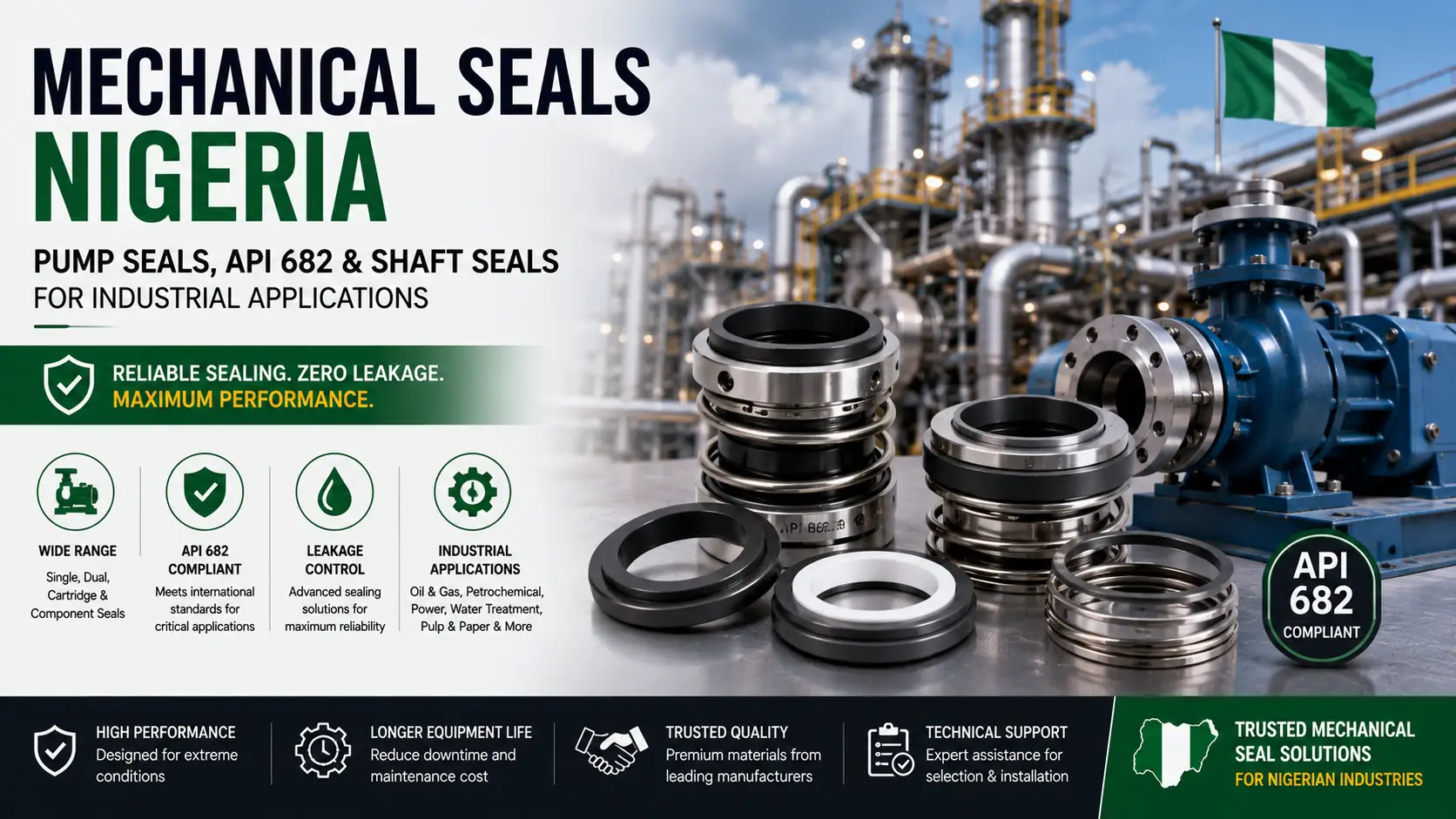
In Nigeria's oil fields in the Niger Delta, the mechanical seal is at the heart of pump reliability in refineries located at Port Harcourt and Warri, in water treatment plants, chemical processing plants, and manufacturing plants in Lagos and Kano. Mechanical seals in Nigeria are what the engineers and maintenance personnel in Nigeria rely on to keep the fluid under pressure inside the casing from escaping around the rotating shaft each time the centrifugal pump, the mixer or the compressor shaft rotates. The wrong seal for the application or a substandard replacement seal will directly cause leaks, equipment downtime, environmental problems and expensive emergency maintenance. This complete guide addresses the types, materials, standards, applications and procurement factors of industrial mechanical seals in Nigeria that reliability engineers and procurement teams in Nigeria need.
Definition: This is a precision device fitted into rotating equipment to prevent liquids and/or gases from passing between rotating surfaces and to allow the rotating shaft to move freely. It forms a dynamic seal between the rotating face (which is attached to the shaft) and a stationary face (which is retained in the gland), with contact between the faces being maintained by the springs and the hydraulic pressure.
Looking for certified mechanical seals in Nigeria? We can provide you a very quick seal quote for any pump model, shaft diameter, operating pressure, and fluid type!
→ Request a Quote
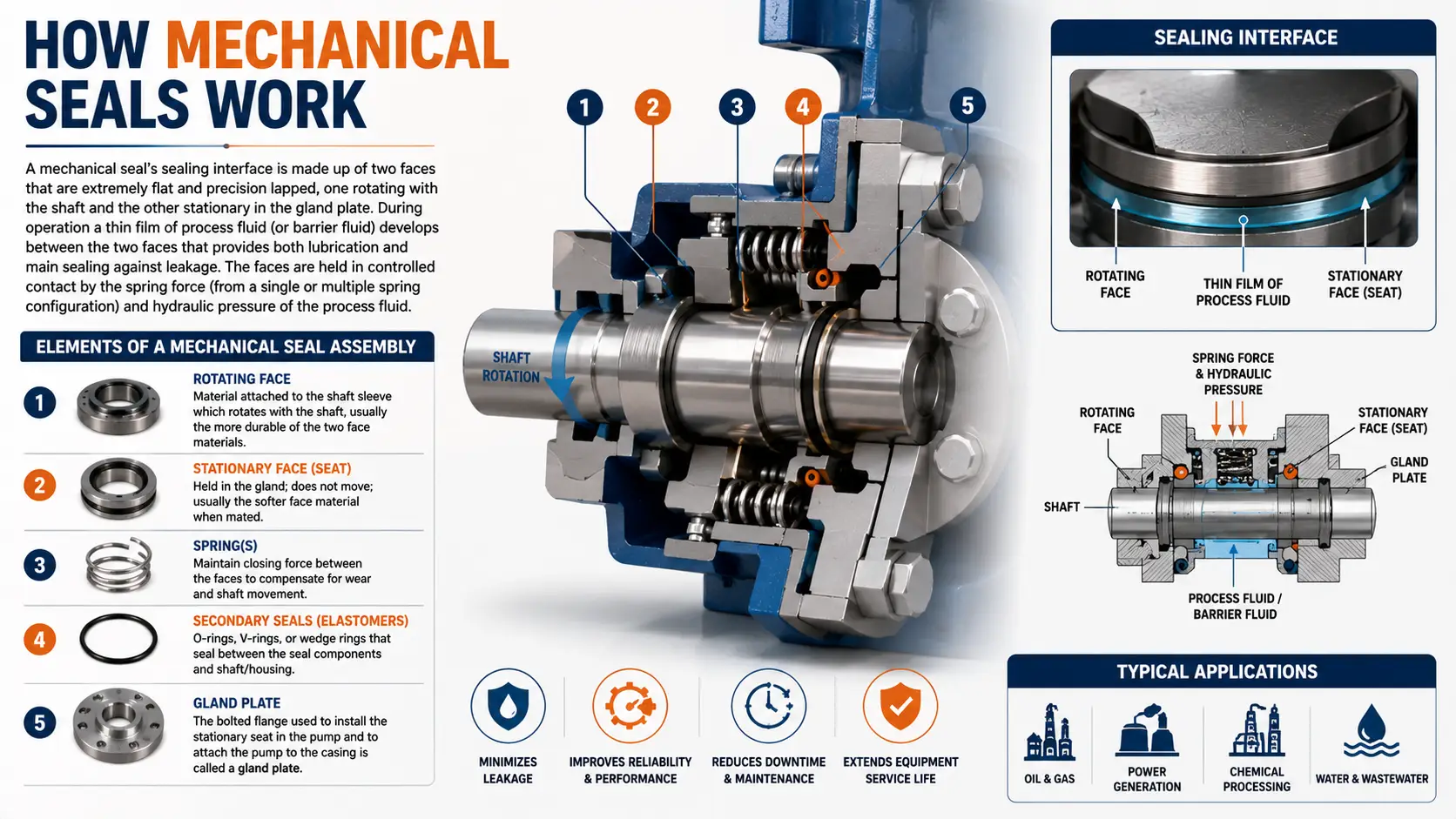
How Mechanical Seals Work
A mechanical seal's sealing interface is made up of two faces that are extremely flat and precision lapped, one rotating with the shaft and the other stationary in the gland plate. During operation a thin film of process fluid (or barrier fluid) develops between the two faces that provides both lubrication and main sealing against leakage. The faces are held in controlled contact by the spring force (from a single or multiple spring configuration) and hydraulic pressure of the process fluid.
The elements of a mechanical seal assembly are:
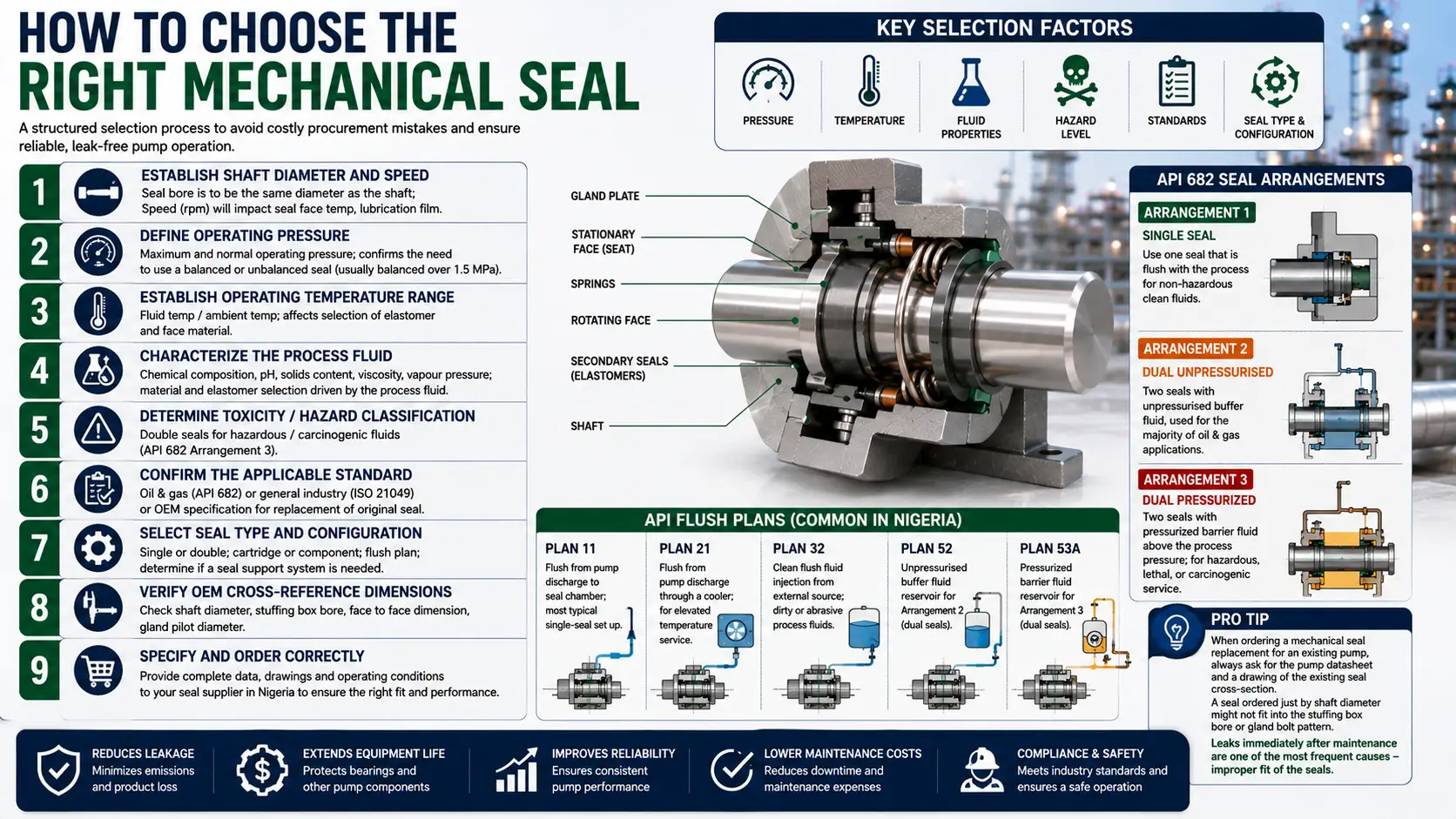
Rotating face — material attached to the shaft sleeve which rotates with the shaft, usually the more durable of the two face materials.
Stationary face (seat) — held in the gland; does not move; usually the softer face material when mated
Spring(s) — maintain closing force between the faces to compensate for wear and shaft movement
Secondary seals (elastomers) — O-rings, V-rings, or wedge rings that seal between the seal components and shaft/housing
Gland plate —The bolted flange used to install the stationary seat in the pump and to attach the pump to the casing is called a gland plate.
Types of Mechanical Seals
The first step in any pump mechanical seals Nigeria procurement enquiry is to choose the right seals for the application. The table below outlines the main types of seals found in the industrial industry in Nigeria.
Seal Type | Configuration | Pressure Range | Typical Nigeria Application |
Single Component Seal | One seal face pair, basic design | Up to ~20 bar | General water, low-hazard process fluids |
Double Mechanical Seal | Two seal face pairs, barrier fluid system | Up to 40 bar+ | Hazardous, toxic, or fugitive emission-sensitive fluids |
Cartridge Seal | Pre-assembled unit, no field measurement | Wide range | Critical equipment; reduces installation error |
Split Seal | Halved for installation without shaft removal | Low to medium | Large vertical pumps, agitators, fans |
Balanced Seal | Reduced face hydraulic load | High pressure service | High-pressure refinery and process pumps |
Unbalanced Seal | Full hydraulic load on seal faces | Low to medium | Light duty, water, non-hazardous fluids |
Gas-lubricated (dry gas) | Non-contacting faces with gas barrier | High pressure | Gas compressors, high-speed turbomachinery |
Single Mechanical Seals
Most process, water supply and non-hazardous fluid pumping use single seals (rotating and stationary faces) across Nigeria. They can be used when the amount of leakage through the seal faces is tolerated and when the process fluid is not toxic, carcinogenic, or flammable.
Double Mechanical Seals
Double seals have two seal faces and in between them is a pressurized or unpressurised barrier/buffer fluid. They are required for fluids that are toxic, carcinogenic, volatile, or hazardous to the environment where it is impractical or impossible to prevent any leakage to the atmosphere. Double seals are specified for produced water, hydrocarbon vapour service and chemical injection service in all the oil and gas facilities across Nigeria, in Bonny Island, Onne and the Niger Delta.
Cartridge Mechanical Seals
Cartridge mechanical seals are pre-assembled seals that have all components – seal faces, springs, gland plate, and shaft sleeve – assembled in the factory and mounted on the shaft and bolted to the pump without any field measurement or component setting. In Nigeria, where maintenance teams often have to work with a diverse range of equipment and may have a large number of cartridges, cartridge seals can help to minimize installation errors and downtime.
Split Mechanical Seals
Split seals are split radially so they can be installed around a shaft without separating the shaft from the machine. They are especially interesting in Nigeria for large vertical pumps, agitators and fans where the removal of the shaft is not feasible, either because of size or installation. Split seals offer comparable sealing performance to continuous seals, but significant maintenance cost savings for proper applications.
Cartridge vs Component Seals: Key Differences
Factor | Cartridge Mechanical Seal | Component Mechanical Seal |
Installation complexity | Low — pre-set, slide in as a unit | Higher — requires precise field measurement and assembly |
Installation error risk | Minimal — pre-assembled at factory | Higher — face gap, spring compression, and centering critical |
Cost | Higher initial cost | Lower initial cost |
Maintenance speed | Faster seal change, less downtime | More time-consuming to replace |
Suitability for critical equipment | Preferred for pumps requiring high reliability | Suitable for general-purpose and non-critical equipment |
API 682 compliance | Standard form for API 682 seal arrangement | Available but less common for API service |
Nigeria maintenance context | Recommended for offshore and refinery service | Common in water and general manufacturing applications |
Mechanical Seal Materials
In industrial applications, mechanical seals Nigeria the materials used will decide the life of the seal, whether a few weeks or even years. All face materials, elastomers, and metal parts should be compatible with the process fluid, temperature, and pressure. The table below is a representation of the most common materials used for the selection of seals face and elastomer.
Material | Hardness | Corrosion Resistance | Nigeria Industry Application |
Carbon Graphite | Low | Good | General purpose; stationary face in most standard seals |
Silicon Carbide (SiC) | Very High | Excellent | Abrasive fluids, slurries, chemicals; most common hard face |
Tungsten Carbide (WC) | High | Good | Abrasive and high-load applications; oil & gas pumps |
Alumina / Ceramic | High | Good | Water, non-abrasive fluids; light duty |
Satellite (Cobalt Alloy) | High | Good | High temperature, harsh duty where SiC unsuitable |
PTFE (elastomer insert) | Low | Excellent | Corrosive chemicals, acids; used as secondary seal / O-ring |
Viton (FKM) | Elastomer | Very Good | Oil & gas, hydrocarbons, elevated temperature elastomers |
EPDM | Elastomer | Good | Water, steam, alkaline fluids; avoid with hydrocarbons |
Silicon Carbide vs Tungsten Carbide
The most commonly specified hard face material for mechanical seals in Nigeria's oil and gas, chemical and water treatment industries is silicon carbide (SiC). It offers exceptional hardness, chemical resistance and thermal conductivity and is found in reaction bonded silicon carbide (RBSiC) and sintered silicon carbide (SSiC), with sintered silicon carbide being more chemically inert for difficult process fluids.
However, where high impact loads and abrasive loads are involved, a silicon carbide face would chip easily and tungsten carbide (WC) will be preferred due to its toughness. It is frequently used in slurry pumps, heavy process pumps and the mining industry in Nigeria's cement industry.
Elastomer Selection
The secondary seal elastomers (O-rings, wedge rings and bellows) need to be chemically compatible with the process fluid. The most common elastomer used for hydrocarbon and oil & gas service in Nigeria is Viton (FKM). EPDM is recommended for water, steam and alkaline service. For corrosive acids and solvents, use PTFE wedge rings or encapsulated O-rings which do not swell or deteriorate in corrosive conditions.
Gasket and static seal materials are also utilized in flanged connections and piping systems in conjunction with mechanical seals, please consult our Gaskets Pillar for guidance on these materials, their types, pressure ratings and materials selection for Nigeria's industrial piping systems.
API & ISO Standards for Mechanical Seals
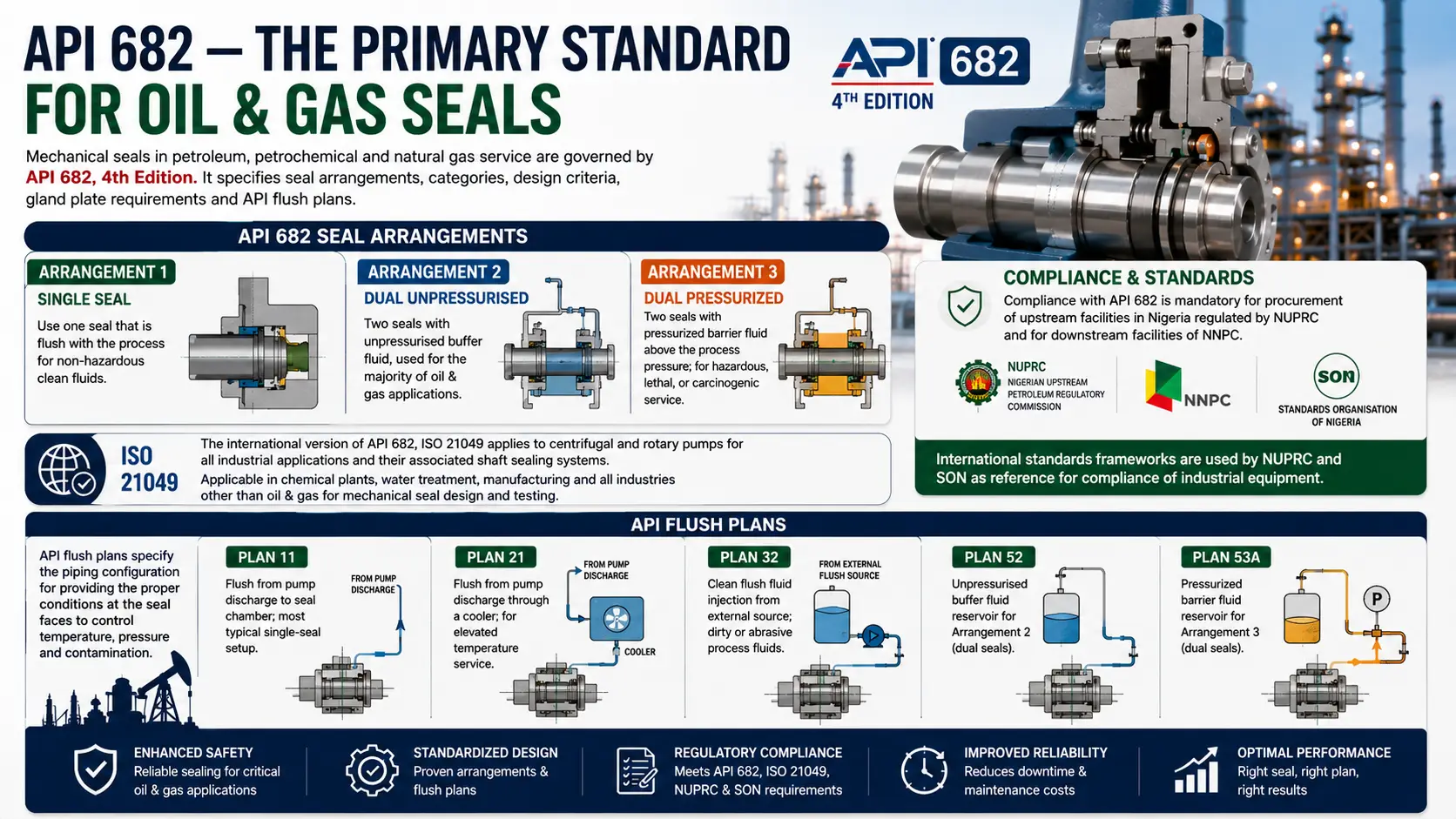
API 682 — The Primary Standard for Oil & Gas Seals
Mechanical seals in petroleum, petrochemical and natural gas service are governed by API 682, which is the fourth edition of Pumps — Shaft Sealing Systems for Centrifugal and Rotary Pumps. It specifies the three seal arrangements for use and three seal categories with design criteria related to the seal, gland plate, seal support system and piping flush plans.
API 682 seal arrangements:
Arrangement 1 (single seal) — use one seal that is flush with the process for non-hazardous clean fluids
Arrangement 2 (dual unpressurised) — Two seals with unpressurised buffer fluid, which is used for the majority of oil & gas applications.
Arrangement 3 (dual pressurized) — Two seals with pressurized barrier fluid above the process pressure; for hazardous, lethal, or carcinogenic service.
Compliance with API 682 is a mandatory standard for the procurement of upstream facilities in Nigeria regulated by NUPRC as well as for the downstream facilities of NNPC. International standards frameworks are used by both Nigerian Upstream Petroleum Regulatory Commission (NUPRC) and the Standards Organization of Nigeria (SON) as reference for the compliance of industrial equipment.
ISO 21049
The international version of API 682, ISO 21049 applies to centrifugal and rotary pumps for all industrial applications and their associated shaft sealing systems. In all industrial plants other than oil and gas, such as chemical plants, water treatment and manufacturing, ISO 21049 applies the mechanical seal design and testing.
API Flush Plans
API flush plans specify the piping configuration for providing the proper conditions at the seal faces to control the temperature, pressure and contamination.
In Nigeria, the most common specified plans for the industrial sector are:
Plan 11 — flush from the pump discharge to seal the chamber; most typical single-seal setup.
Plan 21 — flush from pump discharge through a cooler; for elevated temperature service
Plan 32 — clean flush fluid injection from external source; dirty or abrasive process fluids.
Plan 52 — unpressurised buffer fluid reservoir for Arrangement 2 (dual seals)
Plan 53A — The pressurized barrier fluid reservoir (Arrangement 3) for Plan 53A.
Industries That Use Mechanical Seals in Nigeria
Oil and Gas
The most prominent market for API 682 mechanical seals prescribed by Nigerian engineers is the upstream and downstream oil and gas industry which includes offshore production platforms, flow stations in the Niger Delta, export terminals at Onne and Bonny Island as well as refineries at Port Harcourt and Warri. In this area, pumps that use mechanical seals include crude transfer pumps, produced water injection pumps, gas sweetening recirculation pumps, and booster pumps during the production and processing stages.
Water Treatment and Municipal Infrastructure
Mechanical seal failures are usually single-seal designs using silicon carbide faces on carbon graphite faces with EPDM elastomers in water treatment plants at urban water supply sources throughout Nigeria, such as Lagos, Abuja, Kano and Port Harcourt water treatment works. Municipal water supply pumps operate around the clock and at moderate pressures, where sealing demands are more demanding, with a reduced amount of leakage and service callouts.
Chemical and Petrochemical Processing
The expanding chemical manufacturing industry in Nigeria such as fertilizer production, paint manufacturing and petrochemical derivatives need mechanical seals that are resistant to corrosion and handle corrosive liquids (acids, alkalis, solvents and reactive chemicals) and gases. The typical secondary seal for sealing a chemical process pump is a sintered silicon carbide face with PTFE or Viton. Double seal arrangements are used for carcinogenic and toxic products.
Manufacturing, Food Processing, and Pharmaceutical
Mechanical seals are used in mechanical pumps for cooling water systems, mechanical pumps for transferring process water and product handling equipment at manufacturing plants throughout Lagos, Kano, and Calabar. Mechanical seals are used in the food and pharmaceutical manufacturing industries where they must be designed to be hygienic, with FDA-compliant elastomers, electropolished metal parts and smooth external surfaces, that are compatible with CIP (clean-in-place) washing cycles.
Mining and Cement
Heavy duty mechanical seals are needed for slurry pumps pumping abrasive materials in Nigeria's cement plants, which are among the largest in Africa in terms of production capacity, as well as in the mining operations and aggregate processing. For this challenging application, the tungsten carbide face will be matched with strong spring arrangements and good slurry sealing of the springs.
How to Choose the Right Mechanical Seal
Any pump seal supplier in Nigeria will know that this is a structured selection process to avoid the most expensive of procurement mistakes:
Establish shaft diameter and speed — Seal bore is to be the same diameter as the shaft; Speed (rpm) will impact seal face temp, lubrication film
Define operating pressure — maximum and normal operating pressure; confirms the need to use a balanced or unbalanced seal (usually balanced over 1.5MPa)
Establish operating temperature range — fluid temp/ambient temp; affects selection of elastomer/face material
Characterize the process fluid — Chemical composition, PH, Solids content, Viscosity, Vapour pressure, material and elastomer selection driven by the process fluid.
Determine toxicity / hazard classification — double seals for hazardous / carcinogenic fluids (API 682 Arrangement 3)
Confirm the applicable standard — oil & gas (API 682) or general industry (ISO 21049) or OEM specification for replacement of original seal
Select seal type and configuration — single or double; cartridge or component; flush plan; determine if a seal support system is needed
Verify OEM cross-reference dimensions — check shaft diameter, stuffing box bore, face to face dimension, gland pilot diameter
When ordering a mechanical seal replacement for an existing pump, Pro Tip – always ask for the pump datasheet and a drawing of the existing seal cross-section. A seal ordered just by shaft diameter might not fit into the stuffing box bore or gland bolt pattern. Leaks immediately after maintenance are one of the most frequent causes - improper fit of the seals.
Common Seal Failures in Nigeria’s Industrial Environment
Knowing about failure modes can help maintenance teams solve the cause of failure instead of just replacing seals at regular intervals.
Failure Cause | Symptoms | Root Cause | Prevention |
Dry running | Thermal cracking of seal faces, rapid wear | Running pump without fluid, cavitation | Ensure pump is fully primed; install dry-run protection |
Misalignment | Uneven face wear, vibration, leakage | Shaft or coupling misalignment at installation | Precision shaft alignment before commissioning |
Contamination | Face pitting, abrasive wear, scored faces | Solid particles in process fluid | Install cyclonic separator or flush filter; check API plan |
Incorrect installation | Immediate or early leakage after startup | Wrong spring compression, cocked gland | Use cartridge seal; verify installation against OEM manual |
Chemical attack | Elastomer swelling, face degradation | Incompatible seal materials for process fluid | Verify material compatibility against fluid chemistry |
Cavitation | Noise, vibration, face erosion | Insufficient NPSH, valve throttling on suction | Correct pump sizing; ensure adequate NPSH |
Over-pressure | Face separation, leakage under pressure | System pressure exceeds seal pressure rating | Select seal with adequate pressure rating; use balanced seal |
Nigeria Specific Context: Mechanical seal failure mode which poses the greatest challenge in mechanical seals as it applies for pump start-up after maintenance or when water supply to cooling and flush system is interrupted is the single most prevalent throughout the process industries in Nigeria. Use a dry-run protection device (flow switch, level switch, or pump protection relay) on each critical pump to greatly reduce the service life of the pump's seal.
Maintenance Best Practices
Preventive Maintenance Schedule
Daily — visually inspect for leaks at gland; listen for abnormal pump sounds; instrumented — check seal flush flow
Weekly — check seal flush pipework for blockages, leaks and cooler fouling; check the fluid levels and pressure in the barrier on double seals
Monthly — vibration check of pump and motor, shaft alignment check, and review of seal leakage log for trends that could be developing
At scheduled maintenance — replace seals at OEM recommended intervals or when the leakage pattern suggests they are nearing end of service life; inspect the stuffing box bore for wear and shaft sleeve for wear
Installation Best Practices
Thoroughly clean the stuffing box bore and shaft sleeve before installing, removing all traces of the previous seal.
Use clean lubricant (usually water or compatible fluid) on O-rings and shaft sleeve during installation - do not use petroleum-based grease on EPDM seals.
Carefully adjust spring compression to the OEM specification for component seals; improper spring compression is a major failure cause.
When using cartridge seals, do not remove the setting clips until all bolts are tightened on the gland.
Before starting, line up the pump coupling to the manufacturer's tolerances at this time, or the seal faces will be loading unequally.
Always prime the pump completely before starting, even for a short time just to ‘check if it works’!
Seal Storage and Handling
Keep replacement mechanical seals in the original packaging in a cool dry area protected from direct exposure to sunlight and ozone-generating equipment.
Don't stack or compress packaged seals – seals faces are precision-lapped and susceptible to point loading damage.
Monitor the condition of all elastomers on which the seals are stored before use as they deteriorate over time even when in storage.
Follow a first in first out (FIFO) inventory system, by which oldest stock is used first
See our Pumps Pillar for more information on centrifugal pumps in which these mechanical seals are fitted, their performance curves, and how they work with industrial pumps in Nigeria and their applications.
Procurement Considerations for Nigeria
OEM vs OEM-Equivalent Seals
Original Equipment Manufacturer (OEM) mechanical seals are made to the original pump specification and include the same warranty coverage as the pump manufacturer. OEM equivalent seals are typically offered at a competitive price, as they are made by seal specialist companies based on the same dimensional and material specifications, if they have equivalent or superior face and elastomer materials and are dimensionally the same as the OEMs.
OEM-equivalent mechanical seal replacement Nigeria from reputable mechanical seal manufacturers can offer substantial cost and lead-time benefits if material compatibility is thoroughly verified with the process conditions for Nigeria's maintenance teams that are faced with ageing pump fleets, where original OEM seals may have long lead times and/or high import costs.
Common Brands in the Nigerian Market
Products from top global manufacturers cater to the Nigerian industrial seal market. For information only, without any partnership or endorsement, common brands used in the oil and gas industry, as well as the industrial sector, in Nigeria are Flowserve, John Crane, Eagle Burgmann, AESSEAL, Chesterton, Flexaseal, etc. The choice of a particular brand or equivalent shall be made based on both dimensional compatibility and material specification, as well as API 682 certification as necessary and ability of the supplier to support Nigeria delivery and after sales service.
Frequently Asked Questions
What do you mean by a mechanical seal?
The mechanical seal Nigeria industrial pumps employs are precision engineered devices that prevent any leakage of process fluid along the rotating shaft of rotating equipment through a controlled dynamic sealing interface which consists of a pair of flat lapped faces, one of which rotates along the shaft, and the other being stationary.
What is API 682?
API 682 is the American Petroleum Institute specification for the design, testing, and documentation of mechanical seals for centrifugal and rotary pumps used in petroleum, petrochemical, and natural gas service. It specifies a range of seal arrangements, categories, flush plans and testing requirements, which have been broadly defined and specified throughout Nigeria's oil and gas facilities.
What's the difference between a single and double mechanical seal?
Single seals are designed with a single pair of sealing faces and suitable for non-hazardous process fluids. Two seals are mounted back-to-back on a double valve with a barrier or buffer fluid in between to further contain leakage from the valve for hazardous, toxic and carcinogenic fluids, which is required for "lethal service" according to API 682 Arrangement 3.
What are the causes for mechanical seal failures?
Common causes in the industrial environment in Nigeria include: low level operation or dry running during pump start-up, shaft misalignment, installation errors e.g. face gap, spring compression, and incompatible seal material for the process fluid as well as contamination of the seal faces with solids from the process stream.
What is the life of mechanical seals?
When installed and maintained properly and under the correct specification, mechanical seals in general process service will last for 1-3 years. For clean, low duty applications, service life can be as long as 5 years, or longer. This can be drastically shortened to weeks or months in abrasive sludge, dry running and misalignment conditions.
What are the applications of mechanical seal in Nigeria?
Industrial mechanical seals Nigeria are widely used in oil and gas, water treatment, power generation, chemical manufacturing, food processing, pharmaceutical, cement, mining, and general manufacturing industries all over Lagos, Port Harcourt, Warri, Onne, Abuja, Kano, and Calabar.
Is it better to use cartridge mechanical seals or component mechanical seals?
Cartridge mechanical seals minimize the risk of installation error by providing a pre-set, pre-assembled unit, which eliminates field measurement and component assembly. Cartridge seals are the specification of choice for critical equipment in Nigeria's oil and gas and process industries. Standard duty general manufacturing applications are still suitable for component seals.
What certifications should mechanical seals be given?
API 682 certification by a third-party test programme is the relevant compliance reference for oil and gas, and petrochemical applications. Any reputable seal manufacturer or supplier will have ISO 9001 quality management certification as the minimum requirement for a quality system. Face and metal components of critical service seals should be accompanied by material certificates to EN 10204 3.1.
Summary: Selecting and Sourcing Mechanical Seals in Nigeria
Industrial operations in Nigeria rely on reliable mechanical seals, which are not just a purchase of commodity but a precision engineering decision that directly impacts uptime, environmental compliance, and maintenance costs. The type of seal, the material of the face and shaft, the elastomer, and the flush plan are all critical to determining the months or years of service provided by a seal, depending on the size of the shaft, operating pressure, temperature, and fluid chemistry.
From mechanical seals Nigeria oil and gas operators need, to mechanical seals proxy pump maintenance to minimize downtimes, to mechanical seals for chemical process applications that are resistant to corrosion, the principles presented in this guide — mechanical seal type selection, material compatibility, adherence to standards, and mechanical seal procurement documentation — will help in the decision making process to ensure long-term reliability throughout the various industrial sectors in Nigeria.
To obtain further technical guidance, look at our Pumps Pillar for centrifugal pump selection, performance and application principles used in the oil and gas, water and process industries of Nigeria, and our Gaskets Pillar on static seals and gasket selection.
Looking for mechanical seal technical assistance in Nigeria? Our experts will be able to pinpoint suitable seals for your pump model, process fluid and operating requirements, having verified local availability.→ Talk to Our Specialist