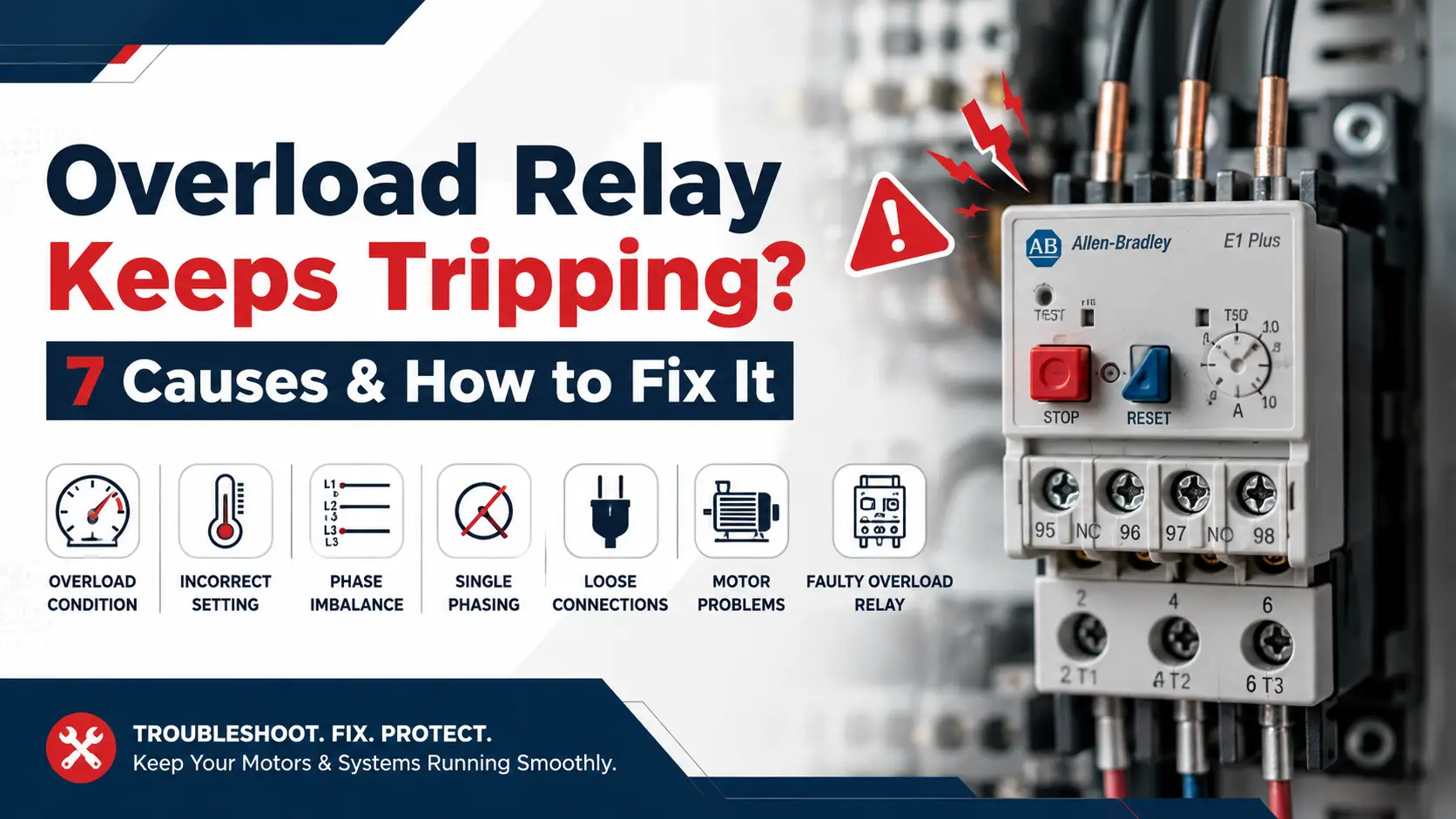
Overload Relay Keeps Tripping? 7 Causes & How to Fix It
An overload relay that keeps tripping is protecting a motor from a real, sustained overcurrent condition in almost every case — the relay itself is rarely the problem. Before you swap it out, the two questions worth answering first are: is the relay actually set correctly for the motor's full load current, and is the motor drawing more current than it should be? Get those two right and most "faulty overload relay" call-outs resolve without a single part being replaced.
Here are the seven most common reasons a thermal overload relay trips repeatedly, how to tell them apart quickly, and what actually fixes each one — for anyone chasing a nuisance trip on a motor starter rather than a genuine mechanical fault.
Never bypass an overload relay to "solve" tripping. Overriding or oversizing it beyond the motor's rating removes the protection it exists to provide and risks burning out the motor winding. Every check below assumes safe isolation and current measurement by a competent person.
How a Thermal Overload Relay Decides to Trip
A thermal overload relay mimics the heating behaviour of the motor windings it protects. Current flowing to the motor also flows through a set of bimetallic strips inside the relay; if that current stays above the relay's set point for long enough, the strips heat and bend, tripping a mechanism that opens the control circuit and drops out the contactor. The relay is deliberately built with an inverse time characteristic — a small overcurrent takes longer to trip than a severe one — because that mirrors how a motor winding actually heats up, and it's what lets the relay tell a brief, harmless starting surge apart from a sustained fault that will genuinely cook the motor.
Overload Relay Terms Worth Knowing
| Term | Meaning |
|---|---|
| F.L.C. | Full Load Current — the motor nameplate current the relay should be set to |
| Trip class (10/20/30) | Maximum seconds to trip at 7.2× set current — higher class allows longer starting times |
| Single-phasing protection | Detects current imbalance between phases and trips faster than on a balanced overload |
| Reset (manual/auto) | Manual reset requires a physical button press; auto-reset re-engages once cool |
7 Causes of an Overload Relay Tripping Repeatedly
Relay Set Too Low for the Motor's F.L.C.
The single most common cause by a wide margin. If the dial is set below the motor's actual full load current — often left over from a previous, smaller motor on the same starter — the relay will trip under completely normal running conditions. Check the motor's nameplate F.L.C. against the relay's current dial setting before assuming anything else is wrong.
Genuine Motor Overload From Mechanical Strain
A pump fighting a partially blocked line, a conveyor jamming intermittently, or a bearing starting to seize all increase the mechanical load the motor has to work against — and current rises with it. The relay is doing exactly its job here. Measure actual running current against the nameplate F.L.C.; if it's genuinely high, the fix is on the driven machine, not the electrical protection.
Single-Phasing on a Three-Phase Motor
A blown fuse, a loose terminal, or a failed contactor pole on one phase leaves the motor running on two phases, drawing sharply higher current on the remaining two to try to maintain torque. Most modern overload relays include dedicated phase-loss/imbalance detection specifically because this failure mode is common and destructive if left running. A trip that coincides with unusual motor noise or vibration points here first.
Starting Time Longer Than the Relay's Trip Class Allows
High-inertia loads — large fans, centrifuges, some pumps — can take longer to accelerate to full speed than a standard Class 10 relay is designed to tolerate, tripping the relay during every start even though the motor and load are both healthy. This calls for a relay rated to a higher trip class (20 or 30), not a higher current setting, since raising the current setting removes real overload protection instead of accommodating the longer start.
Frequent Start/Stop Cycling Without Enough Cooldown
Thermal overload relays need time to cool between trips, just like the motor windings they're modelling. An application that starts and stops a motor frequently — jogging, inching, or a control system cycling too aggressively — can trip the relay from accumulated heating even if no single start looks abnormal on its own. If the process genuinely needs frequent cycling, an electronic overload relay with a proper duty-cycle rating is a better fit than a basic thermal unit.
High Ambient Temperature Around the Relay
Standard bimetallic overload relays are temperature-compensated for a typical panel environment, but a control cabinet running hot — poor ventilation, direct sun, or sitting next to a heat-generating drive — can still push the relay toward tripping sooner than its rating suggests. If the panel itself is noticeably warm to the touch, address the enclosure's cooling before touching the relay setting.
Worn or Fatigued Bimetallic Element
The one genuine "faulty relay" scenario in this list: repeated thermal cycling over many years can fatigue the bimetallic strips so they trip below their rated setting even under normal, correctly-sized load. This is confirmed by ruling out every cause above first, then substituting a known-good relay of the same rating on the same motor — if the trip stops, the original relay had drifted out of tolerance.
Quick Reference: Symptom, Likely Cause & What to Check
| Symptom | Most Likely Cause | Quick Check |
|---|---|---|
| Trips consistently, motor sounds and runs fine | Relay set below the motor's F.L.C. | Compare dial setting to nameplate F.L.C. |
| Trips with unusual motor noise or vibration | Single-phasing from a blown fuse or failed contactor pole | Measure current on all three phases; check fuses and contactor |
| Trips every time on a high-inertia start | Trip class too fast for the actual starting time | Time the start; fit a higher trip-class relay if genuinely needed |
| Trips only after frequent starts/stops | Insufficient cooldown between cycles | Review duty cycle; consider an electronic overload relay |
| Trips more on hot days or in a warm panel | High ambient temperature around the relay | Check enclosure ventilation and panel temperature |
| Trips below setting even with a correctly sized, healthy motor | Fatigued bimetallic element | Substitute a known-good relay of the same rating to confirm |
Fault-Finding Flow: From Trip to Fix
Does the dial setting match the motor's nameplate F.L.C.?
NoCorrect the dial to match the nameplate F.L.C. and retest.
YesMove to step 2.
Is current balanced across all three phases?
NoSingle-phasing — check fuses, contactor poles and terminals.
YesMove to step 3.
Final check
Time the start against the relay's trip class, check for mechanical strain on the driven load, and consider a fatigued relay if everything else checks out.
Frequently Asked Questions
Can I just turn the overload relay's setting up to stop it tripping?
Only up to the motor's actual nameplate F.L.C. — never beyond it. Setting the relay above the motor's rated current removes the protection it's there to provide, and a genuine overload will be allowed to run long enough to damage the winding insulation.
Why does the relay only trip when the motor starts, not while running?
This points to a starting time that's longer than the relay's trip class tolerates — common on high-inertia fans and pumps. Time the actual start and compare it against the relay's trip class rather than increasing the current setting.
What's the difference between a thermal and an electronic overload relay?
A thermal relay uses bimetallic strips to physically mimic motor heating and is simple and robust for standard duty. An electronic overload relay measures current directly and can offer tighter accuracy, adjustable trip classes, communication/diagnostics, and better handling of frequent cycling — worth it on demanding or high-value applications.
Does the overload relay protect against short circuits too?
No — an overload relay is designed for sustained moderate overcurrent, not the very high fault currents of a short circuit, and it isn't fast enough to clear one safely. Short-circuit protection is the job of an upstream fuse or motor protection circuit breaker (MPCB), typically paired with the overload relay and contactor in a full motor starter.
How do I know if it's single-phasing versus a genuine mechanical overload?
Measure current on all three phases with a clamp meter. Roughly equal, elevated current across all three points to a genuine mechanical overload on the driven equipment; a large imbalance between phases, or near-zero current on one phase, points to single-phasing from a blown fuse or failed contactor pole.
Related Reading
Overload relays are almost always specified alongside a contactor and an upstream breaker in a full motor starter — worth checking these if the trip doesn't resolve cleanly:
Shop the Parts
| Product | Use | Link |
|---|---|---|
| ABB TF42 Thermal Overload Relay, 1.3-1.7A F.L.C. | Small motors and control circuits | View product → |
| ABB EF45 Overload Relay, 9A F.L.C. | General-purpose motor starters | View product → |
| ABB Thermal Overload Relay, 100-135A F.L.C. | Larger motors on heavier starting duty | View product → |
| Full overload relay range | Browse by F.L.C. range, trip class and contact configuration | Browse thermal overload relays → |
| Motor protection circuit breakers | Combined overload and short-circuit protection in one device | Browse MPCBs → |
| All genuine ABB products | Overload relays, contactors and motor starters from the same manufacturer | View all ABB products → |
Disclaimer: ABB, and any other manufacturer or brand names referenced in this article, are used solely for identification and compatibility purposes. Z&F Corporation is not affiliated with, authorised by, or an official representative of these manufacturers; all trademarks are the property of their respective owners.