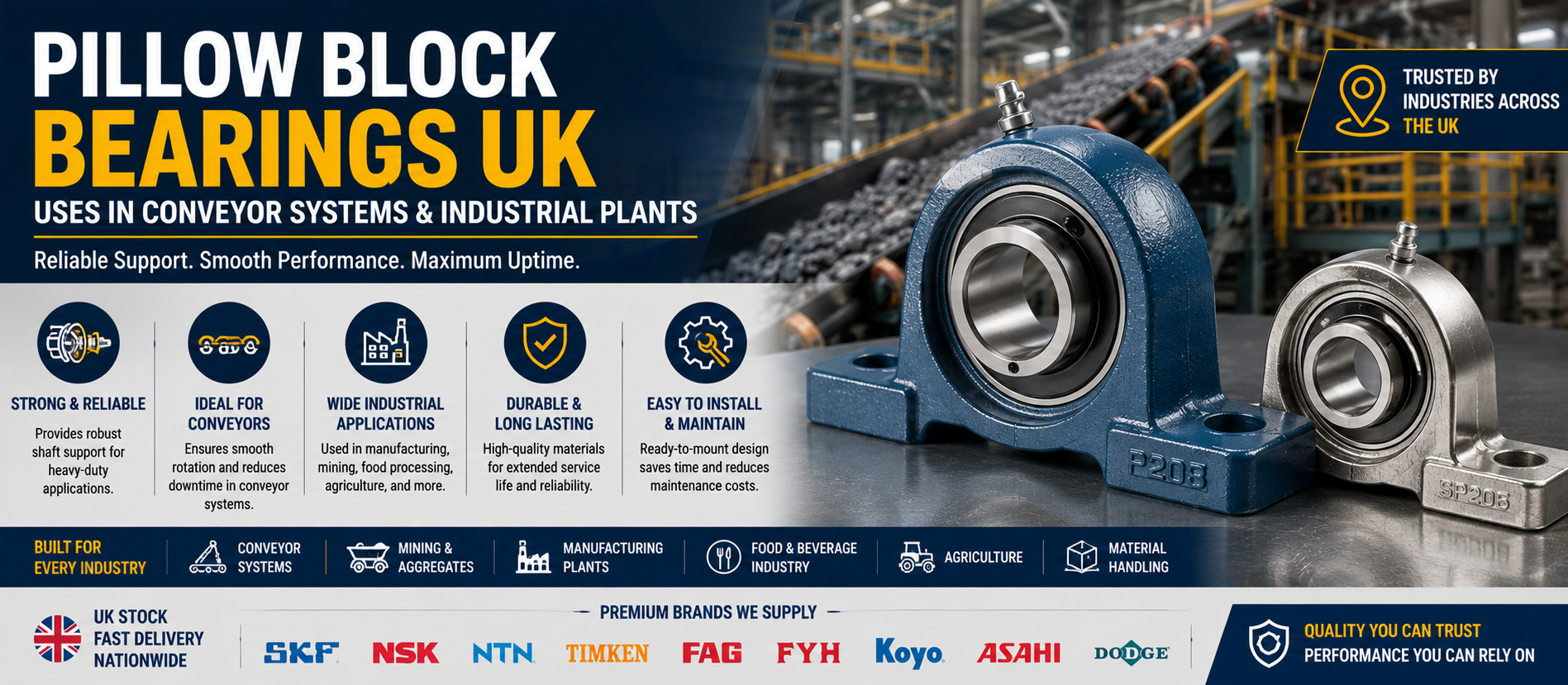
Pillow block bearings are among the most widely used mounted bearing assemblies in British industry. Whether you are maintaining a conveyor in a distribution center, replacing worn components in a food processing plant, or sourcing bearings for a new production line, understanding what to look for before you buy is essential. This guide walks maintenance engineers, plant managers, and procurement specialists through everything they need to know — from housing materials and load ratings to UK supplier selection and long-term maintenance planning.
What Are Pillow Block Bearings?
Pillow Block bearings are housed bearings constructed from a bearing insert and a bearing housing which are combined into one, ready-to-install unit. The housing is flat, resting on a surface and bolted to it; it supports a rotating shaft which goes through the bearing insert. This design is easy to install, does not require extensive alignment, and allows for easier maintenance than separate bearing and housing.
The bearing insert in the housing is usually a self-aligning bearing, most often of a spherical outer ring type, which permits the unit to accommodate slight misalignment of the shaft as a result of thermal expansion, structural deflection or incorrect installation. Buyers of pillow block bearings UK do so for one of the principle reasons that these bearings are self-aligning.
How Do Pillow Block Bearings Work?
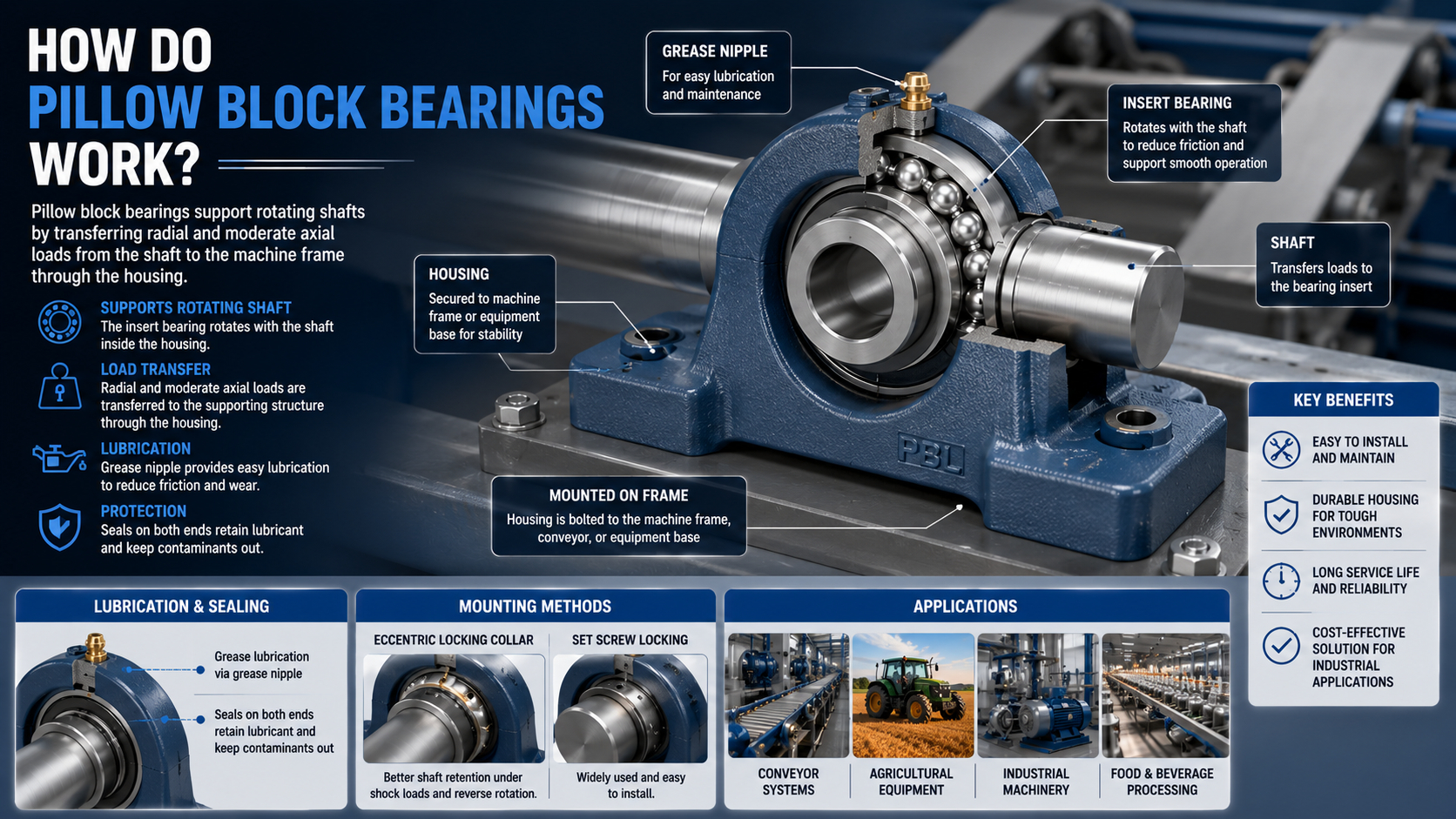
The insert bearing is a part of the housing that rotates along with the shaft. The housing is secured to a machine frame, conveyor structure or equipment base. When the shaft is spinning, the radial and moderate axial loads as a result of the application are transferred by the bearing insert to the supporting structure through the housing.
They are lubricated (usually greased) via a grease nipple on the housing. Sealed on each end to hold lubricant and keep contaminants away from the bearing. The sealing quality can also vary between bearing grades, especially for industrial pillow blocks for washdown, outdoor or contaminated applications.
Mounting is done in the form of eccentric locking collar and set screw locking arrangement. Both designs are used in industry in the United Kingdom but eccentric collar designs tend to have better shaft retention in cases of shock loads and reverse rotation.
Pillow Block Bearing vs Flange Bearing: What's the Difference?
This is one of the most frequently asked questions when looking at sourcing housed bearing units UK applications call for. The difference is in the way the mounts are positioned:
Pillow block bearings are installed on a horizontal surface (floor, frame, base plate) with its shaft axis parallel to the surface. They are the conventional bearing for conveyor systems, line shafting and drive arrangements where the bearing is located below the shaft.
Flange bearings fasten to a vertical surface like a wall, panel or machine frame end plate. They are needed when the shaft is located within the mounting surface instead of on top.
These both feature comparable insert bearing technology and are offered in the identical housing materials. This is based on machine geometry and not load or performance.
Housing Materials: Cast Iron vs Stainless Steel
The type of material used for the housing is a critical factor in purchasing pillow block bearings in the UK. Cast iron and stainless steel are the two most common materials, each with its own set of advantages and disadvantages.
Cast Iron Pillow Block Bearings
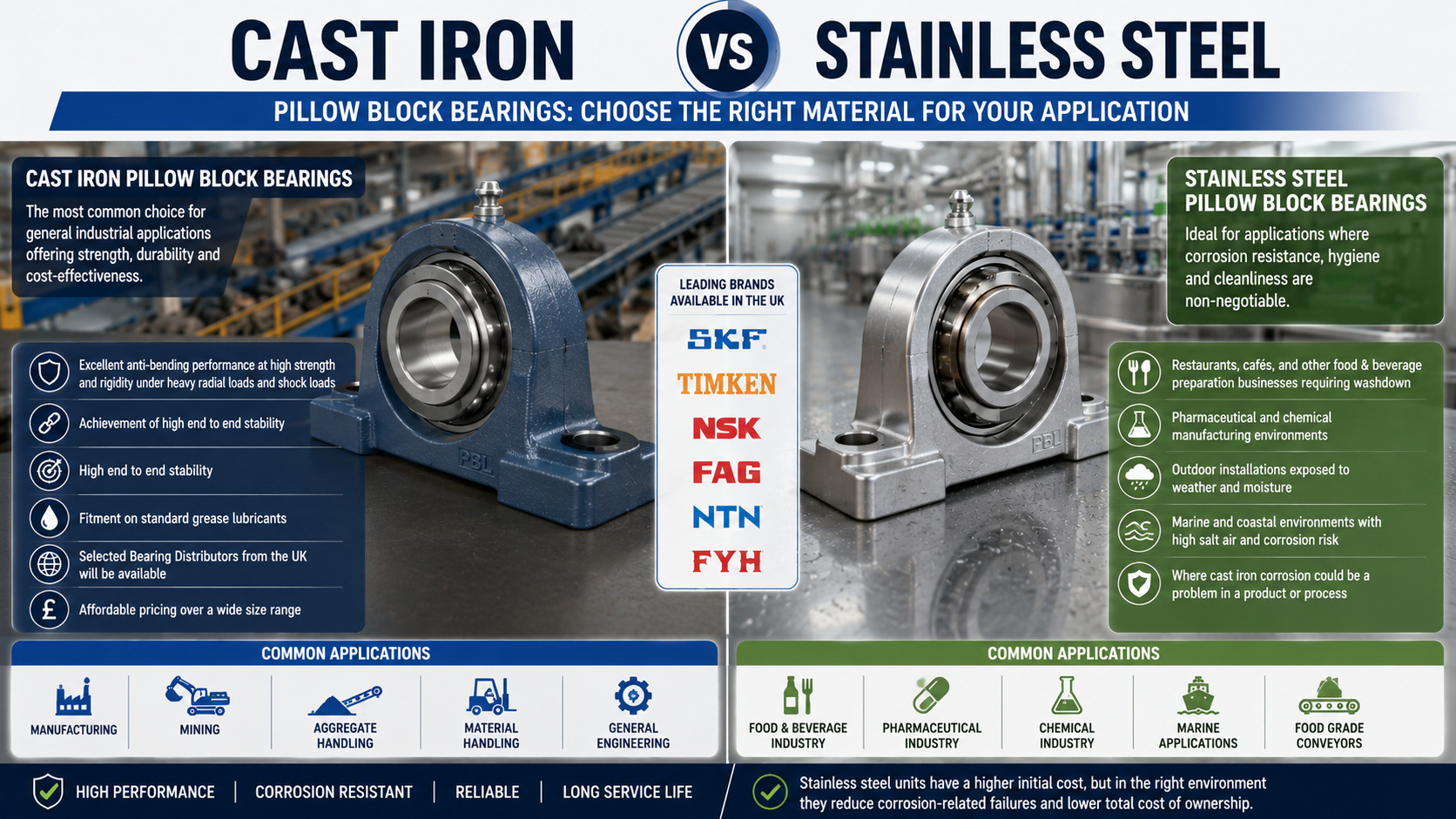
Most commonly, cast iron pillow block bearings are used in most of the general industrial applications. The cast iron housing provides:
Excellent anti-bending performance at high strength and rigidity under heavy radial loads and shock loads.
Achievement of high end to end stability.
High end to end stability.
Fitment on standard grease lubricants
Selected Bearing Distributors from the UK will be available.
Affordable pricing over a wide size range
Cast iron bearing housing units are the most requested in manufacturing, mining, aggregate handling, material handling and general engineering applications. Brands of this kind include SKF(SY Series), Timken, NSK, FAG, NTN and FYH with lots of cast iron ranges throughout the United Kingdom.
Stainless Steel Pillow Block Bearings
With applications where there is no compromise on corrosion resistance and hygiene compliance, stainless steel pillow block bearings UK are in steady demand. The following are stainless steel housings:
Restaurants, cafés, and other food and beverage preparation businesses that need to wash down their work areas.
Pharmaceutical and chemical manufacturing environments
Any installations outdoors that are subject to weather and moisture
Marine and coastal environments with high levels of salt air that cause corrosion to speed up
Where cast iron corrosion could be a problem in a product or process
Self-aligning bearings UK installations are also FDA approved with grease choices and hygienic sealing options, making them the right solution for food grade conveyor systems and food processing machinery where contamination risk needs to be minimized.
Stainless steel units have a higher unit cost than cast iron units, but in a suitable environment the stainless-steel units can lower the cost of failures due to corrosion throughout the life of the bearing.
Industries Using Pillow Block Bearings in the UK
There are many industries in the UK that are using pillow block bearings.
It is worth noting that mounted bearings UK applications range to almost every major industry:
Conveyor and material handling: aggregate quarries, distribution centers, recycling plants and ports.
Food processing and packaging: stainless steel enclosed units on hygiene critical lines and filling machines.
Manufacturing and production — line shafting, press drives, roller tables, and production line conveyors
Agriculture and grain handling: which includes grain auger, crop processing equipment and feed handling systems.
Heavy industry: overland conveyors, screening plants and crusher drives, mining.
Water and wastewater treatment: Heavy-duty pumping and rotating screen work in wet conditions when treating wastewater and water.
How to Choose the Correct Pillow Block Bearing Size
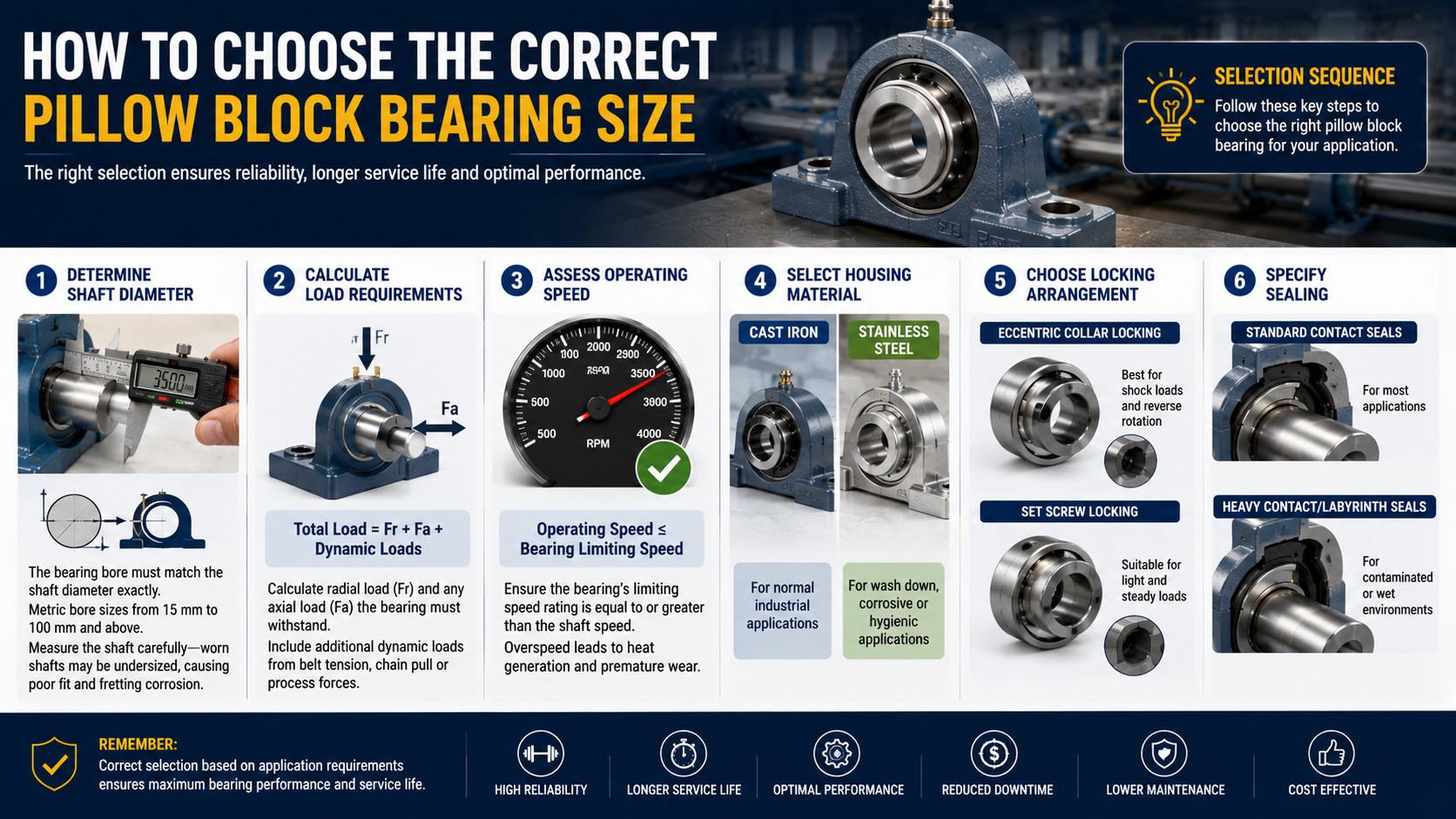
Soaking up is the basis of bearing reliability. The wrong bore, load rating or housing design will lead to failure, irrespective of the brand or the quality of the build, and no amount of quality control can compensate for that. Use this Selection Sequence:
1. Determine Shaft Diameter
The diameters of the bearing bores and the shaft should be exactly equal. Most metric bore types are available from 15 mm up to 100 mm and larger in heavy duty types. Legacy Machines can also be purchased in Imperial bore sizes. Carefully measure the shaft, because shaft journeys that have worn out may cause the shaft to become undersized, resulting in poor fit and fretting corrosion.
2. Calculate Load Requirements
Calculate the radial load and any axial load the bearing has to withstand. Include dynamic loads due to belt tension, chain pull or process forces on top of the static load.
3. Assess Operating Speed
Verify that the limiting speed rating for the selected bearing is at or equal to or greater than the shaft speed rating. Overspeed will lead to heat generation and premature wear.
4. Select Housing Material
For normal industrial applications, use cast iron. Use stainless steel for wash down, corrosive or hygienic applications.
5. Choose Locking Arrangement
Eccentric collar locking suits are used for shock and reversal loading. Set screw locking can be used for light and steady loads.
6. Specify Sealing
Most applications use standard contact seals. Heavy contact seals or labyrinth seals should be used in contaminated or wet environments.
What Causes Pillow Block Bearing Failure?
Knowing about failure modes enables procurement and maintenance professionals to make informed purchasing decisions and prevent reoccurring failures:
Contamination: Many of the industrial applications in the UK suffer early failures due to contamination. In the UK, the most prevalent cause of premature failures in industrial applications is contamination, especially in aggregates, recycling and outdoor applications.
Inadequate or incorrect lubrication: Under or over greasing will cause the bearing to starve and will lead to damage of the seal or heat.
Misalignment: when the shaft isn't properly aligned, beyond the bearing's self-aligning, it will lead to uneven loading and fatigue.
Overloading: when a bearing is given a lower dynamic load rating than required for the particular application.
Improper installation: Incorrect shaft fit or over tightened locking collars or if the seals are damaged during fitting.
Corrosion: In standard cast iron units when placed in corrosive environments where stainless steel is needed.
Failure analysis prior to replacement is always worthwhile since it will give an insight into the root cause and thus prevent the same failure from happening again in a new bearing.
Maintenance Requirements for Pillow Block Bearings
A planned maintenance program will help prolong the life of the bearings, while also minimizing unplanned downtime. Core requirements include:
Lubrication schedule: regreasing intervals based on speed, temperature, load and contamination level. Please follow the instructions of the bearing manufacturer.
Vibration monitoring: Handheld or fixed vibration sensors can be used to alert to developing bearing faults early, enabling planned replacement before faults occur.
Alignment checks: Periodic checks for misalignment using laser or dial gauges prevent misalignment-related wear.
Seal inspection: inspect contact seals for wear/damages at recommended times.
Bearing temperature monitoring: higher housing temperature is a good early warning of problems with the lubrication or overload.
Here, the developments of the so-called Industry 4.0 are becoming more and more relevant. In the past, condition monitoring of rotating equipment was possible only during scheduled downtimes, but this is no longer the case as customers in the UK are now able to achieve continuous condition monitoring of their rotating equipment across all industrial bearing suppliers, facilitating condition-based maintenance and minimizing planned and unplanned maintenance costs.
How Much Do Pillow Block Bearings Cost in the UK?
There are significant differences in price, depending on the bore size, the housing material, the sealing arrangement and the brand. As a general guide:
Small cast iron (15-30 mm bore) units from standard brands come in at a few pounds per unit.
Medium cast iron units (40-65 mm bore) come in moderately priced to high priced brands in established series.
Stainless steel units represent a high price for material and manufacture, and can be two to four times more expensive than similar cast iron units.
Heavy duty or large bore units for heavy duty applications are sold individually depending on the specification.
In procurement, total cost of ownership should be taken into account, not unit price. A good bearing from a reputable pillow block bearing supplier UK distributor will be more likely to be affordable over the duration of its service life than a less expensive bearing of the same quality which has a short service life.
Frequently Asked Questions
Are self-aligning pillow block bearings worth it?
Yes. The self-aligning pillow block bearings UK insert bearing allows for a slight deflection in the shaft and installation inaccuracies that are bound to occur on real industrial machinery, prolongs the life of the bearing and has less sensitivity to imperfect installation.
Are pillow block bearings heavy duty?
Heavy-duty cast-iron pillow block bearings are for heavy radial loads and moderate axial loads. In cases of heavy and/or combined loading, refer to the bearing manufacturer's load rating tables and choose a suitable unit. Often the reason for a bearing failure is an undersized application for the job.
What is the life expectancy of pillow block bearings?
If the pillow block bearings are selected properly, installed correctly and following a well-established lubrication regime, the life of a pillow block bearing in an industrial machine can be extended for many years. Service life will vary based on the load, contamination, the quality of lubrication, and speed. By providing a window of opportunity to replace bearings before failure, condition monitoring plays a major part in maximizing bearing life.
Summary
Pillow block bearings are fundamental parts of industrial machines, conveyor systems and processing equipment in the UK. The key to reliable, low-maintenance performance is selection – bore size to shaft diameter, the type of housing for the environment and the proper sealing and lubrication. Stainless steel pillow block bearings UK are well justified in their demand for food-grade and washdown environments, thanks to the corrosion resistance and hygiene compliance they offer. In most general industries, cast iron housed units sold by well-known industrial bearing suppliers UK continue to be the industry standard and cost-effective solution.
For conveyor, manufacturing, or processing machinery, use the above procurement checklist when ordering mounted bearings UK to ensure that you order the correct unit on the first time and save money from having to pay for failure.
Disclaimer
Z&F Corporation is not affiliated with, authorized by, endorsed by, or acting as an official representative of any manufacturer, brand, or trademark owner referenced on this website. All product names, trademarks, brand names, logos, and manufacturer references are the property of their respective owners and are used solely for identification, reference, and compatibility purposes.