Industrial Pneumatic Tools Supplier in the Czech Republic: Complete Guide to Air-Powered Tools, Applications, and Industrial Procurement
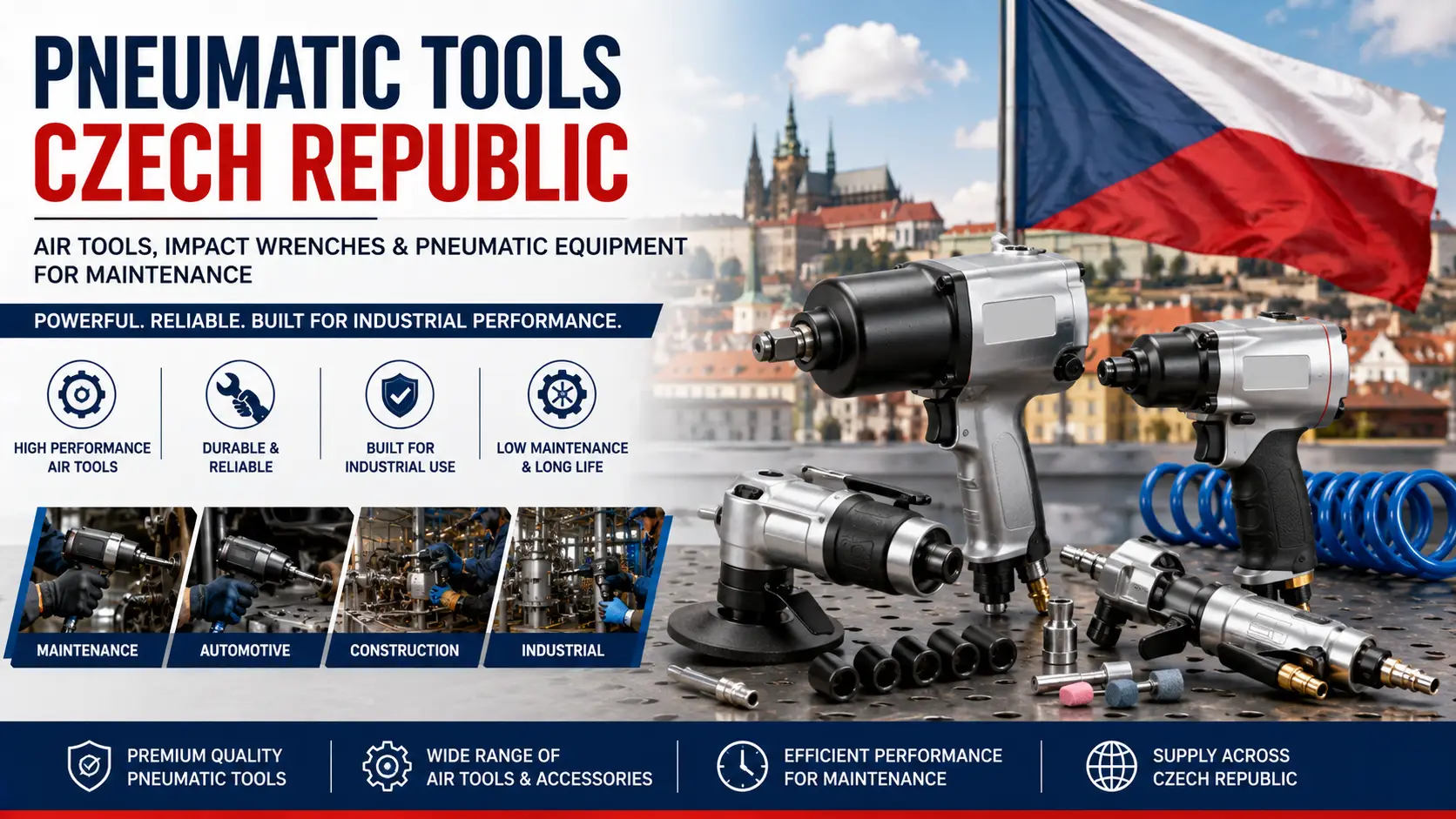
In the Czech Republic, industrial pneumatic tools are essential for ensuring efficient and reliable operations in manufacturing facilities, automotive suppliers, and maintenance workshops throughout Central Europe. The selection of the proper industrial pneumatic tools Czech partner can have a direct impact on the total cost of ownership, safety, and productivity, whether you are a Prague-based assembly line, a metal fabrication shop in Brno, or a maintenance facility in Ostrava. This guide takes you through the basics of pneumatic tools, explains the difference between them and electric tools, identifies the industry applications, and guides you through how to objectively choose a supplier based on standards.
Looking for quotes on compressed-air equipment for your facility?
What Are Industrial Pneumatic Tools?
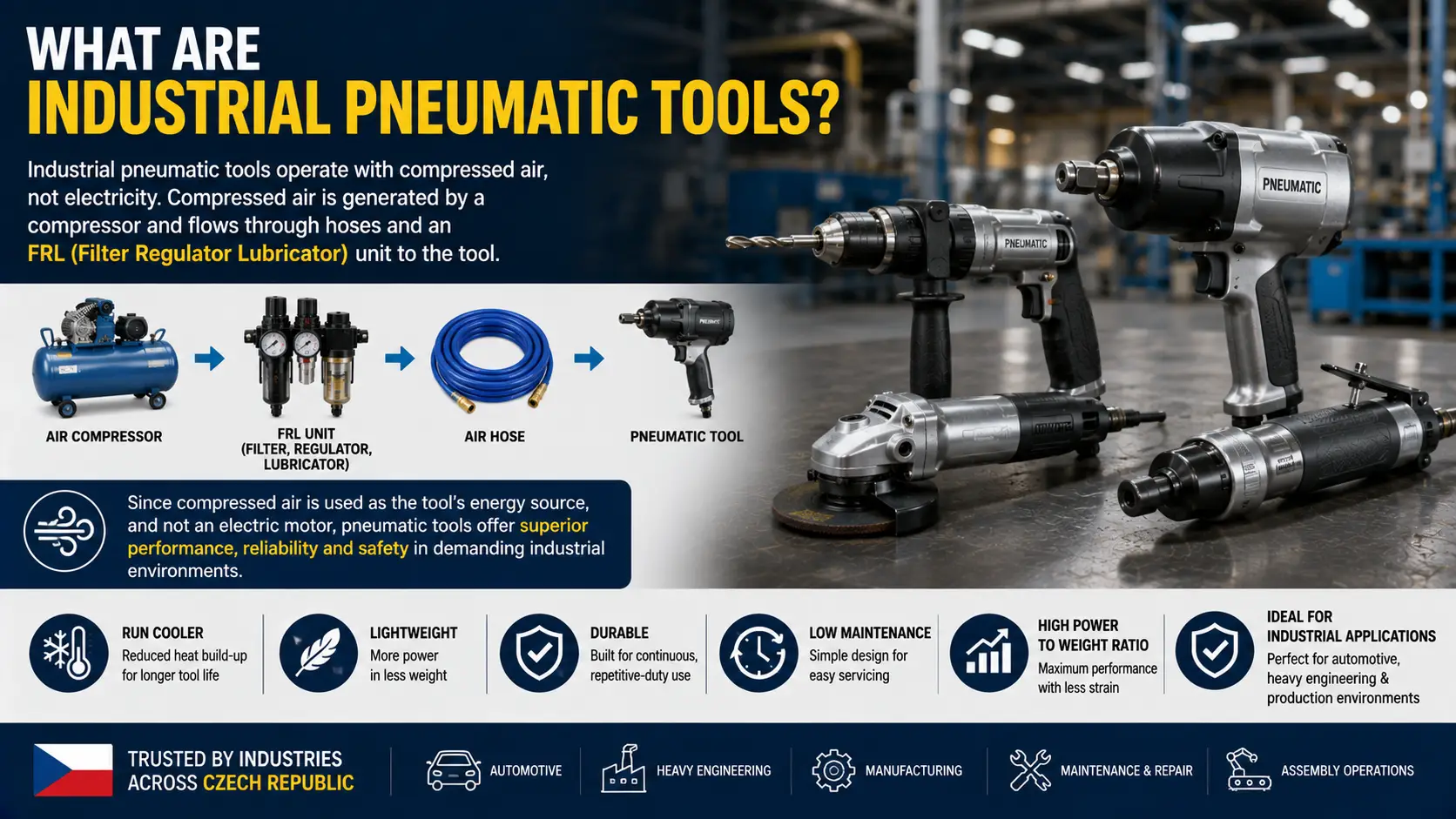
Industrial pneumatic tools: These are tools that operate with compressed air rather than electricity and are used to fasten, drill, grind, cut, polish and assemble. The air is pressurized by the compressor and then flows through the hoses and an FRL (Filter Regulator Lubricator) unit to the tool. Since compressed air is used as the tool's energy source, and not an electric motor, these tools run cooler, weigh less for a given amount of power, and are more durable in continuous repetitive-duty production settings, which is why industrial pneumatic tools Czech Republic buyers enjoy for their use in automotive and heavy engineering applications.
Why Industries Choose Pneumatic Tools
Compressed-air equipment is particularly suited to the manufacture in high volume of continuous duty, and has a specific set of engineering advantages that make it the preferred option:
Compact design that minimizes the space required, especially for storage or transport
Non-stop running without motor over heating
Lower long-term maintenance complexity than many designs for electric tools
Lower ignition risk – this is important where there may be hazardous or flammable conditions
Long service life with clean and well-controlled compressed air
Types of Industrial Pneumatic Tools
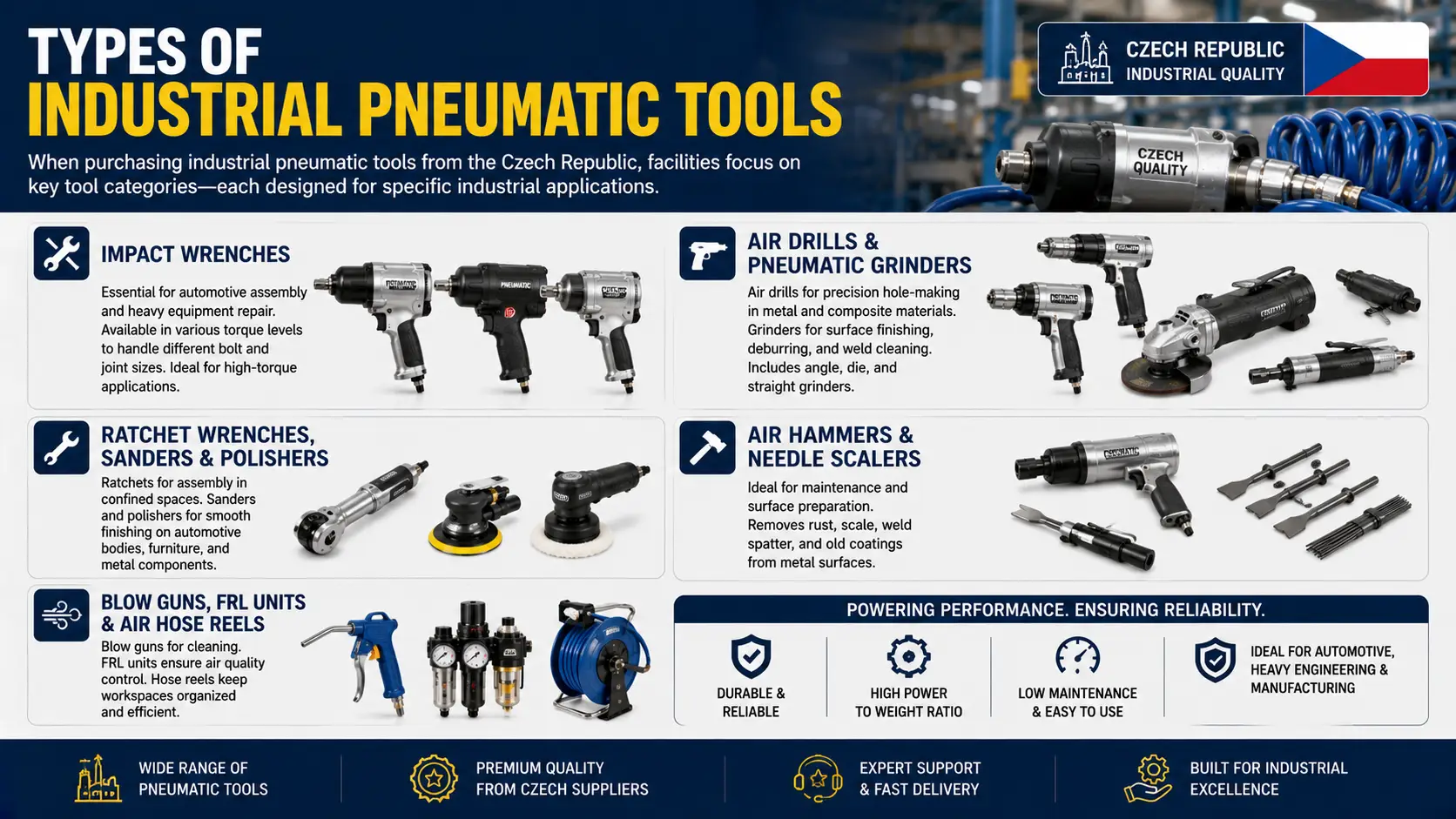
When purchasing industrial pneumatic tools from the Czech Republic, the facilities tend to focus on a few basic categories of tools, each of which can be used to perform a particular job:
Impact Wrenches
In automotive assembly and heavy equipment repair, a pneumatic impact wrench supplier must provide various torque levels to accommodate different bolt and joint sizes, as torque is crucial for high-torque operations. Torque is critical in high-torque applications, such as automotive assembly and heavy equipment maintenance, where a pneumatic impact wrench supplier must offer a range of torque levels to accommodate different bolt and joint sizes.
Air Drills and Pneumatic Grinders
Precision hole-making in metal and composite materials is performed using air drills and a pneumatic grinder supplier will have grinders for surface finishing, deburring, and weld cleaning during metal fabrication, all of which can be angle grinders, die grinders, or straight grinders.
Ratchet Wrenches, Sanders, and Polishers
Ratchets are used in assembly in confined spaces, sanders and polishers are used to finish surfaces on automotive bodies and furniture and metal components.
Air Hammers and Needle Scalers
These are used in maintenance or surface preparation applications for removing rust, scale, weld spatter, and old coatings from metal surfaces.
Blow Guns, FRL Units, and Air Hose Reels
The ancillary equipment, such as blow guns for cleaning, FRL units for air quality control and hose reels for workspace organization, are critical to the proper operation of a compressed air system.
Applications Across Czech Industries
Demand for industrial pneumatic tools in the Czech Republic covers various sectors that are the core of the country's manufacturing economy such as industrial air tool supplier facilities in the Czech Republic's capital of Prague, to workshops in Brno and Ostrava.
Automotive assembly plants with pneumatic and torque tools
Metal work shops using pneumatic grinders and die tools.
Maintenance work on heavy equipment that uses impact wrenches and ratchets
In the aerospace field, parts assembly that demands accurate torque control.
Any construction equipment servicing and field maintenance activities
Maintenance workshops for rail, energy and mining industries
Benefits of Air-Powered Industrial Equipment
Czech Republic buyers of air tools should also be able to quantify efficiency gains with the aid of an air tools supplier. The International Energy Agency (IEA) and the European Commission estimate that about 10% of the world's industrial electricity use is consumed by electric motor-driven compressed air systems, making efficient system design, leak detection, and preventive maintenance a significant opportunity to cut operating costs – not simply equipment purchases.
Pneumatic vs Electric Tools
There's a place on the factory floor for both families of tools. The right selection will vary based on duty cycle, environment and applications.
Factor | Pneumatic Tools | Electric Tools |
Power-to-weight ratio | High — lighter for equivalent output | Lower — heavier motors for same torque |
Continuous duty cycle | Well suited, minimal overheating | Limited by motor heat build-up |
Maintenance | Requires clean air, lubrication | Requires motor/brush servicing |
Mobility | Needs compressor and hose runs | Cordless options offer mobility |
Spark risk | Lower, useful in certain environments | Higher, depending on tool design |
Best fit | High-volume, repetitive industrial tasks | Mobile, low-frequency, field tasks |
How to Choose the Right Pneumatic Tool Supplier
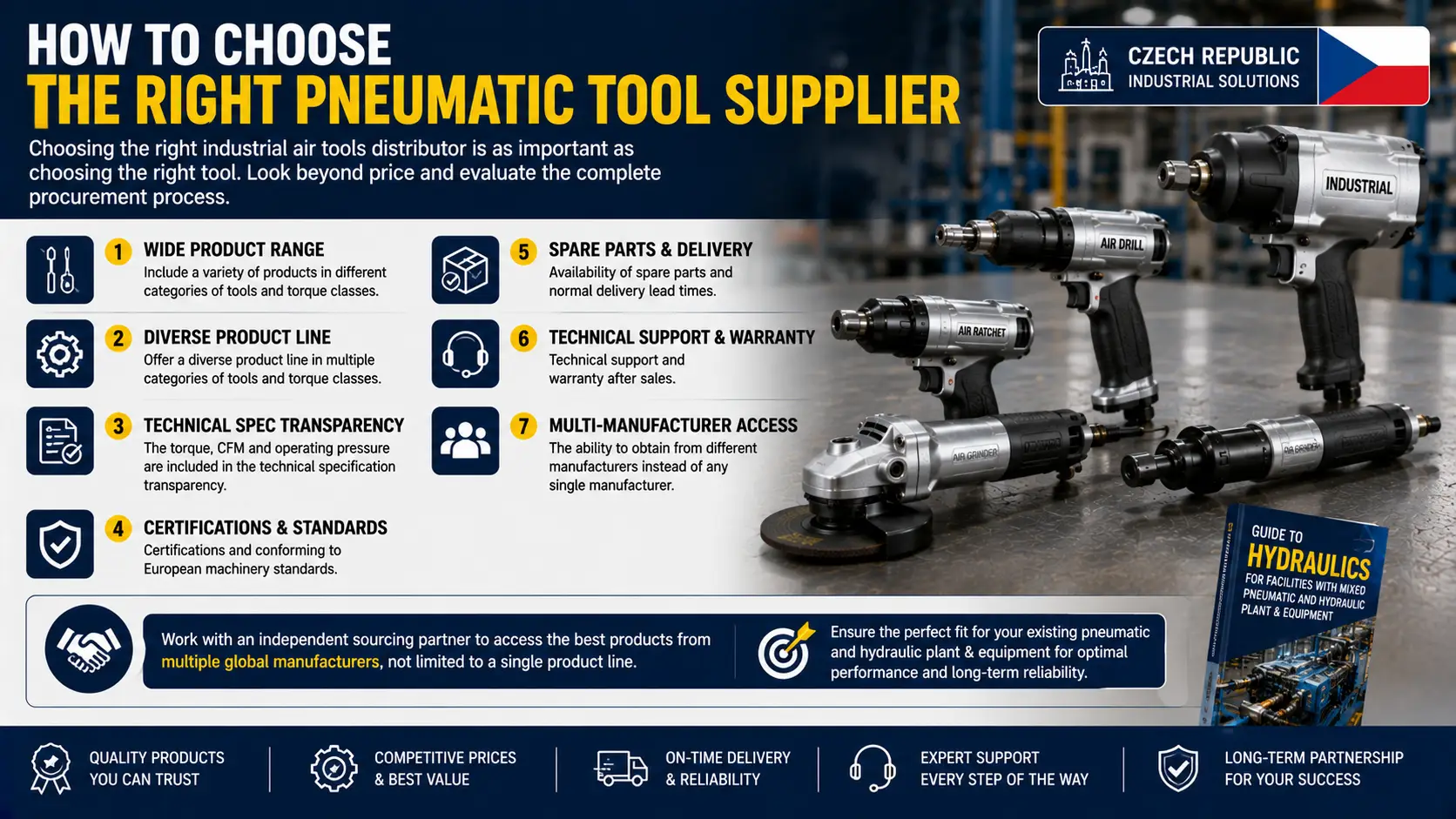
As crucial as the choice of tool is, the one of an industrial air tools distributor. When choosing an industrial pneumatic tools supplier in the Czech Republic, buyers should not consider only price, they should take into account the entire procurement process:
Include a variety of products in different categories of tools and torque classes.
Offer a diverse product line in multiple categories of tools and torque classes.
The technical specification transparency includes the torque, CFM, and operating pressure.
The torque, CFM and operating pressure are included in the technical specification transparency.
Certifications and conforming to European machinery standards
Availability of spare parts and normal delivery lead times.
Technical support and warranty after sales
The ability to obtain from different manufacturers instead of any single manufacturer
You can find a suitable product from several global manufacturers using an independent sourcing partner that will guide you in the right direction instead of toward a one-line product.
This is especially valuable if the industrial maintenance tools Czech buyers require components that are an exact fit for their existing pneumatic and hydraulic plant and equipment, such as hydraulic cylinders and other fluid-power components that we've covered in our more comprehensive Guide to Hydraulics for Facilities with Mixed Pneumatic and Hydraulic Plant & Equipment.
Technical Specifications to Evaluate
Prior to asking for quotes, ensure the following parameters are checked with the application requirement:
Specification | What to Check |
Operating pressure | Most industrial tools run between 6–7 bar (90–100 PSI) |
Air consumption (CFM) | Match tool demand to compressor capacity |
Torque output | Confirm range fits fastening or assembly application |
Duty cycle rating | Verify suitability for continuous production use |
Weight and ergonomics | Assess operator fatigue for repetitive tasks |
Noise and vibration | Check compliance with workplace exposure limits |
European Standards and Certifications
When looking for a pneumatic tools supplier in Czech Republic that offers ISO certified products, buyers should ensure that the product and its manufacturing process are based on the following standards: ISO 11148: Hand-held, non-electric power tools, CE marking under the EU Machinery Directive, and guidance from the European Committee for Standardization (CEN) and the European Agency for Safety and Health at Work (EU-OSHA). The references are offered for educational or technical purpose and are not intended as endorsement, partnership or certification by any particular manufacturer.
Maintenance Best Practices
The most important condition for the service life and reliability of industrial pneumatic tools in the Czech Republic is regular maintenance:
Apply lubrication to tools as per manufacturers' recommendations to minimize internal wear.
Ensure compressed air is kept clean and dry using the correct sized FRL's
Regularly check hoses, couplings and seals
Replace seals and vanes that become worn, preventing tool failure.
Track service history to move from reactive to preventive maintenance
Common Mistakes to Avoid
Purchasing tools that do not account for the required airflow (CFM) from the compressor
Undersizing the compressor to meet the number of tools that are to use it at the same time.
Failure to replace filters, resulting in dirt and dust accumulation that increases wear
Not checking spare parts availability when selecting suppliers
Focusing on lower upfront cost and ignoring total cost of ownership.
Frequently Asked Questions
In which industries are pneumatic tools used?
they are used in many industries, including automotive, metalworking, aerospace, heavy machinery, construction, railway, energy, mining and industrial maintenance.
How do pneumatic tools work?
A compressor is used to create the pressurized air, which passes through a filter and regulator in an FRL unit and is then pushed through hoses to the internal motor or mechanism in the tool.
So, is pneumatic tooling superior to electric tooling?
There is no single best solution. Typically, pneumatic tools are used for high volume and long-duration industrial tasks, whereas electric tools are used for mobility needs for lighter work or field applications.
How large does the compressor need to be?
Compressor size will depend on the total compressor airflow (CFM) and total compressor pressure (bar/PSI) required for all the tools that can be operated at the same time.
When should pneumatic tools be serviced?
The lubrication and inspection frequency is determined by the application, manufacturer, and duty cycle of the equipment; however, it is recommended that routine lubrication and inspections be performed as part of a preventive maintenance program.
What certifications should industrial air tools have?
Check for CE marking under the EU Machinery Directive, ISO 11148 standards for non-electric hand-held tools, and manufacturer compliance documents.
What can I do to decrease compressed-air use?
Perform leak audits, ensure proper sizing of hose and couplings and ensure FRL units are maintained to ensure a system operates at peak efficiency.
How to find a good industrial supplier?
Consider product range, technical transparency, certifications, spare parts, delivery and after-sales service – not just the price.
Request Industrial Pneumatic Tool Sourcing Assistance
Looking for industrial pneumatic tools in the Czech Republic? Our team's role is to be a sourcing and procurement partner to you to help identify compressed air tools supplier solutions that are technically suitable, standards compliant, and are offered by multiple global manufacturers that meet your operational requirements, budget, and procurement timeline. Complementary fluid-power equipment is explored in our Hydraulic Cylinders resource and full Hydraulics Pillar page when combined with the other systems discussed in the resource page.
Discuss pneumatics: tooling options and procurement options with an expert.
DISCLAIMER: Z&F Corporation is not affiliated with, authorized by, endorsed by, or acting as an official representative of any manufacturer, brand, or trademark owner referenced on this website. All product names, trademarks, brand names, logos, and manufacturer references are the property of their respective owners and are used solely for identification, reference, and compatibility purposes.