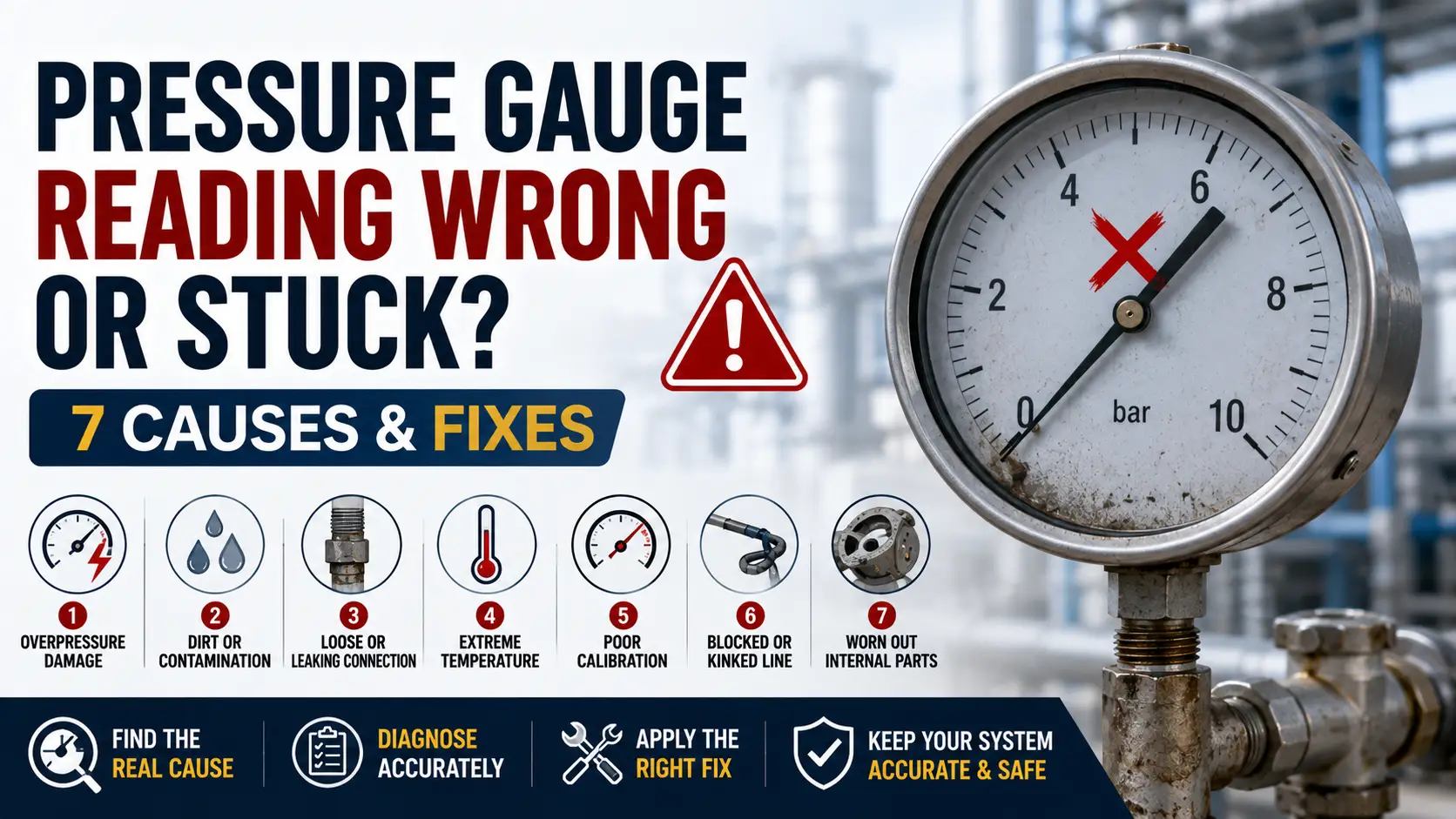
Pressure Gauge Reading Wrong or Stuck? 7 Causes & Fixes
A mechanical pressure gauge reading wrong, stuck, or not returning to zero is almost always a mechanical problem inside the Bourdon tube movement — pressure spikes, vibration, or a blocked connection — not a sign the gauge needs recalibrating from scratch. Genuine calibration drift is real but comes on gradually; a gauge that's suddenly stuck, reading way off, or won't return to zero has usually taken physical damage.
This guide covers the seven most common reasons a pressure gauge misbehaves, how to tell them apart, and when a gauge genuinely needs replacing versus a straightforward fix.
Isolate the system before removing any gauge. A gauge under pressure can discharge fluid or gas forcefully if disconnected while the line is still live — always isolate and safely depressurise the connection point first.
The Mechanism Behind Most "Faulty Gauge" Complaints
Inside a standard mechanical pressure gauge, process pressure enters a curved, flattened metal tube — the Bourdon tube — sealed at the far end. Pressure tries to straighten the curved tube, and that small mechanical movement is amplified through a gearing mechanism to sweep the needle across the dial. It's an elegant, purely mechanical system with no electronics to fail — but exactly because it's mechanical, it's vulnerable to fatigue from repeated pressure cycling, physical shock, and vibration in ways an electronic sensor isn't. Almost every fault in this guide traces back to something interfering with that tube's free, repeatable movement.
Common Gauge Features Worth Knowing
| Feature | Purpose |
|---|---|
| Glycerine-filled case | Dampens needle flutter from pulsating pressure and vibration |
| Blow-out back/disc | Vents case pressure safely if the Bourdon tube ruptures |
| Accuracy class | Maximum permissible error as a % of full-scale reading |
| Snubber/restrictor | Restricts flow into the gauge to dampen pressure spikes |
7 Causes of a Pressure Gauge Reading Wrong or Sticking
Blocked or Partially Blocked Process Connection
Debris, scale, or a viscous process fluid partially blocking the connection between the process and the gauge slows or stops the Bourdon tube from responding to real pressure changes — the gauge reads a stale value rather than current pressure, or moves sluggishly. This is especially common on gauges fitted directly without isolation, where the connection can't be cleared without shutting the process down.
Overpressure Event Deforming the Bourdon Tube
A pressure spike beyond the gauge's rated range — even briefly — can permanently deform the Bourdon tube, leaving the gauge reading incorrectly (often not returning fully to zero) even after pressure returns to normal. This is a permanent mechanical fault; the gauge needs replacing, and it's worth investigating what caused the spike in the first place, such as a water hammer event or a valve closed too quickly.
Fatigue Failure From Pulsating Pressure or Vibration
Gauges fitted directly to reciprocating pumps, compressors, or other pulsating pressure sources undergo constant micro-flexing of the Bourdon tube, and the gearing mechanism wears from continuous vibration. This shows up as a fluttering or unstable needle and, eventually, permanent inaccuracy — a glycerine-filled (liquid-filled) gauge or a snubber fitted upstream is the standard fix for this exact application.
Corrosion or Chemical Attack on the Wetted Parts
A gauge with a Bourdon tube material incompatible with the process fluid — standard brass or bronze in a chemically aggressive service, for example — can corrode internally, changing the tube's mechanical response and accuracy well before any external sign of damage is visible. Confirm wetted material compatibility against the actual process chemistry, not just pressure and temperature rating.
Ambient Temperature Extreme Affecting the Reading
Standard gauges are temperature-compensated for a normal ambient range, but installations in direct sun, near hot equipment, or in cold outdoor environments can push readings outside their stated accuracy band even with a perfectly healthy mechanism. If the reading drifts noticeably with time of day or season rather than with actual process changes, ambient temperature is worth checking before condemning the gauge.
Loose or Worn Movement/Gearing Internally
Years of normal use wear the gear sector and pinion that translate the Bourdon tube's tiny movement into the needle sweep, introducing backlash — the needle sticks slightly then jumps, or reads differently depending on whether pressure is rising or falling. This is a genuine mechanical wear-out fault, generally not economical to repair on a standard commercial gauge, and the gauge should be replaced.
Genuine Gradual Calibration Drift
Even a healthy gauge drifts slowly outside its rated accuracy over years of normal service — this is expected and why process-critical gauges are on a periodic calibration schedule rather than assumed accurate indefinitely. A gauge reading slightly off, consistently, with no other symptoms, and no history of overpressure or damage, points here rather than at a specific fault.
Quick Reference: Symptom, Likely Cause & What to Check
| Symptom | Most Likely Cause | Quick Check |
|---|---|---|
| Sluggish or stale reading, doesn't track process changes | Blocked process connection | Isolate and inspect/clear the connection |
| Won't return to zero after pressure is removed | Overpressure damage to the Bourdon tube | Replace gauge; investigate the pressure spike source |
| Needle flutters constantly on a pump/compressor line | Fatigue from pulsating pressure/vibration | Fit a liquid-filled gauge or snubber |
| Needle sticks then jumps, differs rising vs falling | Worn internal gearing (backlash) | Replace the gauge — not economical to repair |
| Small, consistent, gradual reading offset | Normal calibration drift over time | Recalibrate or replace per the site's calibration schedule |
Frequently Asked Questions
Can a mechanical pressure gauge be repaired, or does it always need replacing?
On standard commercial gauges, replacement is almost always more cost-effective than repair — the labour to disassemble, diagnose, and re-calibrate a small mechanical movement usually exceeds the cost of a new gauge. Higher-value process or test gauges may be worth sending for professional calibration and repair.
Why is my gauge reading different from a digital reference gauge on the same point?
Some difference is expected and normal — every gauge has a stated accuracy class defining its maximum permissible error, and two gauges of different accuracy classes will legitimately disagree within their combined tolerance. A difference larger than both gauges' stated accuracy classes combined points to a genuine fault in one of them.
Do I need a liquid-filled gauge for every application?
No — liquid-filled gauges add cost and are specifically justified where pulsating pressure or vibration is a real factor (pumps, compressors, mobile equipment). A stable, steady-pressure application doesn't need one, and a dry gauge is perfectly reliable there.
How often should process gauges be recalibrated?
There's no universal fixed interval — it depends on the gauge's criticality, accuracy class, and site quality procedures, but annual calibration is a common baseline for process-critical instrumentation, with more frequent checks on gauges in harsh or high-cycling service.
Should I fit a gauge isolation valve if there isn't one already?
Strongly recommended — a gauge isolation (needle or ball) valve lets the gauge be removed, cleared of blockage, or replaced without shutting down or depressurising the whole line, and is a low-cost addition compared with the downtime avoided the first time a gauge needs attention.
Related Reading
Shop the Parts
| Product | Use | Link |
|---|---|---|
| Emerson-ASCO 1/8in NPT Pressure Gauge, 40mm, 10 bar | Direct replacement for compact process pressure indication | View product → |
| Emerson-ASCO R 1/8in Tapered Pressure Gauge, 50mm, 12 bar, UKAS | Calibrated gauge with traceable UKAS certification | View product → |
| Full pressure gauge range | Browse by dial size, range, connection and liquid-filled option | Browse pressure gauges → |
| All genuine Emerson products | Pressure gauges, sensors and process instrumentation | View all Emerson products → |
Disclaimer: Emerson, ASCO, and any other manufacturer or brand names referenced in this article, are used solely for identification and compatibility purposes. Z&F Corporation is not affiliated with, authorised by, or an official representative of these manufacturers; all trademarks are the property of their respective owners.