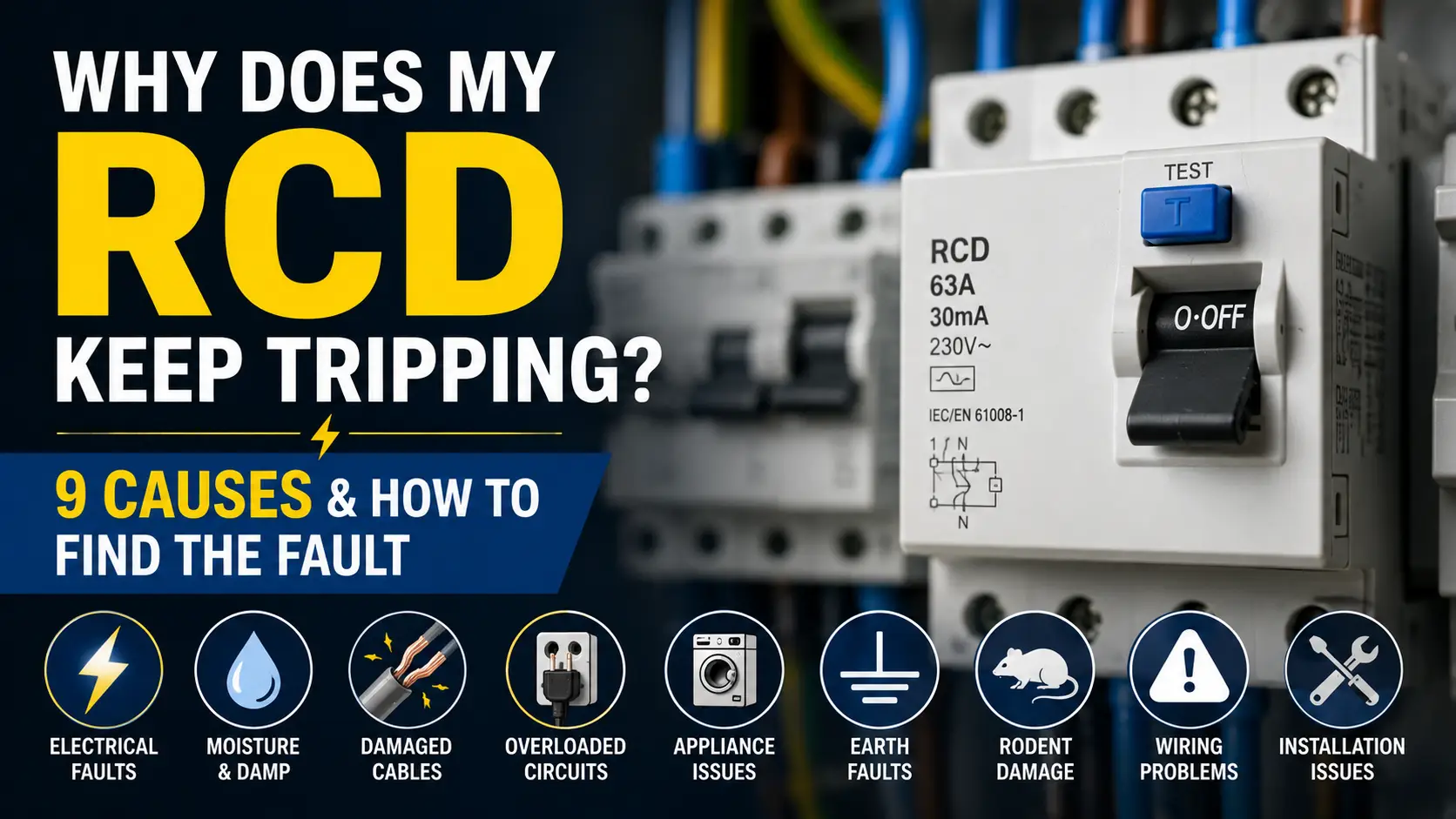
Why Does My RCD Keep Tripping? 9 Causes & How to Find the Fault
An RCD that keeps tripping is doing exactly what it's designed to do — it has almost certainly detected a real imbalance between line and neutral current, not developed a fault of its own. In most cases the cause is a leaking appliance, damp cabling outdoors, or several small "healthy" leakages from filtered equipment adding up on one shared RCD, rather than the device itself being defective. Replacing a tripping RCD without finding out why it tripped usually just moves the same nuisance trip onto the next one.
This guide covers the nine most common reasons an RCD keeps tripping, how to narrow down which circuit or appliance is responsible, and when the RCD genuinely is the faulty part — for maintenance electricians on a call-out and facilities engineers trying to stop a nuisance trip from taking out a whole distribution board.
Don't just keep resetting it. An RCD that trips repeatedly is reporting a real leakage path to earth. Repeated resetting without investigating risks re-energizing a genuine fault — such as damaged cable insulation or a failing appliance — that could become a shock or fire risk. All checks below assume safe isolation by a competent person before any wiring is touched.
How an RCD Actually Detects a Fault
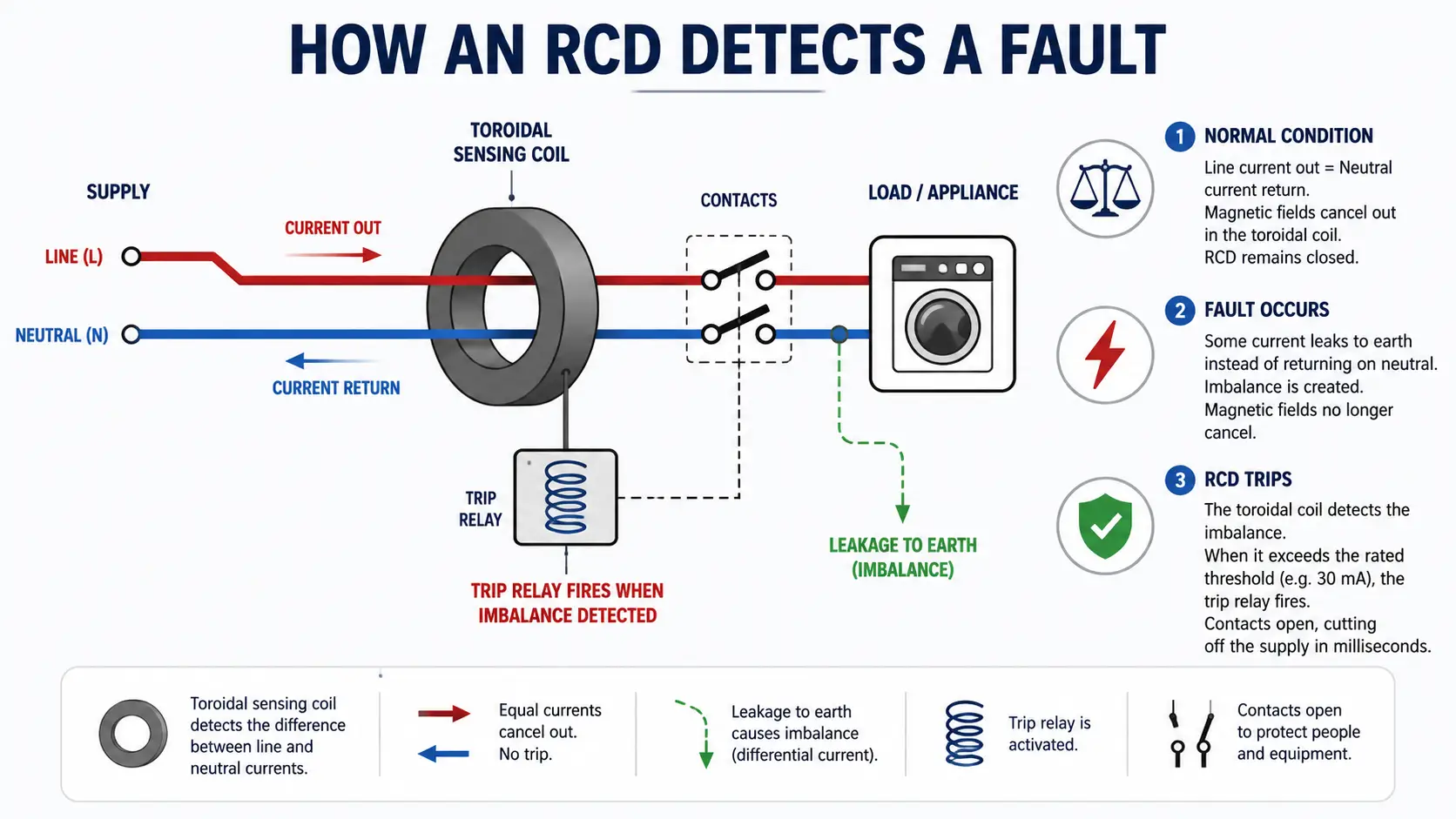
An RCD works by comparing the current flowing out to a circuit on the line conductor against the current returning on the neutral conductor. Both pass through a toroidal current transformer inside the device; in a healthy circuit, the two currents are equal and their magnetic fields cancel out. The moment some current finds a path to earth instead of returning through neutral — through a person, damp insulation, or a faulty appliance casing — that balance is broken. The transformer detects the resulting differential current, and once it crosses the rated tripping threshold (commonly 30 mA for personal protection), a trip relay fires and opens the contacts within milliseconds. Nothing about this process cares whether the leakage is dangerous or completely benign — it trips on the imbalance itself, which is exactly why nuisance tripping from harmless sources is so common.
Line and neutral conductors pass through a toroidal sensing coil. When current leaks to earth instead of returning on neutral, the coil detects the imbalance and fires a trip relay that opens the contacts. Supply Line Neutral Toroidal sensing coil Contacts Load / appliance Leakage to earth (imbalance) Trip relay fires when imbalance > rated mA
RCD Types at a Glance
|
Type |
Detects |
|---|---|
|
Type AC |
Sinusoidal AC residual current only — the most basic and increasingly unsuitable for modern loads |
|
Type A |
AC plus pulsating DC residual current — required for most modern electronic loads |
|
Type B |
AC, pulsating DC, and smooth DC residual current — needed for three-phase drives, PV inverters and EV charging |
|
RCBO |
Combines RCD earth-fault protection with MCB overcurrent protection in one device, per final circuit |
9 Causes of an RCD Tripping Repeatedly
1
A Genuinely Faulty Appliance
By far the most common cause. Kettles, washing machines, immersion heaters, and outdoor power tools are frequent offenders because their heating elements or motors sit close to earthed metal casework, and insulation breakdown there leaks current straight to earth. Unplug everything on the affected circuit, reset the RCD, then reconnect appliances one at a time — the one that trips it again is the culprit.
2
Damp or Water Ingress in Cabling and Enclosures
Outdoor sockets, garden lighting, and cable joints in unsealed enclosures are classic sources of moisture-related leakage — and the trip often correlates neatly with rain or humidity. Water doesn't need to be visible; a compromised gland or a cracked junction box can let in enough moisture to bridge a leakage path long before anything looks obviously wet. Isolate outdoor circuits first when tripping tracks with weather.
3
A Shared or Borrowed Neutral
If a neutral conductor from one circuit has been cross-connected onto another — common in older installations that have been added to over the years — some of that circuit's return current takes a path outside the RCD's sensing coil entirely. The device reads this as an imbalance and trips even though there's no earth fault at all. This is a wiring fault, not a device fault, and it needs tracing at the distribution board and downstream junctions.
4
Cumulative Leakage From Multiple Filtered Loads
Modern electronics — PCs, VFDs, LED drivers, switch-mode power supplies — all contain small EMC filter capacitors between line/neutral and earth that leak a tiny, permitted amount of current by design. One or two on a circuit is harmless, but a distribution board with dozens of them sharing a single 30 mA RCD can add up to a trip with no single "faulty" item at all. This shows up as a trip that happens only once a certain number of devices are switched on together, and the long-term fix is splitting loads across more RCDs or RCBOs rather than hunting for one bad appliance.
5
Wrong RCD Type for the Load
A Type AC RCD can behave erratically or fail to sense correctly on circuits feeding VFDs, EV chargers, or PV inverters, because these loads can produce smooth DC residual current components that a basic AC-only sensing coil isn't designed to detect reliably — and in some documented cases can even desensitize it. The nuisance-trip version of this problem is a Type A device installed where three-phase drive equipment genuinely needs a Type B. Check the load's manufacturer documentation for the minimum RCD type it requires.
6
Voltage Transients and Surges
Motor starting inrush, lightning-induced surges on overhead supplies, and switching transients from large loads elsewhere on the network can all momentarily unbalance the sensing coil enough to trip a standard RCD — even with no real earth fault present. This tends to show up as a trip that coincides with a specific plant item starting, or after storms. RCDs with a built-in time delay (Type S, typically used upstream for discrimination) are more resistant to this than instantaneous types.
7
Reversed or Crossed Line/Neutral Wiring
If line and neutral have been swapped somewhere downstream, or neutral has been accidentally linked to earth at a socket or light fitting, the RCD sees an imbalance that has nothing to do with a genuine leakage current. This is more common after DIY wiring work or a recent alteration, and it's worth checking anywhere that's been touched recently before assuming an appliance is at fault.
8
A Genuine Overload or Short Circuit Mistaken for an RCD Trip
On a board with a combined RCD/MCB arrangement, it's easy to assume the RCD tripped when actually an MCB tripped on overload or short circuit, or vice versa. The two point to completely different faults — one to a leakage-to-earth problem, the other to excess current draw or a line-to-neutral fault — so check which device has actually operated (look at the toggle position and, on RCBOs, any trip-indication flag) before diagnosing further.
9
The RCD Itself Has Degraded
Least common, but real: mechanical wear, dust ingress, or age can lower an RCD's own trip threshold or make it mechanically over-sensitive, so it trips well below its rated mA with no external cause at all. This is the one genuine "faulty RCD" scenario in this list — confirmed by isolating every downstream circuit and appliance and still getting a trip on reset, or by an RCD tester showing a trip time or current well outside its rated tolerance.
Quick Reference: Symptom, Likely Cause & What to Check
|
Symptom |
Most Likely Cause |
Quick Check |
|---|---|---|
|
Trips as soon as one specific appliance is switched on |
Faulty appliance leaking to earth |
Reconnect appliances one at a time after a clean reset |
|
Trips correlate with rain or damp weather |
Water ingress in outdoor cabling or enclosures |
Isolate outdoor circuits; inspect glands and joints |
|
Trips only once several devices are on together |
Cumulative leakage from filtered electronic loads |
Count filtered devices on the circuit; consider splitting across RCBOs |
|
Trips on a VFD, EV charger or PV inverter circuit |
Wrong RCD type (AC/A) for a DC-leakage load |
Check the load's required RCD type against what's fitted |
|
Trips coincide with a large motor starting or storms |
Voltage transient or surge |
Note timing pattern; consider a time-delayed (S-type) RCD upstream |
|
Trips even with every downstream circuit isolated |
Degraded RCD or a wiring fault ahead of it |
Test with a calibrated RCD tester; replace if out of tolerance |
Fault-Finding Flow: From Trip to Fix
Start by isolating all circuits, then reset the RCD alone; if it still trips the device or upstream wiring is at fault, otherwise reconnect circuits one at a time to find the offending circuit or appliance. RCD keeps tripping repeatedly Still trips with ALL circuits isolated at the board? Yes Fault is the RCD itself or the wiring feeding it — test with a calibrated RCD tester No Trips again when ONE circuit is reconnected on its own? No Likely cumulative leakage — reconnect loads gradually together Yes That circuit has the fault — isolate appliances on it one at a time to find the specific item or damp cable run
1
Does it still trip with every downstream circuit isolated at the board?
Yes The fault is the RCD itself or the wiring feeding it — test with a calibrated RCD tester.
No Move to step 2.
2
Does it trip again as soon as one circuit is reconnected on its own?
No Likely cumulative leakage — reconnect loads gradually together.
Yes Move to step 3.
3
Final check
That circuit carries the fault — isolate appliances on it one at a time to find the specific item, or inspect for a damp or damaged cable run.
Frequently Asked Questions
Is it safe to just keep resetting a tripping RCD?
No — an RCD trips because it has detected a real leakage current, and repeatedly resetting it without investigating re-energizes whatever is causing that leakage. If the cause is damaged cable insulation or a failing appliance, that's a genuine shock or fire risk, not a nuisance to work around.
Why does my RCD only trip when it rains?
This is a strong indicator of water ingress somewhere in an outdoor circuit — a cable joint, gland, garden light fitting, or outdoor socket that's letting moisture bridge a leakage path to earth. Isolate outdoor circuits first and inspect enclosures and glands for signs of water entry.
Can one small appliance really trip a whole distribution board?
Yes, if every circuit on that board shares a single RCD. Any single appliance leaking above the device's rated threshold — commonly 30 mA — will trip it regardless of how small or otherwise harmless that appliance seems. This is exactly why splitting circuits across multiple RCDs or RCBOs limits how much of an installation goes down from one fault.
What's the difference between an RCD, an RCBO and an MCB when something trips?
An MCB trips on overcurrent — too much current draw or a short circuit. An RCD trips on an earth leakage imbalance, regardless of how much current is actually flowing. An RCBO combines both functions in one device per circuit, so it can tell you which type of fault occurred rather than leaving you to guess between a shared RCD and MCB.
How do I find which circuit is causing an RCD to trip?
Isolate every circuit at the board, reset the RCD, then reconnect circuits one at a time. The circuit that causes the RCD to trip again as soon as it's reconnected is the one carrying the fault — from there, isolate appliances on that circuit individually to narrow it down further.
Should I upgrade from one shared RCD to individual RCBOs?
On boards with many circuits, or a mix of sensitive electronic loads and outdoor/wet-area circuits, RCBOs are usually worth it — a fault on one circuit only takes that circuit down instead of the whole board, and cumulative leakage from unrelated equipment stops adding up against a single shared threshold.
Related Reading
RCD tripping is one of three nuisance-trip questions we hear most often — the other two are contactors that won't pull in and breakers that keep tripping on load. If this guide didn't solve it, one of these is worth checking next:
Shop the Parts
|
Product |
Use |
Link |
|---|---|---|
|
ABB DDA200 Series RCD, 25A, 4-Pole, 30 mA, Type A |
Direct replacement for a degraded RCD, or splitting an overloaded shared circuit |
|
|
ABB DDA204 Series RCD, 40A, 4-Pole, 30 mA, Type AC |
Higher-current three-phase distribution circuits |
|
|
ABB DDA200 Series RCD, 40A, 4-Pole, 30 mA, Type B |
VFD, EV charging, and PV inverter circuits needing full DC-leakage sensing |
|
|
RCBOs |
Per-circuit RCD + MCB protection to stop one fault taking down a whole board |
|
|
Full RCD range |
Browse by pole count, sensitivity (mA) and Type AC/A/B |
|
|
All genuine ABB products |
RCDs, MCBs, contactors and switchgear from the same manufacturer |
Disclaimer: ABB, and any other manufacturer or brand names referenced in this article, are used solely for identification and compatibility purposes. Z&F Corporation is not affiliated with, authorized by, or an official representative of these manufacturers; all trademarks are the property of their respective owners.