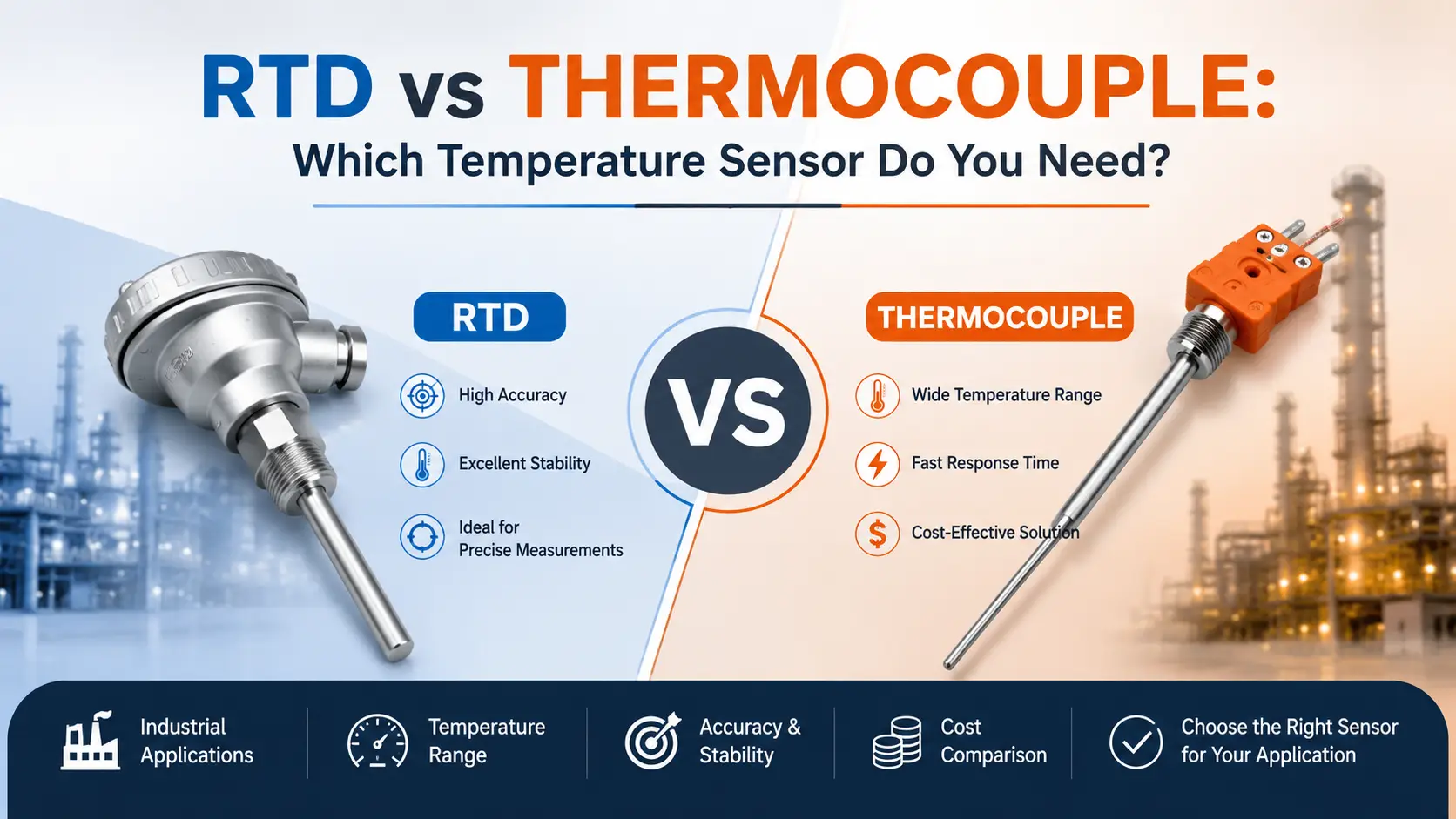
RTD vs Thermocouple: Which Temperature Sensor Do You Need?
An RTD (resistance temperature detector) is more accurate and more stable over time, and is the standard choice for process temperatures up to roughly 600°C. A thermocouple is more rugged, responds faster, needs no external excitation current, and is the only realistic option once temperatures climb into the high hundreds or thousands of degrees. Below that shared operating range, the choice comes down almost entirely to how much accuracy the application actually needs versus how much it needs to survive mechanical abuse and rapid temperature swings.
This guide compares how each one actually measures temperature, where their operating ranges and accuracy genuinely differ, and how to pick the right one for a given process.
Two Completely Different Measurement Principles
An RTD measures temperature by exploiting the fact that a metal's electrical resistance changes predictably and repeatably with temperature — typically a platinum element (the "Pt" in PT100/PT1000), chosen because its resistance-temperature relationship is extremely linear and stable over long periods. A small, known excitation current is passed through the element and the resulting voltage drop is converted to a resistance, and then to a temperature, by an instrument or transmitter. A thermocouple works on an entirely different principle — the Seebeck effect — where two dissimilar metal wires joined at one end generate a small voltage proportional to the temperature difference between that junction and the reference end. No excitation current is needed; the junction itself generates the signal, which is what makes thermocouples simple, rugged, and fast to respond.
Side-by-Side Comparison
| Feature | RTD (Pt100/Pt1000) | Thermocouple |
|---|---|---|
| Typical accuracy | ±0.1°C to ±0.5°C | ±1°C to ±2.5°C (type dependent) |
| Typical range | -200°C to ~600°C | -200°C to ~1800°C (type K/R/S/B) |
| Response time | Slower | Faster |
| Mechanical robustness | Lower — more fragile element | Higher — simple wire junction |
| Long-term stability | Excellent — very low drift | Fair — can drift with thermal cycling |
| Relative cost | Higher | Lower |
Three Questions That Settle the Choice
What Temperature Range Does the Process Reach?
Above roughly 600°C, RTDs are no longer viable and a thermocouple is the only realistic choice. Within the shared operating range below that, both are viable and the decision shifts to accuracy and robustness requirements instead of range alone.
How Much Accuracy and Long-Term Stability Does the Process Need?
Precision temperature control, custody transfer measurement, and long unattended runs without recalibration all favour an RTD's superior accuracy and stability. If the application just needs a good working temperature indication rather than tight, drift-free precision, a thermocouple's lower accuracy is rarely a practical problem.
How Fast Does Temperature Change, and How Harsh Is the Mechanical Environment?
A thermocouple's smaller thermal mass and simple wire junction respond faster to rapid temperature swings and tolerate vibration, mechanical shock, and thermal cycling better than an RTD's more delicate resistance element. Fast-cycling processes, or sensors exposed to physical abuse, tend to favour a thermocouple even where an RTD's accuracy would otherwise be preferred.
Frequently Asked Questions
What's the difference between a 2-wire, 3-wire and 4-wire RTD?
The wire count determines how the instrument compensates for the resistance of the lead wires themselves, which would otherwise be read as part of the sensor's own resistance and introduce error. 2-wire offers no compensation and is only suitable for short runs; 3-wire is the common industrial standard; 4-wire gives the highest accuracy by fully cancelling lead resistance, used where precision matters most.
What do thermocouple types K, J, T, and N actually mean?
Each letter designates a specific pair of dissimilar metals with a defined temperature-voltage relationship and operating range — Type K (chromel-alumel) is the most common general-purpose type; Type J has a narrower range but higher output at lower temperatures; Type T suits low/cryogenic temperatures; Type N offers improved stability over K at high temperatures. The right type depends on the process temperature range and required accuracy.
Can I connect either sensor type directly to a standard PLC analogue input?
No — both need a dedicated input module or transmitter designed specifically for RTD resistance measurement or thermocouple millivolt-level signals with cold-junction compensation, rather than a generic 4-20mA or voltage analogue input. Using the wrong input type produces meaningless or wildly inaccurate readings.
What is cold-junction compensation and why does a thermocouple need it?
A thermocouple actually measures the temperature difference between its hot junction and its reference ("cold") junction at the instrument, not an absolute temperature. Cold-junction compensation measures the reference junction's actual temperature (often with a small built-in sensor) and corrects the reading accordingly — without it, thermocouple readings drift with the ambient temperature at the instrument end.
Which one is cheaper to install and maintain over the sensor's life?
Thermocouples are cheaper upfront and simpler to replace. RTDs cost more initially but hold calibration longer, which can reduce recalibration frequency and associated labour over a multi-year service life — the total cost comparison depends heavily on how critical accuracy is and how often the site recalibrates either type.
Related Reading
Shop the Parts
| Product | Use | Link |
|---|---|---|
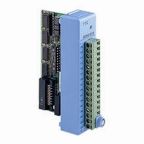
| Allen Bradley 1762-IR4 RTD Input Module, MicroLogix, 4 Channels | RTD signal input for PLC-based temperature monitoring | View product → |
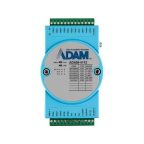
| Advantech ADAM Series Thermocouple Module for PLCs | Thermocouple signal conditioning and PLC integration | View product → |
| Advantech ADAM Series RTD Sensor for PLCs | RTD temperature sensing for PLC-integrated monitoring | View product → |
| Full temperature sensor range | Browse RTDs, thermocouples and temperature instrumentation | Browse temperature sensors → |
| All genuine Allen Bradley products | PLC I/O modules and industrial automation components | View all Allen Bradley products → |
Disclaimer: Allen Bradley, Advantech, and any other manufacturer or brand names referenced in this article, are used solely for identification and compatibility purposes. Z&F Corporation is not affiliated with, authorised by, or an official representative of these manufacturers; all trademarks are the property of their respective owners.