Safety Relay vs Standard Relay: What's the Difference & Why It Matters
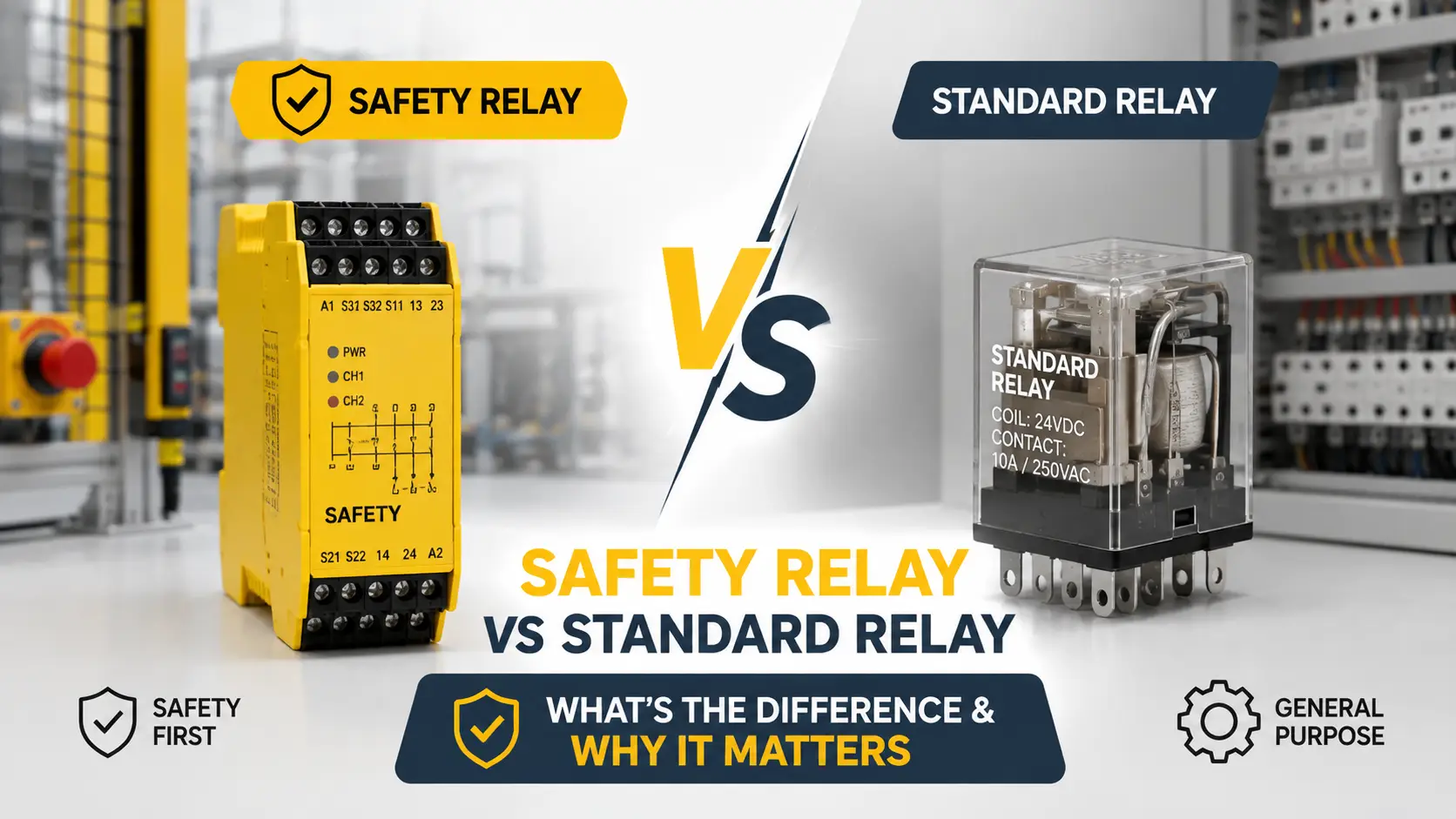
A standard relay switches on command and trusts that it will work correctly — if a contact welds shut, nothing in the relay itself detects that failure. A safety relay is built with internal contact monitoring, forcibly guided (mechanically linked) contacts, and redundant circuit paths specifically so that a single internal fault causes it to fail safe rather than fail silently. If a relay sits in the stop path of an emergency stop, a guard interlock, or any other safety function, that difference isn't a nice-to-have — it's the entire reason the device exists.
This guide covers what actually makes a safety relay different internally, how to tell whether a function genuinely needs one, and what the safety category and PL/SIL ratings on a datasheet mean in practice.
Never substitute a standard relay in a safety function. A risk assessment (and standards like ISO 13849 or IEC 62061) determines the required Performance Level or Safety Integrity Level for a given machine function — a standard relay cannot meet those requirements regardless of how reliable it seems in service.
What "Fail Safe" Actually Means Inside the Device
A safety relay's key internal feature is forcibly guided contacts — the normally-open and normally-closed contacts are mechanically linked so they can never both be closed at once, even if one contact welds. This lets an internal feedback circuit continuously monitor that the contacts actually moved as commanded; if they didn't, the relay locks out rather than presenting a false "safe" state. Most safety relays also run two independent, redundant channels through the whole safety function, so a single-point failure in one channel doesn't silently defeat the protection — the other channel or the monitoring circuit catches it. A standard relay has none of this: single contacts, no forced guiding, no self-monitoring, and no defined behaviour on internal failure beyond "it might still work, or might not."
Side-by-Side Comparison
| Feature | Standard Relay | Safety Relay |
|---|---|---|
| Contact construction | Standard, independent contacts | Forcibly guided (mechanically linked) |
| Fault detection | None built in | Internal monitoring, locks out on fault |
| Redundancy | Single channel | Dual/redundant channels standard |
| Certification | General-purpose only | Rated to a specific PL (ISO 13849) or SIL (IEC 62061) |
| Typical use | Signalling, interlocking (non-safety), indicator control | E-stops, guard interlocking, light curtain monitoring |
How to Tell If a Function Actually Needs a Safety Relay
Does a Failure Here Create a Risk of Injury?
This is the fundamental test. An emergency stop button, a guard door interlock, a two-hand control, or a light curtain that stops a hazardous motion all sit in a safety function by definition — if the relay controlling that stop signal fails silently, a person can be injured. Signalling, general interlocking between non-hazardous processes, and indicator control don't carry that same risk and don't need safety-rated hardware.
What Performance Level or SIL Does the Risk Assessment Require?
A formal risk assessment on the machine (following ISO 12100 and ISO 13849, or IEC 62061 for electrical safety-related control systems) determines the required Performance Level (PLa–PLe) or Safety Integrity Level (SIL 1–3) for each safety function. The safety relay chosen must be rated to meet or exceed that requirement — a relay rated PLd doesn't automatically satisfy a function that's been assessed as needing PLe.
Does the Function Need Multiple Inputs Monitored Together?
Many safety relays are built specifically to monitor combinations — several e-stops in series, an e-stop plus a guard interlock, or a light curtain plus a two-hand control — with a single certified module handling the logic rather than trying to wire discrete standard relays into an equivalent (and unverified) safety circuit. If the application needs this kind of combined monitoring, a purpose-built safety relay module is almost always the simpler and safer route.
Frequently Asked Questions
Can I wire two standard relays together to create redundancy instead of buying a safety relay?
Not to an equivalent safety level. A certified safety relay's redundancy is validated as a complete system with a defined diagnostic coverage and failure mode — an ad-hoc arrangement of standard relays has no such validation and cannot be assumed to meet any Performance Level or SIL, however logical the wiring looks on paper.
Do safety relays need periodic testing once installed?
Yes — most safety functions require a documented periodic proof test (often as part of a scheduled maintenance regime) to confirm the safety relay and the whole safety chain still operate correctly, particularly on higher-demand or continuous-mode safety functions where the required test interval is defined by the risk assessment.
Is a safety PLC a replacement for discrete safety relays?
On larger or more complex machines, yes — a safety PLC can consolidate many safety functions into one certified controller with configurable logic, reducing panel wiring compared with many discrete safety relay modules. For simpler machines with just one or two safety functions, discrete safety relays are often the simpler and more cost-effective choice.
What happens if a safety relay's monitoring circuit detects a fault?
It locks out — the relay drops its outputs and typically requires a manual reset after the underlying fault (a welded contact, a wiring fault, mismatched channel timing) has been identified and corrected, rather than attempting to continue operating in a degraded, unverified state.
Can a safety relay be used for non-safety control functions too?
Technically yes, but it's an expensive and oversized choice for a non-safety function — a standard relay does that job at a fraction of the cost, and reserving safety-rated hardware for genuine safety functions keeps the panel design and documentation clearer for anyone auditing it later.
Related Reading
Shop the Parts
| Product | Use | Link |
|---|---|---|
| ABB Vital 24V dc Safety Relay, 2 Safety Contacts | E-stop and guard interlock monitoring | View product → |
| Siemens 3SK1 Safety Relay, 24V ac/dc, 4 Safety Contacts | Multi-channel safety function monitoring | View product → |
| Full safety relay range | Browse by safety category, PL/SIL rating and safety contact count | Browse safety relays → |
| Contactor relays | For non-safety control-circuit switching and signalling | Browse contactor relays → |
| All genuine ABB products | Safety relays and machine safety components | View all ABB products → |
Disclaimer: ABB, Siemens, and any other manufacturer or brand names referenced in this article, are used solely for identification and compatibility purposes. Z&F Corporation is not affiliated with, authorised by, or an official representative of these manufacturers; all trademarks are the property of their respective owners. This article is general guidance, not a substitute for a formal machinery risk assessment or safety validation.