Stainless Steel Fasteners UK Marine : Complete Guide to Grades, Corrosion Resistance & Offshore Applications
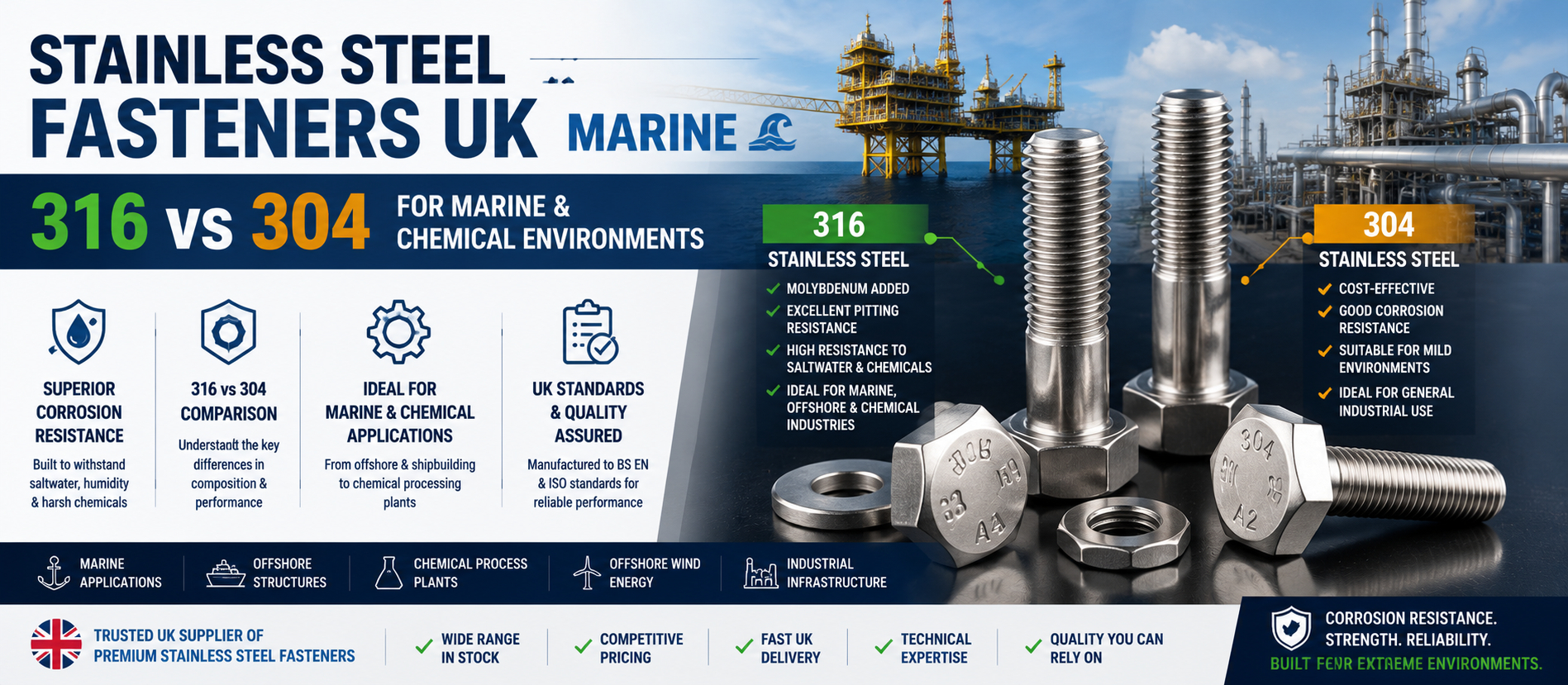
When you are sourcing stainless steel fasteners UK marine, and as a critical operation for marine projects, you need to know what grade you require. Whether it's fasteners on an offshore wind platform in the North Sea, a shipbuilding project in Portsmouth or coastal defense in the English Channel, the fasteners you choose need to be able to cope with the constant assault of salt water, chloride attack and the rigors of marine environments. Learn all about it — grades of material, corrosion, offshore standards, and more, and what to look out for from suppliers.
What Are Marine-Grade Stainless Steel Fasteners?
Marine grade stainless steel fasteners are specially-designed corrosion resistant bolts, nuts, screws and washers that are used in marine, offshore and coastal environments where a normal fastener would quickly corrode. Marine fasteners are designed to withstand the specific environment of marine service, including the presence of chloride ions, moisture, temperature cycles and mechanical stress.
The general usage of the term "marine grade" is associated with A4 (316) stainless steel or grades of higher corrosion resistance like duplex stainless steel. The general usage of the term "marine grade" is with stainless steel A4 (316) or higher performance grades such as duplex stainless steel which have significantly superior resistance to pitting and crevice corrosion compared to standard grades.
A2 vs A4 Stainless Steel Fasteners: Understanding the Key Difference
A common question from marine engineers and procurement is: What is the difference between A2 and A4 stainless steel fasteners marine applications need?
A2 (304) Stainless Steel Fasteners
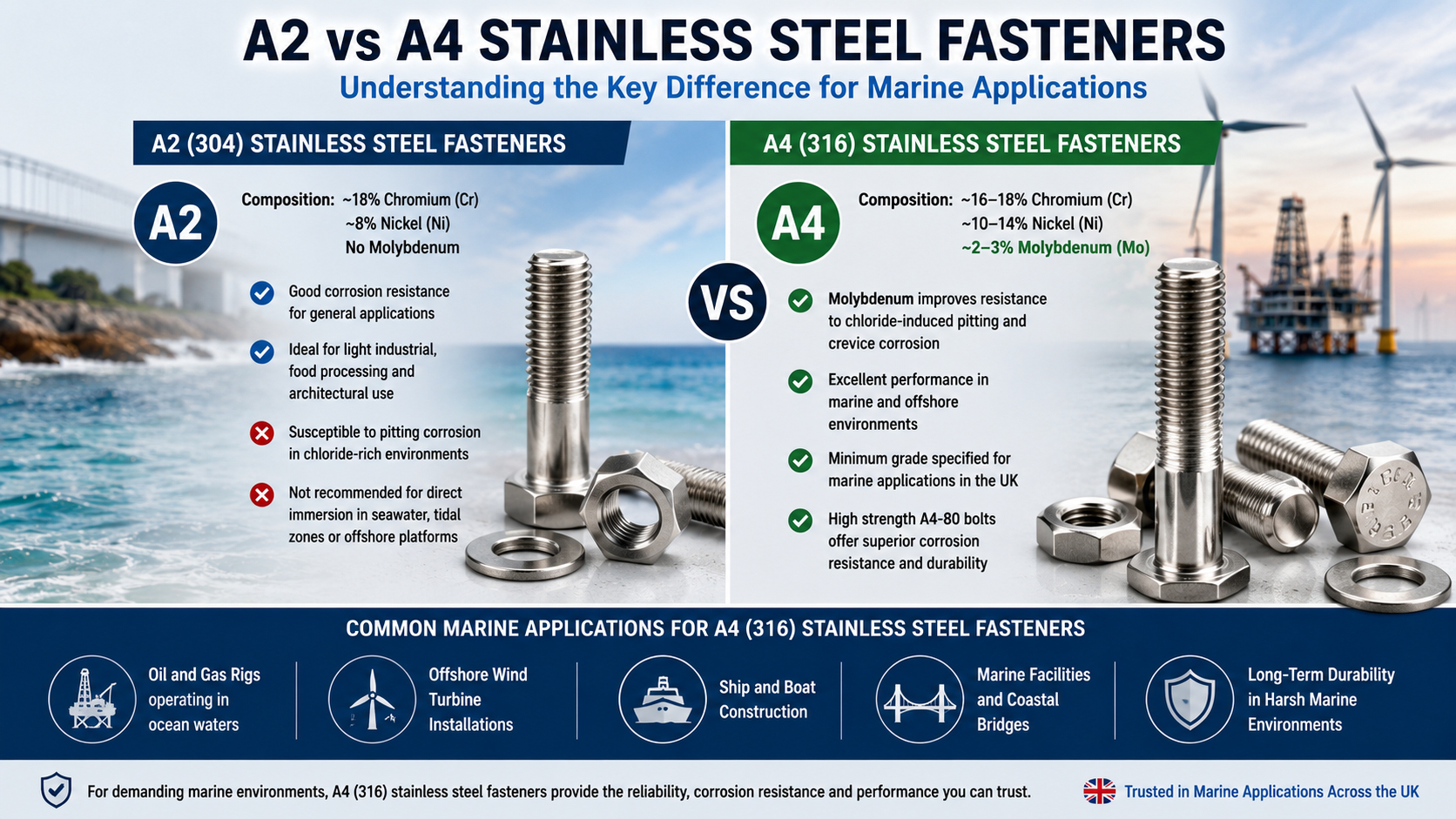
The A2 stainless steel, also known as 304, is a composition that contains about 18% chromium and 8% nickel. It offers good corrosion resistance for general use and is commonly used in light industrial, food processing and architectural applications. A2 is however molybdenum deficient, thus being susceptible to pitting corrosion in chloride-rich environments, such as coastal or marine environments.
A2 stainless steel fasteners are suitable for use in mild coastal locations but are not recommended for direct immersion in the sea or in tidal zones or for use in off shore platforms or when prolonged exposure to salt water is likely.
A4 (316) Stainless Steel Fasteners
A4 stainless steel is the same as the 316 alloy and has ~16-18% Cr, 10-14% Ni and importantly 2-3% Mo. This is the molybdenum that makes A4 better suited for marine applications, giving it much greater resistance to chloride-ion induced pitting and crevice corrosion.
In virtually all stainless-steel fasteners for marine environments UK projects specify, A4 316 stainless steel fasteners are the minimum grade specified. They are used liberally in the following areas:
Oil and gas rigs operating in the ocean waters.
Installations of offshore wind turbines.
Construction of ships and boats
Marine facilities and coastal bridges
The high-strength A4-80 stainless steel bolts are especially popular when both corrosion resistance and mechanical strength are needed.
A2 vs A4: Quick Comparison Table
Property | A2 (304) | A4 (316) |
Chromium Content | ~18% | ~16–18% |
Nickel Content | ~8% | ~10–14% |
Molybdenum | None | ~2–3% |
Pitting Resistance | Moderate | High |
Crevice Corrosion Resistance | Moderate | High |
Seawater Suitability | Limited | Recommended |
Typical Marine Use | Mild coastal only | Offshore & marine standard |
ISO 3506 Grade | A2-70 / A2-80 | A4-70 / A4-80 |
Duplex Stainless-Steel Fasteners: When Standard A4 Is Not Enough
For the most demanding offshore stainless steel bolts applications — particularly on offshore wind turbines, oil and gas platforms, and subsea structures — duplex stainless-steel fasteners offer a significant step up in both corrosion resistance and mechanical strength.
Duplex stainless steels, such as 2205 (UNS S31803), combine a two-phase microstructure of austenite and ferrite, delivering:
Higher tensile strength than standard A4 316
Superior resistance to stress corrosion cracking
Excellent pitting resistance, with a Pitting Resistance Equivalent Number (PREN) typically above 35
Reduced susceptibility to chloride-induced corrosion in aggressive offshore environments
Is Duplex Stainless Steel Fasteners superior? Duplex grades may be more reliable in highly aggressive marine environments such as splash zones, tidal zones, subsea connections or high stress structural joints. They, however have more cost of materials and may need special expertise for installation and torque control.
A4 316 stainless steel fasteners continue to be the standard for most common marine engineering fasteners applications. Grade Duplex is used in environments of particular aggression and/or extended service intervals require a higher level of corrosion margin.
What Causes Corrosion in Marine Fasteners?
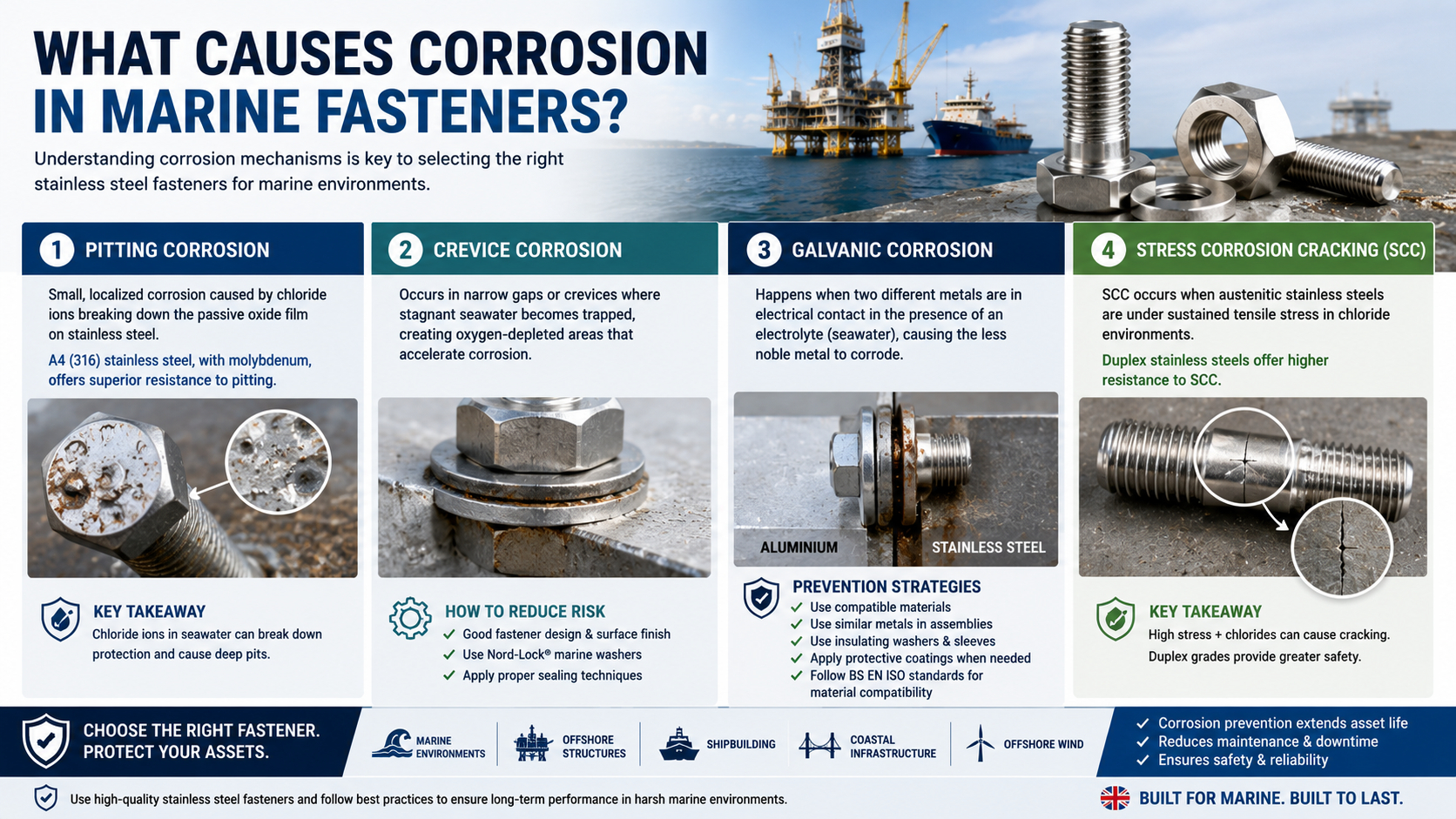
To determine the most appropriate corrosion-resistant fasteners for any marine application it is important to understand corrosion mechanisms. The principle causes for corrosion of fasteners in marine environments are:
1. Pitting Corrosion
Pitting corrosion is small, localized corrosion caused by the ingress of chloride ions into the passive oxide film of stainless steel which can cause fast propagation. The molybdenum content of A4 stainless steel makes it extremely resistant to this mechanism.
2. Crevice Corrosion
Where stagnant seawater has been allowed to become trapped in joints, threaded connections or under washers/gaskets, this sea water can set up oxygen depleted areas which can cause corrosion to happen faster. This risk can be reduced by good fastener design, surface finish and the use of Nord-Lock marine washers or suitable sealing techniques.
3. Galvanic Corrosion
Galvanic corrosion takes place when two different metals are electrically coupled in the presence of an electrolyte (seawater). An example of this is the use of fasteners made from stainless steel welded directly to an aluminium alloy structure which can lead to the more rapidly corrodible metal being corroded. Prevention strategies include:
Assembling all components compatible with the completed project.
Working with similar materials throughout the assembly.
Use of insulating washers and sleeves to break galvanic contact.
Application of protective coatings where different materials are required.
Using relevant BS EN ISO standards for guidance on material compatibility.
4. Stress Corrosion Cracking (SCC)
Under sustained tensile stress in chloride environments, austenitic stainless steels can be susceptible to SCC. In this case, duplex grades have higher resistance than A4.
Standards Governing Marine Fasteners in the UK
Ensuring standards are met with a recognized standard is critical to offshore stainless steel fastener standards UK projects and for the Health and Safety Executive (HSE) and other regulatory bodies.
ISO 3506
The ISO 3506 is the most widely used international specification for mechanical properties of corrosion resistant stainless steel fasteners. It identifies different grades; A2-70, A4-70, A4-80, etc., which indicate minimum tensile strength, proof load, and hardness requirements for bolts, nuts, and screws.
BS EN ISO Standards
A range of BS EN ISO standards published by the British Standards Institution (BSI) cover fastener dimensions, tolerances, thread forms, and testing requirements relevant to marine applications.
Offshore Project Specifications
Offshore projects (oil and gas or wind) have other specific requirements that are often referenced in connection with these standards, including those of the following:
Offshore Renewable Energy Catapult (ORE Catapult)
Energy Industries Council (EIC)
U.K. Maritime and Coastguard Agency (MCA)
The Institution of Mechanical Engineers (IMechE)
Fasteners should always be identified as having been purchased in accordance with ISO 3506 and suppliers should always supply material test certificates to prove the alloy composition and mechanical properties of the fasteners.
Marine Fastener Applications Across the UK
The UK's long coastlines, ports and global maritime energy sector present a high and continuous demand for stainless steel nuts and bolts UK marine/offshore markets. These are key areas of application:
Offshore Wind Energy
The UK is among the world's largest offshore wind markets. According to the Offshore Renewable Energy Catapult, thousands of offshore structures in operation and under development require reliable corrosion resistant fasteners for coastal structures and offshore turbine assemblies. Locations including Grimsby, Hull, Aberdeen, and Teesside serve as major bases for offshore wind operations, driving demand for marine grade stainless steel fasteners across the supply chain.
For offshore wind farm fasteners, A4-80 stainless steel bolts, duplex stainless steel fasteners, and specialist marine fastening systems from manufacturers such as BUMAX and Nord-Lock are commonly specified to ensure structural integrity over the 25-year or longer design life of offshore assets.
Shipbuilding and Naval Applications
Stainless steel fasteners for shipbuilding UK projects — including vessel construction in Portsmouth and commercial shipbuilding across England and Scotland — require fasteners capable of withstanding continuous saltwater exposure, vibration, and the mechanical demands of marine structural connections.
Coastal Infrastructure
A4 316 stainless steel fasteners and duplex stainless steel fasteners are commonly used in coastal defense structures, port infrastructure, marine jetties and harbor facilities throughout the UK for long term reliability.
Offshore Oil and Gas
Scotland's offshore oil and gas sector — centered around Aberdeen — has long been a significant user of high-specification marine hardware fasteners, including duplex stainless steel grades for subsea and topside applications where corrosion performance is critical.
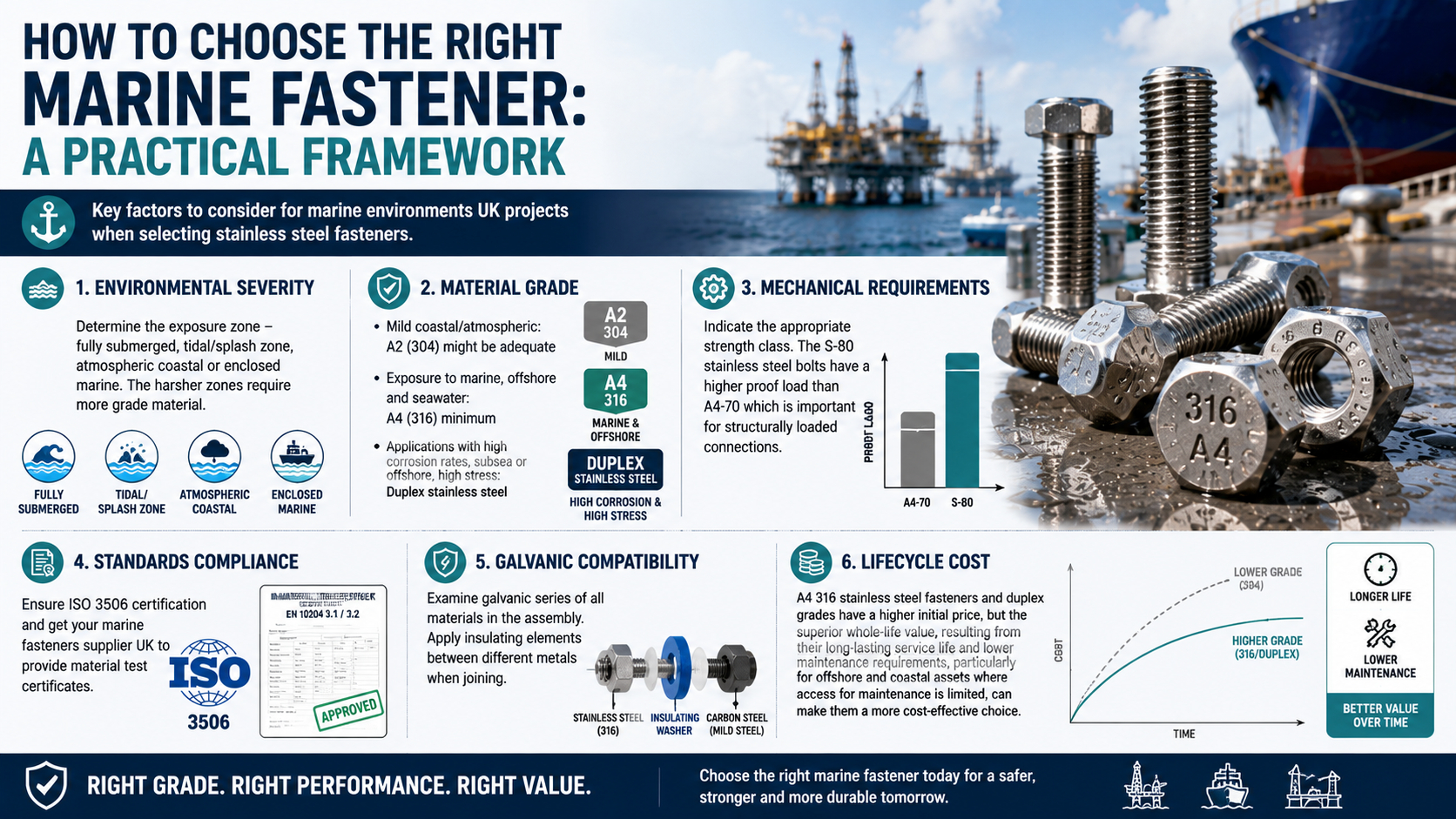
How to Choose the Right Marine Fastener: A Practical Framework
When it comes to marine environments UK projects, there are a number of factors to consider to make the right choice of stainless steel fasteners:
1. Environmental Severity
Determine the exposure zone – fully submerged, tidal/splash zone, atmospheric coastal or enclosed marine. The harsher zones require more grade material.
2. Material Grade
Mild coastal/atmospheric: A2 (304) might be adequate
Exposure to marine, offshore and seawater: A4 (316) minimum
Applications with high corrosion rates, subsea or offshore, high stress: Duplex stainless steel
3. Mechanical Requirements
Indicate the appropriate strength class. The S-80 stainless steel bolts have a higher proof load than A4-70 which is important for structurally loaded connections.
4. Standards Compliance
Ensure ISO 3506 certification and get your marine fasteners supplier UK to provide material test certificates.
5. Galvanic Compatibility
Examine galvanic series of all materials in the assembly. Apply insulating elements between different metals when joining.
6. Lifecycle Cost
A4 316 stainless steel fasteners and duplex grades have a higher initial price, but the superior whole-life value, resulting from their long-lasting service life and lower maintenance requirements, particularly for offshore and coastal assets where access for maintenance is limited, can make them a more cost-effective choice.
Leading Suppliers of Marine Stainless Steel Fasteners in the UK
There are a number of well-established marine fasteners supplier UK options available in the UK market, who can supply certified A4 stainless steel fasteners UK grades and duplex stainless products. The UK market includes a range of established manufacturers and distributors supplying certified A4 and duplex stainless steel fasteners for marine and offshore applications:
The material test certificate is available
Kindly note that there is no grade 6 in the standards. It should be noted that the grade 6 is not present in the standards
Technical support in the selection of marine grade
The inventory of A4-80 stainless steel bolts and corresponding nut/washer sizes
Gain experience in providing services for projects in the offshore or marine industry
Frequently Asked Questions
Can A2 stainless steel fasteners be used in coastal areas?
If the conditions are mild coastal atmospheric environments, the A2 (304) fasteners are suitable to be used, although they are not recommended for applications in direct contact with seawater, tidal zone or offshore. A4 316 stainless steel fasteners are suitable for challenging marine applications as the minimum specification.
How long do marine stainless steel fasteners last?
If properly specified and installed, marine quality stainless steel fasteners in A4 or duplex grades can last for decades. Fastening systems for offshore wind turbines are required to operate, for instance, for 25 years or more with very limited maintenance effort.
Are stainless steel fasteners suitable for offshore platforms?
Yes. Offshore oil and gas platforms, offshore wind turbines, and marine vessels are all common applications of A4 stainless steel fasteners and duplex stainless steel fasteners. The selection of grades should be based on the particular level of exposure and structure of the application.
What is the best fastener for saltwater environments?
A4 (316) stainless steel fasteners are the recommended fastener for most saltwater and offshore uses. Duplex stainless-steel grades deliver greater performance for the most aggressive environments.
Conclusion
The choice of the right stainless steel fasteners UK marine / offshore projects demand will have a direct effect on the safety, reliability and life cycle cost of the marine assets. A4 (316) stainless steel fasteners are still the standard for most marine and coastal infrastructure fasteners applications in the UK and duplex stainless-steel grades offer an important step up in the most challenging offshore applications.
Whether on a North Sea wind turbine, a harbor structure in Liverpool or a naval vessel in Portsmouth, an engineer or procurement professional can make well-informed decisions about which fasteners to use to ensure long-term performance, understanding the differences between grades, understand how marine environments causes corrosion and which standards are relevant, as well as understanding the lifecycle economics of material selection.
When in doubt, consult a qualified marine fastening engineer or technical specialist to confirm material selection, certification requirements, and installation practices
DISCLAIMER: Z&F Corporation is not affiliated with, authorized by, endorsed by, or acting as an official representative of any manufacturer, brand, or trademark owner referenced on this website. All product names, trademarks, brand names, logos, and manufacturer references are the property of their respective owners and are used solely for identification, reference, and compatibility purposes.