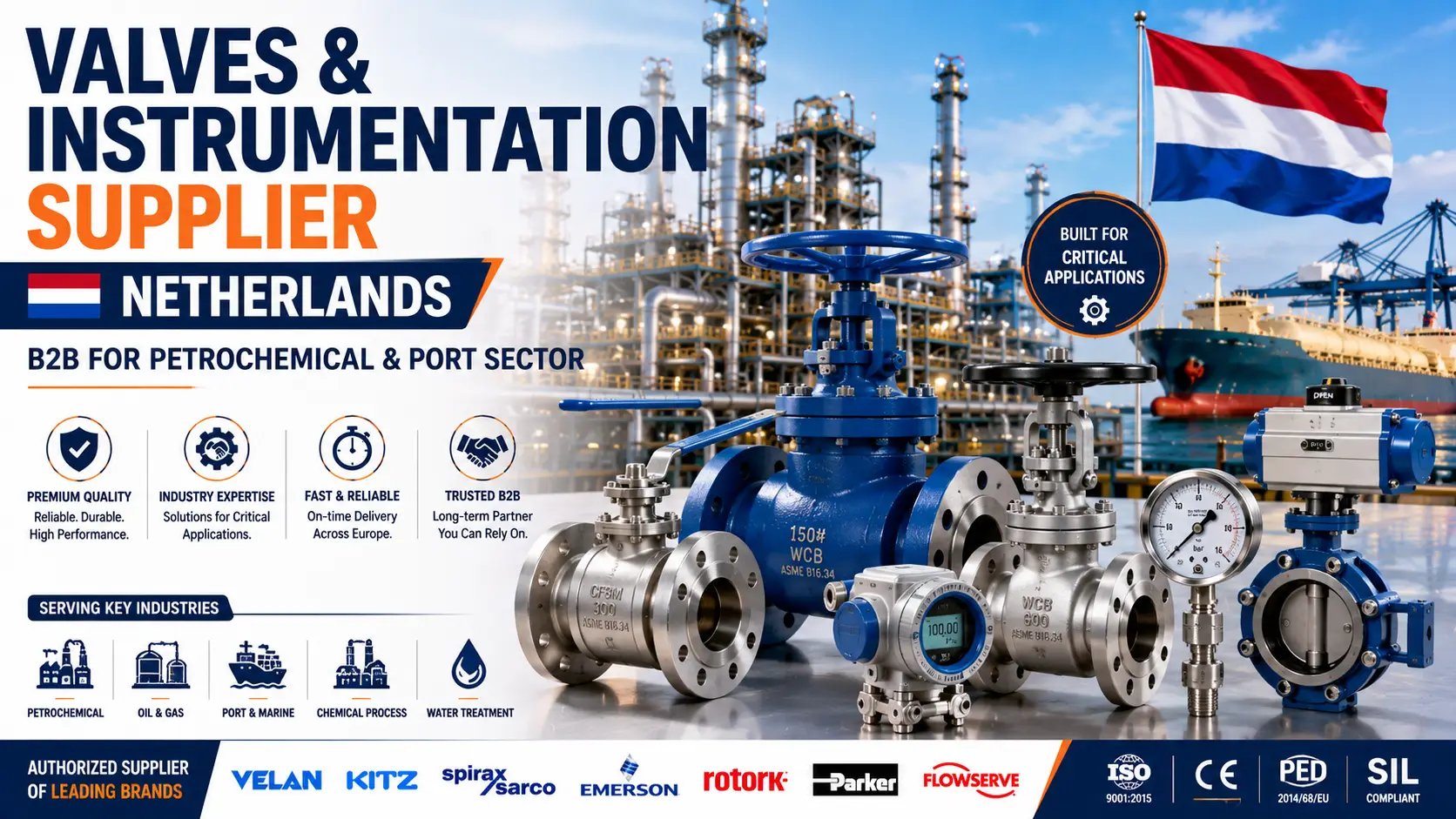
Valves & Instrumentation Supplier Netherlands
Precise flows of liquids, gases and processes data are essential to the Netherlands, from the petrochemical clusters at Rotterdam Port and Europoort to the high tech manufacturing hubs around Eindhoven, and the food and pharmaceutical processing facilities throughout North Brabant. Ensuring safe, efficient and fully compliant operation of these systems requires a trusted valves instrumentation supplier Netherlands engineers and procurement teams can depend on. From specifying control valves for a chemical process unit, sourcing instrumentation for a refinery upgrade, through to the complete automation package for a new manufacturing line, this guide covers all types of valves, all the instrumentation products, materials, standards and criteria for evaluating industrial valve suppliers in the Netherlands, across all major industrial sectors.
Valves and instrumentation supplier refers to the supplier of products that control or measure fluids, gases, temperature and pressure in industrial processing systems, to help control the flow and operate industrial processes.
Looking for valves and instrumentation from a Netherlands project? We will be able to give you a quick and accurate quote for your technical requirements regardless of the type of valve, instrumentation category or brand. Request a Quote.
What Does a Valves & Instrumentation Supplier Do?
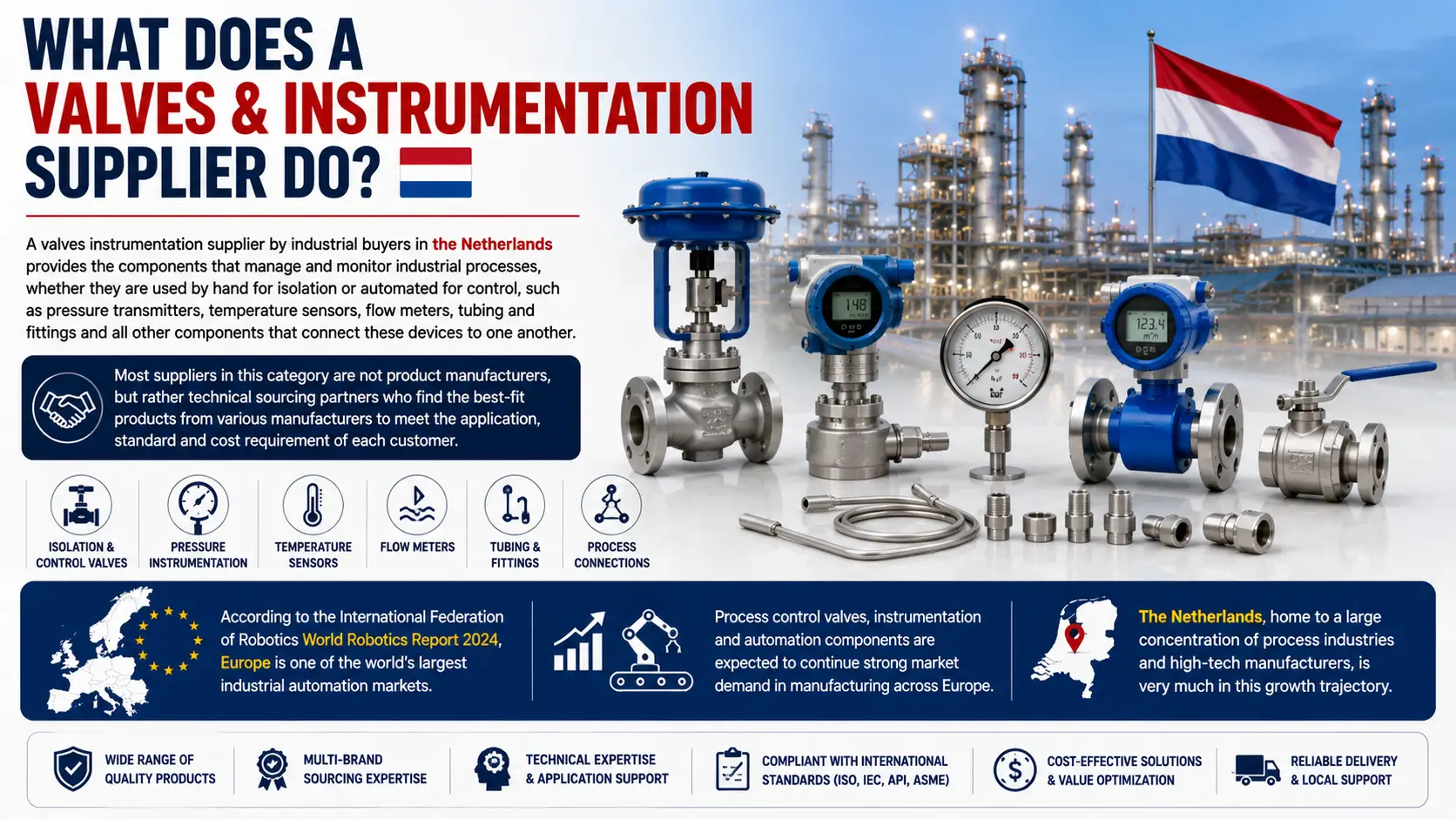
A valves instrumentation supplier by industrial buyers in the Netherlands provides the components that manage and monitor industrial processes, whether they are used by hand for isolation or automated for control, such as pressure transmitters, temperature sensors, flow meters, tubing and fittings and all other components that connect these devices to one another. Most suppliers in this category are not product manufacturers, but rather technical sourcing partners who find the best-fit products from various manufacturers to meet the application, standard and cost requirement of each customer.
Despite this, the International Federation of Robotics World Robotics Report 2024 highlights Europe as one of the world's biggest industrial automation markets, and process control valves, instrumentation and automation components are expected to continue to have market demand in manufacturing across Europe. The Netherlands, which is home to a large concentration of process industries and high-tech manufacturers, is very much in this growth trajectory.
Industrial Valve Types
The choice of the right type of valve is the basis of any valves specification in the Netherlands process control application. The table below gives an overview of the main valve types used in the various industrial and process applications in the Netherlands.
Valve Type | Function | Flow Control | Typical Application |
Ball Valve | Quick quarter-turn shutoff | On/off, limited throttle | Process isolation, gas service, instrumentation root valves |
Gate Valve | Full bore isolation | On/off only | Pipeline isolation, water and utility service |
Globe Valve | Flow regulation | Throttling, control | Steam systems, process control, dosing |
Butterfly Valve | Quarter-turn flow control | Throttle & isolation | Water treatment, HVAC, large-bore low pressure |
Needle Valve | Precise fine flow control | Fine throttling | Instrumentation, sampling, calibration systems |
Check Valve | Backflow prevention | Unidirectional | Pump discharge, compressor protection |
Solenoid Valve | Electrically actuated on/off | Automated on/off | Automation systems, batch processing, safety shutdown |
Ball Valves
Throughout Dutch chemical and oil & gas plants, the valves used for root valve instrumentation, gas service and process isolation are Ball valves, due to their excellent sealing ability and fast, reliable quarter turn shut-off. Full-bore ball valves provide the least restriction of flow and are often used where pigging or unrestricted flow is required.
Gate Valves
Gate valves provide full-bore isolation in pipeline service where the valve is not used very often — open or closed. They are still the benchmark for large diameter water utility and pipeline isolation but not for throttling duty as wedge erosion is problematic in flow conditions less than full open.
Ball Valve vs Gate Valve: Key Differences
Factor | Ball Valve | Gate Valve |
Operation | Quarter-turn (90°), fast | Multi-turn, slower |
Sealing performance | Excellent, bubble-tight shutoff | Good, but wedge wear over time |
Flow resistance | Low, full-bore design available | Low when fully open |
Throttling suitability | Not recommended (standard port) | Not recommended (wedge erosion) |
Space requirement | Compact | Larger — requires stem clearance |
Best use case | Frequent operation, instrumentation, gas | Infrequent operation, large pipeline isolation |
Needle Valves
For applications where a standard ball or globe valve cannot provide the metering accuracy required, instrumentation engineers in the Netherlands depend on provide for precise, fine flow control needed for sampling systems, calibration loops and instrument isolation.
Solenoid Valves
Rapid on/off control, automation and reliability are essential in batch processes, safety shutdown systems and pneumatic control circuits throughout Dutch manufacturing and process automation installations. Electrical solenoid valves are the technology used to achieve this.
Instrumentation Products We Source
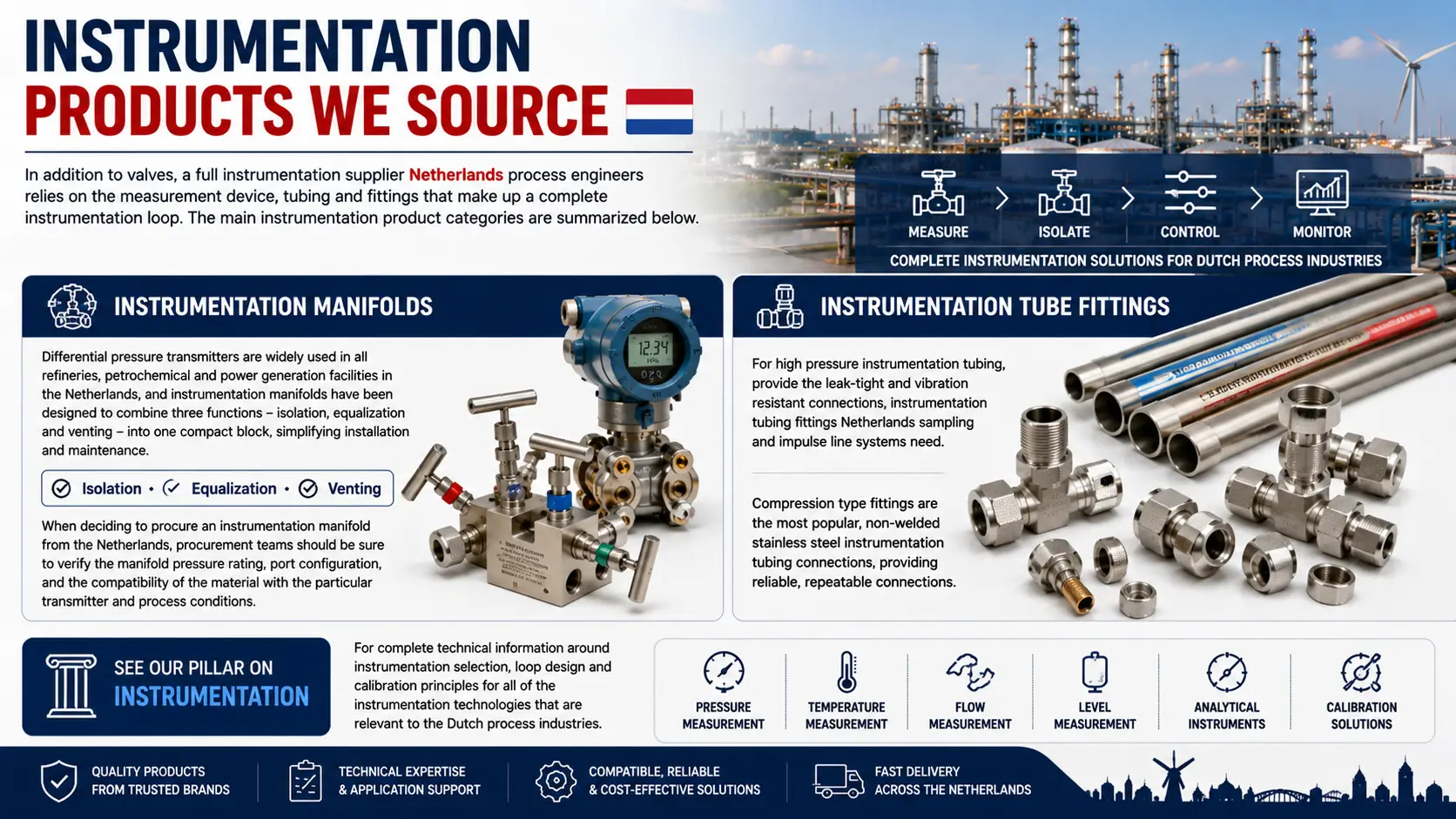
In addition to valves, a full instrumentation supplier Netherlands process engineers relies on the measurement device, tubing and fittings that make up a complete instrumentation loop. The main instrumentation product categories are summarized below.
Instrumentation Device | Function | Typical Application |
Pressure Gauge | Local visual pressure indication | Pump discharge, vessel monitoring, panel display |
Pressure Transmitter | Converts pressure to electronic signal (4-20mA / HART) | Process control, DCS/PLC integration |
Temperature Sensor | Measures process or ambient temperature | RTDs, thermocouples for process monitoring |
Flow Meter | Measures volumetric or mass flow rate | Custody transfer, process control, batching |
Instrumentation Manifold | Isolates and equalizes transmitter connections | Differential pressure transmitter mounting |
Tube Fittings | Connects instrumentation tubing securely | High-pressure sampling, impulse lines, pneumatic signal |
Instrumentation Manifolds
The differential pressure transmitters are widely used in all refineries, petrochemical and power generation facilities in the Netherlands, and instrumentation manifolds have been designed to combine three functions – isolation, equalization and venting – into one compact block, simplifying installation and maintenance. When deciding to procure a instrumentation manifold from the Netherlands, the procurement teams should be sure to verify the manifold pressure rating, port configuration, and the compatibility of the material with the particular transmitter and process conditions.
Instrumentation Tube Fittings
For high pressure instrumentation tubing, provide the leak-tight and vibration resistant connections, instrumentation tubing fittings Netherlands sampling and impulse line systems need. Compression type fittings are the most popular, non-welded stainless steel instrumentation tubing connections, providing reliable, repeatable connections.
See our Pillar on Instrumentation for complete technical information around instrumentation selection, loop design and calibration principles for all of the instrumentation technologies that are relevant to the Dutch process industries.
Industries Served Across the Netherlands
Oil & Gas and Petrochemical
The port of Rotterdam and Europoort are home to the Netherlands' oil and gas sector, as well as its petrochemical division. Rotterdam Port and the industrial complex of Europoort are one of the largest combined petrochemical and refining complexes in Europe, creating significant demand for API certified valve suppliers to be used in pipeline isolation, process control and instrumentation in upstream storage, refining and export processes. Instrumentation valves in oil and gas Netherlands applications in this sector are usually API 6D and ASME B16.34 compliant, and ATEX certified for use in hazardous areas.
Chemical Processing
Corrosion-resistant materials for chemical process valves supplier Netherlands facilities – stainless steel, duplex and specialty alloys – must be able to withstand corrosive chemical streams with minimal risk to sealing integrity and service life.
Pharmaceutical and Food & Beverage
Pharmaceutical clean process systems, food & beverage automation systems in the Netherlands demand hygienic-design valves and instrumentation featuring smooth, crevice-free internal surfaces suitable for clean-in-place (CIP) and sterilize-in-place (SIP) and FDA compliant elastomer seals.
Water Treatment
Butterfly valves are used for controlling large diameter flows at municipal and industrial water treatment facilities throughout the Netherlands, as well as flow meters and level instrumentation for monitoring the treatment processes and reporting for regulatory control.
Marine
In the Netherlands, shipbuilding and marine engineering – which gives the city of Rotterdam its status as one of the world's large-scale maritime hubs – calls for marine process applications, engine room piping and ballast systems that are required to be corrosion resistant and are frequently made of bronze or duplex stainless steel for seawater applications.
To find out more about valve and piping specifications for upstream and downstream oil and gas operations, please visit our Oil & Gas Page with process system requirements relevant to the oil and gas sector in Rotterdam Port, Euro port and the wider Dutch energy sector.
Valve Materials & Specifications
The service life or reliability of any stainless steel valves Netherlands or any other material specification is directly determined by material selection. The following table may be helpful as a reference.
Material | Corrosion Resistance | Relative Cost | Typical Application |
Brass | Moderate | Lowest | Utility water, low-pressure pneumatic systems |
Bronze | Good | Low | Marine, water service, mild corrosive exposure |
Carbon Steel | Low | Low | Hydrocarbon service, general process piping |
Stainless Steel 316 | High | Moderate | Chemical, pharmaceutical, food & beverage, instrumentation |
Duplex Stainless Steel | Very High | High | Offshore, seawater, chloride-rich environments |
Alloy / Hastelloy | Exceptional | Highest | Aggressive acids, high-temperature chemical processes |
Pro Tip: Do not choose the valve material only because of its price. Check chemical compatibility for the process fluid; the concentration and temperature of the fluid, as well as any trace contaminants, will all affect corrosion rates in a different way. Ask your supplier for a chemical compatibility chart before finalizing material specification for any new application.
International Standards & Certifications
Industrial valves and instrumentation sold in the Netherlands and the EU market as a whole must comply with recognized standards. The following table lists the most important standards concerning procurement in the Netherlands.
Standard | Scope | Relevance in the Netherlands |
CE Marking / PED | EU Pressure Equipment Directive — mandatory conformity for pressure-containing equipment placed on the EU market | Required for valves and instrumentation sold in the Netherlands and wider EU |
ATEX | Equipment for use in potentially explosive atmospheres | Hazardous area instrumentation, refineries, chemical plants |
API 6D / 600 / 608 | Pipeline and process valve design, manufacture, and testing standards | Oil & gas valve specification at Rotterdam Port / Europoort facilities |
ASME B16.34 | Valves — flanged, threaded, and welding end — pressure-temperature ratings | Design basis for valve pressure class selection |
ISO 9001 | Quality management system certification | Baseline supplier quality assurance |
NEN | Netherlands national standards published by the Royal Netherlands Standardization Institute | Dutch-specific compliance and technical reference |
NAMUR | User association recommendations for process instrumentation and control technology | Instrumentation interface standards widely adopted in Dutch process industry |
The compliance landscape for valves and instrumentation used in industrial applications is defined by the Royal Netherlands Standardization Institute (NEN), the European Committee for Standardization (CEN) and other international organizations such as ISA, API and NAMUR.
How to Choose the Right Supplier
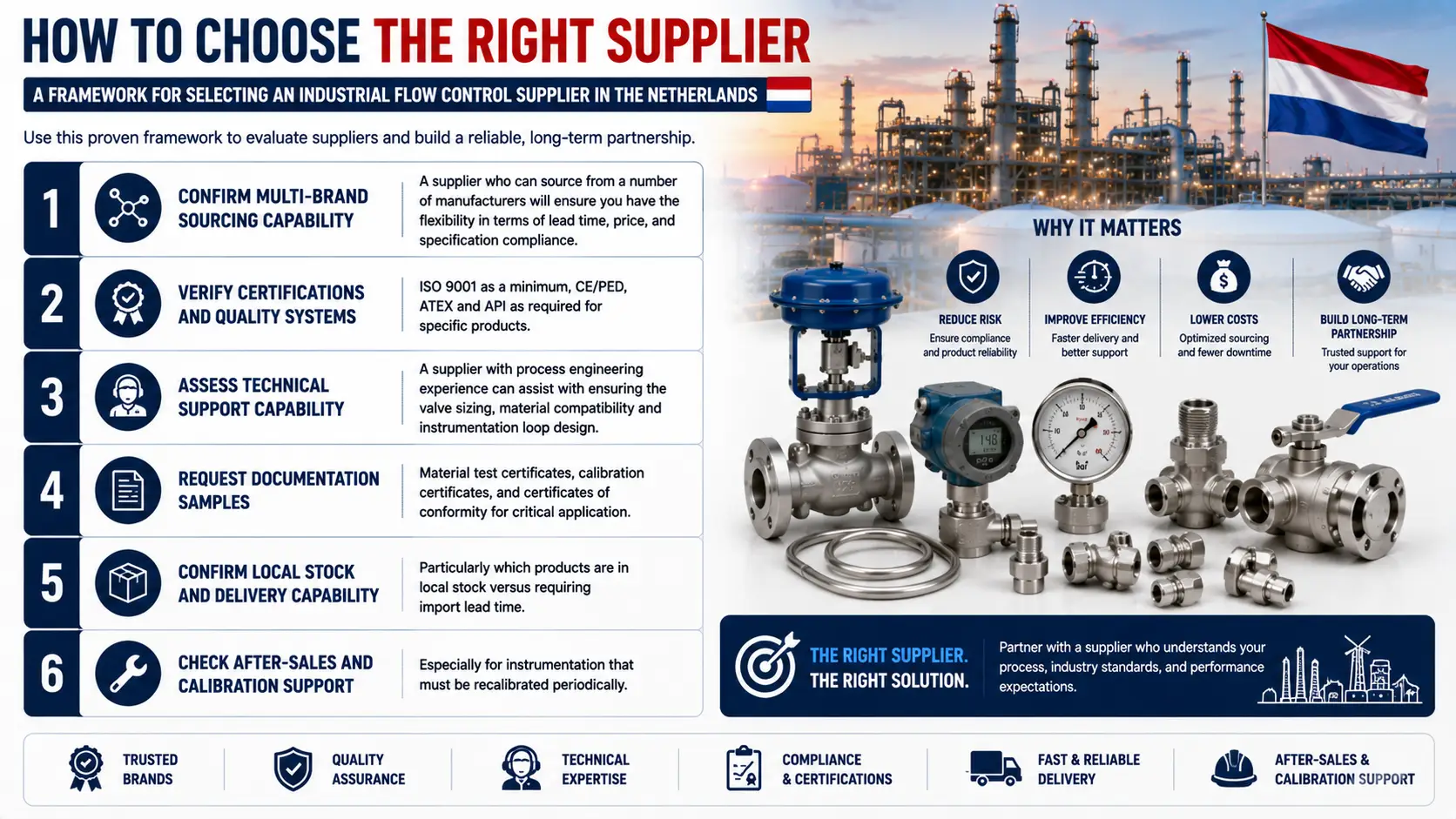
When assessing any partnership with an industrial flow control supplier in the Netherlands, use the following framework:
Confirm multi-brand sourcing capability — a supplier who can source from a number of manufacturers will ensure you have the flexibility in terms of a lead time, price, and specification compliance.
Verify certifications and quality systems — ISO 9001 as a minimum, CE/PED, ATEX and API as required for specific products
Assess technical support capability — A supplier with process engineering experience can assist with ensuring the valve sizing, material compatibility and instrumentation loop design.
Request documentation samples — Material test certificates, calibration certificates, and certificates of conformity for critical application.
Confirm local stock and delivery capability — particularly which products are in local stock versus requiring import lead time
Check after-sales and calibration support — especially for instrumentation that must be recalibrated periodically
Common Procurement Mistakes to Avoid
Using the wrong valve materials because the process fluid chemistry is not right for the typical material selected
Not taking into account the maximum design pressure as opposed to the normal operating pressure
Choosing incompatible tube fittings — using a different brand or type of fittings on the same tubing system, without checking for compatibility
Awareness of certifications for hazardous area and/or pressure-retaining applications
Purchase without calculating the total life cycle cost such as maintenance and calibration
Improper valve sizing — Oversized control valves don't perform well with low flow; undersized control valves can't respond to high flow
Why Technical Sourcing Matters
A trusted Netherlands valves instrumentation supplier experienced in the industry has more than just the ability to fill a purchase order; they can ensure that the product you need for your application is the right one before the product even arrives at site. Technical sourcing experience provides measurable value in many areas, including:
Valve sizing and Cv calculation verification — ensuring the valve will provide the desired flow characteristic at operating conditions
Material compatibility cross-checking — The following are examples of how you can prevent specification issues from occurring by cross-checking the material prior to installation.
Instrumentation loop compatibility — make sure that transmitters, manifolds and control system inputs are compatible
Hazardous area classification verification — Design verification of ATEX zone rating in accordance with the actual installation environment.
Counterfeit product avoidance — procuring from authentic and traceable supply chains with supplier documentation from the manufacturer.
Frequently Asked Questions
What industries require instrumentation valves?
Instrumentation valves are used in all industries for process isolation, sampling and protecting measurement systems in the Netherlands, including oil and gas, chemical processing, pharmaceuticals, food and beverage, water treatment, marine, and power generation.
Which valve material is best for corrosive media?
Most moderate corrosive applications can be used with stainless steel 316. In an aggressive chemical or high chloride environment, duplex stainless steel or other specialty alloys such as Hastelloy offer better corrosion resistance at a higher cost.
What certifications should industrial valves have?
Check for CE marking in accordance with the Pressure Equipment Directive (PED); if in hazardous areas, also look for ATEX; if for oil and gas applications, also check API certification; and if it's a quality management certification from the manufacturer, check for ISO 9001.
What is the difference between process valves and instrumentation valves?
Process valves are used for the primary process flow at production scale (usually larger bore sizes). Instrumentation valves are smaller, precision valves intended to isolate, sample, or control flow in measurement and control loops and, in many instances, are rated for very high pressure in a compact size.
Can one supplier source multiple valve brands?
Yes. Flexible sourcing is another aspect of buying valves through many industrial sourcing companies in Netherlands, where the sourcing company can maintain relationships with multiple manufacturers, and thus allow the world of technical fit, lead time and budget to choose the supplier that most meets the customers need, not one brand.
What are instrumentation tube fittings used for?
The instrumentations tube fittings are leak-tight tube fittings that join small-bore stainless steel or polymer tubing at high pressure without welding in sampling lines, impulse lines to pressure transmitters and pneumatic signal tubing.
How can procurement lead times be reduced?
The shorter the procurement lead time, the sooner your valves and instrumentation will arrive at the site; and the faster they arrive, the better it will be for you. The sooner your valves and instrumentation arrive at the site, the better, and the shorter the procurement lead time, the sooner they will arrive, all the better!
Summary: Sourcing Valves and Instrumentation in the Netherlands
Choosing the right valve instrumentation supplier for Netherlands operations require some more than just comparing catalogue prices. It requires a formal investigation into the type of valve, material compatibility, certification requirements and instrumentation system design – suited to your particular application for oil and gas, chemical processing, pharmaceuticals, water treatment, marine or general manufacturing.
From choosing the best high-pressure valves Netherlands refinery projects require to specifying pneumatic valves suppliers for Netherlands automation systems demand to designing the complete instrumentation package for a new process unit — the frameworks in this guide will help you with your procurement decisions, ensuring you get the right valves to fulfill reliable, compliant flow control and process measurement in Dutch industry.
For more technical advice, visit our Valves Pillar, our Instrumentation Pillar and our Oil & Gas page where you can find all the different types of valves, measurement and control technologies and sector-specific applications in Rotterdam Port, Euro port and in the Dutch energy sector.
Looking for advice on choosing valves or instrumentation for a project? Our company can check a product's size, material compatibility, and certification requirements before you place your order.. → Talk to Our Specialist