Industrial Welding Consumables in GCC & Asia Pacific: Complete Selection and Procurement Guide
Offshore fabrication yards across GCC, pipeline projects in Southeast Asia and shipyards in South Korea and Singapore rely on properly specified welding consumables that the fabricators can count on to produce strong, defect-free welds. For the welding of structural steel in a metro rail project or for critical joints in a pipeline in an LNG terminal, it is not just the price that matters when it comes to sourcing welding consumables GCC Asia Pacific projects. This guide will explain about the various types of consumables, standards, applications, selection criteria and the objective and specification-based supplier assessment.
Looking for certified welding consumables pricing information on your project?
What Are Welding Consumables?
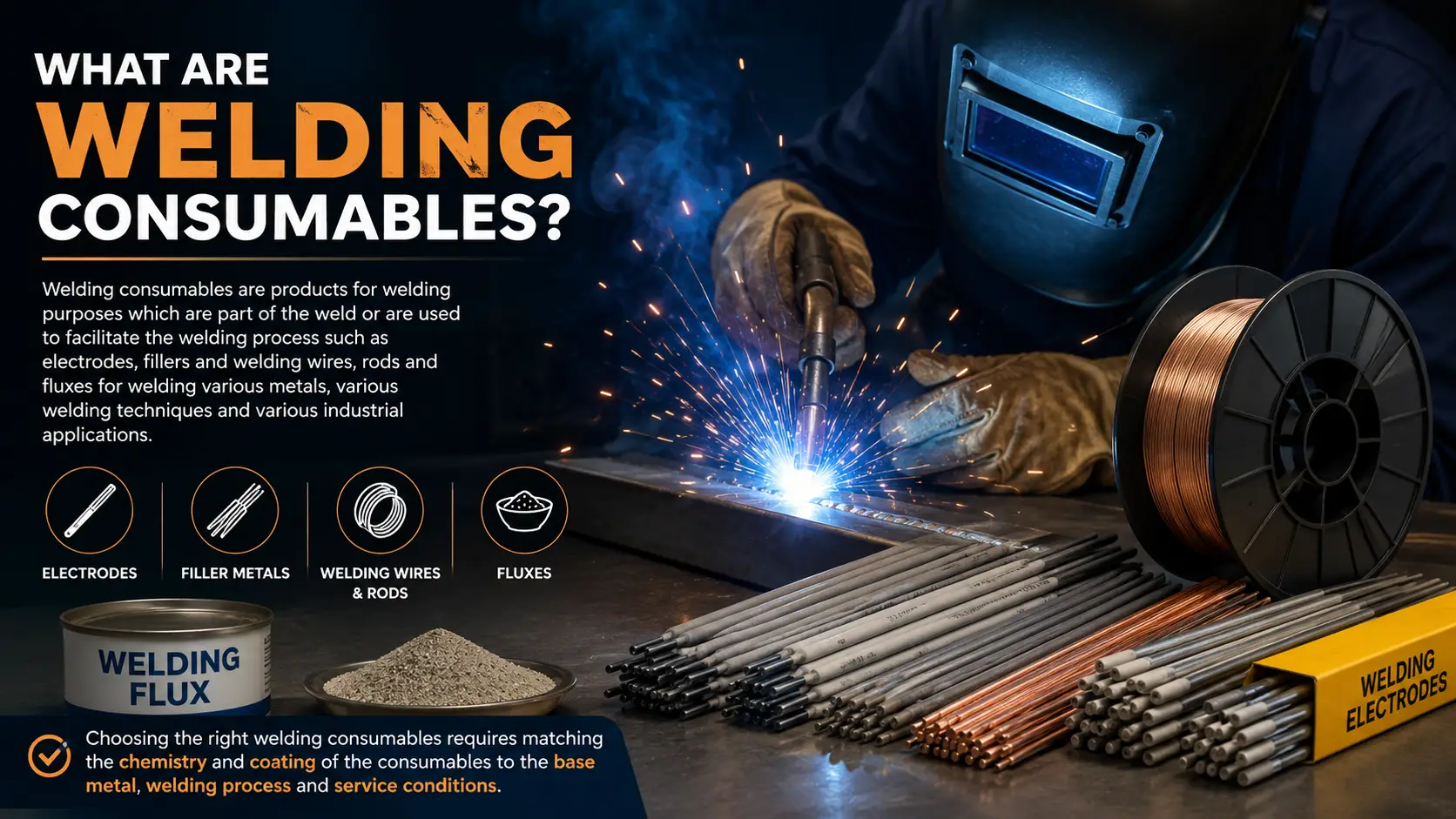
Welding consumables are products for welding purposes which are part of the weld or are used to facilitate the welding process such as electrodes, fillers and welding wires, rods and fluxes for welding various metals, various welding techniques and various industrial applications. Choosing industrial welding consumables fabrication shops requires matching of the chemistry and coating of the consumables to the base metal, welding process and service conditions.
Types of Industrial Welding Consumables
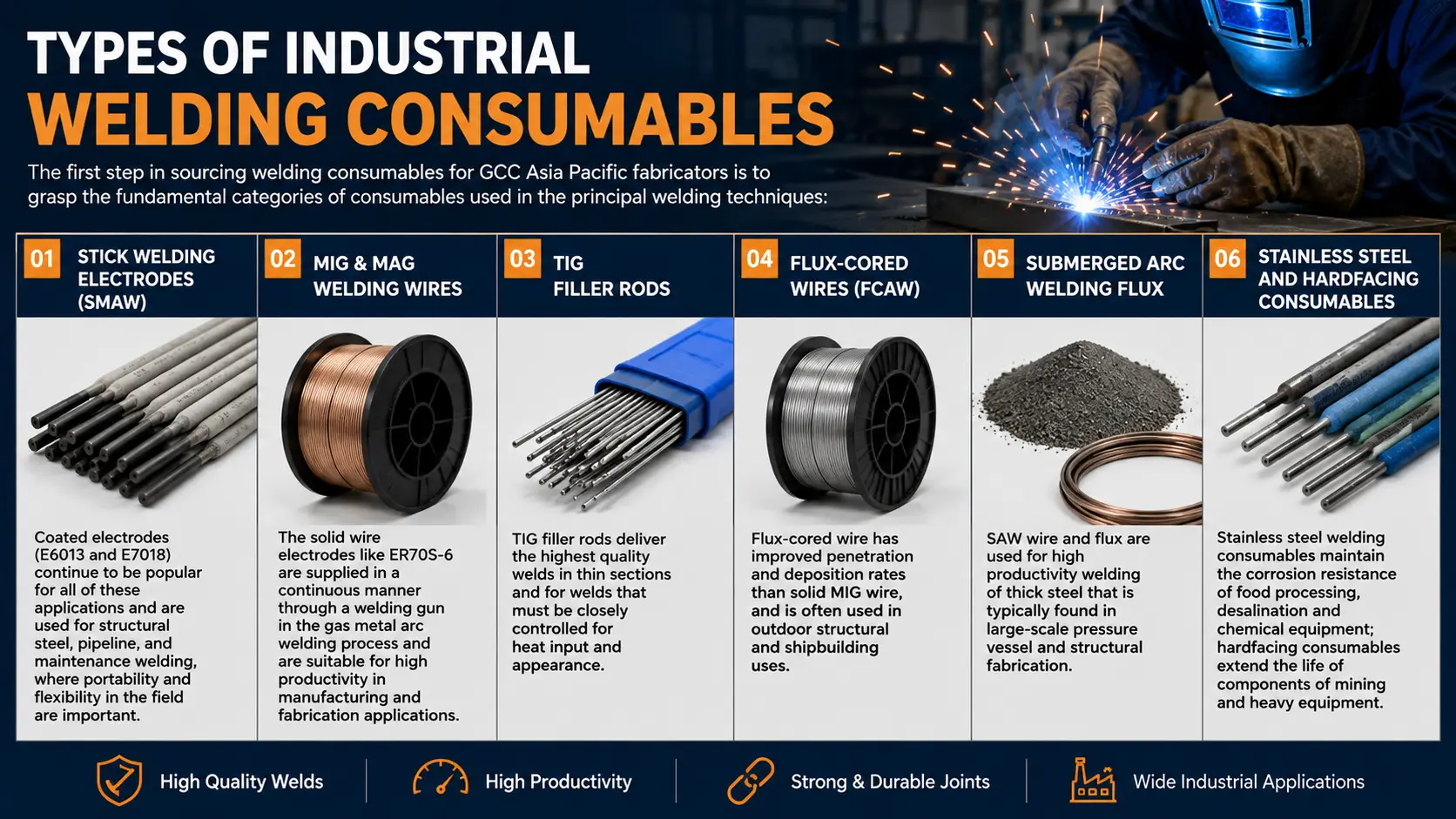
The first step in sourcing welding consumables for GCC Asia Pacific fabricators is to grasp the fundamental categories of consumables used in the principal welding techniques:
Stick Welding Electrodes (SMAW)
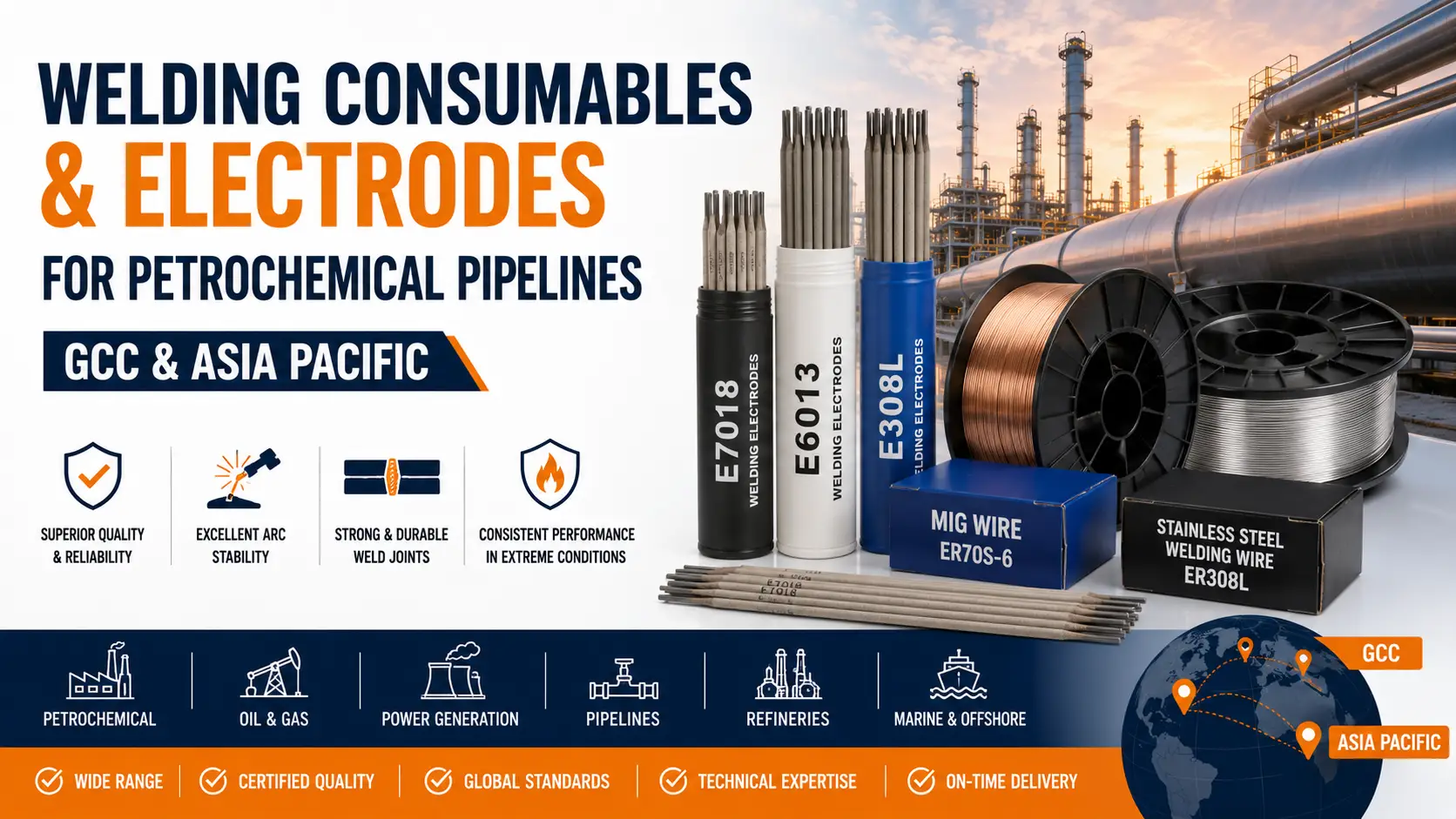
Coated electrodes (E6013 and E7018) continue to be popular for all of these applications and are used for structural steel, pipeline, and maintenance welding, where portability and flexibility in the field are important.
MIG & MAG Welding Wires
The solid wire electrodes like ER70S-6 are supplied in a continuous manner through a welding gun in the gas metal arc welding process and are suitable for high productivity in manufacturing and fabrication applications.
TIG Filler Rods
TIG filler rods deliver the highest quality welds in thin sections and for welds that must be closely controlled for heat input and appearance.
Flux-Cored Wires (FCAW)
Flux-cored wire has improved penetration and deposition rates than solid MIG wire, and is often used in outdoor structural and shipbuilding uses.
Submerged Arc Welding Flux
SAW wire and flux are used for high productivity welding of thick steel that is typically found in large-scale pressure vessel and structural fabrication.
Stainless Steel and Hardfacing Consumables
Stainless steel welding consumables maintain the corrosion resistance of food processing, desalination and chemical equipment; hardfacing consumables extend the life of components of mining and heavy equipment.
Welding Consumables by Welding Process
Process | Typical Consumable | Best Suited For |
SMAW (Stick) | Coated electrodes (E6013, E7018) | Structural steel, pipeline, field maintenance |
GMAW (MIG/MAG) | Solid wire (ER70S-6) | High-productivity shop fabrication |
FCAW | Flux-cored wire | Outdoor structural welding, shipbuilding |
GTAW (TIG) | Filler rods | Precision welds, thin sections, critical joints |
SAW | Wire and flux combination | Thick steel sections, pressure vessels |
Applications Across Major Industries
The GCC Asia Pacific facilities are sought by the welding consumables market, which mentions the following sectors that play an important role in both regions' industrial economy:
Fabrication of oil and gas platforms in the Middle East region for offshore deployment in the Gulf of Arabia countries
Clean energy generation and transmission in the Philippines and Taiwan
South Korea, Singapore and Japan shipbuilding yards
Structural steel work for metro rail and infrastructure projects
Wind turbine towers for wind energy generation and materials production. Materials and components for wind energy towers.
Heavy repair and hard facing work in relation to heavy mining equipment in Australia.
International Standards and Certifications
When looking for a welding electrode supplier in Asia Pacific, buyers need to ensure standards are met by the recognized frameworks. Electrode and wire classification are universally employed and accepted within the region and are equivalent to AWS standards, ISO standards offer international equivalents, and ASME Section IX regulations govern welding procedure and performance qualification for critical structural and pressure service applications.
Standard / Organization | Relevance |
AWS A5 series | Electrode and filler metal classification standards |
ISO | International classification for covered electrodes and wires |
ASME Section IX | Welding procedure and performance qualification |
API | Oil and gas pipeline and facility welding requirements |
Bureau Veritas / Lloyd's Register / DNV | Marine and offshore classification society requirements |
How to Select the Right Welding Consumables
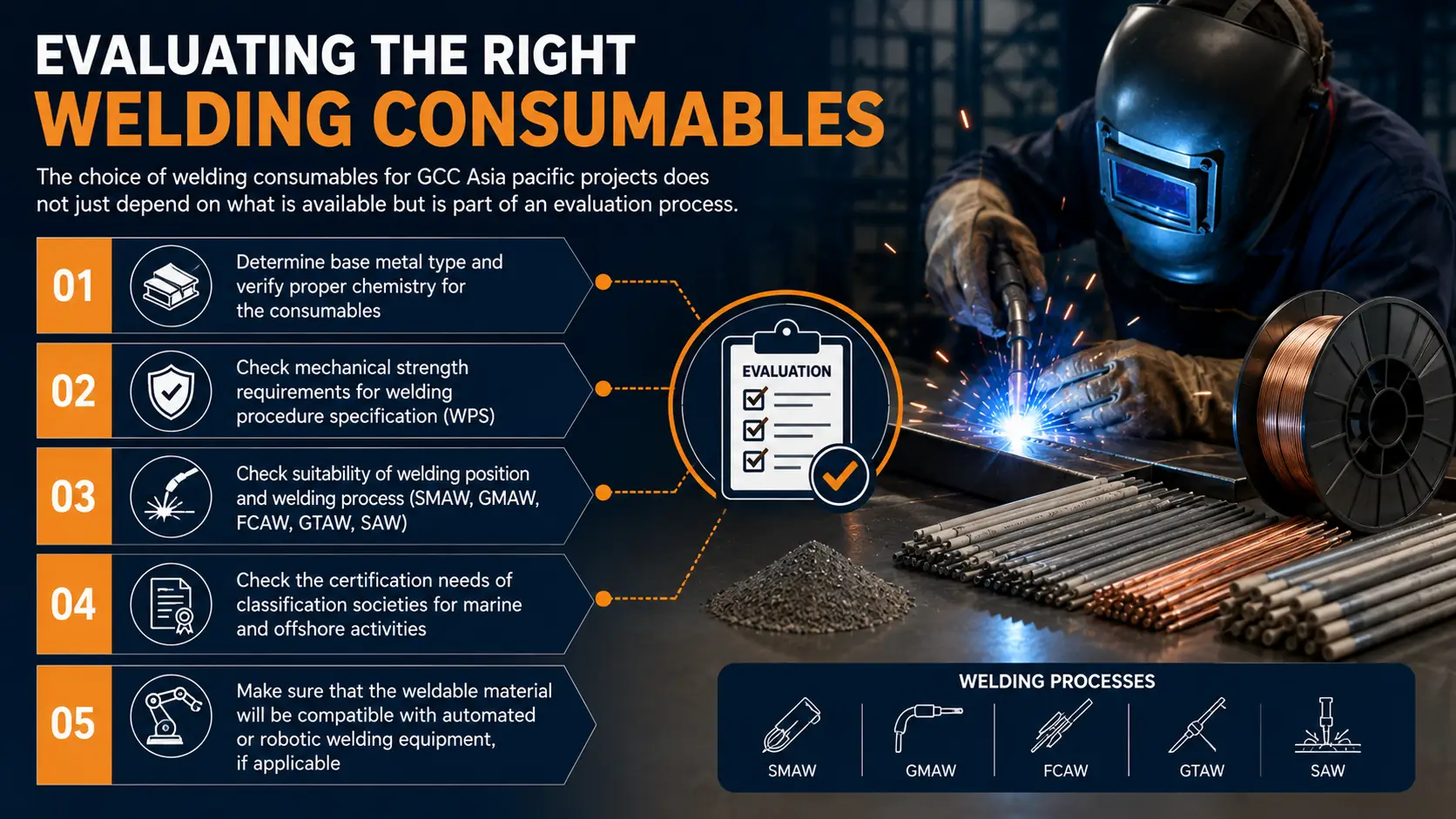
The choice of welding consumables for GCC Asia pacific projects does not just depend on what is available but is part of an evaluation process.
Determine base metal type and verify proper chemistry for the consumables
Check mechanical strength requirements for welding procedure specification (WPS)
Check suitability of welding position and welding process (SMAW, GMAW, FCAW, GTAW, SAW)
Check the certification needs of classification societies for marine and offshore activities
Make sure that the weldable material will be compatible with automated or robotic welding equipment, if applicable.
Storage and Handling Best Practices
One of the most crucial aspects of weld quality for welding consumables storage in GCC Asia Pacific fabrication shops is the proper storage method. Weld defects are often caused by improper storage, especially in the case of low hydrogen electrode types:
Store electrodes in dry, temperature controlled conditions
Use heated holding ovens for low hydrogen electrodes after they have been opened.
Do not leave wire spool in a humid or condensation environment before use.
Monitor exposure time and ensure that moisture is not absorbed during fieldwork
Common Welding Challenges and Solutions
Weld porosity caused by moisture, contamination or use of inappropriate consumables
Having stored low-hydrogen electrodes incorrectly, resulting in hydrogen-induced cracking
A lack of consistent feedability from incompatible wire selection – robotic welding.
Lower corrosion protection when using conventional electrodes with stainless steel
More rework due to the selection of consumables based on price only not on specification.
Emerging Trends in Welding Consumables
As welding automation and sustainability needs grow, the welding consumables market continues its evolution. Automation-friendly consumables for robotic welding applications in automotive and heavy manufacturing are among the examples of consumables supporting robotic welding in industrial applications, while low-emission formulations and consumables tailored for renewable energy and hydrogen infrastructure projects show the transition to cleaner industrial fabrication.
Procurement Considerations
Welding filler sourcing teams in the GCC and Asia Pacific region can utilize the ability to do more than just rely on catalog prices. Buyers must verify the certification documents, batch traceability and technical support that are available in the regional supply chains. For more Welding Equipment & Welding Consumables information, please visit our Welding Pillar and for more information about Oil & Gas applications and standards, please visit our Oil & Gas Page. Our Pipe Fittings Article provides detailed information on the various pipe fittings components and how they're selected and specified for pipe fabrication.
Frequently Asked Questions
What are welding consumables?
Welding consumables are materials used in welding processes, such as electrodes, wires, rods and flux, to make strong and durable welds.
Which welding consumables are suitable for structural steel?
For structural steel fabrication, low-hydrogen electrodes like E7018 and ER70S-6 MIG wire are commonly used.
How do I choose welding electrodes?
Consider base metal, welding process, joint design, service conditions and applicable standards (AWS & ISO).
What is the difference between MIG wire and TIG filler rod?
The TIG filler rods are manually fed into the weld for precise and controlled welds and the MIG wire is continuously fed into a welding gun.
What standards apply to welding consumables?
Depending on application and region, AWS, ISO, ASME and EN standards are widely referenced.
How should welding electrodes be stored?
Dry storage should be used for the electrodes, and when unpackaged, low hydrogen types should be transferred to heated holding ovens.
Which consumables are best for pipeline welding?
For pipeline welding applications, cellulosic electrodes of particular low hydrogen electrodes are used extensively.
Can welding consumables be used for robotic welding?
Not every consumable is suitable; robotic systems need products that are designed to be easily fed and arc stable.
Conclusion
Choosing the appropriate welding consumables for GCC Asia Pacific projects is not a matter of copying what is the cheapest or most readily available, but of selecting the consumables that are appropriate for the chemistry, coating type and welding process of the base metal and service conditions. Whether it's SMAW electrodes for pipeline or structural applications, flux-cored wire for shipbuilding, or stainless wire for corrosion-critical applications, using the right choice accompanied by AWS or ISO certification, proper storage, and compliance with welding procedure specifications, will minimize rework, enhance weld integrity and ensure long-term reliability in fabrication, oil and gas, marine and infrastructure projects in both regions.
Learn from the experts how to choose and source welding consumables.
DISCLAIMER: Z&F Corporation is not affiliated with, authorized by, endorsed by, or acting as an official representative of any manufacturer, brand, or trademark owner referenced on this website. All product names, trademarks, brand names, logos, and manufacturer references are the property of their respective owners and are used solely for identification, reference, and compatibility purposes.