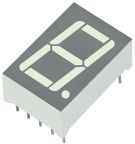
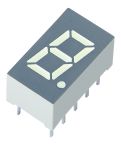
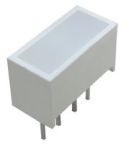
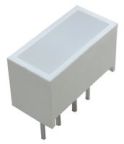
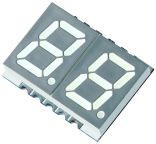


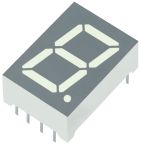
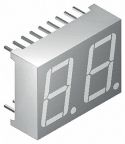
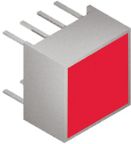
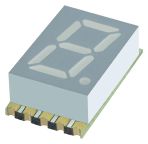
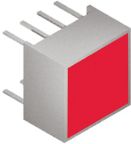
Kingbright is a Taiwan-based optoelectronics manufacturer known almost entirely for one product family in our stock: 7-segment and 14-segment LED numeric displays. The range spans single and dual-digit modules, common-cathode configurations, and a full colour spread — red, orange, yellow and green — at luminous intensities from around 11 mcd up to 100 mcd depending on colour and part.
Digit height varies by part from roughly 5 mm up to 38 mm, which is the dimension that actually drives selection: a 5.1 mm display suits a compact instrument panel or indicator readout viewed close-up, while a 38 mm display is sized for readability from several metres away — a wall-mounted counter or status board. The 14-segment variants add alphanumeric character capability where a plain digit isn't enough, useful for simple alphanumeric status or fault-code displays.
Segment polarity (common cathode vs. common anode) and forward voltage aren't interchangeable between parts, so match the exact Kingbright part number on your existing design or datasheet before substituting — a display that looks identical can still need different driver circuitry. Kingbright displays are frequently specified alongside the LED indicators and pilot devices in our Switches & Pushbuttons range. We are not Kingbright, and not an authorised Kingbright distributor — we source and supply genuine Kingbright stock from our own inventory.
Frequently Asked Questions
Q: What's the difference between common-cathode and common-anode displays?
A: It determines how the display is wired and driven — common-cathode displays share a single ground connection across segments, common-anode share a single positive supply. The two are not interchangeable without redesigning the driving circuit.
Q: How do I choose the right digit size for my application?
A: Match viewing distance to digit height — smaller displays (5-10 mm) suit close-range panel indicators, while larger displays (20 mm+) are for readability from a distance, such as a wall-mounted counter.
Q: Can I mix Kingbright displays with a different manufacturer's driver IC?
A: In most cases yes, since these are standard LED segment displays, but always check forward voltage and current requirements against your driver IC's specification first.