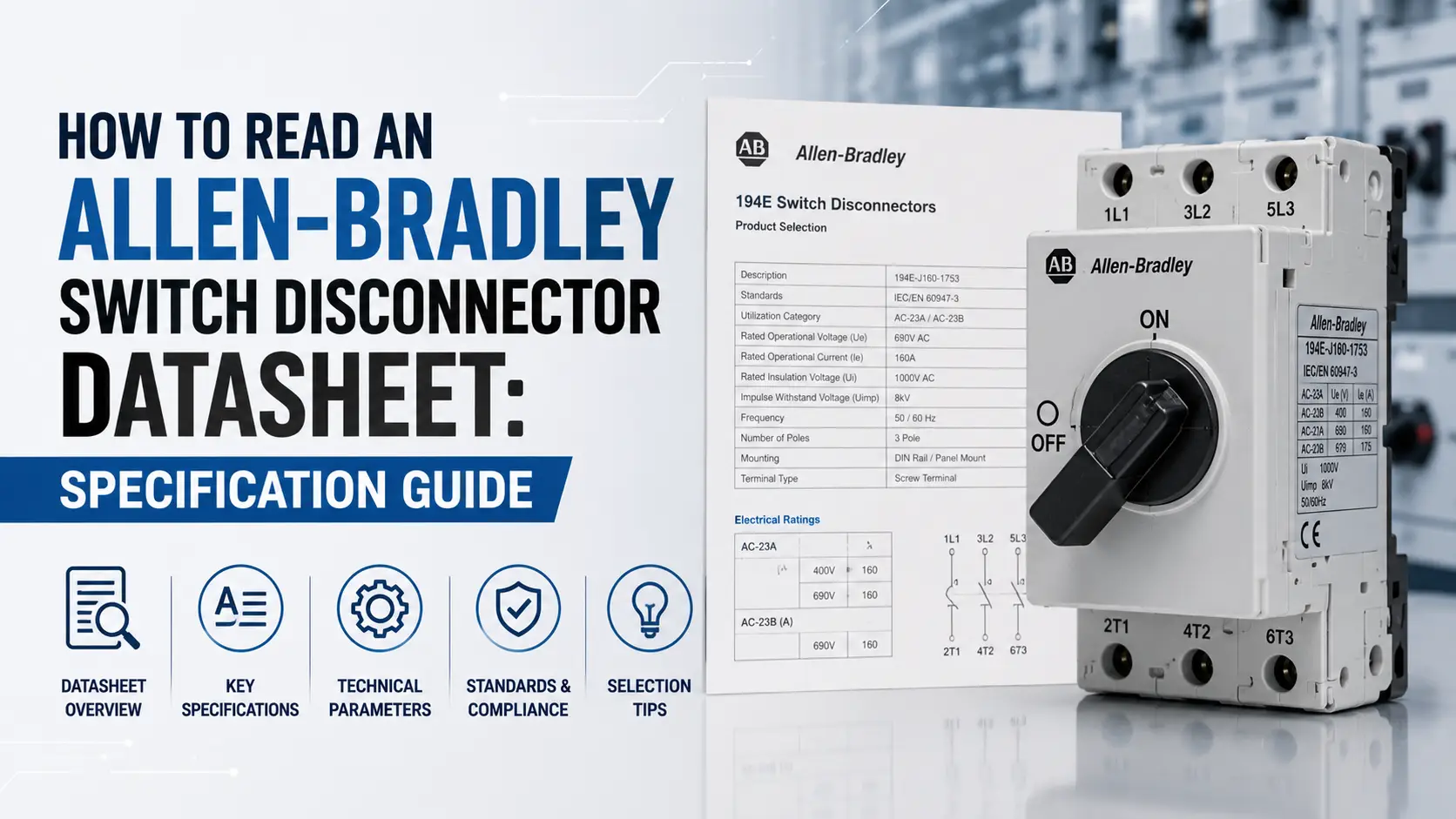
How to Read a Switch Disconnector Datasheet: An Allen-Bradley & ABB Specification Guide
A switch disconnector datasheet packs a dozen ratings onto a single page, and misreading any one of them results in a device that either won't isolate safely under load or won't physically fit the enclosure you've already built. Whether you're comparing an Allen-Bradley control accessory to an ABB switch disconnector, or checking a legacy nameplate before re-ordering, this guide walks through every field on the sheet in the order an engineer should actually check it, using a real switch disconnector's specification as a worked example.
Datasheets for switch disconnectors are written for cross-manufacturer comparison, which is exactly why they're easy to misread in a hurry — the fields aren't always presented in the order that matters for your application, and two devices that look similar on the headline current rating can differ significantly on mounting method, fused/non-fused construction or accessory compatibility. Reading the sheet in a fixed order, rather than jumping straight to the amp rating, is the single habit that prevents most switch disconnector ordering mistakes.
Need help reading a switch disconnector datasheet or sourcing a replacement?
Key Specification Fields Explained
Every switch disconnector datasheet, regardless of manufacturer, is built around the same core fields. Read them in this order and you'll catch a mismatch before it becomes a site problem rather than after.
Datasheet Field | What It Means | What to Check |
|---|---|---|
Rated operational current (Ie) | The continuous current the device can carry and switch under normal conditions | Must exceed your circuit's design load with a sensible margin, not sit at the limit |
Poles | Number of switched phases/conductors — 3-pole, 3+N or 4-pole | 3-pole for standard three-phase circuits; 3+N or 4-pole where the neutral must also be isolated |
Fused vs non-fused | Whether the body accepts fuse cartridges as part of the assembly | Fused types combine isolation with overcurrent protection; non-fused types isolate only, relying on an upstream breaker for protection |
IP rating | Ingress protection of the enclosure and terminals | IP65 for washdown, dusty or outdoor panels; IP00/IP20 acceptable inside an already-sealed cabinet |
Power rating (kW) | Indicative motor power the disconnector is suited to switch at the stated voltage | Cross-check against actual motor kW rather than current alone, particularly on motor-duty circuits |
Mounting type | DIN rail, base/panel mount, or door-coupled rotary handle | Confirm against your existing enclosure cut-out, depth and door mechanism before ordering |
Standard | The test standard the device is certified to | IEC 60947-3 for industrial switch disconnectors sold into the UK; UL 489 applies to North American-style equivalents |
Terminal shroud/cover | Optional accessory protecting live terminals after installation | Check whether it's included or needs ordering separately for touch-protection compliance |
Worked Example: Reading a Real Switch Disconnector Datasheet
Take the ABB 3-Pole DIN Rail Non-Fused Switch Disconnector we stock, rated IP65, 200A, 200 kW. Read the fields in order: three switched poles, so it isolates all three phases of a three-phase supply simultaneously; non-fused construction, meaning it isolates only and relies on an upstream MCCB or fuse for overcurrent protection; rated for 200A continuous current with an indicative 200 kW switching capability at typical industrial voltages; IP65 sealed, suitable for washdown areas or dusty production environments; and DIN rail mounted, so it needs to be checked against the existing enclosure's rail length and door clearance before ordering.
Compare that against a base-mounted, non-rated variant such as the ABB 3-Pole Base Switch Disconnector: same pole count and IP65 rating, but a different mounting method entirely, and typically supplied without a pre-assigned current rating because it's built to order against the handle, shaft and fuse-holder combination specified separately. Reading the mounting field first, before comparing current ratings, avoids ordering a base-type unit into a panel designed for a DIN rail footprint.
Now compare both against the ABB 3-Pole Screw Switch Disconnector, rated IP65/IP00, 250A, 250 kW. The higher current and power figures might look like a straightforward upgrade from the 200A DIN rail unit, but the termination method is different — screw terminals rather than a DIN rail clip-in body — which changes the wiring approach and the space needed inside the enclosure. This is the pattern worth remembering across every switch disconnector datasheet: current rating tells you the electrical capacity, but pole configuration, fused/non-fused construction, termination and mounting method together tell you whether the part will actually go into your panel.
Common Misreadings and Mistakes
The most frequent error is treating the rated operational current (Ie) as though it were a fuse rating — it isn't. A switch disconnector's current rating describes what it can safely carry and switch, not what current level it will interrupt on a fault; that's the job of an upstream breaker or the fuse cartridges in a fused variant. The second common mistake is assuming a non-fused, DIN rail-mounted unit and a base-mounted, shaft-operated unit are interchangeable because they share a pole count and IP rating — the mounting method, terminal arrangement and accessory compatibility (shafts, couplings, terminal shrouds) are frequently specific to that mounting family and won't simply bolt into a different enclosure cut-out. A third is overlooking the power (kW) rating on motor-duty circuits: two devices with an identical current rating can carry different indicative kW ratings depending on their internal contact design, and specifying on current alone can leave a motor circuit under-switched for its actual starting duty. A fourth, less obvious mistake is skipping the terminal shroud line entirely — some datasheets list it as a standard inclusion and others as a separate accessory, and assuming it's included when it isn't leaves a panel builder short of a part needed to pass a touch-protection inspection at handover.
Brands We Supply for Isolation and Switching
For complete switch disconnector assemblies, ABB is our core stocked range — but panel builds using Allen Bradley control gear still need compatible accessories, so here's what's genuinely on the shelf for each brand:
Brand | What We Stock | Brand Page |
|---|---|---|
ABB | Full switch disconnector range — DIN rail, base, screw and fused types, 3-pole and 3+N-pole, from small enclosures up to large fused assemblies | |
Allen Bradley | 194E-series auxiliary contacts and coupling accessories used with Allen Bradley load switches in the same panel build |
Related Circuit Protection Categories
A switch disconnector is normally specified alongside these categories to complete the circuit. Browse the full range in each:
Category | Description | Category Page |
|---|---|---|
Switch Disconnectors | The full range this guide covers — DIN rail, base and fused types | |
Miniature Circuit Breakers | Automatic overcurrent protection typically fitted downstream of the isolator | |
Molded Case Circuit Breakers | Higher-current protection where a switch disconnector isolates ahead of an MCCB | |
Auxiliary Contacts | Signalling contacts fitted to the switch disconnector for remote status indication |
Frequently Asked Questions
What is a switch disconnector used for?
It provides visible, lockable manual isolation of a circuit ahead of maintenance work, distinct from an automatic overcurrent device — it switches the circuit off on demand but, unless it's a fused type, doesn't trip automatically on a fault by itself.
How do I choose between Allen-Bradley and ABB switch disconnectors?
ABB supplies the complete switch disconnector assembly across DIN rail, base and fused types in the range we stock; where a panel is built around Allen Bradley control gear, we supply the compatible 194E-series auxiliary contacts and accessories rather than a directly equivalent Allen Bradley switch disconnector body.
What standards apply to switch disconnectors (UL 489)?
Industrial switch disconnectors sold into the UK are typically tested to IEC 60947-3; UL 489 applies to North American-style moulded case disconnect switches rather than the European switch disconnector format covered in this guide.
Can ZF Corporation source obsolete or discontinued switch disconnectors?
Yes — we regularly cross-reference discontinued switch disconnector part numbers to current in-production equivalents for panel repairs and upgrades where the original unit is no longer manufactured.
What is the typical lead time for a switch disconnector in the UK?
Common current ratings and standard mounting configurations are typically available from stock; higher fused ratings, base-type shaft assemblies and obsolete cross-references may carry a short lead time — contact us with the exact part or specification for a quote.
Conclusion
Reading a switch disconnector datasheet correctly comes down to checking the fields in the right order: pole count and fused/non-fused construction first, then current and power rating with margin, then IP rating, termination and mounting method against your actual enclosure. Get those right and the remaining fields on the sheet are confirmation rather than guesswork. It's also worth keeping a copy of the datasheet for whichever part you eventually order, alongside the panel drawing — the next person to touch that panel, whether that's during a plant shutdown or years later during a fault investigation, will need exactly the same fields you just checked, and a saved datasheet is faster than reverse-engineering a nameplate. If a datasheet still looks ambiguous after working through it field by field, it's quicker to ask a supplier who stocks the part than to guess and reorder later.
Have a datasheet you'd like a second opinion on?
Talk to a Product Specialist
DISCLAIMER: Z&F Corporation is not affiliated with, authorized by, endorsed by, or acting as an official representative of any manufacturer, brand, or trademark owner referenced on this website. All product names, trademarks, brand names, logos, and manufacturer references are the property of their respective owners and are used solely for identification, reference, and compatibility purposes.