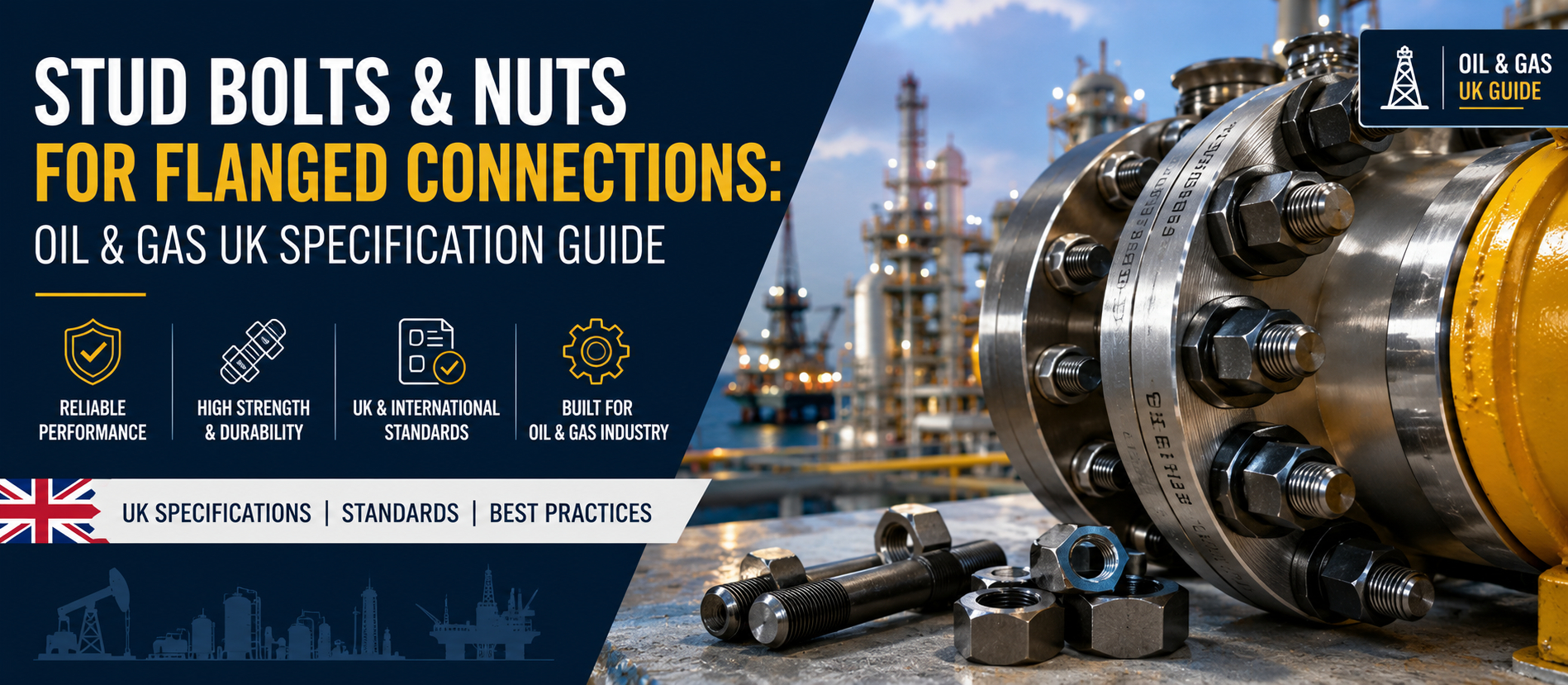
For oil and gas projects across the UK, choosing the right stud bolts for any application is a critical safety mission that can impact the integrity of the flange, operational uptime, and compliance with regulations, no matter whether it is for a refinery shutdown in Teesside, specifying stud bolts nuts oil gas UK for an offshore platform in the North Sea or overseeing the construction of pipelines in Grangemouth.
From ASTM grades and NACE requirements to coating options, supplier evaluation, and considerations of coating life cycles, this guide takes the procurement engineer, EPC contractor, or maintenance manager through all the information necessary to provide.
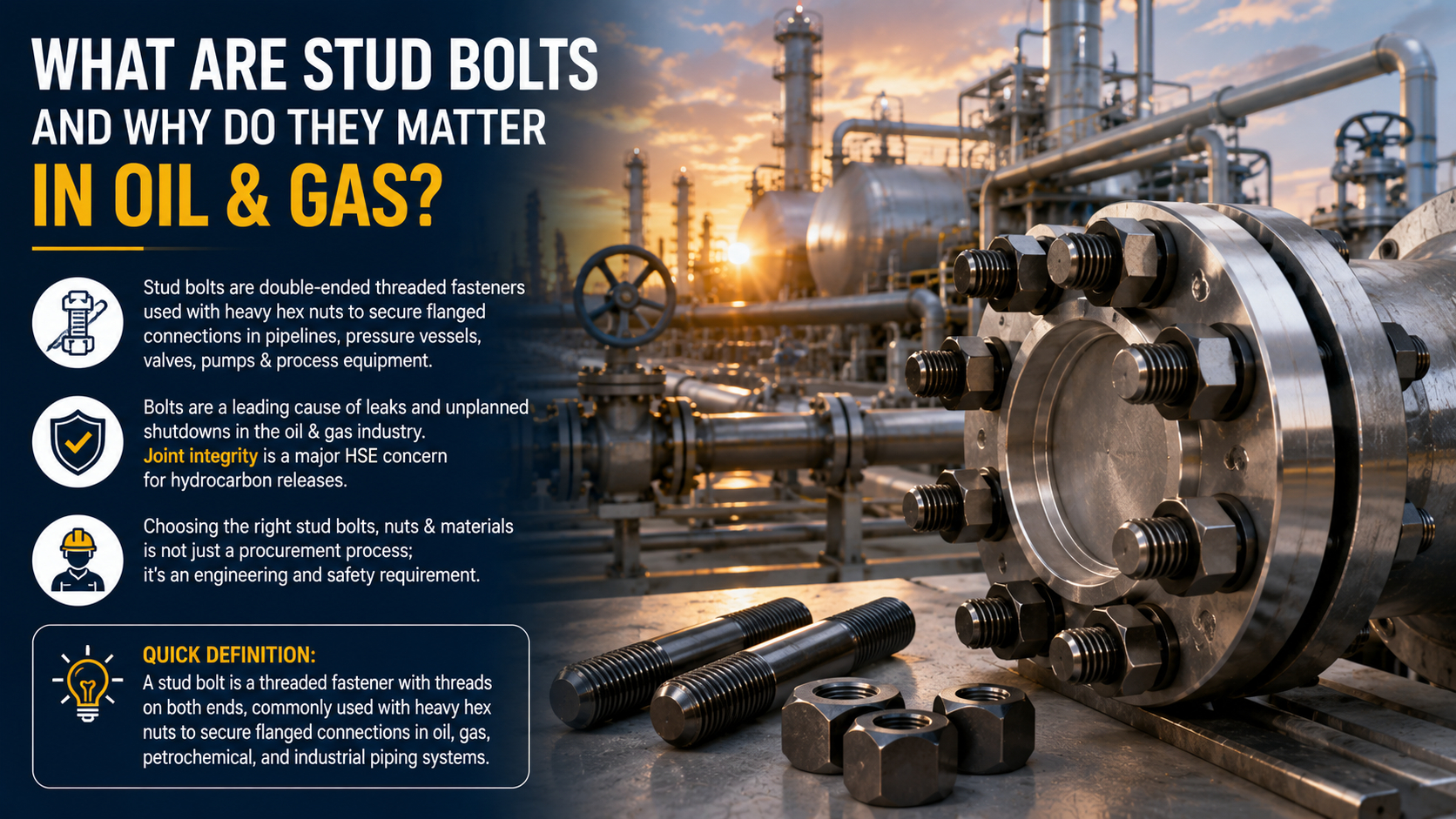
What Are Stud Bolts and Why Do They Matter in Oil & Gas?
A stud bolt is a bolt which is either completely threaded or threaded at each end, used with heavy hex nuts to join flanged parts in pipelines, pressure vessels, valves, pumps and process equipment. Unlike a conventional bolt, the clamping force of a stud bolt is entirely dependent on the clamping force of the nut; for this reason, in situations where controlled preloading, easy alignment and repeatable assembly are critical, a stud bolt is the preferred option.
Bolts are a leading cause of process leaks and unplanned shutdowns in the oil and gas industry in the UK. Joint integrity is a major concern for the Health and Safety Executive (HSE) as a source of hydrocarbon releases on offshore installations and onshore processing sites. Therefore, choosing the right stud bolts nuts oil gas UK is not just a procurement process; it's an engineering and safety requirement.
Quick Definition: A stud bolt is a threaded fastener with threads on both ends, commonly used with heavy hex nuts to secure flanged connections in oil, gas, petrochemical, and industrial piping systems.
Key Standards Governing Oil & Gas Stud Bolts in the UK
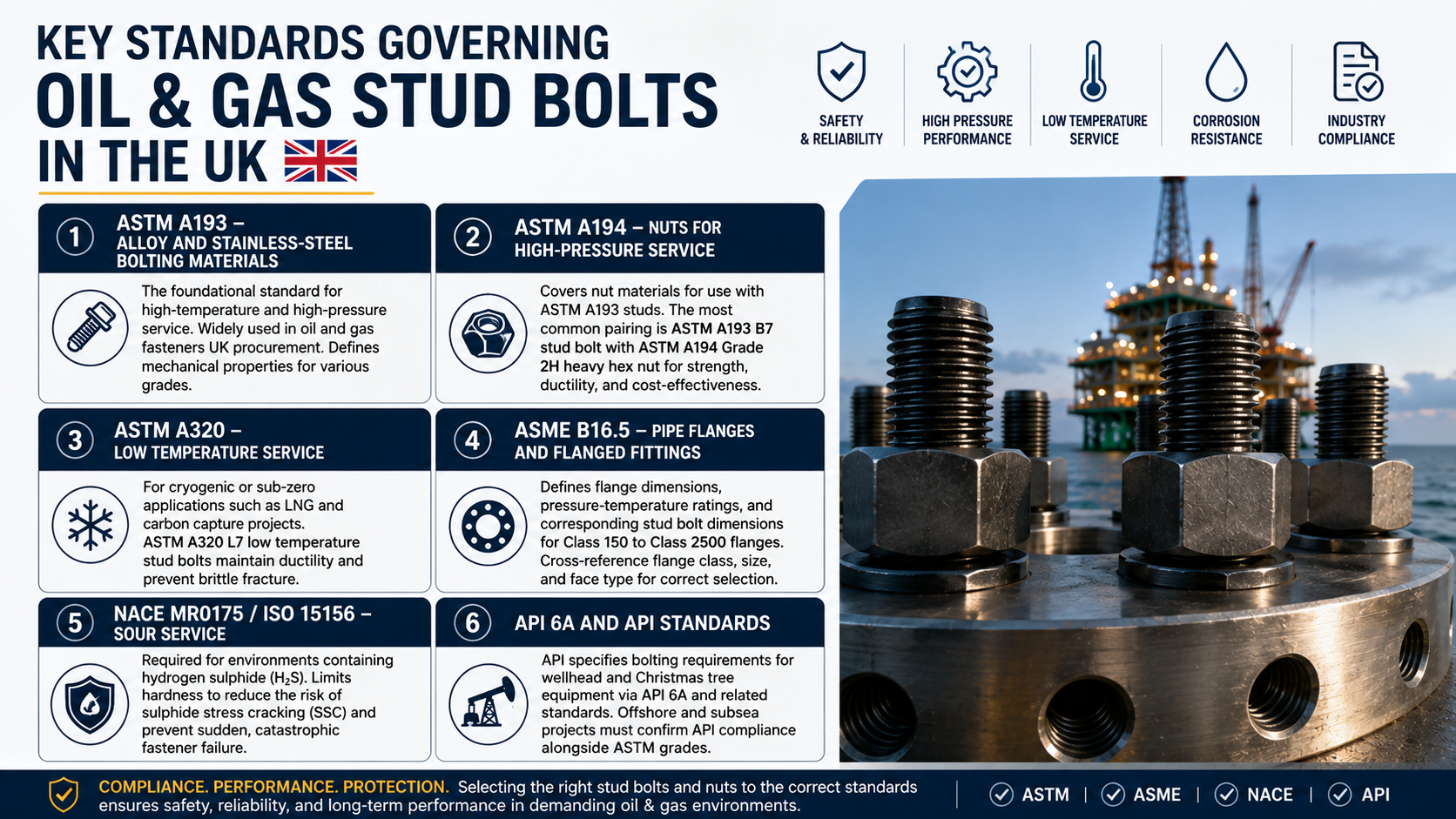
ASTM A193 — Alloy and Stainless-Steel Bolting Materials
ASTM A193 is the foundational standard covering bolting materials for high-temperature and high-pressure service. It is the most widely specified standard for oil and gas fasteners UK procurement and defines mechanical property requirements for a range of grades.
ASTM A194 — Nuts for High-Pressure Service
ASTM A194 covers nut materials intended for use with ASTM A193 studs. The most common pairing across UK oil and gas projects is the ASTM A193 B7 stud bolt matched with the ASTM A194 Grade 2H heavy hex nut — a combination that offers an excellent balance of tensile strength, ductility, and cost-effectiveness.
ASTM A320 — Low Temperature Service
For cryogenic or sub-zero applications — increasingly relevant as LNG infrastructure and carbon capture projects expand across Scotland and northern England — ASTM A320 L7 low temperature stud bolts are required to maintain ductility and prevent brittle fracture.
ASME B16.5 — Pipe Flanges and Flanged Fittings
ASME B16.5 defines flange dimensions, pressure-temperature ratings, and the corresponding stud bolt dimensions for Class 150 through Class 2500 flanges. Procurement engineers must cross-reference flange class, nominal pipe size, and flange face type to determine the correct stud bolt length and thread form.
NACE MR0175 / ISO 15156 — Sour Service
Any bolting intended for environments containing hydrogen sulphide (H₂S) must comply with NACE MR0175. These standard limits hardness levels to reduce the risk of sulphide stress cracking (SSC) — a form of environment-assisted cracking that can cause sudden, catastrophic fastener failure with no visible warning.
API 6A and API Standards
The American Petroleum Institute (API) specifies bolting requirements for wellhead and Christmas tree equipment through API 6A and related standards. For offshore oil and gas fasteners UK and subsea applications, project teams must confirm whether API compliance is required in addition to ASTM grades.
ASTM Grade Comparison: B7, B8, B8M, and L7
Choosing the right material grade is the single most important fastener decision in oil and gas procurement. The table below summarizes the most common grades and their applications across UK energy projects.
Grade | Standard | Material | Typical Application |
B7 | ASTM A193 | Chromium-molybdenum alloy steel | High-pressure, high-temperature service; refineries, pipelines |
B8 | ASTM A193 | 304 stainless steel | Corrosion-resistant applications; offshore, chemical service |
B8M | ASTM A193 | 316 stainless steel | Enhanced chloride resistance; offshore, marine environments |
L7 | ASTM A320 | Chromium-molybdenum alloy steel | Low temperature / cryogenic service; LNG, cold climate installations |
B7M | ASTM A193 | Chromium-molybdenum (controlled hardness) | Sour service; NACE MR0175-compliant |
B7 vs B8: Understanding the Difference
The B7 stud bolt is the workhorse of UK oil and gas bolting. Made of chromium-molybdenum, it provides superior elevated-temperature capability and great tensile strength (at least 125 ksi), which is ideal for most flange use in pipelines, petrochemicals, and refinery applications. It is compatible with ASTM A194 2H heavy hex nuts, and will satisfy most ASME B16.5 flange assemblies up to Class 2500.
B8 and B8M stainless steel stud bolts, on the other hand, are used where corrosion is the primary requirement, especially in offshore platform topsides, marine applications and chemical injection systems where carbon or alloy steel fasteners would be quickly corroded by the presence of chloride ions.
Corrosion Protection: Coating Options for UK Oil & Gas Applications
Bare alloy steel stud bolts are prone to atmospheric corrosion in storage, installation and operation, especially in the harsh marine environment common to many offshore platforms located in the North Sea and coastal UK refineries. The proper coating approach will maximize service life, provide ease in removal and promote long-term joint integrity.
PTFE Coating
A dry-film lubricant layer is formed on the thread of the PTFE-coated stud bolt to minimize friction between the thread and help ensure that torque-tension relationship is consistent; it also offers moderate protection against atmospheric corrosion. They have a wide range of applications across the petrochemical fasteners UK industry, where it is important to have controlled bolt load for gasket sealing. PTFE coating may be used as a project standard for industrial bolting solutions within petrochemical plants UK.
Hot Dip Galvanizing
The hot dip galvanized stud bolts are suitable for atmospheric and mildly corrosive environment, and the galvanized layer is used as sacrificial protection. They are used for onshore pipelines and structures and typically are not used for subsea or immersed service because of potential hydrogen embrittlement concerns.
Xylan and Fluoropolymer Coatings
Corrosion protection with lubricity is provided by fluoropolymer coatings, e.g. Xylan 1424. They are often used in the A193 B7 stud bolts UK suppliers where both corrosion resistance and accurate torque control is required when assembling flanges on offshore installations and refineries.
Flange Assembly Best Practices: Torque, Tensioning, and Preload
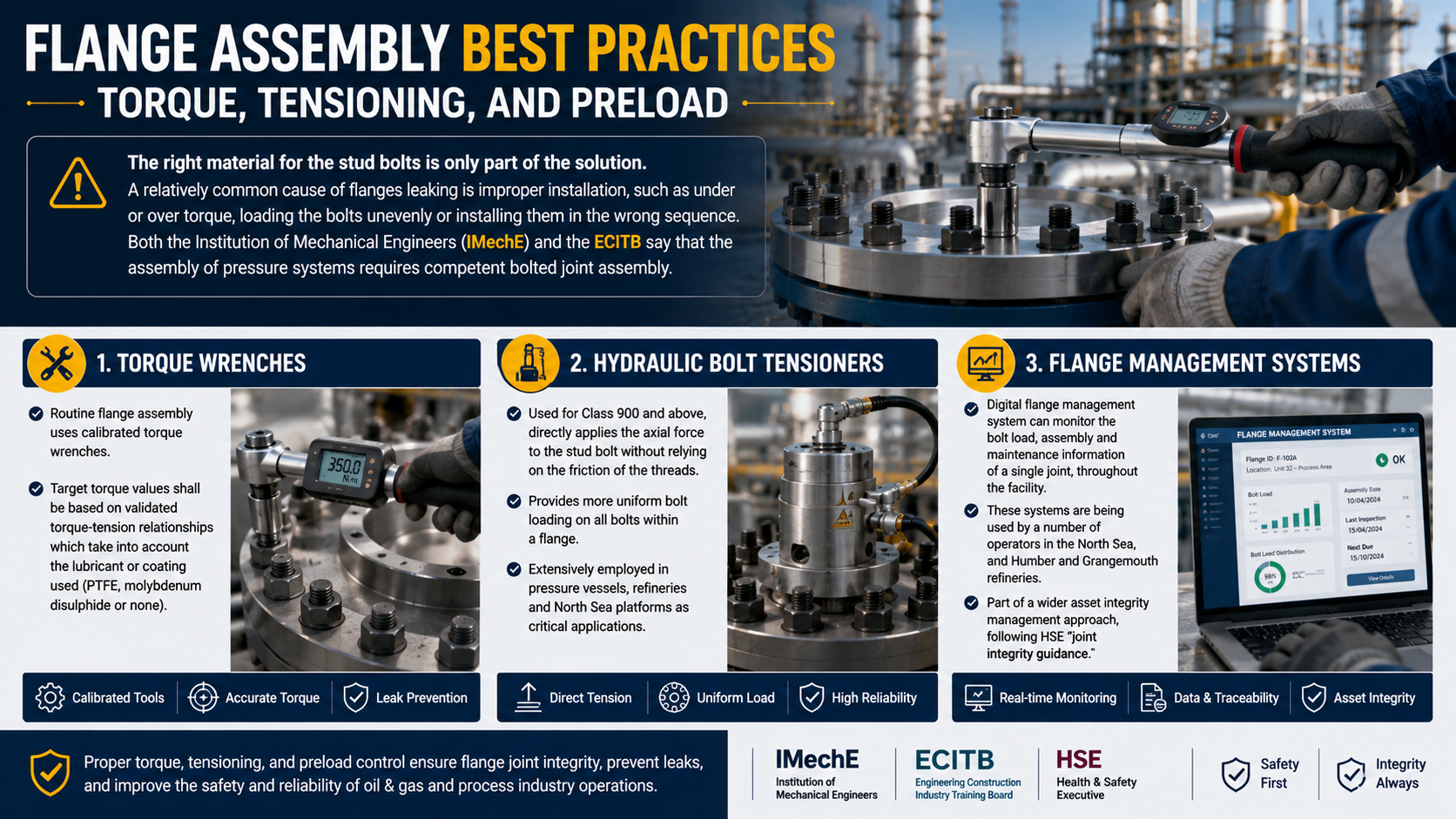
The right material for the stud bolts is only part of the solution. A relatively common cause of flanges leaking is improper installation, such as under or over torque, loading the bolts unevenly or installing them in the wrong sequence. Both the Institution of Mechanical Engineers (IMechE) and the ECITB say that the assembly of pressure systems requires competent bolted joint assembly.
Torque Wrenches
Routine flange assembly uses calibrated torque wrenches. Target torque values shall be based on validated torque-tension relationships which take into account the lubricant or coating used (PTFE, molybdenum disulphide or none).
Hydraulic Bolt Tensioners
The hydraulic bolt tensioner is used for Class 900 and above, and directly applies the axial force to the stud bolt without relying on the friction of the threads. This provides more uniform bolt loading on all of the bolts within a flange and is extensively employed in pressure vessels used in the refinery industry and on North Sea platforms as critical applications.
Flange Management Systems
A digital flange management system can monitor the bolt load, assembly and maintenance information of a single joint, throughout the facility. These systems are being used by a number of operators in the North Sea, and Humber and Grangemouth refineries, and as part of a wider asset integrity management approach, following HSE joint integrity guidance.
Application-Specific Selection Guide
Offshore Oil and Gas Platforms (North Sea)
Corrosion resistant stud bolts oil gas industry specifications are required for installations in the North Sea, where they must be able to resist saltwater spray, humidity, cyclic thermal loading and possible exposure to H₂S. Typical specifications include:
All risers for sour service and process headers are B7M stud bolts to NACE MR0175 standard
B8M stainless steel in splash areas for topsides equipment Coating of the bolts.
PTFE or Xylan for atmospheric bolting.
Most operators from the North Sea require full material test certificates (MTCs) with heat/lot traceability.
Refinery Applications (Grangemouth, Humber, Southampton)
There are many process units used in the UK refinery. If you are looking for stud bolts for refinery application UK, you can expect to find the following types of stud bolts:
ASTM A193 B7 for the majority of elevated-temperature hydrocarbon service
B7M: In sour service units (amine, sulphur, hydrogen)
ASTM A320 L7 for process streams operating at low temperatures and for the cryogenic parts
Standard flanges dimensional compliance to ASME B16.5
Pipeline Construction (Teesside, Humber)
The onshore oil and gas pipelines and offshore pipelines in the UK are regulated by ASME B31.3, B31.4/B31.8 and project specifications from the pipeline operator. Above ground flanged connections are usually connected with hot dip galvanized or PTFE coated B7 type stud bolts.
LNG and Carbon Capture Installations
The UK is home to a growing number of carbon capture and storage (CCS) plants, as well as LNG terminals, which are both fasteners’ consumers. New energy infrastructure, such as LNG terminals and the increasing number of carbon capture and storage (CCS) plants across the UK, is also fasteners consumers. The specification for ductile behaviour (A320 L7 with A194 Grade 4 or 7 nuts) applies to low temperature bolts, meaning performance at -100°C and colder. This is a growing procurement category, driven by the rapid progress of the UK Department for Energy Security and Net Zero towards low-carbon infrastructure investment up to 2025–2026.
Material Traceability and Supplier Certification
The process of supplier certification is called material traceability. When it comes to safety-critical pressure service, material traceability can't be an option. UK oil and gas operators require documentation which can prove that each batch of the high temperature stud bolts UK has an established chain of custody from raw material to finished product.
What Certifications Should Suppliers Provide?
The good qualified stud bolts suppliers UK companies ought to offer:
Material Test Certificates (EN 10204 3.1/3.2): Chemical composition and Mechanical properties.
NCAC (NACE compliance certificates): hardness testing to MR0175, if required.
Dimensional inspection reports: confirming that thread form, length tolerances and heavy hex nut dimensions are correct.
Right pressure service compliance records in line with the Pressure Equipment (Safety) Regulations 2016
System records of manufacturers' qualification: confirming the ISO 9001 or equivalent quality management system.
Supplier Evaluation Framework for UK Procurement Teams
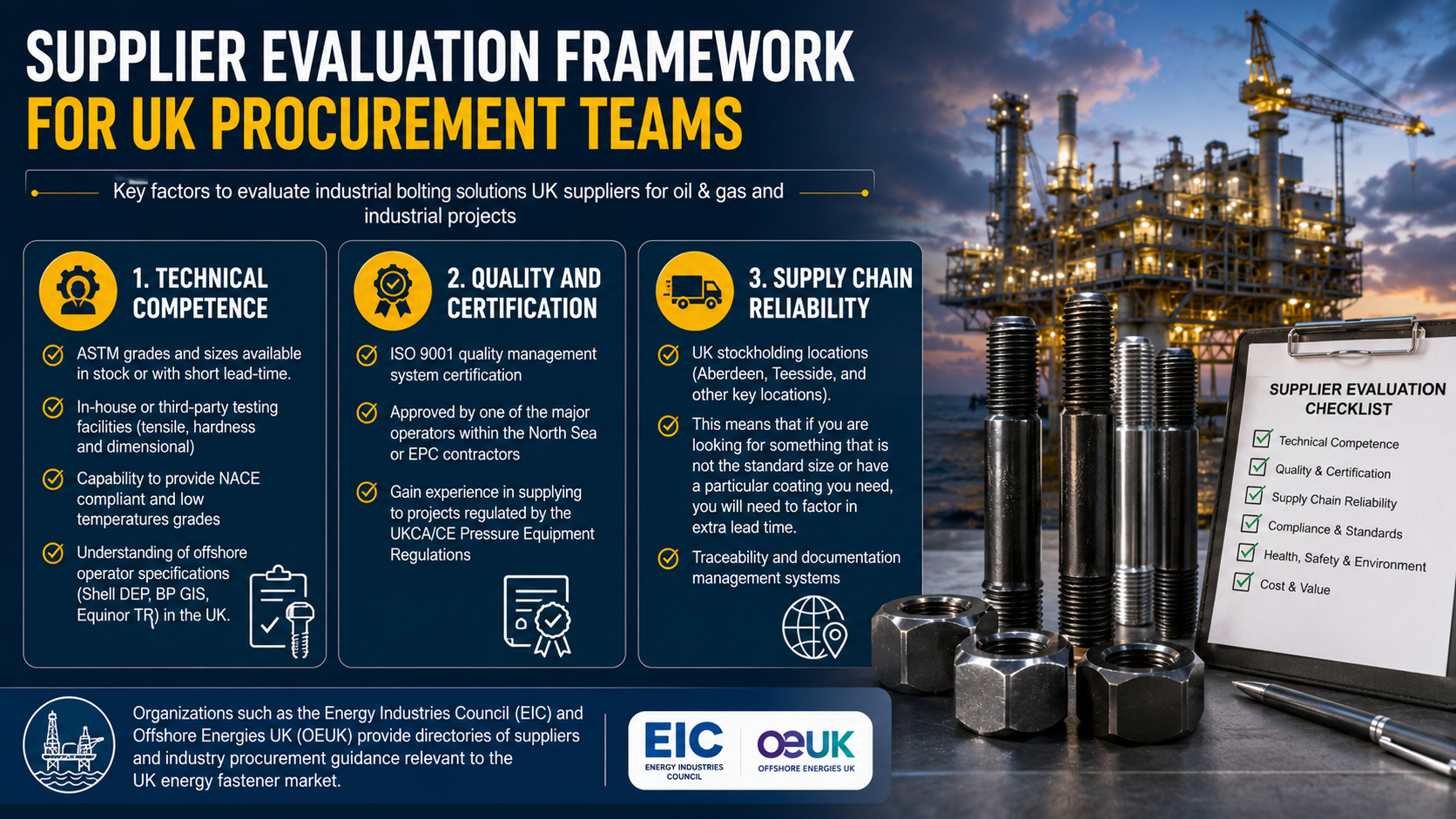
Procurement and engineering teams should evaluate the industrial bolting solutions UK suppliers when entering the shortlist based on the following factors:
Technical Competence
ASTM grades and sizes available in stock or with short lead-time.
In-house or third-party testing facilities (tensile, hardness and dimensional)
Capability to provide NACE compliant and low temperatures grades
Understanding of offshore operator specifications (Shell DEP, BP GIS, Equinor TR) in the UK.
Quality and Certification
ISO 9001 quality management system certification
Approved by one of the major operators within the North Sea or EPC contractors
Gain experience in supplying to projects regulated by the UKCA/CE Pressure Equipment Regulations
Supply Chain Reliability
UK stockholding locations (Aberdeen, Teesside, and other key locations).
This means that if you are looking for something that is not the standard size or have a particular coating you need, you will need to factor in extra lead time.
Traceability and documentation management systems
A number of organizations such as the Energy Industries Council (EIC) and Offshore Energies UK (OEUK) provide directories of suppliers and industry procurement guidance relevant to the UK energy fastener market.
Lifecycle Cost Considerations
The cost of ownership of API compliant stud bolts UK fasteners is only a small portion of the overall cost. There are a number of potential ways in which procurement decisions that focus on the initial unit cost but not material quality, traceability or correct specification, can lead to significantly higher Life Cycle Costs:
Corrosion that happens when it is too early for replacement
Flange leaks causing unexpected shutdowns and HSE reportable incidents
Challenge in dis-assembling seized or corroded studs during maintenance turnarounds .
non-compliant work due to failure to meet project requirements, resulting in rework or regulatory action.
If the stud bolt is correctly specified and installed using calibrated tooling, and coated appropriately, it will provide 10-20 years of reliable service in an onshore refinery environment.
Frequently Asked Questions
What is the difference between a threaded bolt and a normal screw?
Threaded bolts have a thread on both ends or are continuously threaded and are used in combination with nuts. Normal bolts have a head on one end. When installing flanges, threaded bolts are easier to align and the tightening force is more uniform.
Can stainless steel threaded bolts be used at sea?
Yes Stainless steels such as B8 and B8M are often used where alloy steel bolts would fail quickly due to salt. However, when selecting stainless steel, compatibility with other metals must be carefully considered, as well as the risk of galling when tightening.
What are high-strength hexagon nuts used for?
They are used in flange connections and high-pressure applications Compared to Standard hex nuts, they have a larger bearing surface and can withstand a higher load. This makes them more resistant to protrusions and other problems and ensures secure tightening of the bolt.
What surface treatments are available for threaded bolts?
Common options include PTFE (Xylan), hot dip galvanizing, electrolytic galvanizing and fluoropolymer composite coatings. The choice depends on the corrosive environment, the need for lubricity to stabilize the fastener and the contractor's specifications.
Conclusion
Stud bolts nuts oil and gas UK industry is a technically demanding task. Variations in specifications, substandard materials and faulty installations can lead to serious problems such as process leaks, environmental accidents and even total joint failure. Procurement and Engineering Teams in Aberdeen, Teesside, Grangemouth and other locations can safe and reliable.
Select the right studs through a comprehensive understanding of ASTM grade grades, NACE requirements, surface treatment options and supplier qualification criteria.
Specifying corrosion resistant stud bolts for oil and gas projects in the North Sea or considering industrial fastening solutions for UK petrochemical plants, this guide provides you with a framework for selection, evaluation and sourcing.
For project-specific enquiries, material availability and certification documents Please contact qualified stud bolt suppliers UK with proven experience in pressure applications in the oil and gas and UK energy industries.
Disclaimer
Z&F Corporation is not affiliated with, authorized by, endorsed by, or acting as an official representative of any manufacturer, brand, or trademark owner referenced on this website. All product names, trademarks, brand names, logos, and manufacturer references are the property of their respective owners and are used solely for identification, reference, and compatibility purposes.