ABB MCB vs MCCB: How to Choose the Right Breaker
A frequently asked question in the specification of a panel: ABB MCB vs MCCB, which type is best for the circuit? It is not about brand or habit, it is about rated current and prospective fault current and governing standard. This guide describes ABB MCB vs MCCB, based on neutral, standard criteria, in order to be able to identify the appropriate device and receive an accurate quotation.
Ready to specify? Request a Quote with rated current, fault level, standard, quantity and trip unit preference, and our team will review it.
1. What Is the Difference Between an MCB and an MCCB?
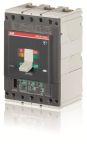
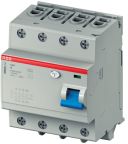
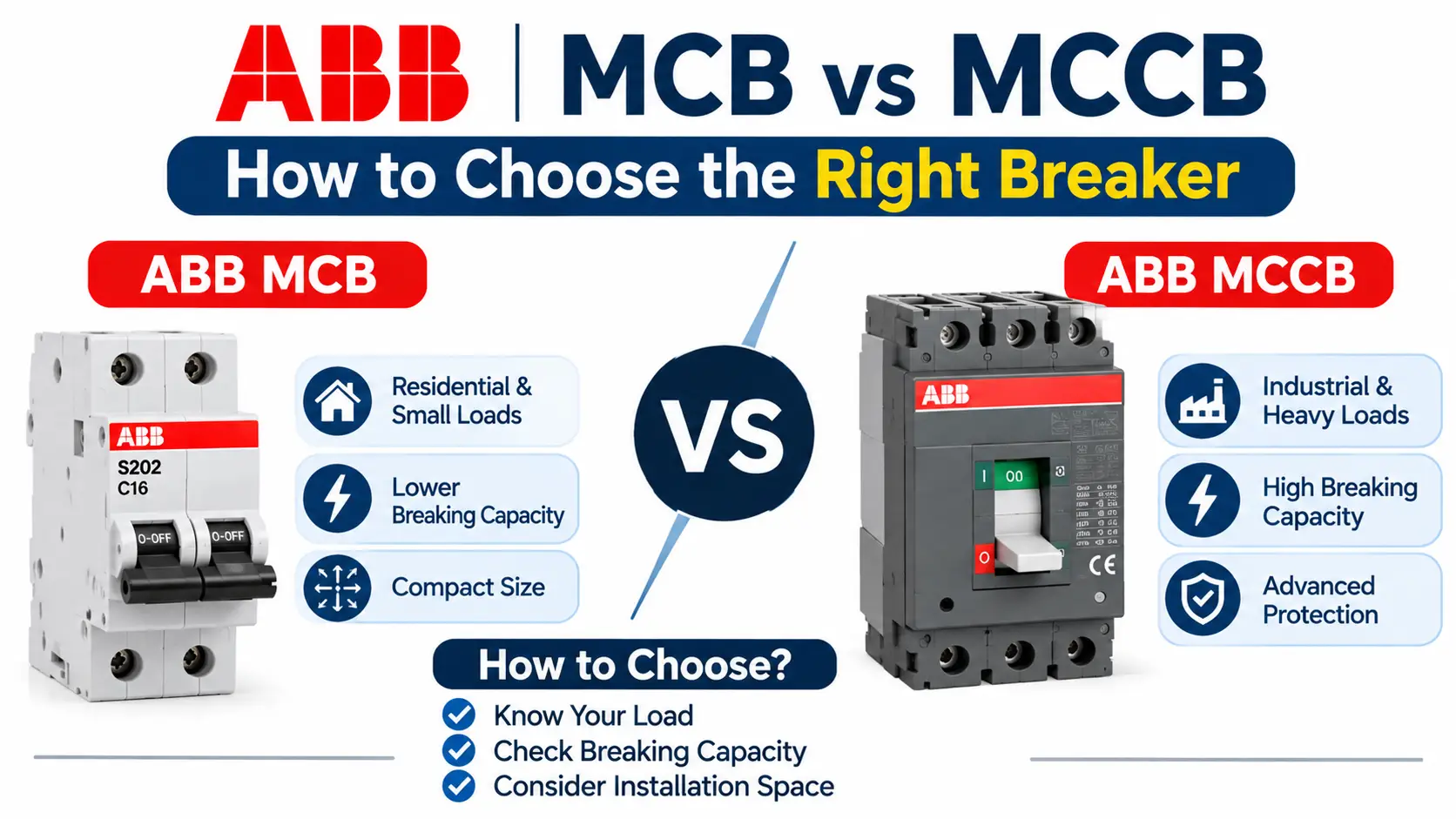
The first difference between MCB and MCCB is the scale. An MCB (miniature circuit breaker) is a small circuit breaker for small final circuits. An MCCB (molded case circuit breaker) is a larger, wider range, and more adjustable circuit breaker used on feeders, motors and high current loads.
Both provide overcurrent and short circuit protection; the choice between a miniature circuit breaker and a molded case circuit breaker is duty related, not quality related. If you get a catalogue from a manufacturer like ABB, you will be able to find both families.
2. Standards Scope: IEC 60898-1 vs IEC 60947-2 and UL 489
IEC 60898-1 vs IEC 60947-2 is the clearest dividing line. MCCBs are included in the IEC 60947-2, which covers industrial low-voltage circuit breakers. Molded case breakers are usually UL 489 rated in North America.
As a result MCB are only rated at 125 A for IEC 60898-1, it is a scope boundary and not a physical limit. The MCB rated current range is therefore up to 125 A and current standard editions are recommended before specifying; the final circuit devices in our miniature circuit breakers range are available..
3. Rated Current and Breaking Capacity: Icn, Icu, and Ics
|
Term |
Standard |
Meaning |
|---|---|---|
|
In |
Both |
Rated current |
|
Icn |
IEC 60898-1 |
Rated short-circuit breaking capacity (MCBs) |
|
Icu |
IEC 60947-2 |
Ultimate short-circuit breaking capacity |
|
Ics |
IEC 60947-2 |
Service capacity; breaker stays serviceable |
Breaking capacity terms of Icn vs Icu are different, please check the symbol and test basis before the comparison of datasheets. The prospective short circuit current at the installation location of any breaker must be equal to or greater than the short circuit current. Use our supported brands page to compare datasheets between brands.
4. MCB vs MCCB Comparison Table
|
Feature |
MCB |
MCCB |
|---|---|---|
|
Standard |
IEC 60898-1 |
IEC 60947-2 (UL 489 in North America) |
|
Rated current |
Up to 125 A |
Wider range, higher currents |
|
Breaking capacity |
Icn |
Icu and Ics |
|
Trip adjustment |
Typically fixed |
Often adjustable |
|
Mounting |
DIN rail |
Bolt-on or plug-in |
|
Typical use |
Final circuits |
Feeders, motors, incomers |
The typical MCB is less expensive and requires less space per pole. The MCCBs are more expensive, have higher ratings, and have adjustable options. Each series has a different price, so please ask for quotations for specific catalogue numbers. Both devices are without residual-current protection capabilities by themselves, as explained in our RCBO vs RCD guide.
5. When to Select an MCB or an MCCB
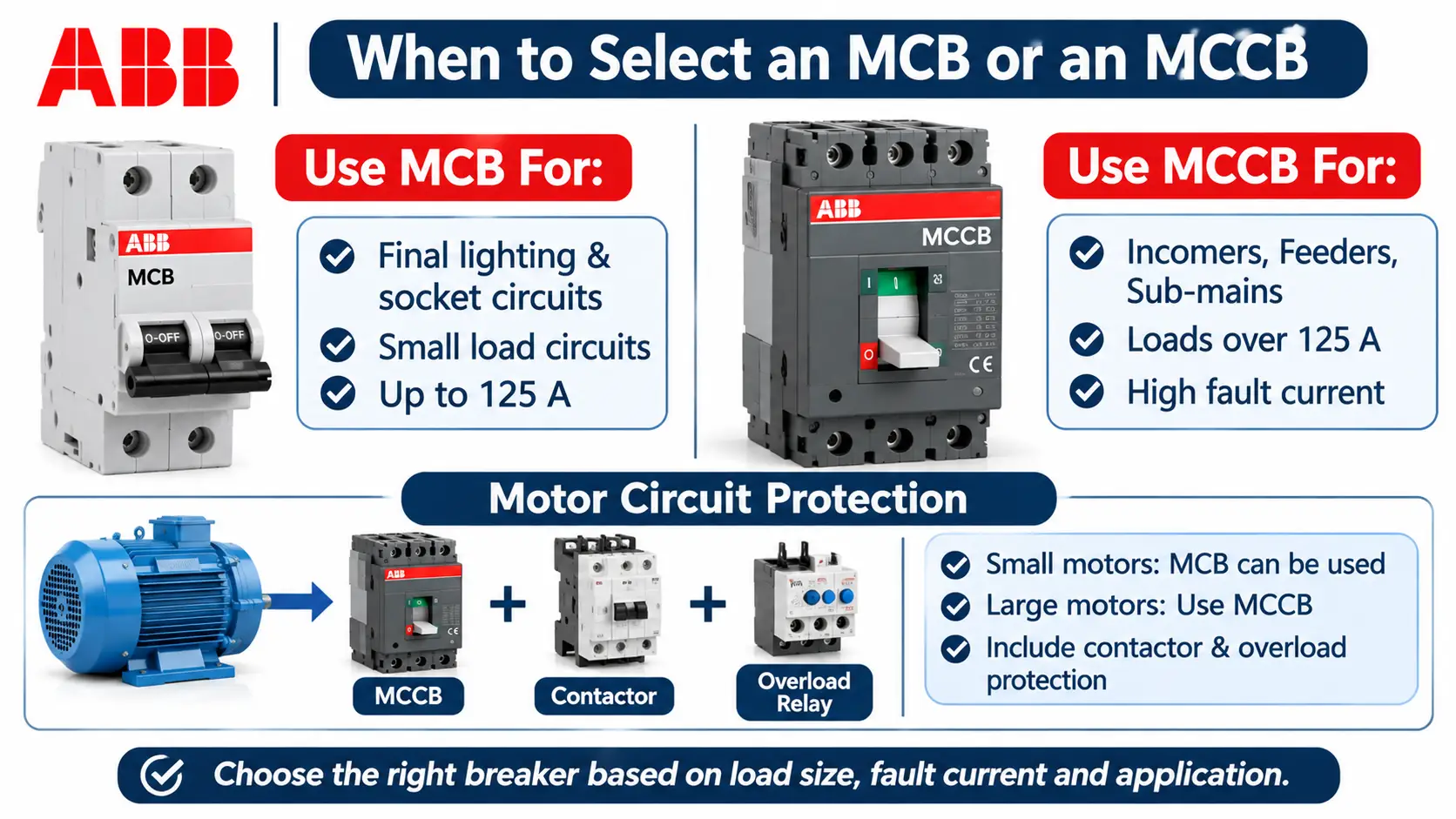
It should be remembered that the use of MCB, instead of MCCB, in a distribution board is permissible for final lighting and socket and small load circuits with the breaking capacity of MCCB up to 125 A. For incomers, feeders, sub-mains and loads in excess of 125 A and/or fault current exceeding MCB, use MCCBs.
Starting current must be checked for MCCB vs MCB for Motor Circuit Protection, some MCB are used for small motor branch protection. Typically, MCCB-based protection is required for larger motors. The selection of circuit breaker for motor protection should also include the use of a contactor for motor protection and overload protection; our contactor vs relay guide explains the starter side.
6. Trip Units, Adjustability, and Selectivity
-
For various inrush conditions, there are MCB trip curves, B, C and D.
-
Adjustable thermal-magnetic MCCB vs fixed MCB: adjustable settings for fine tuning protection.
-
Perform additional protection functions and settings, as per series, with electronic trip units.
-
The difference between DIN rail MCB and bolt-on MCCB mounting is that MCCBs require more panel space and larger terminals.
-
Derating: Effectively lower rating because of ambient temperature or enclosure conditions.
Selectivity is a function of settings and ratings; a coordination study must be made to confirm this. Status and alarm: accessories like auxiliary contacts.
7. Step-by-Step Selection Process for Engineers
-
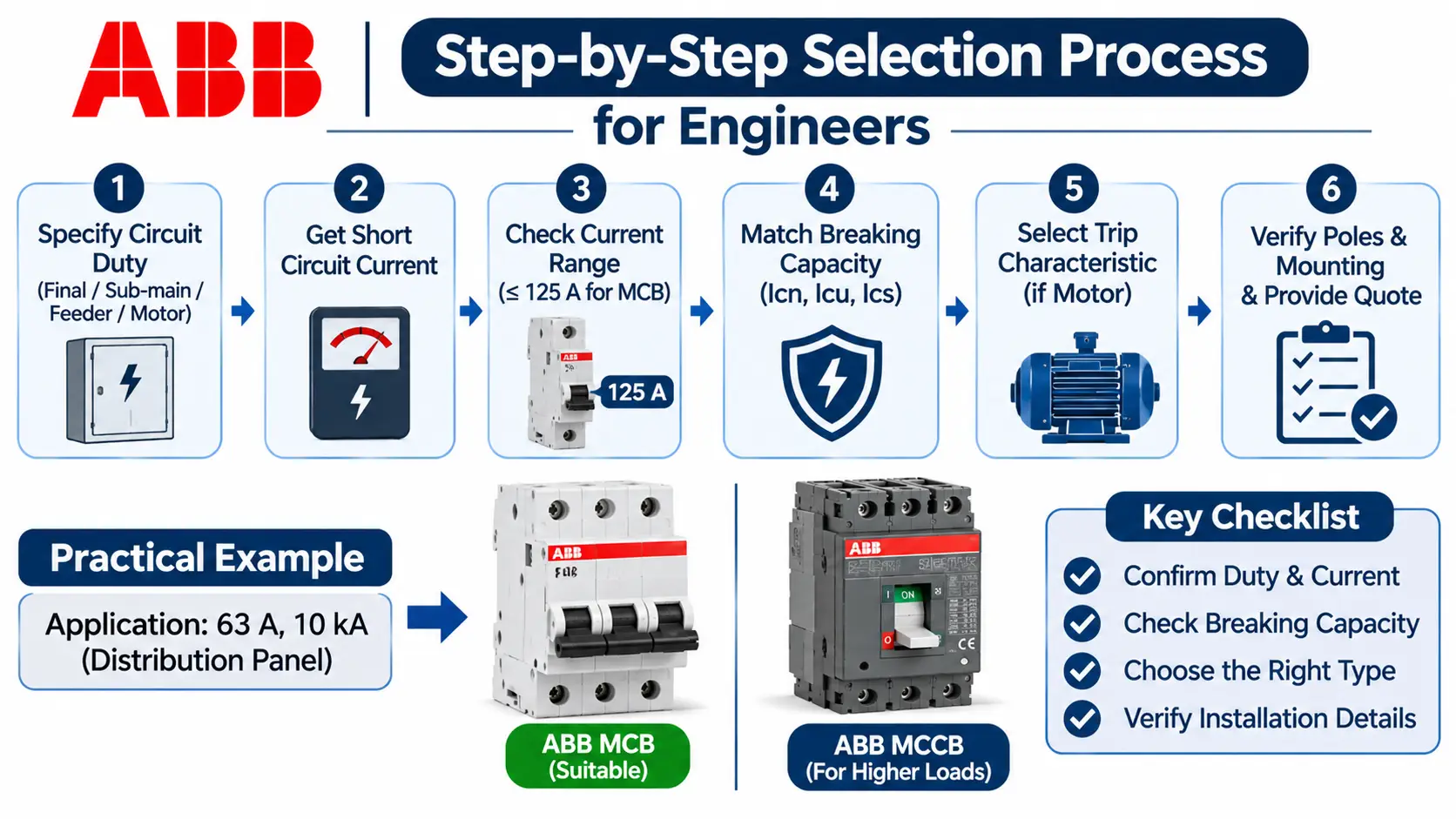
Specify circuit duty, final, sub-main, feeder or motor branch with design current.
-
Get the short circuit current at the installation point..
-
Verify if the required rated current is in the range of the MCB, 125 A.
-
Match the breaking capacity (Icn, Icu and Ics) with the current.
-
Select the trip characteristic (if applicable) motor starting.
-
Verify poles, mounting and panel space and provide a quote with exact catalogue numbers.
This is also an ABB breaker selection checklist for panel builders. In case of MCCB frame size selection, check frame, rated current and trip unit against the current ABB range.
8. Frequently Asked Questions
What is the main difference between an MCB and an MCCB?
According to IEC 60898-1, an MCB protects small final circuits up to 125 A. According to IEC 60947-2, feeders and greater loads are protected by an MCCB.
Can an MCB be used for motor protection?
Some MCBs serve small motor branches within their limits. Check starting current, overload needs and the manufacturer's motor data.
What is the difference between Icn and Icu?
MCBs' rated short-circuit breaking capacity is known as Icn. For MCCBs, Ics is the service capacity and Icu is the ultimate breaking capacity.
Do MCBs and MCCBs follow the same standard?
No. MCBs follow IEC 60898-1 and MCCBs follow IEC 60947-2. In North America, molded case breakers are typically covered by UL 489.
How do I choose an MCCB frame size?
Use the design current and rated current to derate the frame, breaking capacity and trip unit in the catalog.
Are MCBs and MCCBs interchangeable in the same panel?
Not without a review by engineers. Differences in mounting, terminals, ratings, breaking capacity, and standard compliance.
9. Conclusion
ABB MCB vs MCCB comes down to rated current, standard scope, breaking capacity and trip needs, not brand. If replacing items is required, record the fault current, design current and standard on the panel schedule to ensure that the items are replaced to the same standards. Check out our supported brands page for more series.
Brand names are used for identification only. Z&F Corporation is an independent sourcing service and is not an ABB authorized distributor; no partnership or endorsement is implied. Verify ratings against current manufacturer catalogues.
Need to review your circuit duty and fault-level data before specifying? Talk to Our Specialist and we will help.