ASME Pipe Fittings in Qatar: Complete Industrial Procurement & Engineering Guide
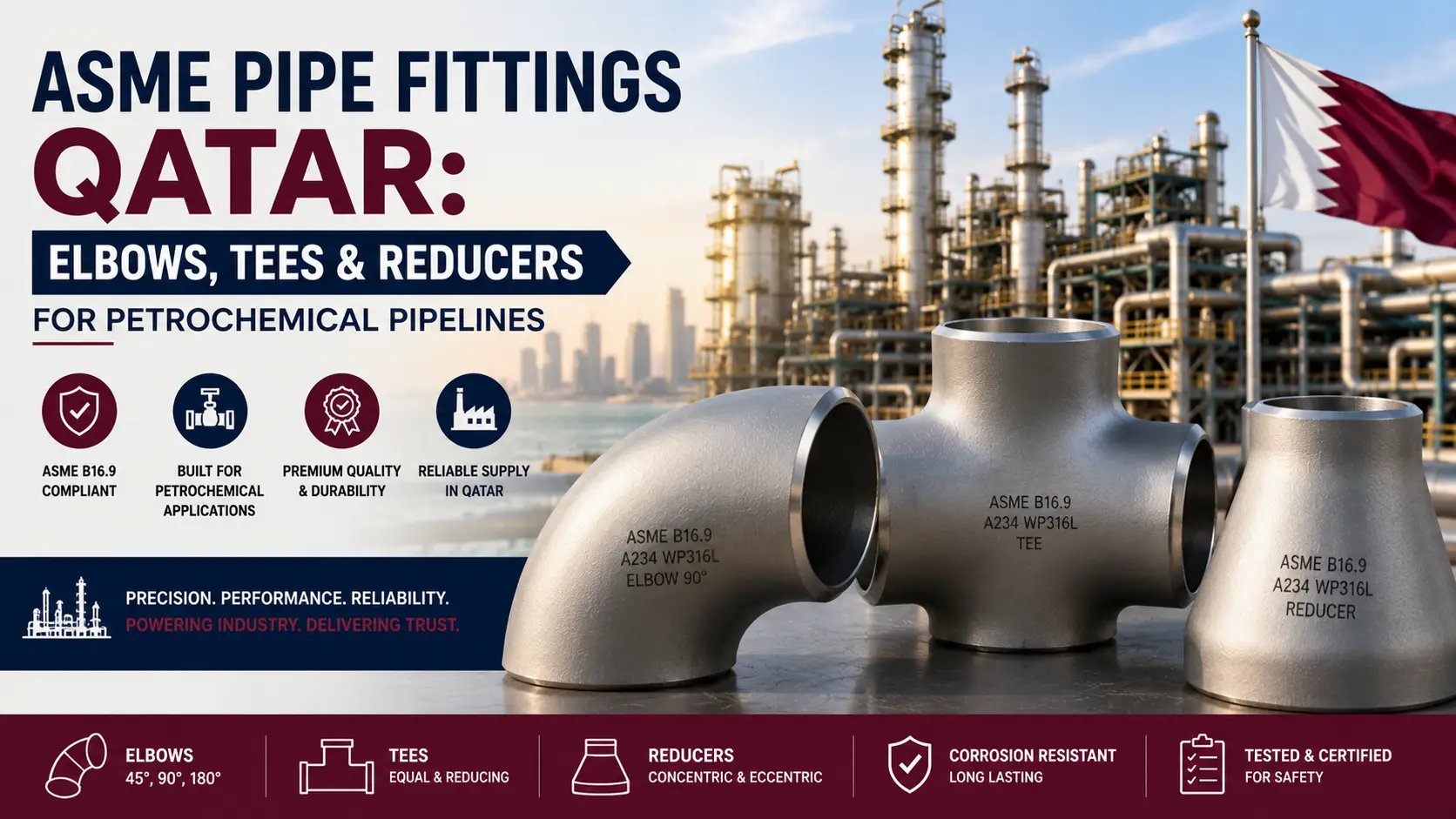
Whether for use in LNG plants at Ras Laffan, refineries at Mesaieed, or offshore platforms in the Arabian Gulf, ASME pipe fittings are essential to ensure safe, leak-free piping systems in harsh pressure and temperatures. The choice of ASME pipe fittings Qatar buyers can rely on should be based on the material grade and size standards, as well as traceability, rather than price. The fitting types and ASME standards, materials and selection, inspection requirements and supplier evaluation are discussed in this guide.
Looking for pipe fitting ASME pricing for your project?
What Are ASME Pipe Fittings?
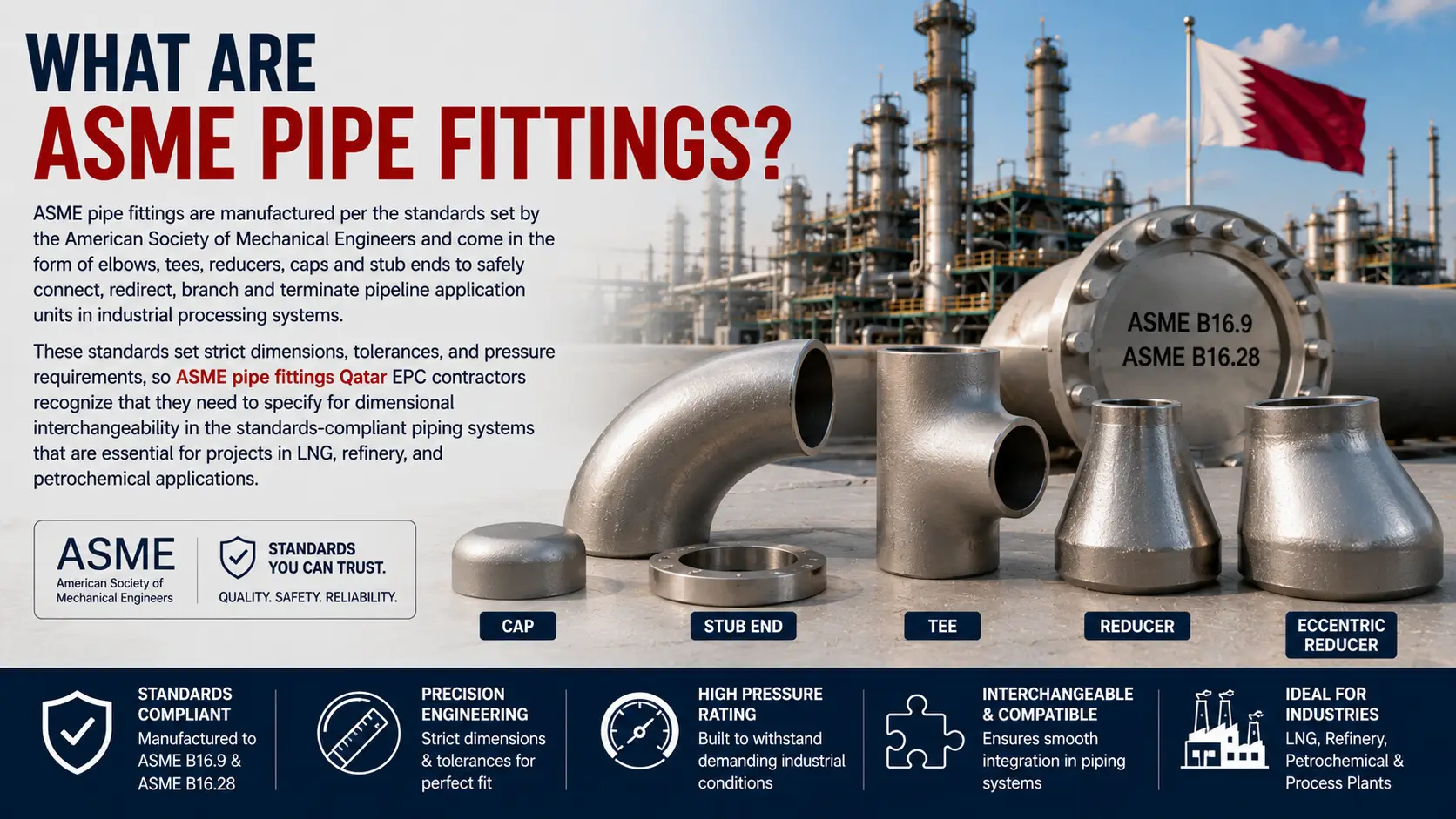
ASME pipe fittings are manufactured per the standards set by the American Society of Mechanical Engineers and come in the form of elbows, tees, reducers, caps and stub ends to safely connect, redirect, branch and terminate pipeline application units in industrial processing systems. These standards set strict dimensions, tolerances, and pressure requirements, so ASME pipe fittings Qatar EPC contractors recognize that they need to specify for dimensional interchangeability in the standards-compliant piping systems that are essential for projects in LNG, refinery, and petrochemical applications.
Types of ASME Pipe Fittings
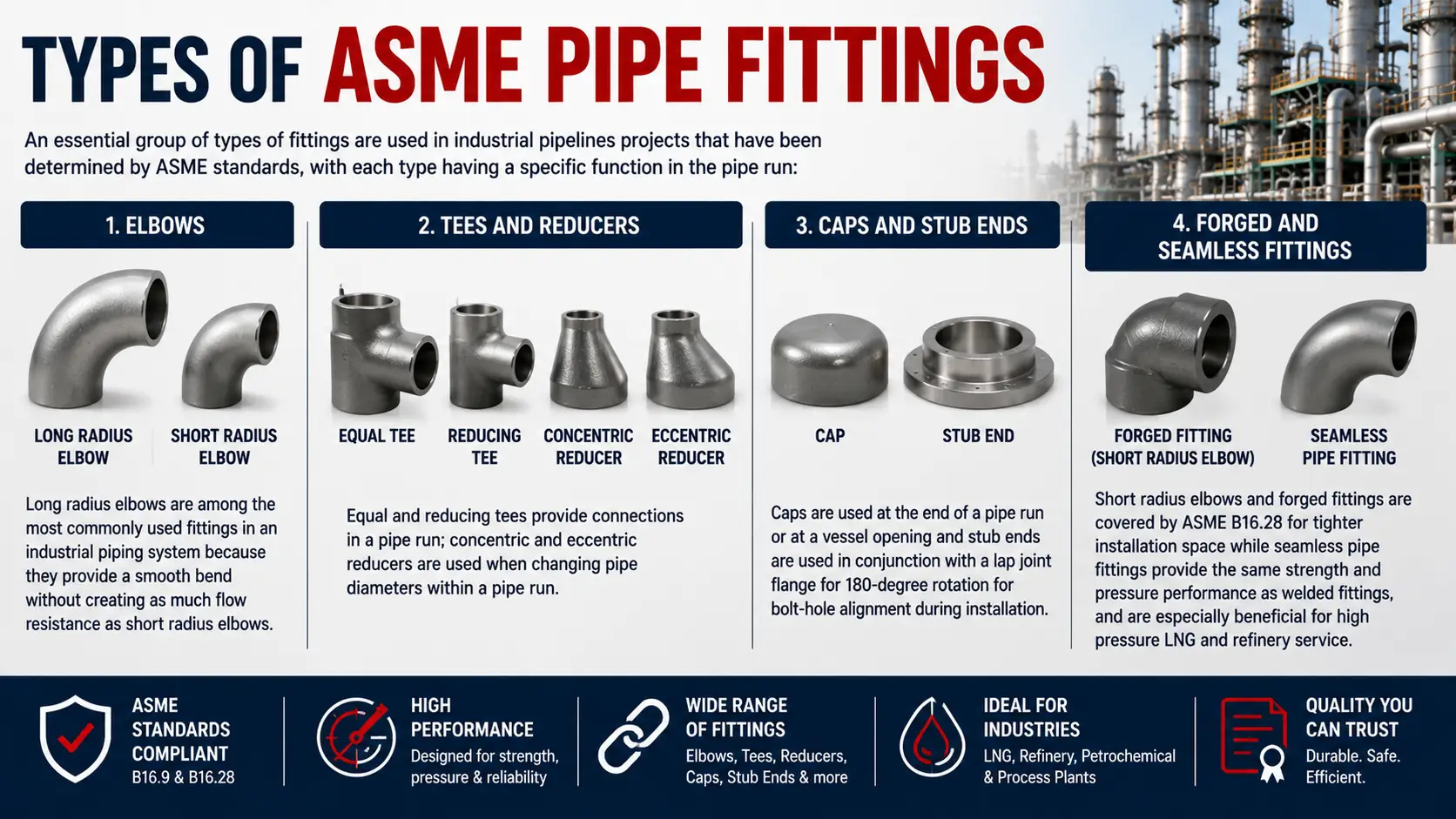
An essential group of types of fittings are used in industrial pipelines projects that have been determined by ASME standards, with each type having a specific function in the pipe run:
Elbows
Long radius elbows are among the most commonly used fittings in an industrial piping system because they provide a smooth bend without creating as much flow resistance as short radius elbows.
Tees and Reducers
Equal and reducing tees provide connections in a pipe run; concentric and eccentric reducers are used when changing pipe diameters within a pipe run.
Caps and Stub Ends
Caps are used at the end of a pipe run or at a vessel opening and stub ends are used in conjunction with a lap joint flange for 180-degree rotation for bolt-hole alignment during installation.
Forged and Seamless Fittings
Short radius elbows and forged fittings are covered by ASME B16.28 for tighter installation space while seamless pipe fittings provide the same strength and pressure performance as welded fittings, and are especially beneficial for high pressure LNG and refinery service.
ASME B16.9 and Related Standards
When considering ASME B16.9 pipe fittings Qatar suppliers, buyers should check for the dimensional compatibility with the latest version of this standard, which defines the sizes and tolerances of wrought butt-welding pipe fittings produced in a factory. Short radius elbows and returns are defined in ASME B16.28 and the material composition and mechanical properties are defined by ASTM specifications which are overlaid on top of the ASME dimensional standard.
Standard | Scope |
ASME B16.9 | Dimensions and tolerances for factory-made wrought butt-welding fittings |
ASME B16.28 | Short radius elbows and returns |
MSS SP-75 | High-strength wrought butt-welding fittings, larger size ranges |
API 5L | Line pipe specifications for pipeline systems |
NACE MR0175 / ISO 15156 | Sour service material requirements |
Materials for ASME Pipe Fittings
Material specification is usually dependent on the operating temperature, corrosion environment, and process fluid of the pipe fitting. carbon steel pipe fittings Qatar buyers are likely to specify ASTM A234 WPB for moderate and high temperature applications, while stainless steel pipe fittings Qatar projects with corrosion resistance needs will most likely reference ASTM A403 grades WP304 or WP316.
Material | Typical Standard | Best Suited For |
Carbon steel | ASTM A234 WPB | General hydrocarbon service, cost-effective strength |
Stainless steel | ASTM A403 WP304/WP316 | Corrosive fluids, moderate temperature service |
Duplex stainless steel | ASTM A815 | Sour service, offshore, chloride-rich environments |
Low-temperature carbon steel | ASTM A420 WPL6 | Cryogenic and LNG process lines |
Applications Across Qatar's Industries
Oil and gas pipe fitting installations in Qatar facilities are necessary for a variety of industries at the heart of the nation's hydrocarbon economy:
LNG processing plants at Ras Laffan Industrial City
Refinery and petrochemical process piping in Mesaieed
Offshore oil & gas production platforms
Desalination plants and industrial water treatment systems
Water supply and distribution systems
Onshore Pipeline Networks of Dukhan & Al Khor facilities.
How to Choose the Right Fitting
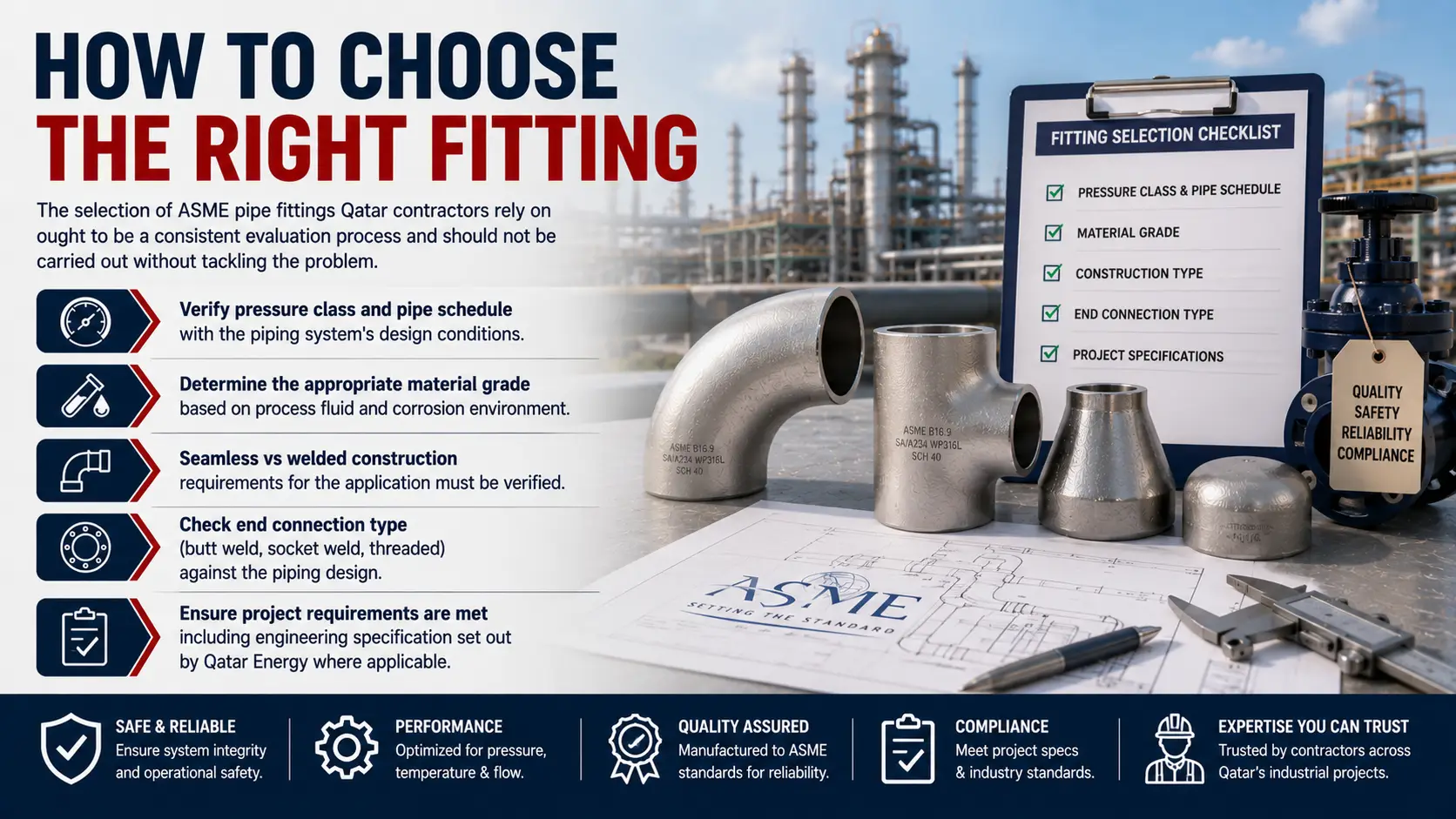
The selection of ASME pipe fittings Qatar contractors rely on ought to be a consistent evaluation process and should not be carried out without tackling the problem.
Verify pressure class and pipe schedule with the piping system's design conditions.
Determine the appropriate material grade based on process fluid and corrosion environment
Seamless vs welded construction requirements for the application must be verified.
Check end connection type (butt weld, socket weld, threaded) against the piping design
Ensure project requirements are met including engineering specification set out by Qatar Energy where applicable
Inspection, Testing, and Documentation
Critical ASME pipe fitting Qatar LNG and refinery projects require documentation, as well as the physical fitting:
Rights to use the marking system of the German Institute for Materials Analysis (DIN 5091) in conjunction with marking by the OVMG (DIN 16939) and the OMG (DIN 476) for quality assurance and auditing
Heat numbers and complete material traces back to the original batch produced
Compliance with ASME B16.9 or B16.28 by dimensional inspection report.
PMI Testing to verify alloy grade prior to installation
A compliance document for sour service applications, in compliance with NACE MR0175.A compliance document for sour service applications based on NACE MR0175.
Choosing an ASME Pipe Fitting Supplier
When choosing a reliable industrial pipe fittings supplier Qatar projects can count on, it's important to consider more than just the price list. Certifications, traceability systems, testing, and lead times for butt weld fittings supplied for orders from the buyers of fittings Qatar, both stock and custom. The complete piping connection also relies on flanges that are compatible with the pressure class and material grade used for flange bolting (see our Flanges Article), as well as on our comprehensive Pipe Fittings Pillar resource which provides information on fitting types, standards, and material comparisons for all fittings.
Common Procurement Mistakes
Connecting pipe to incompatible fittings due to mis-matching pipe schedules
Not taking corrosion allowance into account when specifying material grade
Incorrect material grade for the operating temperature
Documentation discrepancies due to the absence of the documents prior to shipping
Choosing incorrect pressure rating for the piping system's design conditions
Frequently Asked Questions
So what are the ASME pipe fittings?
ASME pipe fittings are standard fitting pieces for pipelines made according to ASME standards to ensure safety in industrial pipelines.
What is ASME B16.9?
ASME B16.9 defines the dimensions and tolerances for fittings to be used in a factory-made wrought butt-welding fittings for industry piping applications.
What are the pipe fitting used in Qatar oil and gas?
Elbows, tees, reducers, caps, stub ends and forged fittings made to ASME standards are very commonly used in upstream and downstream projects.
ASTM A234 WPB is what?
The most used carbon steel material for moderate and high temperature piping fitting is ASTM A234 WPB.
What are the differences between seamless and welded fittings?
Seamless fittings are stronger and have more pressure capacity; Welded fittings can be more economical for larger sizes.
Can stainless steel fit in the conditions of Qatar's offshore environment?
Yes, the corrosion resistant property of stainless steel and duplex stainless steel is better in marine and offshore environments.
How do I know if the product is ASME compliant?
Check material certificates, dimensional inspection reports, test certificates, heat numbers and manufacturing records etc.
What's the difference between ASME and ASTM?
ASME sets design and dimensional requirements and ASTM sets material composition and mechanical properties.
Request Pipe Fitting Sourcing Assistance
Do you require ASME pipe fitting Qatar projects for an LNG, Refinery, Offshore or Petrochemical plant? We are an independent industrial sourcing partner to find the fittings that meet the required standards from several manufacturers — matching the material grade, pressure class, and documentation requirements. For related resources, look at our Pipe Fittings Pillar and Flanges Article resources.
Access expert advice for specification and procurement of your project.
DISCLAIMER: Z&F Corporation is not affiliated with, authorized by, endorsed by, or acting as an official representative of any manufacturer, brand, or trademark owner referenced on this website. All product names, trademarks, brand names, logos, and manufacturer references are the property of their respective owners and are used solely for identification, reference, and compatibility purposes.