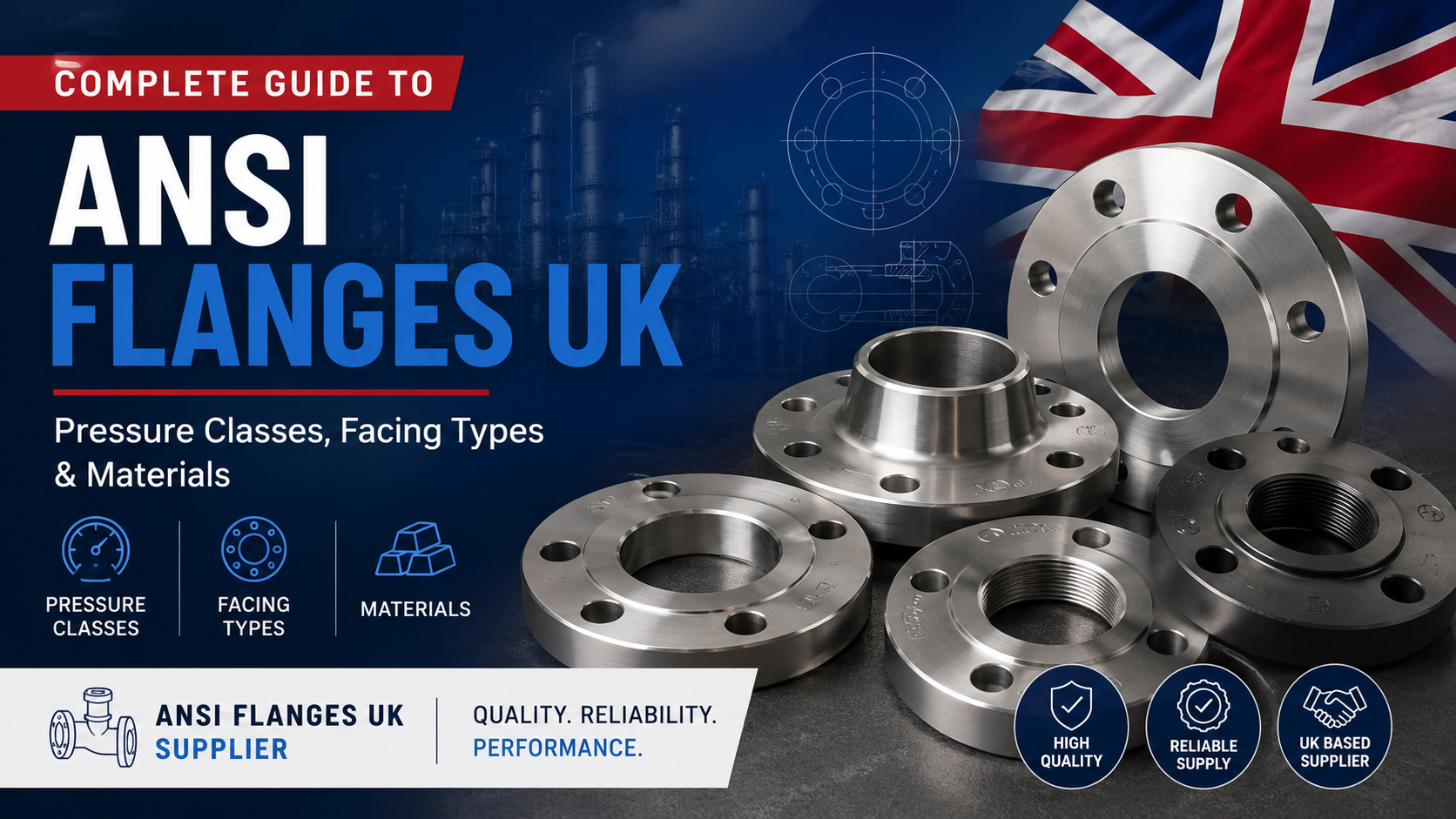
ANSI Flanges UK Supplier : Types, Pressure Classes & Industrial Procurement Guide
When it comes to process pipework, pipelines, or pressure systems, one of the most critical choices a piping engineer or procurement team can make in any UK engineering project is what flanges to use. It is equally crucial to find out ANSI flanges UK supplier who possesses the technical know-how, the material selection, and standards adherence needed for your project. It offers a comprehensive technical and procurement reference, covering flange types, ASME B16.5 flanges UK dimensions, pressure classes, materials, face configurations and key industry applications throughout the UK, whether you're fitting an offshore platform in the North Sea, specifying a flange for a petrochemical facility at Grangemouth or ordering replacement pipework components for an industrial plant at Teesside or Birmingham.
ANSI flanges are standardized pipe connection components manufactured to ASME dimensions and pressure ratings. They allow piping systems to be assembled, inspected, maintained, and modified efficiently in industrial, oil and gas, and process environments.
What Are ANSI Flanges?
ANSI flanges are disk-shaped parts that are welded or threaded onto the ends of pipe to join pipe, valves, pumps, pressure vessels, and other piping components with a bolted, gasketed connection. They are produced to pre-determined sizes, tolerances and material properties, primarily based upon ASME B16.5 (nominal pipe sizes up to NPS 24) and ASME B16.47 (larger diameters).
The UK Energy Sector is still spending billions of pounds a year in oil and gas, offshore wind, hydrogen and industrial infrastructure, all heavily using flanged piping systems conforming to international standards, according to the UK Energy Industries Council (EIC). In the offshore industry of the North Sea, as well as at Grangemouth refinery, Teesside chemical processing and across England and Scotland power generation facilities, ANSI flanges are an integral component of the pressure containment envelope.
To learn more about piping connection parts such as pipe fittings, pipe reducers, elbows and tees, refer to our Pipe Fittings Pillar, which covers the entire spectrum of parts found in piping in UK industrial and process systems.
ANSI Flange Types: Complete Reference
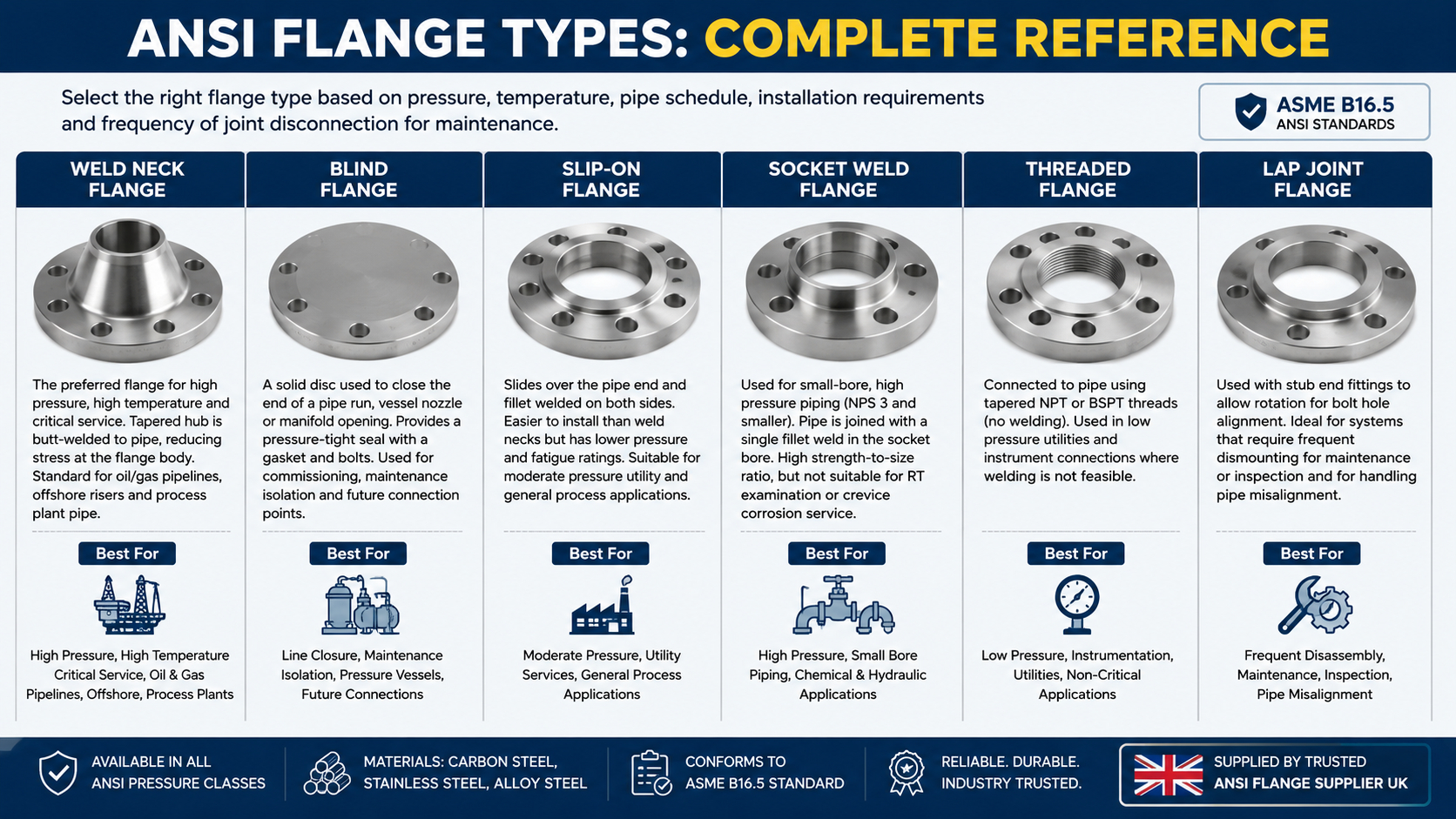
Based on the pressure, temperature, pipe schedule, installation requirements, and frequency of joint disconnection for maintenance, the correct flange type is determined. The table below provides an overview of the main types of flanges offered by any reputable ANSI flange supplier UK and their main use.
Flange Type | Face Type | Pressure Class | Typical Application |
Weld Neck (WN) | RF / RTJ | All classes | High-pressure pipelines, refineries, offshore |
Slip-On (SO) | RF | 150–600 | General pipework, low-to-medium pressure |
Blind (BL) | RF / RTJ / FF | All classes | End closures, vessel nozzles, isolation |
Socket Weld (SW) | RF | Up to Class 3000 | Small bore, high-pressure piping |
Threaded (TH) | RF / FF | 150–600 | Utility services, non-weld applications |
Lap Joint (LJ) | Flat face | 150–2500 | Frequent dismantling, stub end assemblies |
Orifice | RF / RTJ | 150–2500 | Flow measurement, metering |
Weld Neck Flange
The weld neck flange is the preferred flange for high pressure, high temperature and critical service applications. The tapered hub is butt-welded to the pipe, thus the most critical point for fatigue cracking, which is the flange body, is taken out of the pipe's stress path. Weld neck flanges are the standard specification for oil/gas pipelines, offshore risers and process plant pipe throughout the UK industry to meet the ASME B16.5 standard. ANSI weld neck flange UK continues to be the most requested flange type for upstream and downstream energy projects.
Blind Flange
A blind flange is a flange which is closed at the end of a pipe run, pressure vessel nozzle or manifold opening. It is a solid disc (no bore) which is bolted to another mating flange using a gasket to provide a pressure tight seal. The UK is a blind flange used extensively in commissioning, maintenance isolation and future connection points on process pipework that conforms to ANSI standards. Blind Flanges are offered in all standard pressure classes following the standard pressure ratings outlined in ASME B16.5 and they can be made of carbon steel, stainless steel or alloy.
Slip-On Flange
Slip-on flanges are installed over the pipe end and fillet welded on both the bore face and back face. They can be installed more easily than weld necks, but have lower pressure and fatigue ratings and can be used for moderate pressure utility and general process applications. They should not be used for critical service applications, high temperature or high cycle fatigue.
Socket Weld Flange
For high pressure applications, small-bore piping (NPS 3 and smaller) uses socket weld flanges. The pipe end is joined to the socket bore by a single fillet weld. They have very good strength to size, but are not recommended for any service that requires radiographic examination of welds or for any service where crevice corrosion is a factor.
Threaded Flange
Threaded flanges are connected to pipe with a tapered NPT or BSPT thread (no welding). They are used in low pressure utilities, instrument connections and in places where it is not feasible to weld. Not suitable for cyclic loading, high pressure and high temperature service.
Lap Joint Flange
Lap joint flanges are used with stub end fittings to form a joint that allows the flange to rotate in assembly for alignment of bolt holes. They are especially effective when frequent dismounting of the system is necessary for maintenance or inspections, and when misalignment of pipes as a practical installation consideration.
ANSI Flange Pressure Classes Explained
The selection of the proper pressure class is one of the more critical choices to make when ordering ANSI flange products. In ASME B16.5, flanges are classified according to pressure-temperature ratings into six classes. Allowable working pressure will vary depending on temperature and material group, higher temperature means lower allowable working pressure.
Class | Approx. Rating (A105 @ 50°C) | Temp Range | Typical Use |
Class 150 | ~20 bar (290 psi) | –29°C to +538°C | Water, utilities, general process |
Class 300 | ~51 bar (740 psi) | –29°C to +538°C | Steam, general oil and gas |
Class 600 | ~103 bar (1500 psi) | –29°C to +538°C | Medium-high pressure hydrocarbon |
Class 900 | ~154 bar (2220 psi) | –29°C to +538°C | High-pressure gas pipelines |
Class 1500 | ~258 bar (3705 psi) | –29°C to +538°C | Offshore, subsea, refineries |
Class 2500 | ~430 bar (6170 psi) | –29°C to +538°C | Very high-pressure critical systems |
Class 150 to Class 1500 flanges are used in most of the services used in the United Kingdom for oil and gas, petrochemical and process piping projects. Class 2500 is used in very high pressure critical systems like wellhead equipment and high integrity process isolation valves.
How to Select the Correct Pressure Class
When procurement and piping engineers need to specify flange pressure class they should take into account:
Maximum allowable operating pressure (MAOP) of the system, at design temperature.
Design temperature — The second and third are related to the design temperature, which will lower the maximum working pressure of a particular class.
Material group — ASME B16.5 specifies material groups, 1.1 through 3.3, that have varying pressure-temperature ratings
Appropriate design code — BS EN 13480, PD 5500 or ASME BPVC as appropriate to the engineering basis for the project.
Future expansion provisions — where systems may be uprated in the future, by providing the next pressure class, engineering headroom is provided.
Flange Face Types: RF, FF, and RTJ Compared
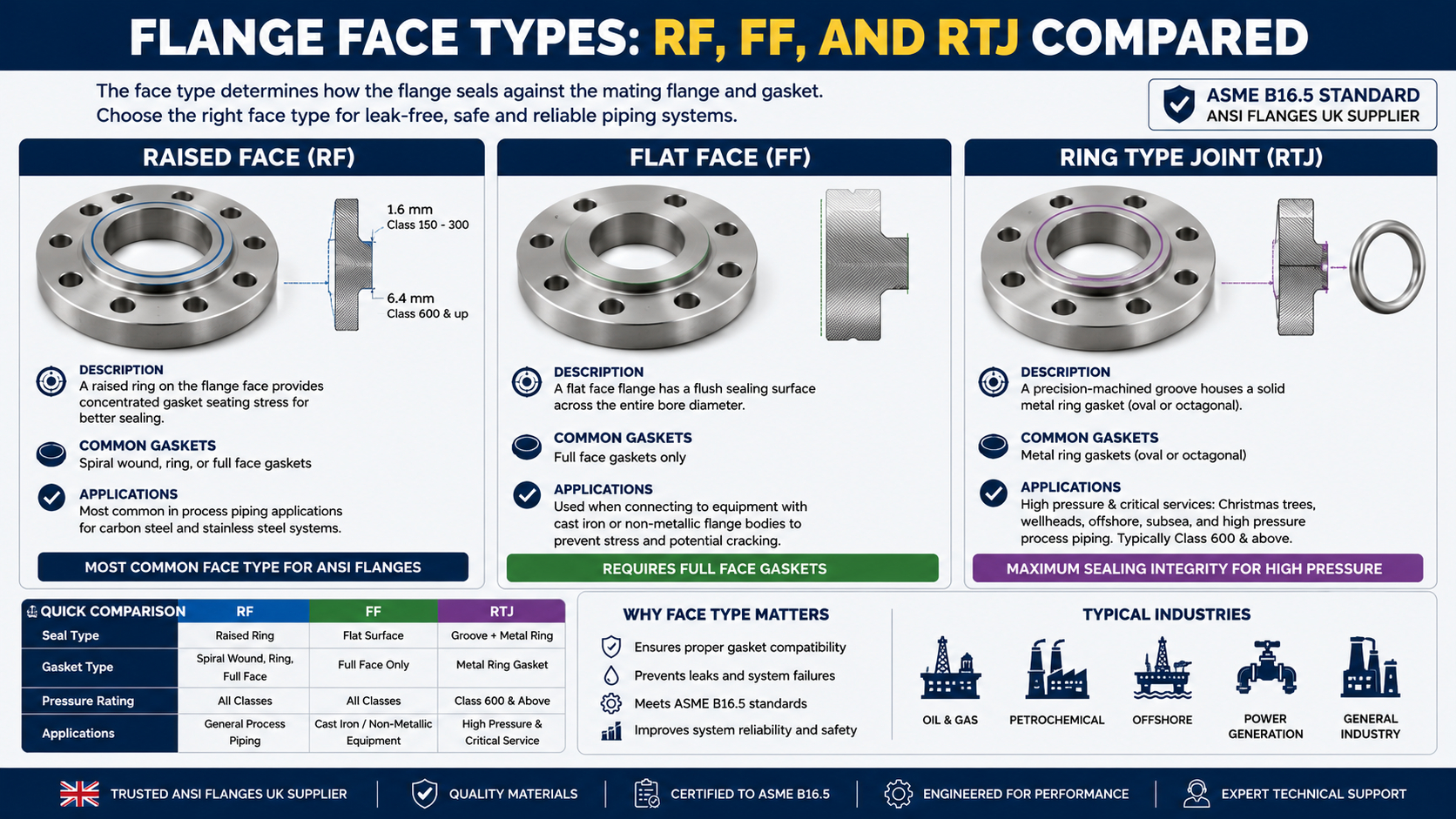
The face type is the type of flange that seals against the mating flange and gasket. Choosing the wrong face type will lead to incompatible assemblies and possible leaks. See our Gaskets Article for detailed information on gasket materials, pressure ratings, gasket ordering and installation guidelines for full-face gaskets, ring joint gaskets, and spiral wound gaskets.
Raised Face (RF)
The most common face type used within industrial pipe flange UK applications is raised face. A small raised ring – normally 1.6 mm for Class 150-300 and 6.4 mm for Class 600 and up – provides a more concentrated gasket seating stress for increased seal reliability. Spiral wound, ring, or full face gaskets are the most common types of gaskets used with RF flanges, and they are the norm for most process piping applications. The raised face finish is the most popular finish for ANSI flanges, and is typically supplied for carbon steel and stainless steel.
Flat Face (FF)
A flat face flange has one flush sealing face all the way around the bore diameter. They are used when connecting to equipment having cast iron bodies or non-metallic flange bodies (to which a raised face would apply bending stress and could cause body cracking). Flat face assemblies must have full-face gaskets.
Ring Type Joint (RTJ)
In the case of RTJ flanges, a precision-machined groove is created on the face of the flange and a solid metal ring gasket, oval or octagonal in cross section, is placed in this groove. The RTJ offers the maximum sealing face integrity of any ANSI face type and is the standard specification for Christmas tree assemblies, high pressure process pipe in UK oil and gas applications, offshore wellhead equipment and subsea connections. The class 600 and above are used with RTJ flanges.
ANSI vs DIN Flanges: Key Differences for UK Projects
There are times when ANSI flanges and DIN/EN flanges are found together on the same project, especially if the project involves a brownfield facility that contains mixed heritage equipment. The two standards cannot be replaced. The main differences are summarized in the table below.
Factor | ANSI / ASME | DIN / EN |
Standard body | ASME (American Society of Mechanical Engineers) | DIN / EN (European) |
Dimension system | Imperial (inches, NPS) | Metric (mm, DN) |
Pressure designation | Class (150, 300, 600…) | PN (PN10, PN16, PN40…) |
Bolt circle / holes | Imperial bolt patterns | Metric bolt patterns |
Face types | RF, FF, RTJ | RF, FF, (no RTJ standard) |
Predominant use (UK) | Oil & gas, offshore, petrochemical | Water, utilities, general process |
Interchangeability | Not directly interchangeable with DIN | Not directly interchangeable with ANSI |
For oil and gas, offshore and petrochemical applications, ANSI flange sizes and standards UK are more prevalent than DIN/EN flanges in UK Industry; DIN/EN flanges are used more in applications such as water treatment, utilities and European origin plant. If both standards are installed on the same system, purpose-made transition assemblies or spools must be used — do not attach ANSI and DIN flanges together.
ANSI Flange Materials: Selection Guide
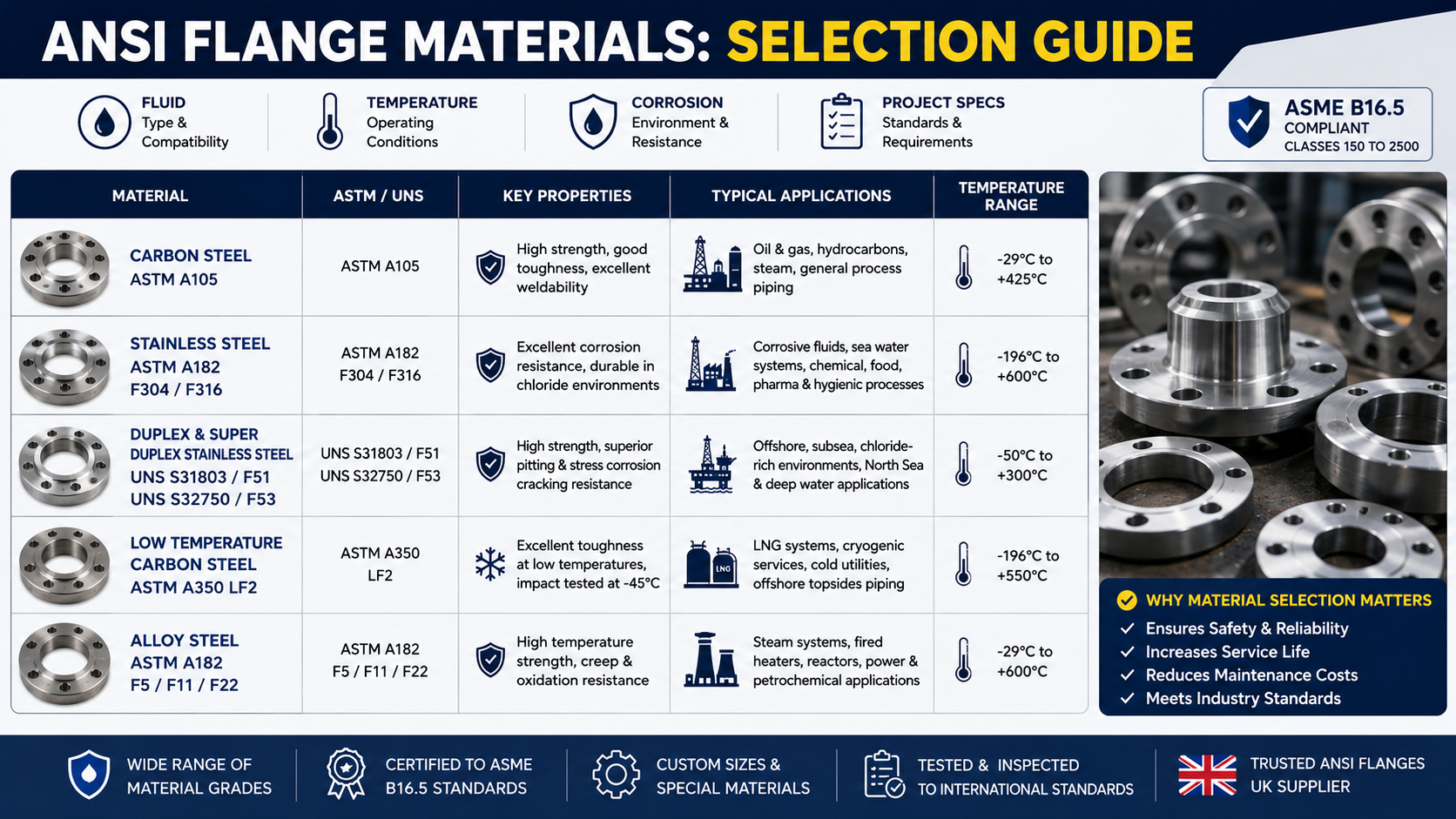
When choosing the material of an ANSI flange, the fluid it will be exposed to, its operating temperature, its corrosion environment and its project specification must all be taken into consideration. The most commonly ordered material grades are:
Carbon Steel — ASTM A105
Most oil and gas, hydrocarbon, steam and general process pipework is manufactured to Carbon steel ANSI flanges UK to ASTM A105. A105 is a forged carbon steel grade, which is suitable for good strength and toughness over a wide temperature range and is the standard material for forged steel flanges UK Classes 150 - 2500. It will not meet the requirements for low temperature service below about –29°C unless impact tested.
Stainless Steel — ASTM A182 F304 / F316
Stainless steel flanges UK to ASTM A182 Grade F316 are used for corrosive fluid services, sea water systems, chloride bearing applications, hygienic or pharmaceutical process applications. The molybdenum content of grade F316 gives it a greater pitting corrosion resistance than F304. All common types of stainless steel flanges are offered from Class 150 to Class 2500.
Duplex and Super Duplex Stainless Steel
In an offshore and subsea application or in a chloride-rich environment where stress corrosion cracking may occur in an austenitic stainless steel, duplex stainless steel (e.g. UNS S31803 / F51) and super duplex grades (e.g. UNS S32750 / F53) are used. They offer a good combination of high strength and corrosion resistance, and are a very high quality choice for North Sea and deep water applications.
Low Temperature Carbon Steel — ASTM A350 LF2
ASTM A350 LF2 is a low-temperature carbon steel flange grade that is the standard for cryogenic and low-temperature carbon steel services, such as LNG systems, cold utilities, and offshore topsides piping operating at sub-zero temperatures. It is Charpy impact tested at –45°C to ensure notch toughness at minimum design temperature.
Alloy Steel — ASTM A182 F5 / F11 / F22
Carbon steel cannot be used in high temperature applications, such as steam systems, fired heaters and reactor piping, and chromium-molybdenum alloy steel grades are specified for these. The most typical alloy types used for power and petrochemical applications in the UK are F11 (1.25Cr–0.5Mo) and F22 (2.25Cr–1Mo).
Industries Using ANSI Flanges Across the UK
Oil and Gas — Offshore and Onshore
The North Sea offshore sector and onshore production and processing facilities in Aberdeen, Grangemouth and Teesside are the largest single market for oil and gas flanges UK. Petrochemical plants UK and energy applications use ANSI flanges, often Class 600, 900 and 1500, RTJ and RF face, carbon steel, duplex or stainless. Typically, for critical service, weld neck flanges are used and blind flanges are very popular for isolation and testing.
Petrochemical and Refining
Hydrocarbon streams, corrosive hydrocarbon streams and hydrogen service are common in the United Kingdom's refinery and petrochemical facilities and demand high temperature service, corrosive service and hydrogen service flanges. Materials selection is challenging: alloy steels, stainless and duplex all come into contact with these depending on the process stream. The flange specifications are normally described in the project's piping material classes (PMCs) and the procurement needs to be done carefully to match the required class, material and face type for each service.
Power Generation
In the UK, ANSI flange dimensions and alloy steel material grades are used to suit the requirements of high pressure, high temperature steam service in Steam Systems at gas fired power stations, nuclear facilities and Combined Heat & Power (CHP) plants throughout the UK. Typical flanges used on main steam and hot reheat piping are the Class 600 flanges and the Class 900 flanges in chromium-molybdenum steel.
Hydrogen and Energy Transition Infrastructure
Hydrogen production, carbon capture and storage (CCS) and offshore wind support infrastructure investments in the UK are driving the introduction of new demand for flanged piping. To prevent hydrogen embrittlement, the proper selection of materials for hydrogen service often demands special material qualification and heat treatment that must be qualified during procurement.
Chemical Processing and Water Treatment
Stainless steel and alloy ANSI flanges are utilized in chemical handling in chemical plants across the Midlands, Sheffield and Liverpool. The vast majority of chemical process piping services are from stainless flanges in classes 150 and 300, and higher classes are used for reactor and pressure vessel nozzle connections.
ANSI Flange Standards and UK Compliance
ANSI flange orders for UK projects must include specification to UK standards to meet technical requirements and legal requirements for fitness for purpose under UK pressure equipment and health and safety legislation.
ANSI Flange Standards for the UK industry:
ASME B16.5— screw-cap closures
Large diameter steel flanges — including Series A and B, NPS 26 to 60 are included in ASME B16.47.
ASTM A193 — fasteners used in pipe connections that are made with nuts, bolts, and washers
ASTM A182 — forged or rolled alloy and stainless steel pipe flanges
ASTM A350 — Carbon and low alloy steel forgings for low temperature piping
EI's experience spans ASME BPVC Section VIII / Section I — pressure vessel and boiler design codes used on projects in the UK.
PD 5500 — UK pressure vessel standard that is often cited on flange dimensions as ASME PESR 2016 stands for the Pressure Equipment (Safety) Regulations 2016, which is a legal requirement in the UK for placing pressure equipment on the market.
Pressure Systems Safety Regulations 2000 (PSSR 2000) — UK legislation for safe operation & maintenance of pressure systems.
The British Standards Institution (BSI) and the Institution of Mechanical Engineers (IMechE) both issue guidance for UK engineers to use when applying pressure equipment standards. The definitive edition of B16.5, B16.47, and the BPVC codes are published by the American Society of Mechanical Engineers (ASME).
Procurement Checklist: What to Specify When Ordering ANSI Flanges
Inquire about a purchase with an ANSI flanges supplier UK by supplying the full specification to ensure that there are no delays, delivery mistakes, or possible site non-conformances. The complete flange specification should consist of:
Standard — ASME B16.5 or ASME B16.47 Series A / B
Flange type — weld neck, blind, slip-on, socket weld, threaded or lap joint.
Nominal pipe size (NPS) — e.g. 4", 6", 12"
Pressure class — Class 150, 300, 600, 900, 1500, or 2500
Type of face — RF (raised face), FF (flat face), or RTJ (ring type joint)
Material grade — ASTM A105, A182 F316, A350 LF2, or other specified grade
Pipe Schedule / Bore — needed for Weld Neck/Socket Weld types
Heat treatment requirements — NACE MR0175, PWHT or other project specific requirements.
Material test certificate — EN 10204 3.1 or 3.2 as specified in project specification
Quantity / Delivery address (UK site) / Project warehouse
Refer to our Stud Bolts Article for detailed information on the different bolt grades (ASTM A193 B7, A320 L7), nut grade, and installation procedures for associated bolting items such as stud bolts, heavy hex nuts, and bolt torquing procedures for ASME B16.5 flange assemblies.
People Also Ask: Quick Answers
What is ASME B16.5?
ASME B165 is an important Standard of the American Society of Mechanical Engineers (ASME) It specifies dimensions, tolerances, pressure and temperature characteristics, and material requirements for pipe flanges and flanged connections from NPS ½ inch to 24 inch In the UK it serves as the Standard for ANSI flanges in the oil, Gas and industrial engineering
Are ANSI flanges used in the UK?
Yes, ANSI flanges are widely used in UK oil, Gas, marine, petrochemical and power generation installations DIN/EN flanges, on the other hand, are commonly used in water supply, power industry and European process installations.
What is the difference between ANSI and DIN flanges?
ANSI flanges conform to the ASME Standard and are identified by inch sizes and pressure classes (class 150, 300, etc.) DIN flanges are based on the European metric Standard and use the PN designation (PN10, PN16, PN40) The two types of flanges are not interchangeable because their dimensions do not match
What is a weld neck flange?
A weld neck flange has a long, tapered neck and is butt welded to the pipe. This shape distributes stress evenly across the hub, making it ideal for the high pressures, temperatures and cyclic stresses in the oil, Gas and petrochemical industries.
What is the difference between RF and RTJ flanges?
Raised Face (RF) flanges have a slightly Raised sealing surface that compresses and seals spiral wrap or Ring seals, while Ring Type Joint (RTJ) flanges use precision milled grooves to accommodate a metal Ring seal, providing a stronger seal in critical high pressure applications such as wellhead equipment and Offshore riser connections.
Which ANSI flange is best for high-pressure oil and gas applications?
Class 900, 1500 and 2500 welded neck flanges in combination with RTJ flanges are Standard in the UK for high pressure oil and gas pipelines, Offshore wellhead equipment and critical Upstream and Downstream process shutoffs.
What materials are ANSI flanges available in?
Carbon steel ANSI flanges (ASTM A105) is most widely used for general applications Stainless steel flanges UK (A182 F316) is used for corrosive environments and seawater For even more demanding maritime environments and low and high temperature applications Duplex, super duplex and alloy steels are used.
Summary: Specifying and Sourcing ANSI Flanges in the UK
To order ANSI flanges UK supplier correctly, you must first understand the flange type, pressure class, connection form, material grade and applicable standards. Choosing the wrong grade, incompatible connections or inappropriate materials can not only pose performance risks, but also violate UK pressure vessel regulations and cause serious safety and Compliance issues.
Whether you are sourcing ASME B16.5 flanges UK for a new North Sea facility, replacing flanges at an Onshore facility, or adding to your maintenance inventory at your Birmingham or Sheffield plant, the "Type Selection → Pressure Class Determination → Material Selection → Standards Compliance" procedure described in this guide will ensure safe and reliable procurement.
DISCLAIMER: Z&F Corporation is not affiliated with, authorized by, endorsed by, or acting as an official representative of any manufacturer, brand, or trademark owner referenced on this website. All product names, trademarks, brand names, logos, and manufacturer references are the property of their respective owners and are used solely for identification, reference, and compatibility purposes.