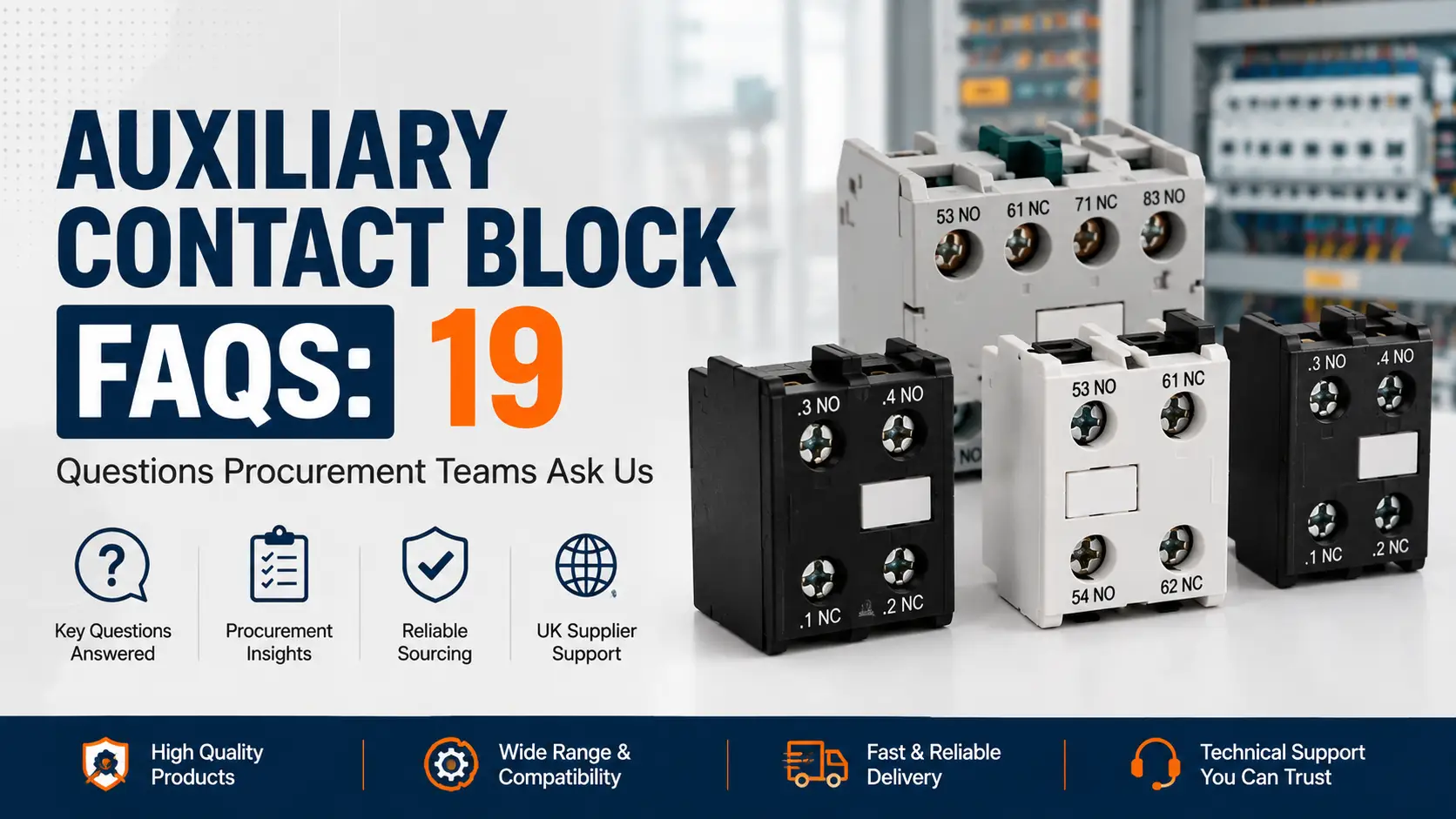
Auxiliary Contact Block FAQs: 19 Questions Procurement Teams Ask Us
Auxiliary contact blocks are small, inexpensive, and easy to overlook — right up until the wrong one is ordered and a signalling circuit doesn't work. Below are the questions we hear most often from procurement and engineering teams sourcing auxiliary contacts for contactors and circuit breakers, grouped by theme so you can jump straight to the section that matters for your order — specification, sourcing, standards, installation, or pricing.
Need help specifying or sourcing an auxiliary contact block for your site?
Quick-Reference Summary
Before the detailed Q&A below, here's the short version for anyone comparing options against the clock:
Question | Short Answer |
|---|---|
What does it do? | Adds NO/NC signalling contacts to a contactor or breaker for status feedback, interlocking or indication |
Is it brand-specific? | Yes — mechanically matched to a contactor/breaker frame size and mounting position |
Common contact configs | 1NO/1NC, 2NO/2NC, 3NO/1NC, 4NO and other combinations depending on the block |
Governing standard | Tested with the parent contactor (IEC 60947-4-1) or breaker (IEC 60947-2) |
Typical UK lead time | Stock for common configurations; short lead time for less common or obsolete references |
Brands stocked | ABB and Allen-Bradley, matched to the installed contactor or breaker range |
Specification & Compatibility
What is an auxiliary contact block used for?
It adds extra signalling contacts (normally open and/or normally closed) to a contactor or circuit breaker, used to feed status information — such as "contactor energised" — back to a PLC, indicator lamp, or interlock circuit.
Will any auxiliary contact block fit any contactor?
No. Auxiliary contact blocks are mechanically specific to a contactor frame size and mounting position (front, side, bottom) from the same manufacturer's range — always match the block to the exact contactor model.
What does "1 NO / 1 NC" mean on a datasheet?
It describes the contact configuration: how many normally-open and normally-closed contacts the block provides. A "2NC/2NO" block has two of each.
How do I choose between ABB and Allen-Bradley auxiliary contact blocks?
The choice is largely dictated by which contactor or breaker range is already installed — auxiliary contacts are brand and frame-size specific, so match to your existing equipment rather than choosing a brand independently.
What current rating do auxiliary contacts carry?
Auxiliary contacts are signalling contacts, not power contacts — typical ratings are in the range of a few amps at control voltage, well below the main contactor's load current rating. Wiring them into a load circuit by mistake, rather than a control or signalling circuit, will damage the contact and can create a safety issue, so always confirm the rated current on the datasheet before connecting anything beyond a PLC input, relay coil or indicator lamp.
Can I fit more than one auxiliary contact block on the same contactor?
Many contactor ranges allow a front-mounted block plus a side or bottom-mounted block simultaneously, giving extra contact combinations where a single block doesn't provide enough NO/NC points for the interlocking or signalling scheme required. Check the parent contactor's datasheet for the maximum number of auxiliary positions it supports before specifying more than one.
What's the difference between an auxiliary contact block and a miniature circuit breaker (MCB)?
They're not interchangeable and don't compete for the same job — an MCB is the primary overcurrent protection device switching the actual load current, while an auxiliary contact block is a low-current signalling accessory fitted to a contactor or breaker purely to report status back to a control system. Confusing the two on a parts list usually means someone has misread a datasheet rather than a genuine specification choice.
What's the difference between a snap-on and a screw-fit auxiliary contact block?
Snap-on blocks clip directly onto a designated slot on the contactor or breaker body with no tools required, and are the more common format on modern ABB and Allen-Bradley ranges. Screw-fit or bolt-on variants are more common on older or larger frame sizes, and typically need a screwdriver and a touch more care to avoid cross-threading the fixing. Both are equally reliable when fitted correctly — the choice is dictated by the parent device, not by preference.
Sourcing & Lead Times
Once the correct contact configuration is confirmed, the next question from most procurement teams is availability — here's what to expect on stock, lead time and bulk ordering.
Where can I buy auxiliary contact blocks in the UK?
ZF Corporation stocks ABB auxiliary contact blocks for UK delivery, and can source Allen-Bradley and other brand equivalents on request.
What is the typical lead time for an auxiliary contact block in the UK?
Common configurations are typically available from stock; less common mounting positions or discontinued references may carry a short lead time.
Can you supply auxiliary contact blocks in bulk for a panel-build programme?
Yes — bulk orders for panel-build or maintenance stock programmes can be quoted with volume pricing, and we can hold agreed stock levels against a call-off schedule so a production line isn't waiting on a single-unit order each time. Send us your annual requirement by part number and we'll put a framework quote together.
Can ZF Corporation export auxiliary contact blocks outside the UK?
Yes, we regularly supply export orders alongside UK deliveries — get in touch for shipping options and documentation.
Can I get UK technical support before I place an order?
Yes — send us the contactor or breaker model number (or a photo of the nameplate if you're not sure) and our team will confirm the correct auxiliary contact reference, contact configuration and price before you commit to an order, rather than leaving it to guesswork.
Standards & Compliance
Auxiliary contacts are rarely certified as a standalone item, which catches out buyers who go looking for a dedicated standard number on the block itself.
What standards apply to auxiliary contact blocks (IEC 60898)?
Auxiliary contacts are typically tested as part of the parent contactor or circuit breaker assembly to IEC 60947-4-1 (contactors) or IEC 60947-2 (circuit breakers), rather than certified as standalone components.
Do auxiliary contact blocks need to match a specific IP rating?
Where the enclosure has an IP rating requirement, confirm the auxiliary contact block doesn't compromise the sealing of the parent device — most snap-on and side-mount blocks are designed to preserve the base unit's rating, but a poorly seated block or a missing cover plate on an unused mounting position can let dust or moisture in on an otherwise IP-rated enclosure. It's a small detail that's easy to miss on a site inspection but matters in washdown or outdoor environments.
Is there a difference in reliability between ABB and Allen-Bradley auxiliary contact blocks?
Both are established industrial ranges used across UK manufacturing, oil & gas and food & beverage sites, and genuine failures are uncommon on either when the block is correctly matched to the parent device. Most of the "reliability" complaints we hear actually trace back to a mismatched configuration or a loose signalling wire rather than the component itself, which is why getting the initial specification right matters more than the brand choice.
Does adding an auxiliary contact block affect the certification of the parent contactor?
Not when a manufacturer-approved accessory is used on the range it's designed for — the combination is covered by the original type testing. Fitting a third-party or mismatched block can void that assurance, which is one more reason to match the block to the exact contactor or breaker model rather than substituting a similar-looking part.
Installation & Maintenance
Fitting an auxiliary contact block is usually a quick job, but a handful of recurring installation and maintenance issues account for most of the field calls we hear about.
How is an auxiliary contact block fitted?
Most are snap-fit or screw-fit onto a designated mounting position on the contactor or breaker — front, side, or bottom depending on the range — with no additional tools beyond a screwdriver in most cases.
How do I wire an auxiliary contact block installation guide correctly?
Wire the auxiliary contact circuit exactly as shown on the manufacturer's terminal diagram, keeping it separate from the main power circuit, and test continuity of the NO/NC contacts before commissioning.
What causes an auxiliary contact block troubleshooting issue in the field?
The most common causes are a loose signalling wire, a mismatched contact configuration (NO wired where NC was expected), or mechanical wear on the block after very high operating cycles. On sites with heavy vibration, a vibration-loosened terminal is worth checking before assuming the contact itself has failed — retorquing the terminal often resolves an intermittent signal fault that would otherwise be misdiagnosed as a component failure and lead to an unnecessary replacement order.
What auxiliary contact block maintenance schedule would you recommend?
Include a visual and continuity check of auxiliary contacts during scheduled panel maintenance, and replace on any sign of pitting, discolouration, or intermittent signal.
Where do I find an auxiliary contact block wiring diagram?
The manufacturer's datasheet for the specific contact reference will show the terminal numbering and NO/NC layout — always wire from that diagram rather than from memory or a similar-looking part, since terminal numbering conventions differ between ABB and Allen-Bradley ranges. If you've lost the datasheet for an older part, send us the reference and we can usually track it down.
Pricing & Procurement
Pricing on auxiliary contact blocks is modest compared to the parent contactor, but getting the reference wrong on a bulk or export order is where the real cost creeps in — here's how we handle it.
What does an auxiliary contact block cost in the UK?
Pricing depends on brand, contact configuration and mounting position — contact our team with the exact part or contactor model for a quote.
Can ZF Corporation source obsolete or discontinued auxiliary contact blocks?
Yes — we regularly cross-reference discontinued auxiliary contact block part numbers to current equivalents for contactors that are still in service.
How do I request a quote for an auxiliary contact block?
Send us the contactor or breaker model number and the contact configuration you need (e.g. 1NO/1NC), and we'll confirm compatible options, price and lead time. If you only have the old part number from an existing panel and it's since been superseded, that's fine too — our team will cross-reference it to the current equivalent as part of the same quote.
What information should I include on an RFQ to avoid delays?
The contactor or breaker model and coil/frame reference, the contact configuration required, quantity, and whether the order is for a one-off repair or a recurring panel-build requirement — that last point alone often changes both the price and the lead time we can offer.
Still Have Questions?
The five we're asked most often, in one place:
What is an auxiliary contact block used for?
It adds extra signalling contacts to a contactor or circuit breaker so its status can be fed back to a PLC, indicator lamp, or interlock circuit.
How do I choose between ABB and Allen-Bradley auxiliary contact blocks?
Match it to whichever contactor or breaker range is already installed — the block is brand and frame-size specific, so the existing equipment decides the brand, not the other way round.
What standards apply to auxiliary contact blocks?
They're tested as part of the parent contactor (IEC 60947-4-1) or circuit breaker (IEC 60947-2) assembly rather than certified as a standalone component.
Can ZF Corporation source obsolete or discontinued auxiliary contact blocks?
Yes — we regularly cross-reference discontinued references to current equivalents for contactors still in service.
What is the typical lead time for an auxiliary contact block in the UK?
Common configurations are typically available from stock; less common mounting positions or discontinued references may carry a short lead time.
Related Categories
Category | Description | Link |
|---|---|---|
Auxiliary Contacts | Auxiliary contact blocks for contactors and circuit breakers | |
Contactors | Contactors compatible with our auxiliary contact range | |
Contactor Relays | Contactors and control relays across brands | |
Safety Relays | Relay-based protection for interlocked and machine safety circuits |
Conclusion
Most auxiliary contact block problems come down to one thing: matching the block exactly to the parent contactor or breaker's frame size and mounting position. Get that right, confirm the contact configuration you need, and the rest is straightforward.
Have a question we haven't covered here?
Talk to Our Expert Team
DISCLAIMER: Z&F Corporation is not affiliated with, authorized by, endorsed by, or acting as an official representative of any manufacturer, brand, or trademark owner referenced on this website. All product names, trademarks, brand names, logos, and manufacturer references are the property of their respective owners and are used solely for identification, reference, and compatibility purposes.