ANSI Flanges for Oil & Gas Projects in Saudi Arabia: Complete Industrial Procurement Guide
In oil and gas projects in the Eastern Province, the supply of ANSI flanges for refineries, Pipelines and petrochemical plants is essential to ensure leak-free and safe piping systems even under extreme pressure and temperature conditions When choosing ANSI flanges by oil and gas buyers in Saudi Arabia, price is not the only important factor; Pressure class, material grade and standards compliance are also crucial. These factors determine the quality and reliability of flanges used in routine maintenance, new construction and expansion of petrochemical facilities in Ras Tanora, Jubail and Yanbu. This guide provides a comprehensive overview of flange types, ASME standards, material selection, testing requirements and even evaluation criteria for critical energy infrastructure suppliers.
Looking for flange pricing for your refinery or pipeline project?
What Are ANSI Flanges?
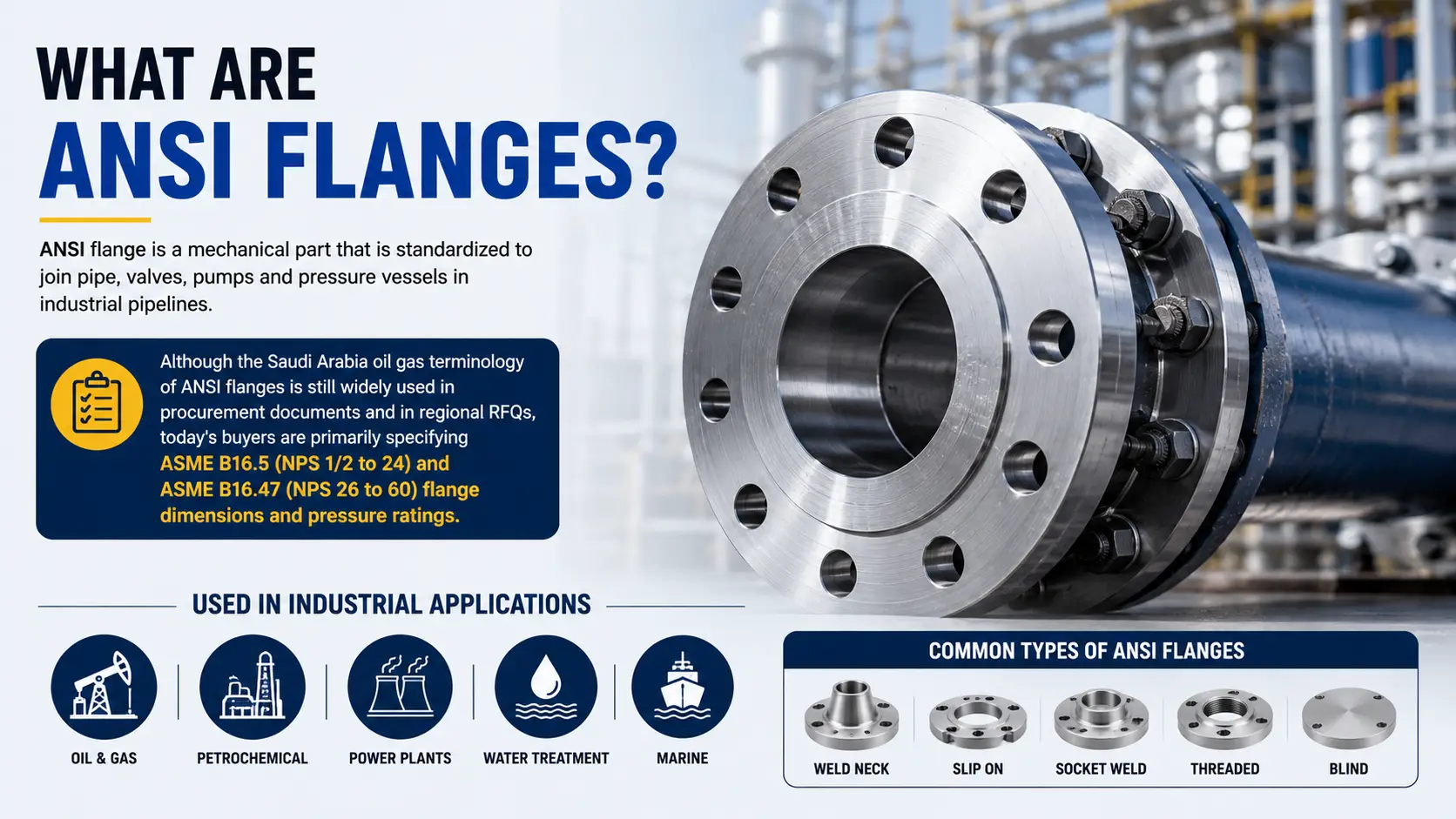
ANSI flange is a mechanical part that is standardized to join pipe, valves, pumps and pressure vessels in industrial pipelines. Although the Saudi Arabia oil gas terminology of ANSI flanges is still widely used in procurement documents and in regional RFQs, today's buyers are primarily specifying ASME B16.5 (NPS 1/2 to 24) and ASME B16.47 (NPS 26 to 60) flange dimensions and pressure ratings.
Why ANSI Flanges Matter in Saudi Arabia's Oil & Gas Industry
Because the oil and gas industry represents a significant proportion of Saudi Arabia's GDP and export revenues, the quality and reliability of piping components, including flanges, is critical to plant uptime and safety. When it comes to sourcing flanges for a refinery or pipeline system, every single mis-specified flange can cause leaks, unplanned shutdowns or even safety incidents, so qualifying the supplier should not be taken lightly.
Common Types of ANSI Flanges
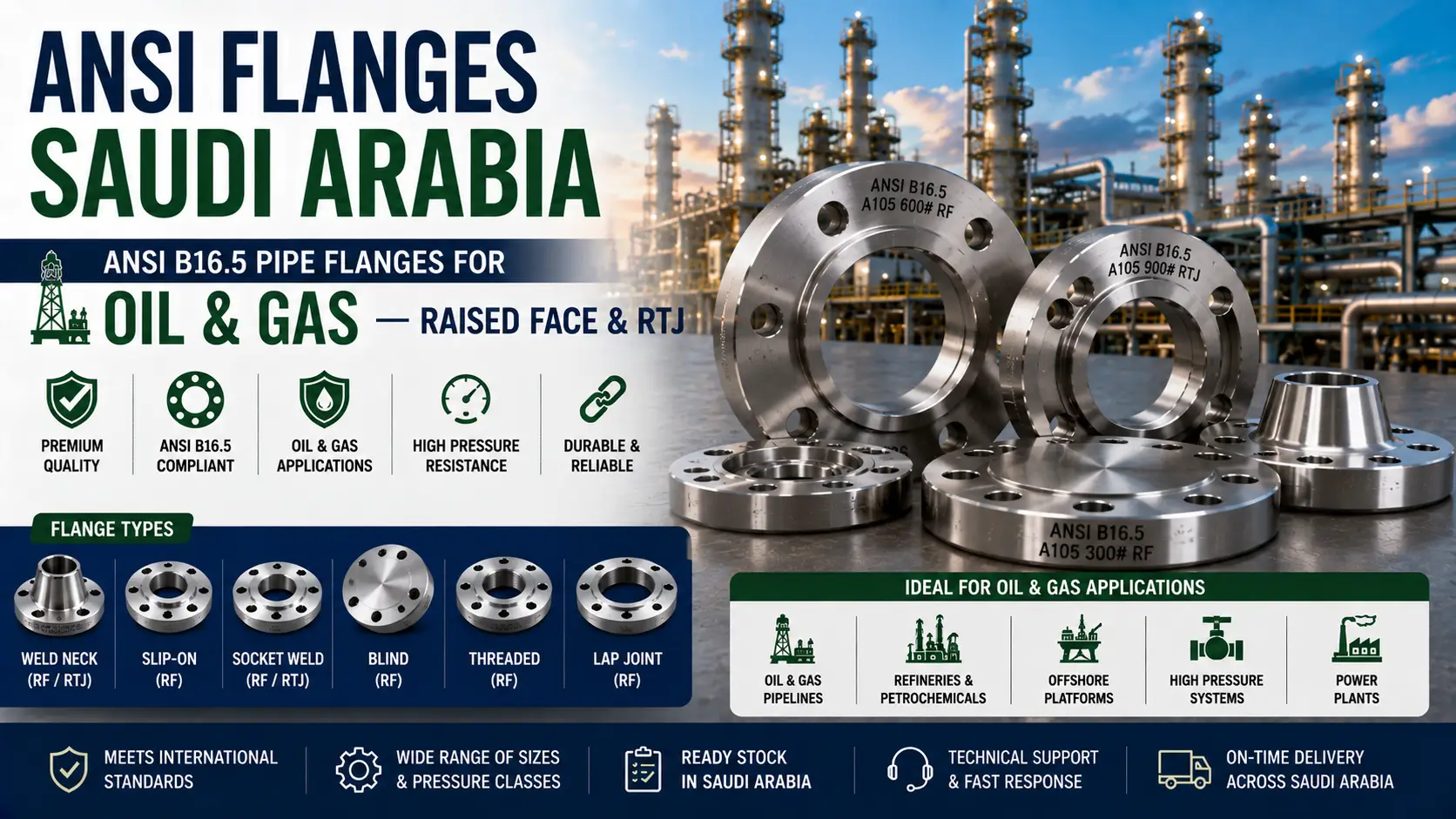
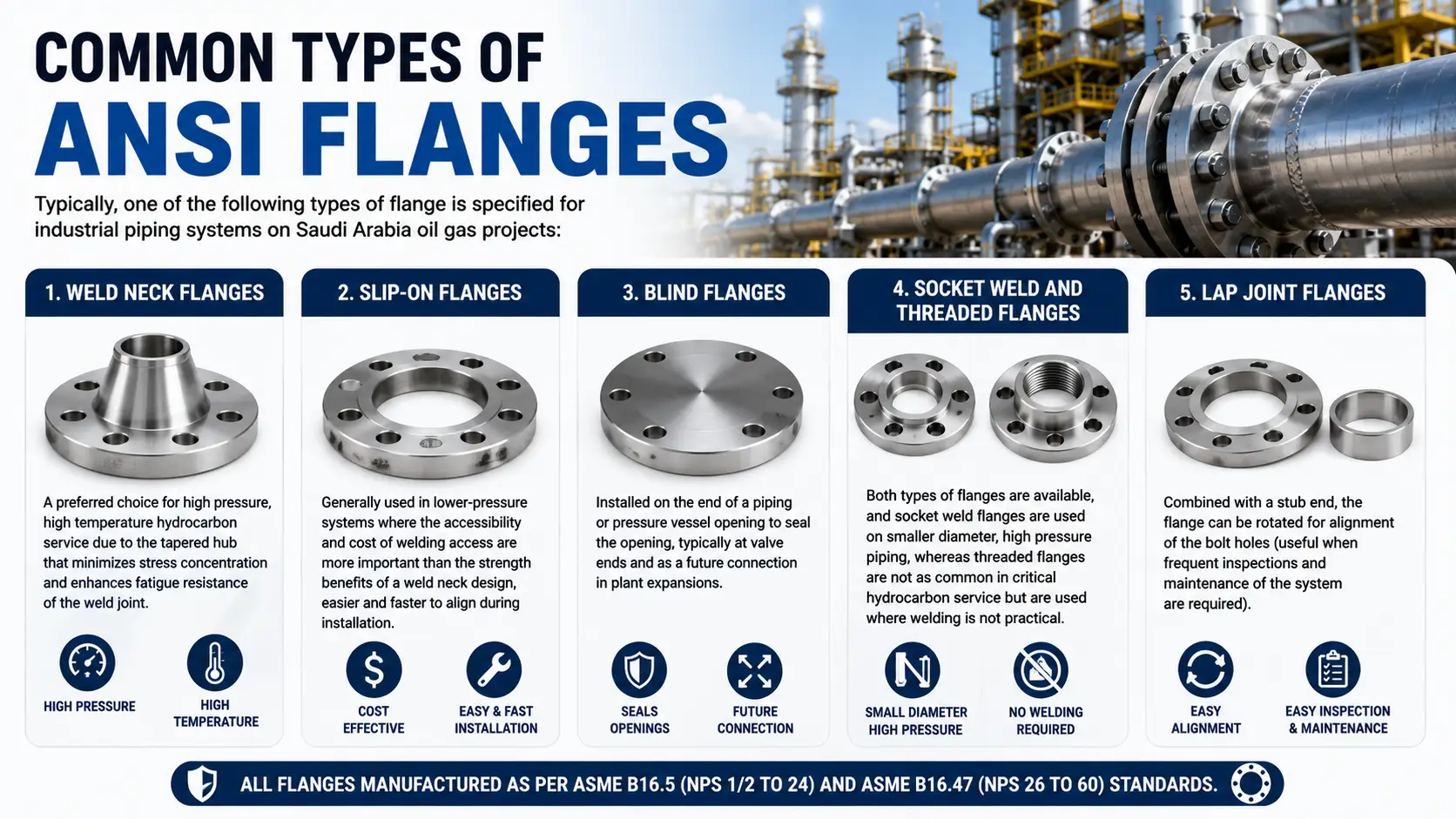
Typically, one of the following types of flange is specified for industrial piping systems on Saudi Arabia oil gas projects:
Weld Neck Flanges
A preferred choice for high pressure, high temperature hydrocarbon service due to the tapered hub that minimizes stress concentration and enhances fatigue resistance of the weld joint.
Slip-On Flanges
Generally used in lower-pressure systems where the accessibility and cost of welding access are more important than the strength benefits of a weld neck design, easier and faster to align during installation.
Blind Flanges
Installed on the end of a piping or pressure vessel opening to seal the opening, typically at valve ends and as a future connection in plant expansions.
Socket Weld and Threaded Flanges
Both types of flanges are available, and socket weld flanges are used on smaller diameter, high pressure piping, whereas threaded flanges are not as common in critical hydrocarbon service but are used where welding is not practical.
Lap Joint Flanges
Combined with a stub end, the flange can be rotated for alignment of the bolt holes (useful when frequent inspections and maintenance of the system are required).
Pressure Classes and Temperature Ratings
The pressure classes shown in ASME B16.5 are the maximum pressure at which a particular group of materials can be used at a certain temperature. For the purpose of choosing proper class for high pressure flanges for applications in the pipeline and refinery systems in Saudi Arabia, it is important to review the pressure-temperature rating table for the specific pressure grade listed, rather than relying on the nominal class number.
Pressure Class | Typical Application |
Class 150 | Low-pressure utility and cooling water systems |
Class 300 | General process piping, moderate pressure hydrocarbon service |
Class 600 | Higher-pressure process lines and refinery units |
Class 900–1500 | High-pressure pipelines and critical process systems |
Class 2500 | Extreme high-pressure wellhead and specialized service |
Carbon Steel vs Stainless Steel vs Alloy Steel Flanges
The most common forged steel flange grades available from buyers in Saudi Arabia are ASTM A105 for general hydrocarbon service; ASTM A182 for corrosive and/or high-temperature service; and duplex stainless steel for sour service and/or chloride-rich applications like seawater injection systems.
Material | Typical Standard | Best Suited For |
Carbon steel | ASTM A105 | General hydrocarbon service, cost-effective strength |
Stainless steel | ASTM A182 (F304/F316) | Corrosive fluids, moderate temperature service |
Duplex stainless steel | ASTM A182 (F51/F53) | Sour service, chloride-rich, high-corrosion environments |
Low-temperature carbon steel | ASTM A350 LF2 | Cryogenic and low-temperature process lines |
ASME Standards Governing ANSI Flanges
When considering the ASME B16.5 flanges Saudi Arabia suppliers, buyers should always verify dimensional and pressure ratings with the latest version of ASME B16.5 (for smaller size flanges) as well as ASME B16.47 (for larger diameter flanges). Many upstream and downstream projects in Saudi Arabia also include Saudi Aramco Engineering Standards, API requirements and NACE MR0175 (sour service), that are layered on the base ASME dimensional standard.
Industries Using ANSI Flanges in Saudi Arabia
In addition to oil and gas, ANSI flanges are used by oil gas facilities in Saudi Arabia for neighbouring industrial sectors:
Refinery/petrochemical process piping
Upstream oil and gas pipeline systems
Gas processing and treatment facilities
Power generation and utility piping
Water treatment plants, desalination plants
Marine and offshore hydrocarbon infrastructure
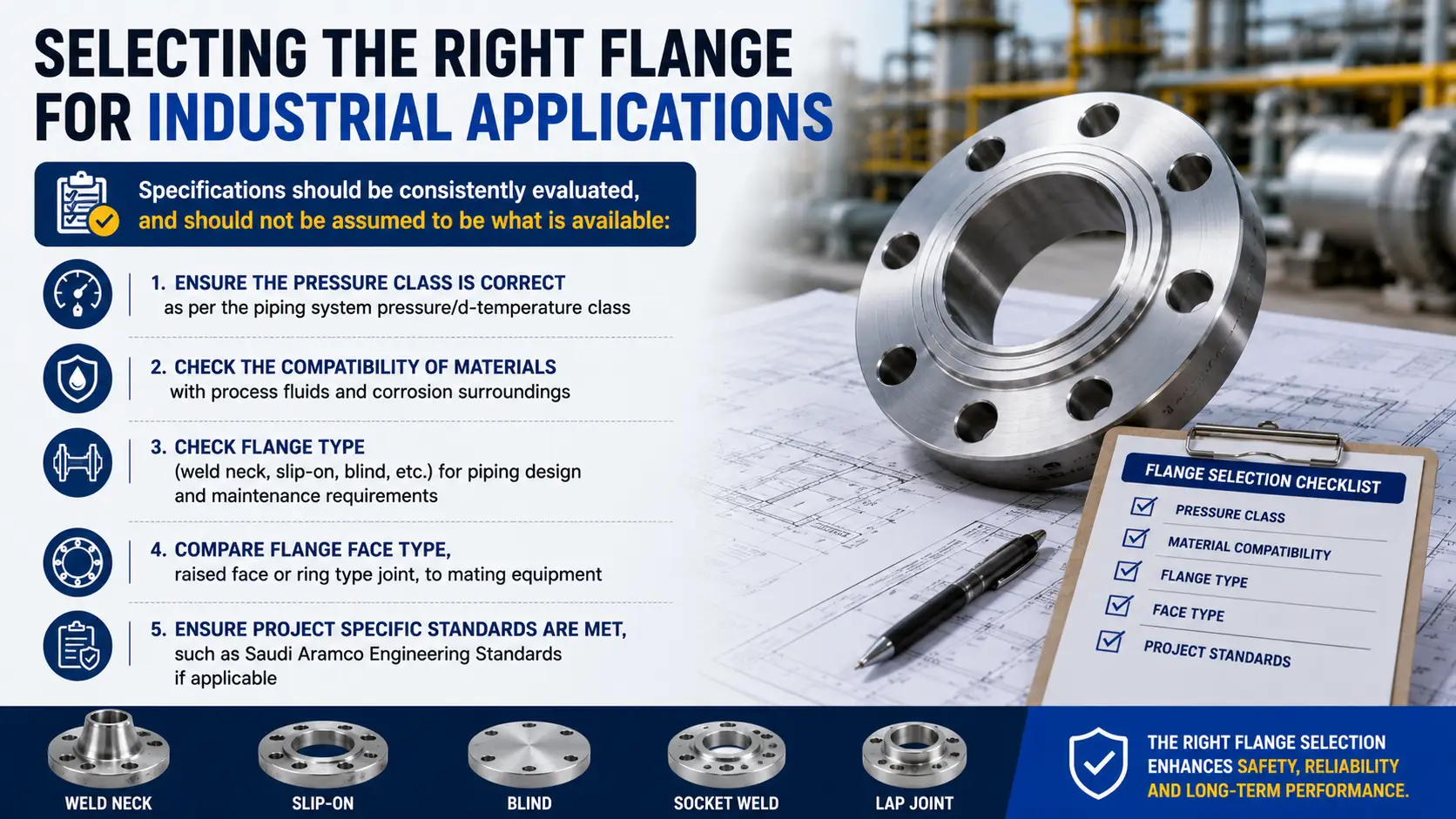
Selecting the Right Flange for Industrial Applications
Specifications should be consistently evaluated, and should not be assumed to be what is available:
Ensure that the pressure class is correct as per the piping system pressure/d-temperature class
Check the compatibility of materials with process fluids and corrosion surroundings
Check flange type (weld neck, slip-on, blind, etc.) for piping design and maintenance requirements
Compare flange face type, raised face or ring type joint, to mating equipment
Ensure project specific standards are met, such as Saudi Aramco Engineering Standards if applicable
Raised Face vs Ring Type Joint
Raised Face (RF) flanges are good for most standard process applications where gasket compression is sufficient, whereas Ring Type Joint (RTJ) flanges are intended for use in higher pressure and higher integrity applications like wellhead and critical process service.
Inspection, Testing, and Certification Requirements
Documentation is as equally essential as the actual flange for critical ANSI flanges Saudi Arabia oil gas projects:
Chemical composition and mechanical properties certified by Material Test Certificate (EN 10204 3.1)
Pre-installation Positive Material Identification (PMI) testing to verify the alloy grade of any material.
Reports of dimensional inspection to ensure compliance with ASME B16.5 or B16.47
Destructive testing, as required for the project.
Where specified, hydrostatic or non-destructive testing.
Documentation for sour service applications that meets NACE MR0175 requirements
Procurement Considerations for Saudi Projects
When buying weld neck flange parts for Saudi Arabia refineries, or any other type of flange, it's not just about the lowest unit price. When considering an oil and gas flange supplier, buyers should take into account:
Traceability and mill certification of all batches delivered
Following Saudi Aramco Engineering Standards when required for the project
Stock and custom-made flange lead times
Packaging for coating and export according to conditions on site in the Eastern Province
Capability to provide complementary components from a single set, coordinated source.
Compatibility of gaskets and fasteners are crucial to a complete piping connection. Our Pipe Fittings Pillar focuses on elbows, tees, and reducers in conjunction with the ANSI flanges; our Stud Bolts guide explains how to select the bolts and nuts, how to choose the correct torque, and how to match materials with flanged joints in hydrocarbon service.
Common Challenges in Flange Sourcing
Even the most experienced procurement teams face certain commonplace pitfalls when procuring stainless steel flanges for petrochemical plants in Saudi Arabia, or standard carbon steel flanges for general use:
A pressure class misspecification due to the incorrect pressure class of the actual operating conditions.
In some cases, corrosion was not taken into account when selecting the carbon steel grade, which led to the choice of stainless steel or duplex steel.
If the material test certificate is not yet available when the product is delivered, we will send it to you immediately.
The flange sealing surfaces of the parts do not match (RF and RTJ are mixed) Suppliers are selected solely based on price, without checking traceability and certifications
Frequently Asked Questions
What is an ANSI Flange?
An ANSI flange is a pipe connection that is made according to the standards of ASME B16.5 or ASME B16.47 for use in industrial piping.
What are the difference between ANSI and ASME Flanges?
The ANSI flange terminology and ASME B16.5 flanges are mostly synonymous with the modern flange standards.
What about high pressure pipelines?
Welded flanges are often chosen for high pressure and high temperature hydrocarbon applications because they are fatigue resistant and minimize stress peaks.
What are the levels of pressure that are the usual ones?
ASME B165 pressure classes are 150, 300, 600, 900, 1500 and 2500 and are selected according to the design pressure and temperature of the system.
What materials can be used for sour service?
Carbon steel, stainless steel and Duplex stainless steel according to NACE MR0175 are most commonly used in hydrocarbon applications.
Which certifications should be on an industrial flange?
Commonly required documents include material test certificates (EN 10204 31), PMI test reports and dimensional test reports.
What is RF vs RTJ flange?
Raised Face flanges rely on gasket compression to seal, and Ring Type Joint flanges rely on a metallic ring to seal for higher integrity at higher pressure.
The industries that utilize ANSI flanges in Saudi Arabia are?
ANSI dimensioned flanges are used in many applications, such as oil and gas, petrochemical, power generation, water treatment, and marine infrastructure, to name a few.
Request Industrial Flange Sourcing Assistance
Looking for ANSI Flange Application in Saudi Arabia Oil Gas Projects for a refinery, pipeline or petrochemical plant? This team is an independent industrial sourcing partner that can help you find the flange solution that meets the standards, available from several manufacturers, with the appropriate pressure range, material grade and project certification. See our resources on Pipe Fittings Pillar and Stud Bolts for related parts.
Learn the flange specs and ordering tips from the experts.
DISCLAIMER: Z&F Corporation is not affiliated with, authorized by, endorsed by, or acting as an official representative of any manufacturer, brand, or trademark owner referenced on this website. All product names, trademarks, brand names, logos, and manufacturer references are the property of their respective owners and are used solely for identification, reference, and compatibility purposes.