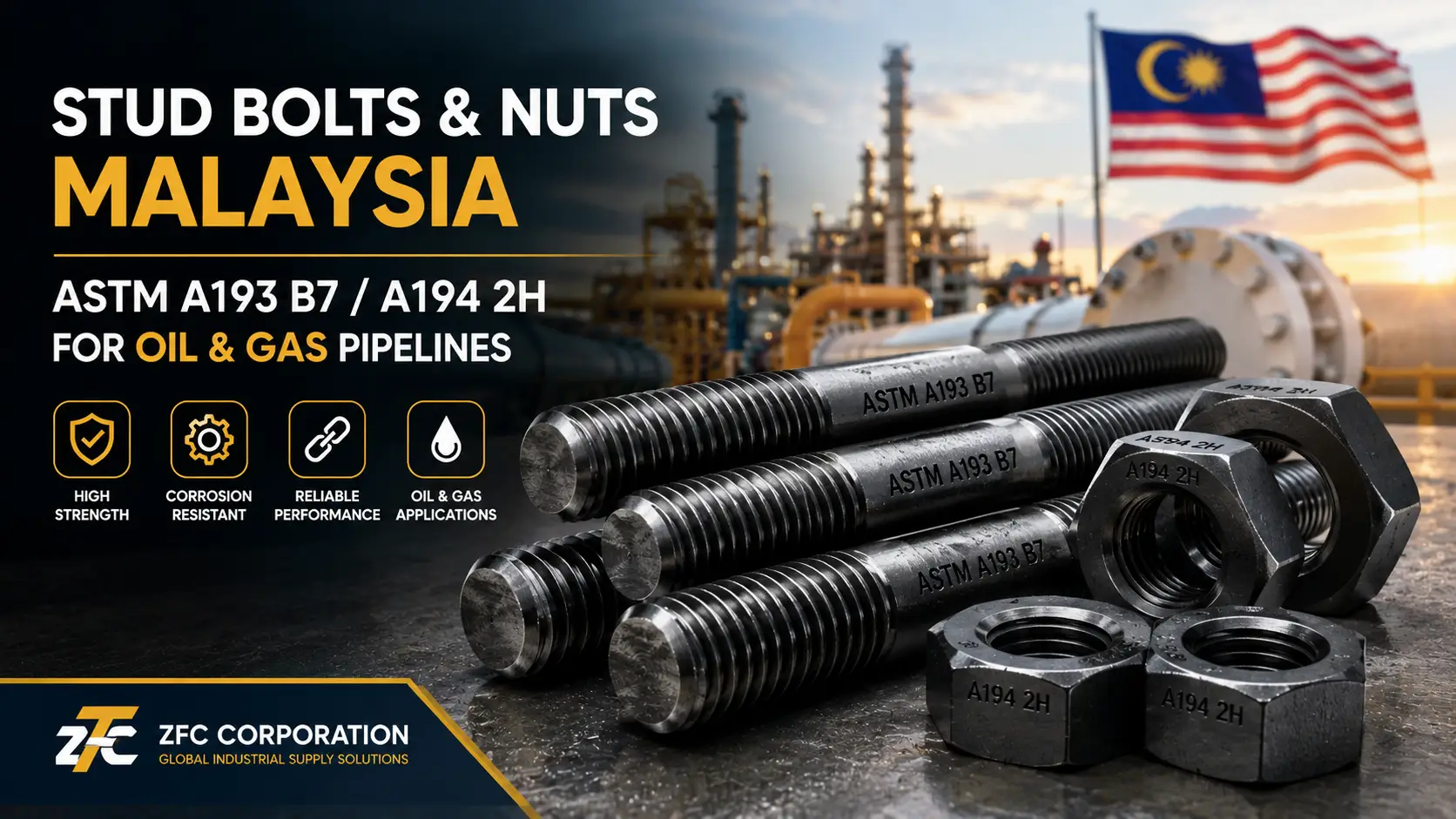
Stud Bolts Malaysia Oil Gas – ASTM A193 B7 & B7M Procurement Guide
Every flanged joint in Malaysia's oil and gas industry has one thing in common. From the subsea wellheads off Sabah to the refinery piping at Pengerang and the LNG trains at Bintulu, the integrity of each connection depends on a single critical component: the stud bolt.
The problem with the oil gas professionals spec of stud bolts Malaysia. Not goods to be exchanged. They are engineered fasteners which are required to pass strict ASTM material requirements, withstand high temperature and pressure, resist corrosion and include full material certification traceable back to manufacturing heat.
The International Association of Oil & Gas Producers (IAOP) estimates that the bolted flange joint is one of the most important elements of mechanical integrity in hydrocarbon facilities. Leaks and incidents are a major problem due to improper bolting practices.
Request a Quote → Source certified stud bolts for your Malaysia oil and gas project with expert procurement support.
What Are Stud Bolts?
A stud bolt is a threaded bolt that has threads at both ends. It is applied to the flanged connection of piping, pressure vessels, valves, pumps, and process equipment with heavy hex nuts.
Unlike a conventional hex bolt which has a head on one end, a stud bolt provides symmetric clamping. Nuts engage on both sides of the flange, creating a more uniform clamping force across the gasket face.
The assembly has three components: the stud bolt itself, two heavy hex nuts, and in many applications, washers or anti-seize compound.
The key is to get and keep the correct amount of bolt preload. It is the clamping force that squeezes the gasket and forms the seal to create the pressure. If the preload is not sufficient, the gasket will relax and leak. Excessive preload can result in the bolt slipping out or the gasket being damaged.
Stud Bolts vs Hex Bolts: Why Stud Bolts Win
Stud bolts are universally preferred over hex head bolts for oil and gas flange connections. Here is why.
Both ends of the thread are engaged in a symmetrical, resulting in more even loading over the face of the flange. Stud bolts can be used in areas where it is not possible to turn the bolt head. They can be used to accurately torque the nut with a torque wrench or a hydraulic bolt tensioner. Then during maintenance, the flange can be separated by removing the nuts on one side of the flange without disturbing the stud.
Why Stud Bolts Are Critical in Oil and Gas Operations
In processing facilities around the world, the most prevalent source of hydrocarbon leaks is bolted flange connections. Process leaks, fire, explosion and release of toxic gases can occur if a single flange joint fails.
The Department of Occupational Safety and Health (DOSH) and the Energy Commission have very demanding criteria for process containment integrity in Malaysia. The bolting and flange management aspect of the PETRONAS Technical Standards are based on international best practices.
IOGP states that there are three major causes of flange leakage: lack of seating stress in the gasket, damage to gasket or flange faces, and deterioration of fastener materials. These are all preventable if the machine is correctly specified, installed and then inspected regularly.
Common Stud Bolt Materials and Grades
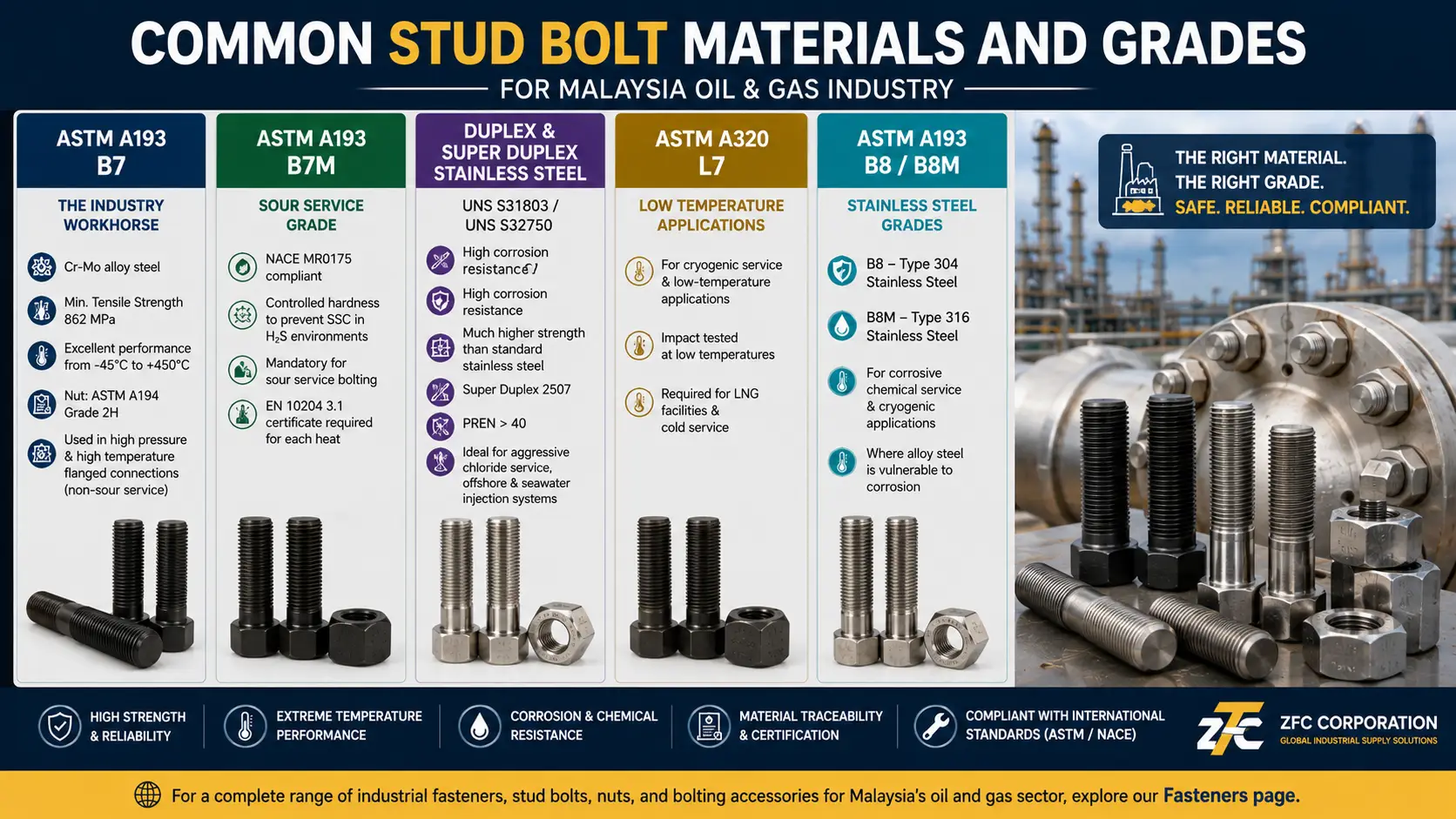
The selection of the correct ASTM grade is the most technically critical procurement decision. Here are the grades most commonly specified in Malaysia's oil and gas sector.
ASTM A193 B7 – The Industry Workhorse
The most common grade used in the oil and gas industry in Malaysia. B7 is made of chromium-molybdenum alloy steel with a minimum tensile strength of 862 MPa, and excellent performance from -45°C to +450°C.
The nut is ASTM A194 Grade 2H. The B7 stud bolt is used for all high pressure and high temperature flanged connections in refineries and petrochemical plants in Malaysia, except for sour service.
ASTM A193 B7M – Sour Service Grade
B7M is the NACE MR0175 compliant variant of B7. It has a controlled maximum hardness below the threshold at which sulphide stress cracking becomes a risk in hydrogen sulphide environments.
The 'M' designation is mandatory for all sour service bolting in Malaysia's gas processing facilities, amine treating units, and sour water strippers. The hardness compliance must be documented on the EN 10204 3.1 material test certificate for each heat.
Duplex and Super Duplex Stainless Steel
According to the duplex stainless steel stud bolts Malaysia offshore applications, the steel used to make these are UNS S31803 or UNS S32750. These grades are a blend of corrosion resistance and a much greater strength than regular stainless steel.
Super Duplex 2507 has a Pitting Resistance Equivalent Number greater than 40 and is appropriate for aggressive chloride service such as with offshore production and seawater injection systems.
ASTM A320 L7 – Low Temperature
For cryogenic service and low-temperature applications, A320 L7 is the specified grade. It is impact tested at low temperatures and is required for LNG facilities and cold service.
B8 and B8M – Stainless Steel
B8 is Type 304 stainless steel. B8M is Type 316 stainless steel. Both are specified for corrosive chemical service and cryogenic applications where alloy steel would be vulnerable to corrosion.
For a complete range of industrial fasteners, stud bolts, nuts, and bolting accessories for Malaysia’s oil and gas sector, explore our Fasteners page.
Offshore vs Refinery Fastener Requirements
Malaysia's oil and gas industry presents two distinct fastener environments with specific material and certification requirements.
Requirement | Offshore Platform | Onshore Refinery / Petrochemical |
Primary corrosion threat | Marine atmosphere, seawater, chlorides | Process chemicals, high temperature, acidic media |
Typical bolt grade | Duplex 2205 / Super duplex 2507 (deck fittings); B7 (process) | B7 and B7M (process); B8M (chemical service) |
NACE compliance | Required for sour gas service | Required for sour service units (amine, SWS) |
Coating / protection | Hot-dip galvanizing or PTFE coating for structural bolts | Typically bare or PTFE-coated; plating avoided for H2S |
Inspection requirement | Rigorous — class society / PETRONAS technical review | Plant inspection per API 570 / ASME PCC-1 |
Traceability requirement | EN 10204 3.1 or 3.2 mandatory for critical joints | EN 10204 3.1 mandatory; 3.2 for high-criticality |
Primary failure modes | Crevice corrosion, galvanic attack, fatigue | Corrosion under insulation (CUI), stress relaxation, thermal fatigue |
Lubrication requirement | Moly disulphide or Molykote to prevent galling | Nickel-based anti-seize for high-temp service |
Key standards | ASME B16.5, API 6A, DNVGL, PETRONAS TS | ASME B16.5, ASME PCC-1, API 570, PETRONAS TS |
Offshore Platforms – Sabah and Sarawak
Offshore platforms are subjected to all Marine elements such as high Humidity, Salt Spray and UV radiation. There are some places with high H₂S concentrations in produced gas streams.
B7 and B7M are still the common process flange types for topside process flanges. Duplex stainless steel is recommended for usage in harsh sea atmosphere on an open deck, splash zone or standing water risk in below-deck areas.
For structural bolting, galvanized steel or marine-grade stainless A4 is used, depending on the situation, where galvanic corrosion is an issue.
Onshore Refinery and Petrochemical Applications
The Pengerang Integrated Petroleum Complex and the Kerteh Industrial Zone are the two foundations for the onshore sector in Malaysia. Petrochemical stud bolt supplier Malaysia procurement need B7 stud bolts and B7M stud bolts from pressure class 150 to Class 2500.
High-temperature service in crude distillation and catalytic cracking units requires B7 stud bolts with verified resistance to stress relaxation at operating temperatures up to 450°C. Re-torquing after the first thermal cycle is standard practice per ASME PCC-1.
For flanges, gaskets, and pressure-containing connection components used alongside stud bolts in Malaysian piping systems, see our Flanges page.
How to Select Stud Bolts for Your Application
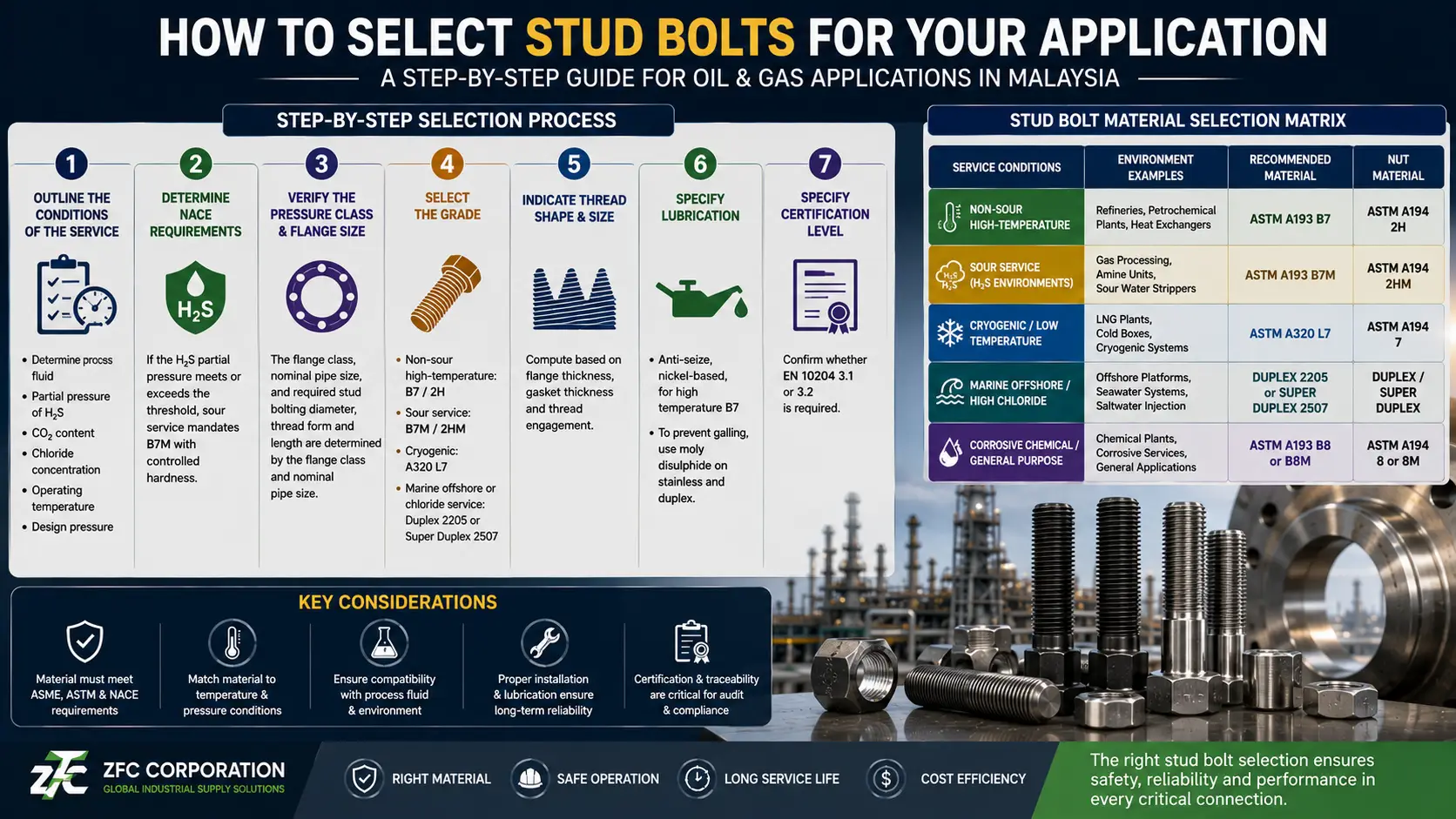
The material selection decision matrix below provides a structured framework for stud bolt material selection oil and gas applications across Malaysia’s diverse oil and gas operating environments.
Service Condition | Recommended Grade | Reason | Standard Reference |
High-temp refinery service (to 450°C) | A193 B7 + A194 2H | High tensile strength, proven high-temp performance | ASTM A193, ASME B16.5 |
Sour service (H₂S present) | A193 B7M + A194 2HM | NACE MR0175 compliant hardness limits | NACE MR0175 / ISO 15156 |
Cryogenic service (to -100°C) | A320 L7 + A194 4 or 7 | Charpy impact tested at low temperature | ASTM A320, ASME B31.3 |
Seawater / marine offshore | Duplex 2205 or Super Duplex 2507 | Chloride pitting resistance, galvanic stability | ASTM A276, ISO 3506 |
Chloride-rich chemical service | A193 B8M (316L) or Duplex | Mo content improves Cl⁻ pitting resistance | ASTM A193, NACE |
Sour + marine (offshore gas) | Super Duplex or Alloy 825 | Combined H₂S + Cl⁻ resistance | NACE MR0175, API 6A |
LNG cryogenic (−162°C) | A320 L7 or A193 B8 (304) | Austenitic / low-temp alloy rated for cryogenic | ASME B31.3, BS EN 1591 |
General process piping | A193 B7 + A194 2H | Most economical compliant grade for non-sour duty | ASME B16.5, ASME PCC-1 |
Step-by-Step Selection Process
Outline the conditions of the service. Determine process fluid, partial pressure of H₂S, CO₂ content, chloride concentration, operating temperature and design pressure.
Determine NACE requirements. If the H₂S partial pressure meets or exceeds the threshold, sour service mandates B7M with controlled hardness.
Verify the pressure class and flange size. The size of the flange class, nominal pipe size, and the required stud bolting diameter, thread form and length are determined by the flange class and nominal pipe size.
Select the grade. Non-sour high-temperature: B7/2H. Sour service: B7M/2HM. Cryogenic: A320 L7. Marine offshore or chloride service: Duplex 2205 or Super Duplex 2507.
Indicate thread shape and size. Compute based on flange thickness, gasket thickness and thread engagement.
Specify lubrication. Anti-seize, nickel-based, for high temperature B7. To prevent galling, use moly disulphide on stainless and duplex.
Specify certification level. Confirm whether EN 10204 3.1 or 3.2 is required.
Preventing Fastener Failure
Corrosion Under Insulation
CUI is a particularly insidious failure mechanism on insulated piping systems. Moisture penetrating degraded insulation creates an electrolyte between the bolt and flange. B7 bolts in CUI-prone zones can be severely corroded when insulation is removed during turnaround. Specifying B7M with PTFE coating or duplex stainless steel significantly reduces CUI risk.
Galling Prevention in Stainless and Duplex Bolts
Galling is the adhesive welding of stainless or duplex bolt threads during installation. Prevention is straightforward. Always apply an appropriate anti-seize compound and use a reduced torque factor to account for the lubricant film. Never assemble stainless or duplex stud bolts without anti-seize.
Counterfeit and Substandard Fastener Risk
Counterfeit fasteners are a documented global problem. Specific risks include grade substitution, MTC fraud, remarked fasteners, and dimensional non-conformance. The primary mitigation is a rigorous incoming inspection program including PMI testing, hardness verification, and MTC verification.
Inspection, Testing and Certification Requirements
EN 10204 Material Test Certificates
For oil and gas stud bolts, EN 10204 3.1 is the minimum acceptable certification level. It confirms that the specific heat of steel meets the chemical composition and mechanical property requirements.
3.2 certificates are issued by an independent third-party inspector. For high-criticality joints, 3.2 provides an additional level of assurance.
Positive Material Identification
PMI verifies the elemental composition of received stud bolts. It is increasingly mandated for critical fastener deliveries, particularly for duplex and super duplex grades. PMI cannot replace EN 10204 3.1 but provides a fast verification layer.
Hardness Testing for Sour Service
For B7M and other NACE-compliant grades, hardness testing on the finished bolt is mandatory and must be documented on the MTC. The maximum hardness limit must be met by every bolt, not just the sample.
Procurement Challenges in Malaysia
Regional Supply Infrastructure
Malaysia's industrial fastener supply network is concentrated in the Klang Valley, with significant presence in Johor serving the PIPC development. Regional supply capability exists from Kerteh and from Bintulu and Labuan serving Sarawak and Sabah offshore operations.
Supplier Evaluation
Before placing any significant purchase order, evaluate suppliers against these criteria: material certification (25% weight), ASTM grade compliance (20%), NACE compliance (15%), traceability and marking (15%), dimensional compliance (10%), counterfeit detection (10%), and lead time (5%).
Installation and Bolting Best Practices
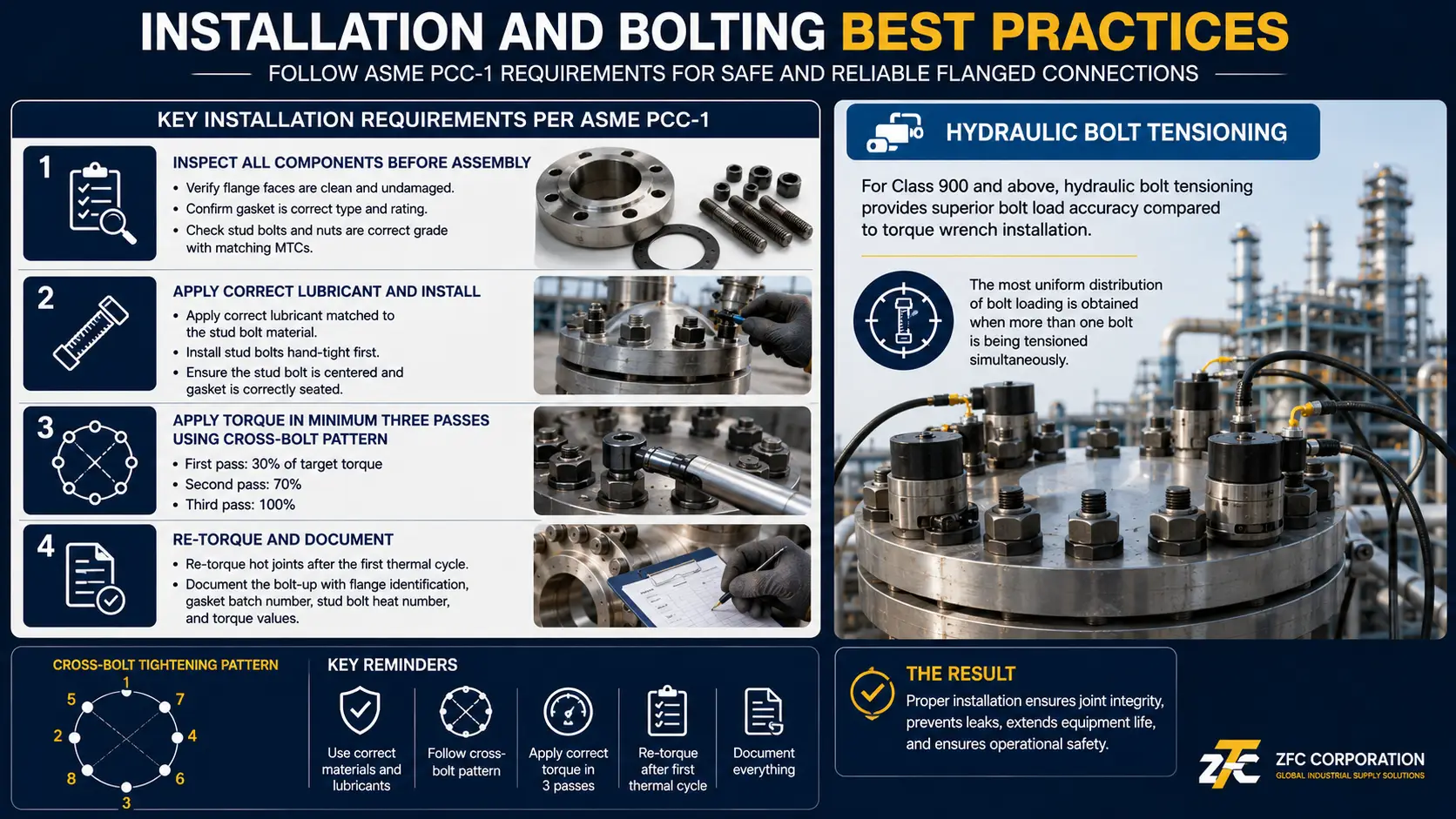
Key Installation Requirements per ASME PCC-1
Inspect all components before assembly. Verify flange faces are clean and undamaged. Confirm gasket is correct type and rating. Check stud bolts and nuts are correct grade with matching MTCs.
Apply correct lubricant matched to the stud bolt material. Install stud bolts hand-tight first. Ensure the stud bolt is centered and gasket is correctly seated.
Apply torque in a minimum three passes using a cross-bolt pattern. First pass: 30% of target torque. Second pass: 70%. Third pass: 100%.
Re-torque hot joints after the first thermal cycle. Document the bolt-up with flange identification, gasket batch number, stud bolt heat number, and torque values.
Hydraulic Bolt Tensioning
For Class 900 and above, hydraulic bolt tensioning provides superior bolt load accuracy compared to torque wrench installation. The most uniform distribution of bolt loading is obtained when more than one bolt is being tensioned simultaneously.
Frequently Asked Questions
What is the use of the stud bolts in the oil and gas industry? Stud bolts are used to join parts together in pipelines, pressure vessels, valves, pumps, and heat exchangers. The pressure-tight seal is achieved and retains pressure in all flanged joints by means of the stud bolts and the heavy hex nuts.
What is ASTM A193 B7?
Maximum minimum tensile strength of 862 MPa, chromium molybdenum alloy steel stud bolt grade, which works reliably from -45 °C to +450 °C. This is the most frequently used grade for non-sour high-temperature process flanges.
What are the differences between B7 and B7M?
B7M has a controlled maximum hardness of 22 HRC to comply with NACE MR0175 for sour service. There is no hardness maximum for B7, and it is specified for non-sour service. H₂S conditions may cause a risk of sulphide stress cracking when using B7.
Would stainless steel stud bolts work on boats or ships?
Chloride stress corrosion cracking is a problem associated with the use of standard austenitic stainless steel in the offshore marine atmosphere. Duplex and super duplex grades are designed to offer corrosion resistance and adequate PREN to resist chloride-induced pitting.
How do I select the right stud bolt material?
Determine whether the service is sour, identify the operating temperature, assess the corrosion environment, and confirm the flange pressure class. The selection process should follow a structured approach, mapping conditions to the correct ASTM grade.
What certifications should stud bolts have?
An EN 10204 3.1 material test certificate is the minimum. It must contain heat number, chemical analysis, tensile and yield strength, and hardness test results. 3.2 Certification is required for high-criticality applications.
What causes stud bolt failure?
Incorrect material specification, inadequate lubrication, corrosion, hydrogen embrittlement, and counterfeit material. All are preventable through proper specification, installation, and inspection.
The Bottom Line
Buying oil gas in Malaysia is not a commonplace procurement activity of studies. It is a critical engineering choice that influences the integrity of flange joints, facility reliability and safety of operation. Malaysia's oil and gas industry covers offshore platforms, refineries, LNG plants and petrochemicals.
Materials, coatings and certifications vary by environment. The application of these key principles are very simple: choose the appropriate ASTM grade based on service conditions; ensure certification/traceability; follow correct installation procedures; have a good incoming inspection program.
For most applications, B7 and 2H nuts are the baseline. Sour service requires B7M with documented hardness compliance. Offshore and chloride environments demand duplex or super duplex grades. Cryogenic service requires A320 L7.
Take the time to specify correctly, verify certification, and qualify suppliers. The fastener that costs a bit more but performs reliably is not expensive. It is the right decision.
Need help sourcing certified stud bolts for your Malaysia oil and gas project? Share your grade, size, quantity, and delivery location. Our team will help you find compliant products with verified traceability and confirmed availability.
DISCLAIMER: Z&F Corporation is not affiliated with, authorized by, endorsed by, or acting as an official representative of any manufacturer, brand, or trademark owner referenced on this website. All product names, trademarks, brand names, logos, and manufacturer references are the property of their respective owners and are used solely for identification, reference, and compatibility purposes.