Cement Plant MRO Products in Libya: Complete Industrial Maintenance & Procurement Guide
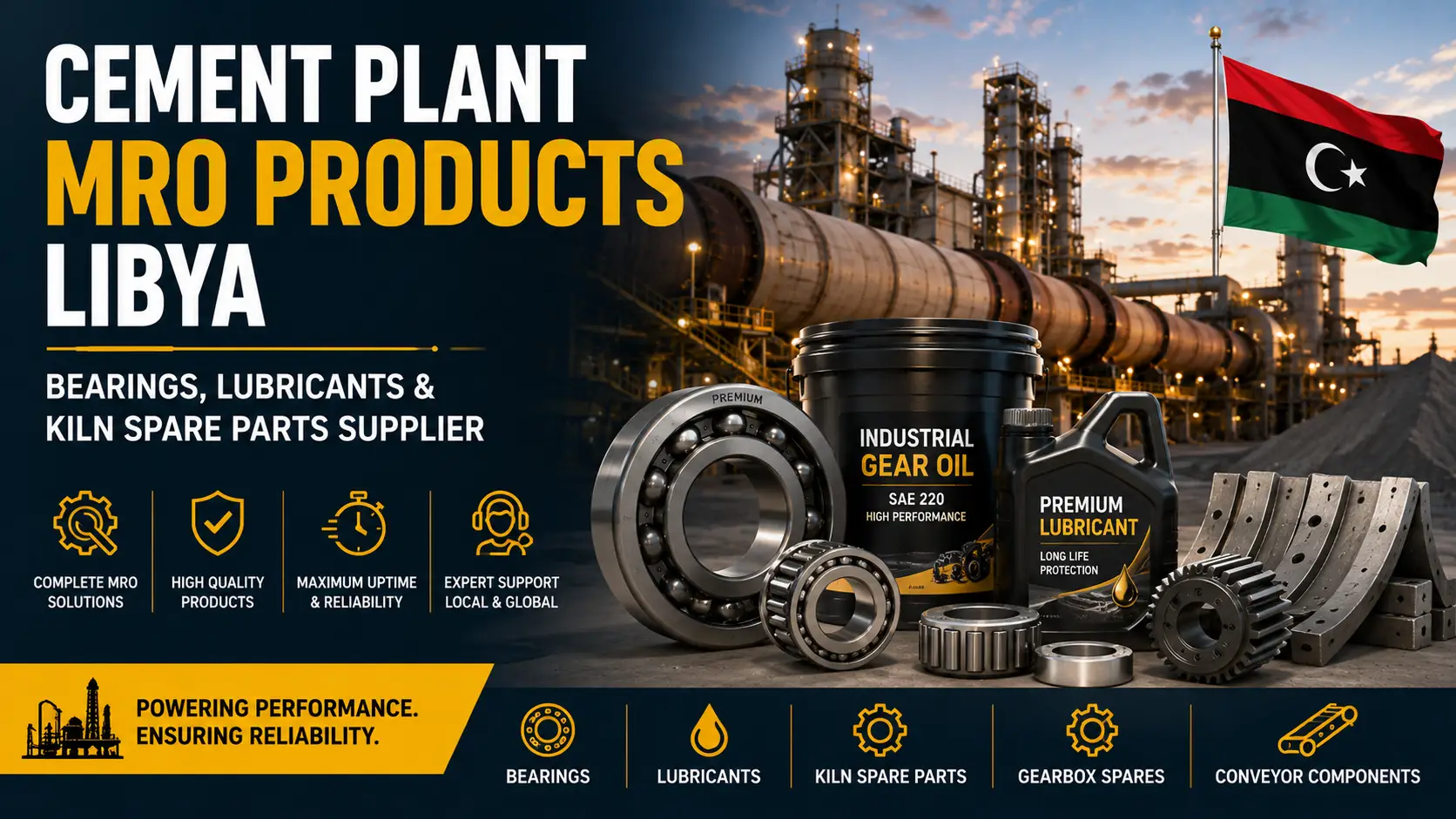
From the cement plant MRO products in Misrata, Benghazi, Al Khums industrial corridor, all depend on the stability and reliability of the cement plant MRO products that these libya maintenance teams can rely on to maintain cement plants with minimal downtime and maximize productivity and profitability. Technical compatibility, certifications and lead times are the key components of choosing the proper cement plant MRO products libya facilities, not price. This guide explains the MRO product categories and critical spare parts, strategies for maintenance, standards, and how to assess the supplier by objective and specification based criteria.
Looking for a cement plant MRO products or spares price quote?
What Are Cement Plant MRO Products?
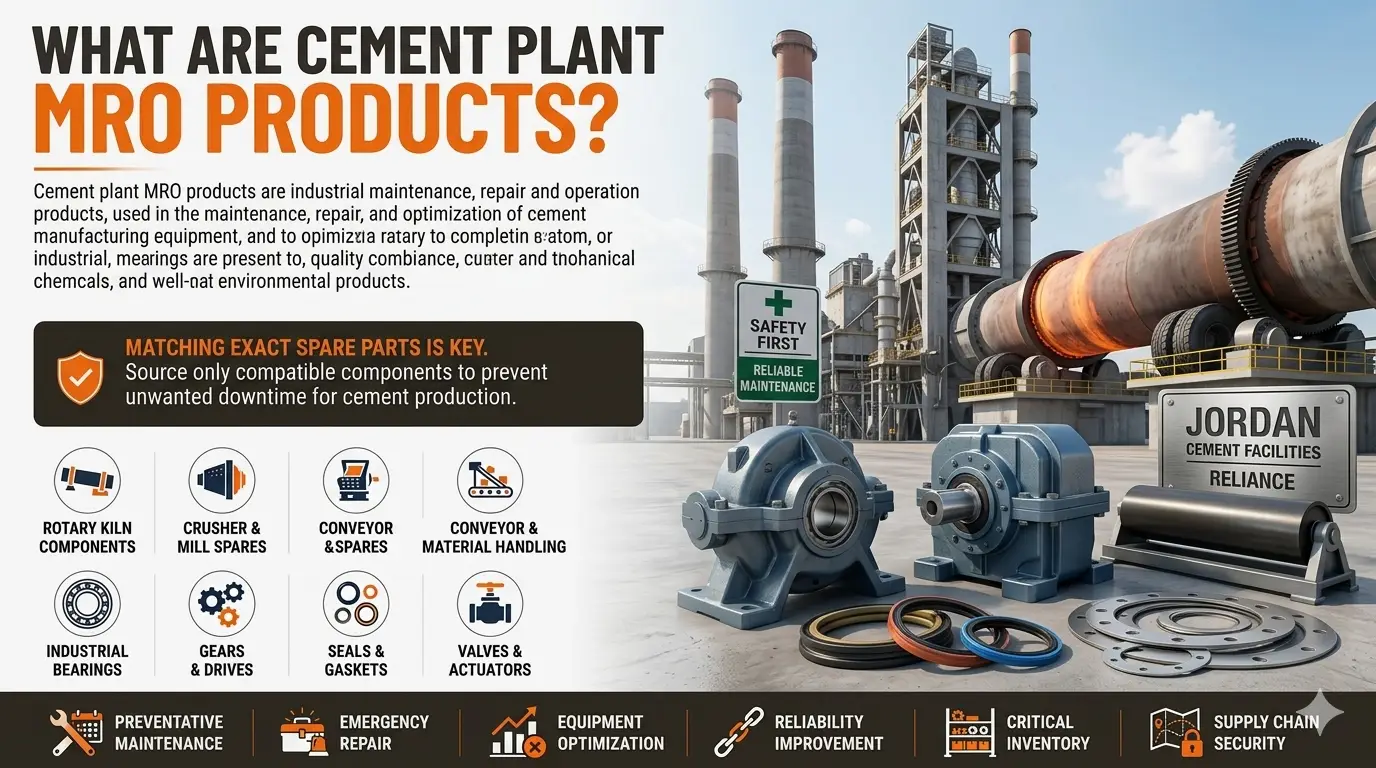
Cement plant MRO products are industrial maintenance, repair and operation product, which can be used in the maintenance, repair and optimization of cement manufacturing equipment, reduce downtime and enhance equipment reliability. When it comes to sourcing cement plant spare parts Libya facilities rely on requires matching each and every component to the particular rotary kiln, mill or conveyor it will be used on; even a single incompatible bearing or seal can lead to unwanted down-time for production.
Why MRO Products Matter in Cement Manufacturing
Research by the U.S. Department of Energy's Industrial Assessment Centers shows that predictive maintenance can save 25-30% on maintenance costs, 70-75% on breakdowns and 35-45% on downtime. Cement plant MRO products libya plant managers determine play a direct role in these reliability gains across the cement industry, for example, the continuous operation of kilns and mills requires plant managers to have the right parts on hand before failure.
Essential MRO Categories for Cement Plants
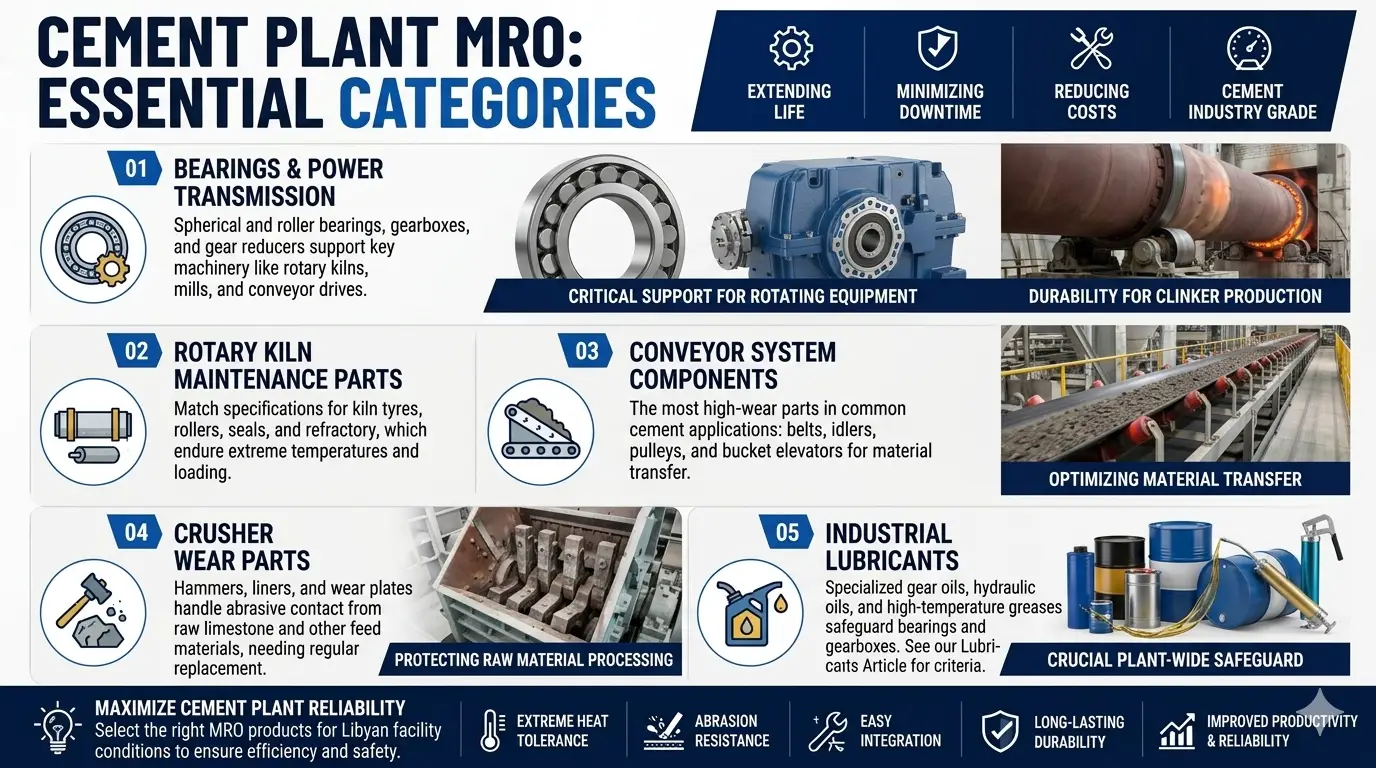
The first step in choosing cement plant MRO products libya facilities is to grasp the fundamental types of equipment that need continuous maintenance assistance:
Bearings and Power Transmission Components
Rotary kilns, mills and conveyor drives are also supported by spherical roller bearings, tapered roller bearings and cylindrical roller bearings, as well as gearboxes and gear reducers which provide power to the large rotating machinery.
Rotary Kiln Maintenance Parts
Matching the specifications of kiln tyres, rollers, seals and refractory components are important, as they are exposed to extreme temperatures and mechanical loading during continuous clinker production.
Conveyor System Components
The conveyor belt, idlers, pulleys and bucket elevators are used for the transfer of raw material and clinker within the plant and are among the most highly wear parts in common cement applications.
Crusher Wear Parts
Raw limestone and other feed materials are subject to constantly occurring abrasive contact with crusher hammers, liners and wear plates, which means the parts need to be replaced regularly.
Industrial Lubricants
Gear oils, hydraulic oils and high-temperature greases safeguard bearings and gearboxes throughout the plant. Details of the selection criteria for lubricants in cement plants are elaborated in our Lubricants Article.
Critical Spare Parts for Cement Plant Equipment
Rotary kiln tyres and rollers and seals
Housing, mounting, and alignment assemblies for kilns, mills and conveyor drives
The hammers, liners and wear plates for the crushers.
Idlers, Conveyor belts and components of Bucket elevator
Heavy rotating equipment gearboxes and gear reducers
Hydraulic Pumps & Pneumatic System Parts
Preventive vs Predictive Maintenance
Factor | Preventive Maintenance | Predictive Maintenance |
Approach | Scheduled inspections and replacement | Condition-based, using sensor and analysis data |
Data source | Manufacturer time intervals | Vibration, thermal, and oil analysis data |
Cost profile | Lower upfront technology investment | Higher upfront investment, lower long-term cost |
Best suited for | Non-critical, easily scheduled components | Critical rotating equipment like kilns and mills |
OEM vs Aftermarket Spare Parts
Deciding on OEM vs aftermarket components will consider equipment criticality, quality requirements, equipment compatibility, equipment certifications, equipment lifecycle cost and maintenance strategy. The OEM parts are usually compatible and supported by a warranty, and the aftermarket parts improve the economic and time-saving aspects of the non-critical, high wear item like a crusher liner.
How to Source Cement Plant MRO Products in Libya
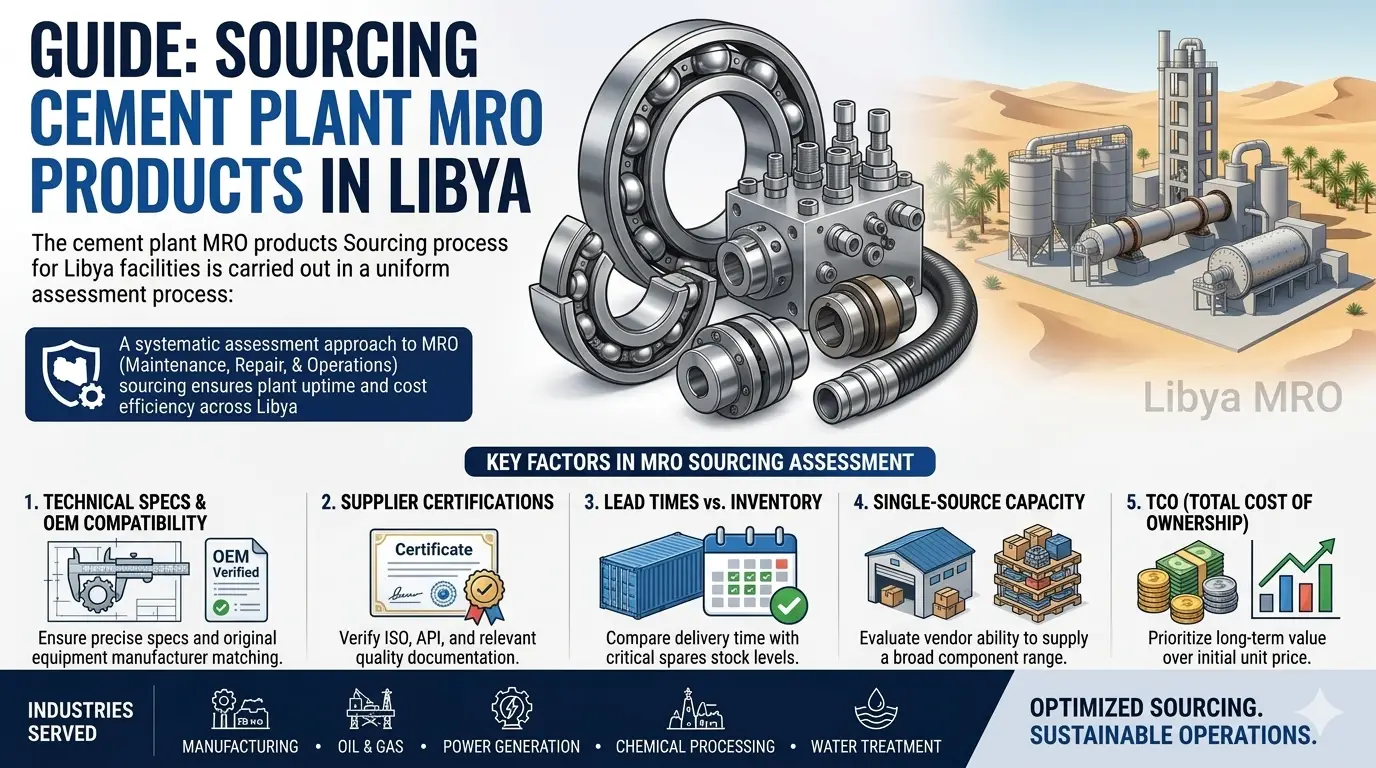
The cement plant MRO products Sourcing process for Libya facilities is carried out in a uniform assessment process:
Ensure technical specifications and OEM compatibility prior to ordering replacement parts.
Verify certifications and quality documentation from the supplier
Compare lead times to your critical spare parts inventory approach
Evaluate suppliers' capacity to obtain various types of components from a single source
Consider the TCO instead of unit price only
Factors to Consider Before Purchasing
Workstation criticality and loss of production from the workstation.
Equipment criticality and loss of production from the equipment.
Works with existing rotary kiln, mill or conveyor systems
Technical support & installation instructions are available
The warranty conditions and after-sales service ability.
Total lifecycle costs, including replacement frequencies and maintenance costs
Relevant Industry Standards and Certifications
Standard / Organization | Relevance |
ISO | General equipment design and quality management standards |
ASTM International | Material specification and testing standards |
ASME | Mechanical equipment design standards |
IEC | Electrical component safety and performance standards |
World Cement Association / CEMBUREAU | Industry-specific technical and operational guidance |
Common Procurement Challenges in Libya
Even seasoned maintenance teams purchasing cement plant MRO products in Libya experience unnecessary problems:
Long lead time for imported OEM spare parts
Lack of adequate local resources of special components for rotary kiln and mill
The technical specifications of the supplies are inconsistent.
Find a balance between cost and equipment reliability demands
Manage logistics for projects that require shutdown maintenance for time-sensitive operations
Maintenance Best Practices
Focus on essential SP inventory for kilns, mills and crushers
Practical condition monitoring of high-value rotating equipment as applicable
Use the same components throughout the plant wherever possible, to make stock-taking easier
Monitor KPIs for track maintenance to detect failure patterns and identify them as recurring issues.
Integrate spare parts procurement with planned outages planning
Procurement Considerations
The use of coordinated sourcing for the industrial bearings Libya plants specify, as well as the gearboxes, conveyor parts and lubricants that keep the production of cement going, is preferable to the management of dozens of individual suppliers. The Lubricants Article is complemented by our Bearings Pillar which offers more detailed information on the selection criteria for bearings in high temperature, high load cement plant applications.
Frequently Asked Questions
What are cement plant MRO products?
Products involved in the maintenance, repair and operation of plant equipment are termed MRO products, and include bearings, belts, motors, lubricants, seals, valves, and electrical products.
Which spare parts require regular replacement?
Parts of the rotary kiln, bearings, conveyor parts, crusher wear parts, gearboxes, motors and hydraulic systems are all subjected to regular replacement as a result of continuous operation and wear.
How can MRO inventory reduce downtime?
Keeping critical spare parts on hand decreases the downtime of equipment awaiting replacement parts.
What maintenance strategy is best for cement plants?
A hybrid approach of preventive and predictive maintenance is typically the best one, and predictive maintenance should be applied to critical rotating equipment.
How often should industrial bearings be replaced?
Replacement schedules will vary based on operating conditions, load, OEM guidelines and condition monitoring data, not a scheduled replacement program.
What lubricants are suitable for cement manufacturing?
In a cement plant, the following gear oils are used in general: Industrial gear oils, hydraulic oils, compressor oils, bearing greases, and high-temperature lubricants.
How do I choose compatible spare parts?
Check OEM specifications, certifications and compatibility paperwork before ordering new parts.
What is the difference between OEM and aftermarket parts?
OEM parts are parts that are directly made by the original equipment manufacturer and are guaranteed to be compatible with that equipment, while aftermarket parts are comparable parts that may provide cost and delivery time savings.
Conclusion
The first step to reliable operation of Libyan cement plants is to develop a Libyan cement plant MRO products procurement process that is planned and driven by the need to be available rather than a reactive approach that responds to equipment failure. Reducing downtime and lifecycle costs is possible by prioritizing critical spare parts inventory for kilns, mills and crushers, using OEM vs aftermarket components based on equipment criticality, and implementing preventive and predictive maintenance. From sourcing bearings, conveyor components or even industrial lubricants, a well-managed and standardized procurement process backed by a trustworthy sourcing partner ensures the production process is kept under control and equipment life is optimized for Libyan cement manufacturers.
Benefit from the professional advice of sourcing MRO products for your cement plant.
DISCLAIMER: Z&F Corporation is not affiliated with, authorized by, endorsed by, or acting as an official representative of any manufacturer, brand, or trademark owner referenced on this website. All product names, trademarks, brand names, logos, and manufacturer references are the property of their respective owners and are used solely for identification, reference, and compatibility purposes.