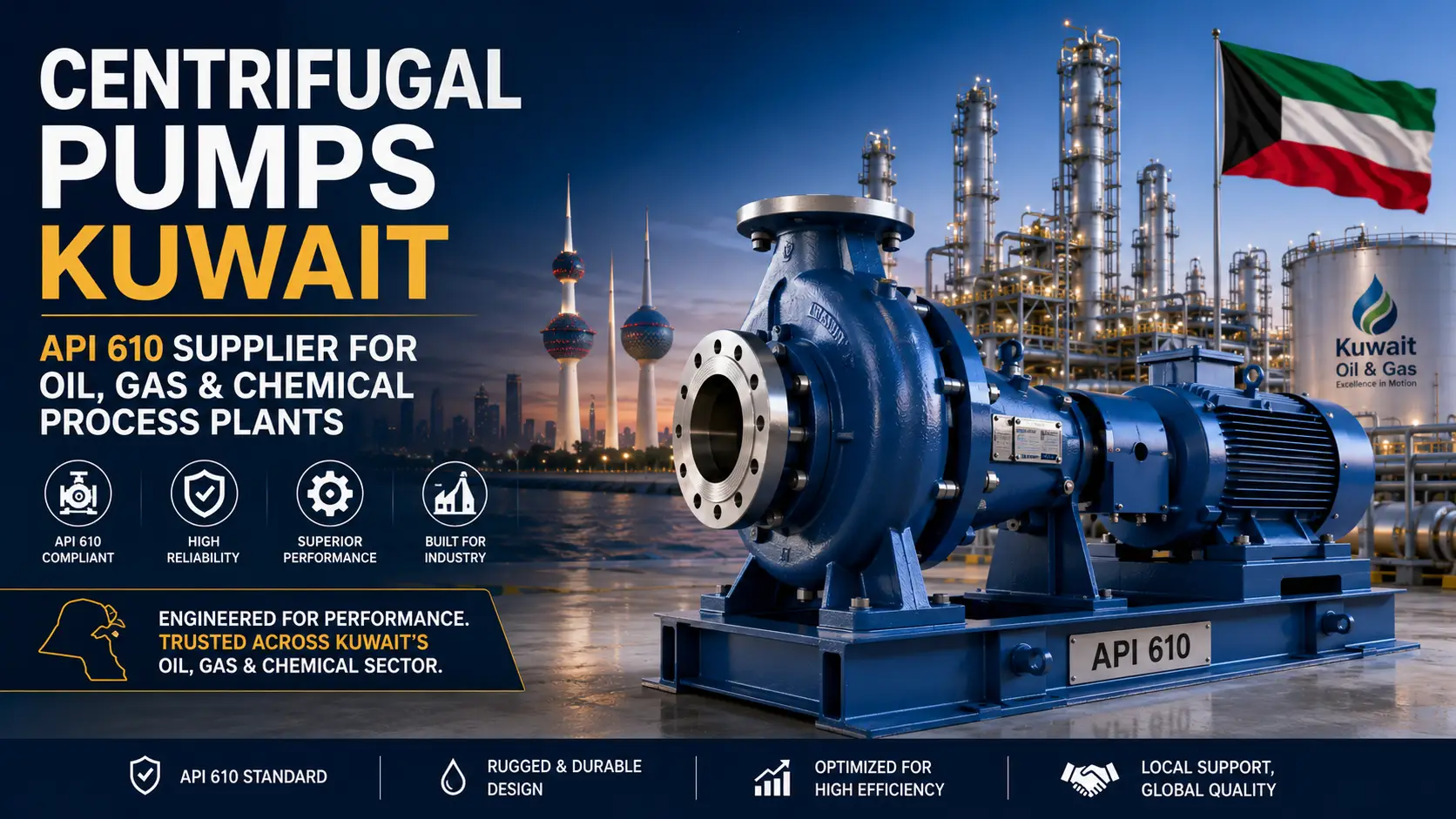
Centrifugal Pumps in Kuwait: Industrial Applications, Suppliers, and Technical Guide
Whether it is the seawater intakes at Kuwait's desalination plants or the district cooling systems running the high-rise buildings in Kuwait City, fluid movement is at the core of just about every aspect of the country's industrial and urban infrastructure. There is more to choosing centrifugal pumps manufacturing in Kuwait than just price lists — choosing the right centrifugal pumps requires a knowledge of materials, pressure ratings, climate-resistance, and standards compliance that are appropriate for Kuwait's operating environment. This guide covers technical basics, applications and supplier considerations for procuring pumps in the Kuwaiti market, whether you're buying pumps for an oil refinery in Mina Al-Ahmadi, a water treatment facility in Shuaiba, or an HVAC system in a commercial tower.
Definition: A centrifugal pump is a machine that moves liquids by spinning an impeller, which increases fluid velocity and pressure, allowing it to be transported through piping systems.
Sourcing centrifugal pumps for a project in Kuwait? Get pricing and technical specifications matched to your application. Request a Quote
How Centrifugal Pumps Work
A centrifugal pump is a hydraulic machine that transforms the mechanical energy of rotation of an electric motor into kinetic energy of the fluid and then transfers this energy to the fluid's pressure at the exit from the pump casing. By knowing the essentials, buyers can make more informed decisions when considering specifications.
Impeller and Volute Design
The impeller is a rotating part that consists of curved vanes and creates a centrifugal force that draws fluid into the center of the impeller (the eye), then throws it outwards. The surrounding volute casing is designed to gradually slow the fluid down to create the pressure (head) of the fluid that can be used to discharge the fluid. The efficiency, solids handling capacity, and the type of fluid that can be handled are related to impeller design (open, semi-open, or enclosed) for different industrial processes in Kuwait.
NPSH and Cavitation Explained
The minimum suction-side pressure needed to prevent the fluid from vaporizing within the pump is called Net Positive Suction Head (NPSH). Cavitation occurs when the available NPSH is less than the pump's NPSH, and vapour bubbles are generated in the pump then violently imploded in higher pressure areas. Cavitation noise and vibration and progressive damage to impeller surfaces is a characteristic phenomenon, and a major contributor to early pump failure in poorly specified pumps, especially in hot climate seawater intake applications found throughout Kuwait's coastal industrial areas.
Key Applications in Kuwait Industries
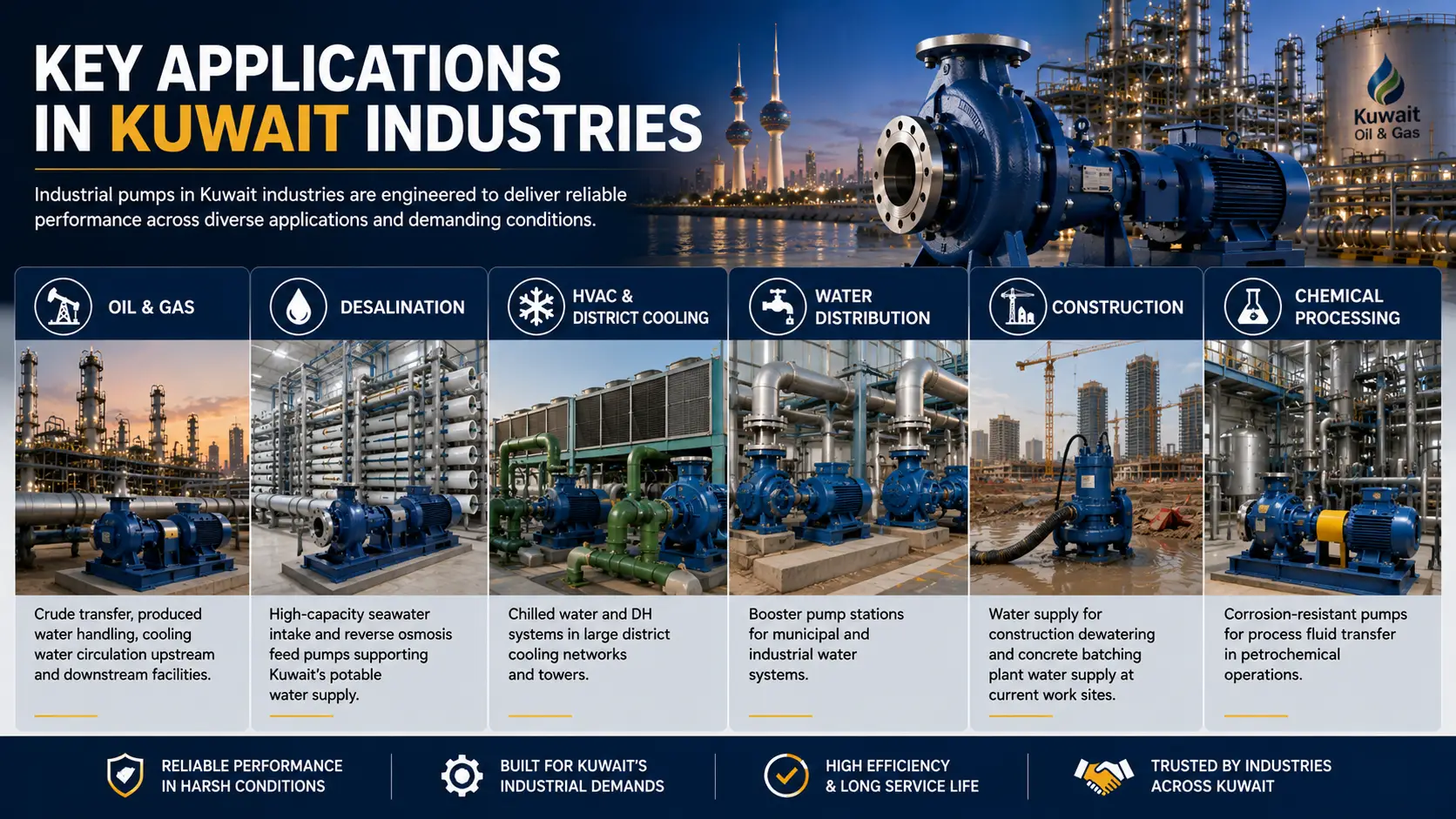
Industrial pumps Kuwait operators mention come in a variety of industries and have different performance and material specifications depending on the climatic conditions, water chemistry, and industrial activities of Kuwait.
Oil and gas — crude transfer, produced water handling, cooling water circulation upstream and downstream facilities
Desalination — For potable water, desalination is provided by high-capacity seawater intake and reverse osmosis feed pumps supporting Kuwait's potable water supply.
HVAC and district cooling — chilled water and DH systems in large district cooling networks and towers
Water distribution — booster pump stations for municipal and industrial water systems
Construction — Water supply for construction dewatering and concrete batching plant water supply at current work sites
Chemical processing — and corrosion-resistant pumps for process fluid transfer in petrochemical operations.
Types of Centrifugal Pumps
Single vs Multi-Stage Pumps
When talking to centrifugal pump suppliers Kuwait, one of the first specification choices is whether to go with a single stage or a multi-stage centrifugal pump, shown in the table below.
Factor | Single-Stage | Multi-Stage |
Pressure capability | Low to moderate head | High head, high pressure |
Number of impellers | One | Two or more in series |
Typical application | General water transfer, HVAC circulation | Boiler feed, high-rise buildings, deep well |
Efficiency at high head | Lower | Higher |
Maintenance complexity | Lower | Higher |
Common Kuwait use | Residential & commercial water supply | Refinery feed, desalination boost stations |
Single Stage pumps consist of one impeller, and are suitable for water transfer and HVAC circulation applications requiring moderate heads. Two or more impellers are serially connected by multi-stage pumps, the pressure each stage adds is cumulative — most commonly used for boiler feed water, deep well extraction and high rise water supply for buildings requiring high head.
Materials Used for Kuwait Conditions
Corrosion Resistance Requirements
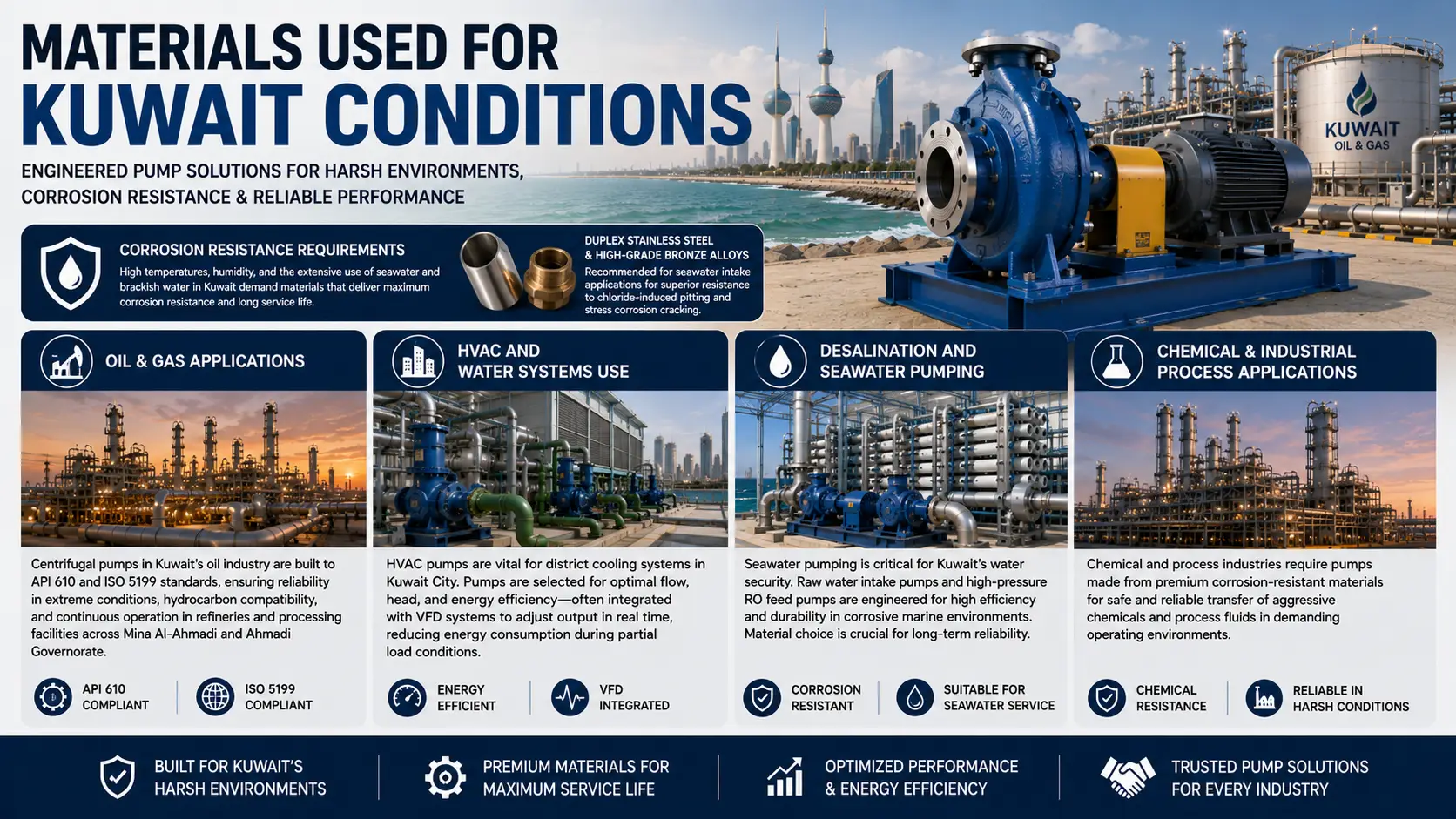
The selection of materials is one of the most important considerations when purchasing pumps as there are high ambient temperatures, high humidity in coastal areas and extensive use of seawater and brackish water in the industrial processes in Kuwait. If you buy stainless steel centrifugal pump for seawater or chemical service, then it will be a lot longer lasting than any cast iron unit, which is also exposed to the same conditions.
Material | Corrosion Resistance | Relative Cost | Typical Use |
Cast Iron | Low | Lowest | Fresh water, non-corrosive fluids |
Bronze | Moderate-High | Moderate | Brackish water, mild chemical service |
Stainless Steel (316) | High | Higher | Seawater, desalination, chemical plants |
Duplex Stainless Steel | Very High | Highest | Seawater intake, high-chloride environments |
Seawater intake applications (such as desalination and coastal cooling water systems) are often recommended to use duplex stainless steel and high-grade bronze alloys because they are expected to last a long time and are more resistant to chloride induced pitting and stress corrosion cracking.
Oil & Gas Applications
Kuwait's oil industry is extremely dependent on centrifugal pumps designed to API 610 (the American Petroleum Institute standard for centrifugal pumps in the petroleum, petrochemical, and natural gas industries) and ISO 5199 (for general industrial process applications). The pumping systems being installed on oil and gas facilities in Kuwait must withstand these extreme conditions, be compatible with hydrocarbons, and be capable of continuous operation in re-refinery fluid transfer systems in Mina Al-Ahmadi and processing systems throughout the Ahmadi Governorate.
HVAC and Water Systems Use
These HVAC pumps Kuwait buildings use are a key to running cooling systems in the buildings of Kuwait City, which are integral to the district cooling system that is essential to energy-efficient cooling strategies. The water pump a Kuwait facility manager chooses for the HVAC circulation system needs to be balanced for flow rate, head and energy efficiency—often integrated with variable speed drive (VFD) systems to adjust the water pump output in real time based on the cooling demand, cutting energy use during partial load conditions when most commercial buildings operate, typically for the majority of the year.
Desalination and Seawater Pumping
In Kuwait, seawater pumping is one of the most technically challenging uses because of the high proportion of the country's potable water that is desalination water. Raw seawater intake pumps are designed to transport raw seawater to the treatment facilities, and high-pressure feed pumps provide reverse osmosis membrane trains that run at pressures much higher than those required for water transfer duty.
The choice of materials for desalination service is critical; conventional cast iron or carbon steel parts corrode quickly when in continuous contact with seawater and are the standard specification in Kuwait's desalination plants located along the Arabian Gulf for transfer pumps and high-pressure RO feed pumps, as well as for intake pumps.
Selection Criteria for Buyers
Buyers should evaluate the pumps systematically from any centrifugal pump supplier in the Kuwait market by considering the following factors:
Flow rate and head requirements — from the hydraulic design and operating range of the system
NPSH available vs required — confirmed with the pump manufacturer's performance curve to prevent the risk of cavitation.
Material compatibility — high pressure and temperature resistance, low coefficient of friction, ability to return to original dimensions after expansion and contraction
Operating temperature range — Operating temperature range is of particular concern because of the high temperatures in Kuwait in summer.
Standards compliance — It is essential that the specifications satisfy the Standards Compliance requirements, either API 610 for oil and gas service or ISO 5199 or ISO 2858 for general industrial applications.
Energy efficiency and VFD compatibility — to minimize lifetime electric energy consumption in continuous duty applications
Local after-sales support — spare parts, seals and qualified after sales technicians by local service.
International manufacturers such as Grundfos, KSB SE & Co. KGaA, Flowserve Corporation, Sulzer Ltd, Xylem Inc., Wilo SE, Ebara Corporation and Kirloskar Brothers Limited are all recognized manufacturers and are commonly specified in the Kuwaiti market and are available in a wide range of duties, ranging from HVAC circulation to heavy industrial process duty.
See our Seals Article on mechanical seal types and selection, which is another key factor in centrifugal pump reliability, for information on seal configurations, seal materials and maintenance issues of importance in Kuwait's industrial operating environment.
Maintenance and Troubleshooting
Seal and Bearing Maintenance
Over the life of a centrifugal pump, most often, you will need to attend to mechanical seals and bearings. Routine checks should include checking for seal blow-off, excessive vibration, bearing temperature, and lubrication condition. Bearing lubricant degradation can be hastened by a lack of cooling in the high ambient temperature in Kuwait, especially for pump maintenance programs operating critical process equipment, so the practice of regular thermal monitoring of the bearing is very useful.
Common Centrifugal Pump Failures
Cavitation damage — Impeller and casing damage due to inadequate NPSH — "cavitation damage" (pitting and erosion)
Mechanical seal failure — Leakage due to wear, installation or running dry
Misalignment — wear and vibration due to poor shaft-to-motor coupling alignment
Corrosion and erosion — accelerated loss of materials due to materials mismatched for the service fluid
Bearing failure — typically associated with lubrication degradation, contamination or withstanding continuous overloads
Pro tip: The vibration trend over time enables maintenance personnel to identify developing problems with bearings or alignment before they ever occur, thereby helping to move towards a predictive rather than reactive maintenance approach.
Standards and Compliance (API / ISO)
Centrifugal pumps for use in Kuwait's industrial applications should be obtained based on the internationally recognised standards, and ensure performance, safety and reliability:
API 610 — centrifugal pumps for pumping liquids.
ISO 5199 — This standard is specifically the technical requirements for centrifugal pumps, Class II.
ISO 2858 — The designation and nominal duty point of end-suction centrifugal pumps conform to ISO 2858.End-suction centrifugal pumps are subject to ISO 2858 for designation and nominal duty point.
ASME (American Society of Mechanical Engineers) fluid machinery guidelines that are used in many engineering specifications.
IEC (International Electrotechnical Commission) standards for the performance of electric motors, combined with pump units.
In addition, engineering teams and procurement specialists can refer to technical guidance provided by the Kuwait Institute for Scientific Research (KISR) for performance of infrastructure and industrial equipment suited for Kuwait's environmental conditions and the technical specifications published by the major national oil and gas operators in the Kingdom of Kuwait.
Supplier Overview in Kuwait
Local distributors, regional engineering companies and authorised representatives of major pump manufacturers serve the industrial sector in Kuwait. Purchasers of pump distributors Kuwait operators must not only take price into account, but also consider the range of suppliers' capabilities.
Officials distributor of well-known brands (Grundfos, KSB, Flowserve, Sulzer, Wilo, Ebara)
Minimizing downtime by having common spare parts (such as seals, bearings, impellers) easily available locally
Engineering assistance (in-house or partner) to size pumps and design systems
Know the history of track servicing, such as oil and gas, desalination, or HVAC, as applicable to the application for which you are using the product.
If you are interested in learning more about pumps, beyond centrifugal technology, then our Pumps Pillar, which covers the entire spectrum of industrial pumping technologies applicable to the commercial, municipal, and process industries in Kuwait, is for you.
Frequently Asked Questions
What is a centrifugal pump used for in Kuwait?
The centrifugal pumps used in industries in Kuwait are employed in oil and gas, desalination, HVAC and district cooling, water distribution, and construction site dewatering industries for fluid transfer.
Which companies supply centrifugal pumps in Kuwait?
Authorized international distributors, such as Grundfos, KSB, Flowserve, Sulzer, Wilo and Ebara as well as regional engineering companies that provide sizing, installation and after-sales service provide products to Kuwait's market.
What is the lifespan of a centrifugal pump?
Ranging from 10 to 20 years based on material choices, quality of maintenance and operating conditions, with applications in Kuwait, where corrosive operating environments may be under the lower end without proper maintenance.
How do you maintain a centrifugal pump in Kuwait's climate?
Seals, bearings and the condition of the impeller should be regularly checked and changed if the temperature of the bearing lubricant becomes high, especially in Kuwait's hot ambient temperatures, as this will lead to downtime due to leakage.
Which pump is best for HVAC systems in Kuwait?
For HVAC and district cooling circulation, end-suction or in-line single-stage centrifugal pumps with VFD control are often used to cope with the variable load profiles of commercial buildings whilst maintaining efficiency.
What is the difference between centrifugal and positive displacement pumps?
Centrifugal pumps provide flow and pressure with a rotating impeller and are ideal for high flow rates, low to moderate viscosity applications. Positive Displacement Pumps are pumps that move a fixed amount of fluid per cycle and are more appropriate for high viscous fluids or when constant and controlled flow is required without regards to system pressure.
Where can I find pump repair services in Kuwait?
There are usually distributors and regional engineering companies within the industrial zones of Kuwait that provide in-house repair, seal replacement and overhaul service as well as supplying spares for the major pump brands from abroad.
Summary
Choosing the appropriate centrifugal pumps projects in Kuwait is simple as choosing the right pump type, material and standards to suit the particular application, whether it's high temperature refinery service, corrosive seawater handling or energy efficient HVAC circulation. The purchaser should know the basic principles of impeller design, NPSH and corrosion resistance of materials to be able to critically assess any offer that a supplier may make and not just on the basis of price.
The process outlined in this guide of application matching, material selection, standards conformance, and supplier evaluation is the basis for reliable and cost-effective procurement for a stainless steel centrifugal pump Kuwait desalination project requires, for replacement centrifugal pumps for HVAC or any other application, or for a maintenance stock program for oil and gas applications.
To get more technical assistance, consider consulting our Pumps Pillar article on the complete portfolio of industrial pumping technologies, as well as our Seals Article for mechanical seal selection and maintenance best practices for centrifugal pump reliability.
Not sure which pump fits your application? Our engineers can help you compare specifications and avoid costly mismatches. Talk to Our Pump Specialist
Related guides: Cement Plant MRO Supplies in Pakistan | Submersible & Sump Pumps in Yemen | More Industry Insights
DISCLAIMER: Z&F Corporation is not affiliated with, authorized by, endorsed by, or acting as an official representative of any manufacturer, brand, or trademark owner referenced on this website. All product names, trademarks, brand names, logos, and manufacturer references are the property of their respective owners and are used solely for identification, reference, and compatibility purposes.