Getting your O-ring seals wrong in a UK industrial setting isn't just an inconvenience. It's a shutdown. A leak on a hydraulic press in Birmingham, a failed seal on subsea equipment in the North Sea, a contaminated water line in a Scottish treatment plant — each one traces back to a single decision made during specification. The right seal material keeps your system running. The wrong one doesn't show its face until the worst possible moment.
This guide is for maintenance engineers, procurement managers, and anyone who's tired of replacing seals that should have lasted longer.
What Is an O-Ring Seal?
Bottom line, an O-ring is a ring of elastomer that fits within a machined groove and is compressed between two mating surfaces. That’s what seals it, that compressing. Easy in theory. Actually quite complex in practice.
Most People don't realize how many variables really go into it. The groove depth, the surface finish, the compression ratio, the interaction of the seals with the process fluid. It all adds up to whether your industrial O-ring lasts for years or fails in weeks. Failure of seals occur when you pick the cheapest from a catalogue and hope for the best.
Here's the way to look at it: the ring itself could cost you pennies. When it goes down, the downtime could cost you thousands.
How Does an O-Ring Work?
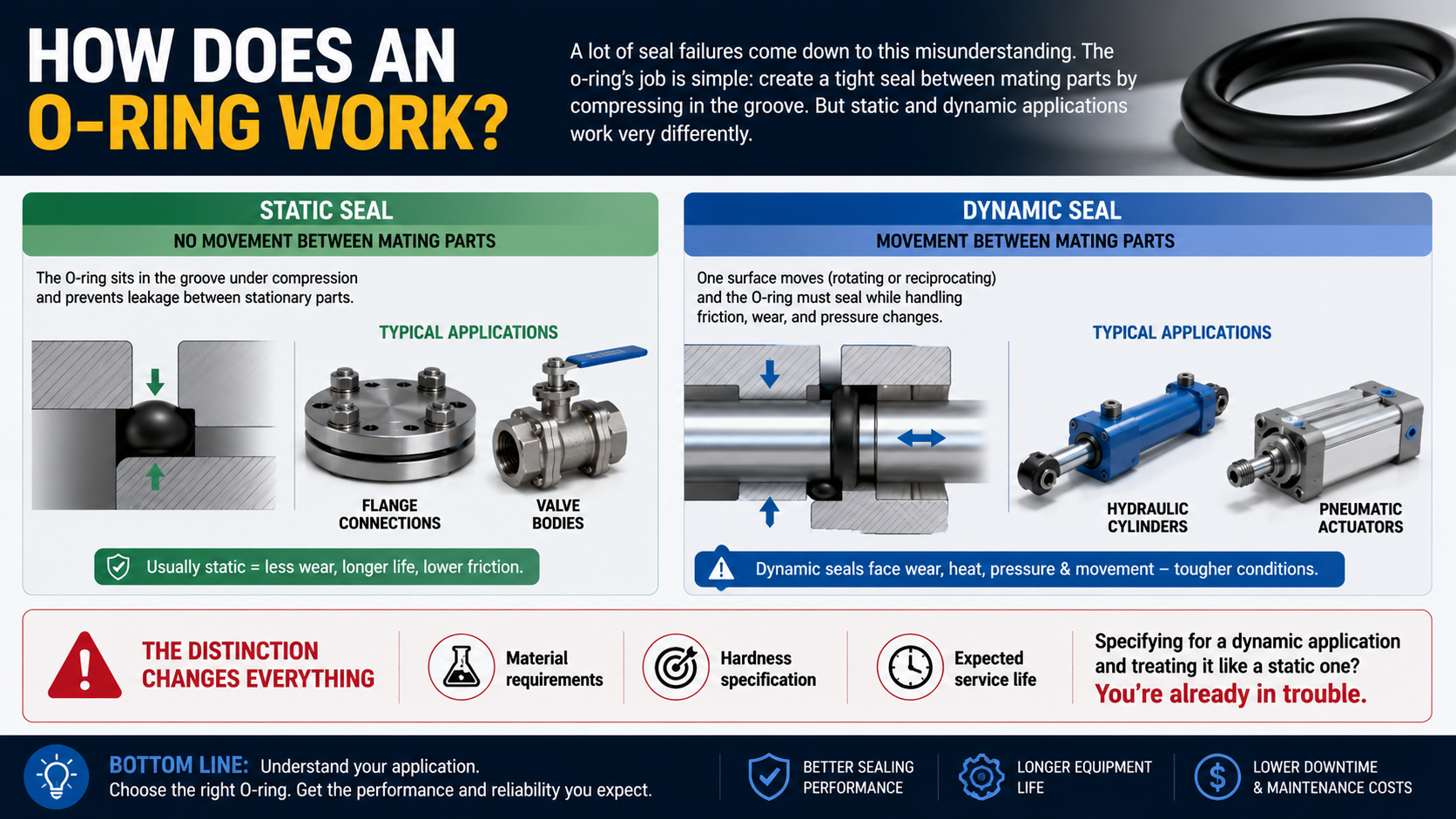
A lot of seal failures come down to this misunderstanding. In a static seal, there's no movement between the mating parts — the O-ring just sits there under compression and holds. In a dynamic seal, one surface is moving, either rotating or reciprocating, and the ring has to handle wear on top of everything else.
Hydraulic cylinders and pneumatic actuators are classic dynamic applications. Flange connections and valve bodies? Usually static. The distinction changes your material requirements, your hardness specification, and your expected service life.
If you're specifying for a dynamic application and treating it like a static one, you're already in trouble.
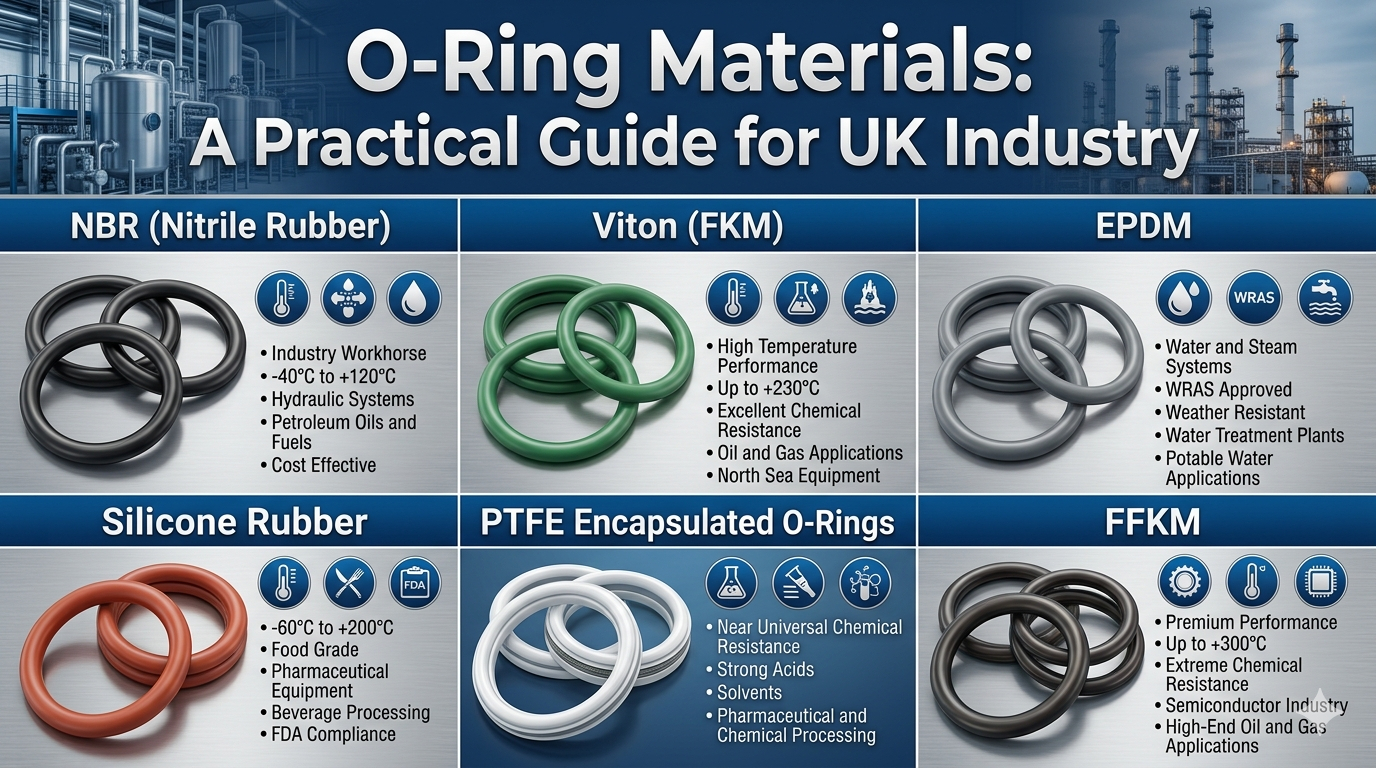
O-Ring Materials: A Practical Guide for UK Industry
This is where most of the real decisions get made. There's no single best material — there's only the right material for your specific conditions. Here's a breakdown of what's actually used across UK industry and why.
NBR (Nitrile Rubber) — The Industry Workhorse
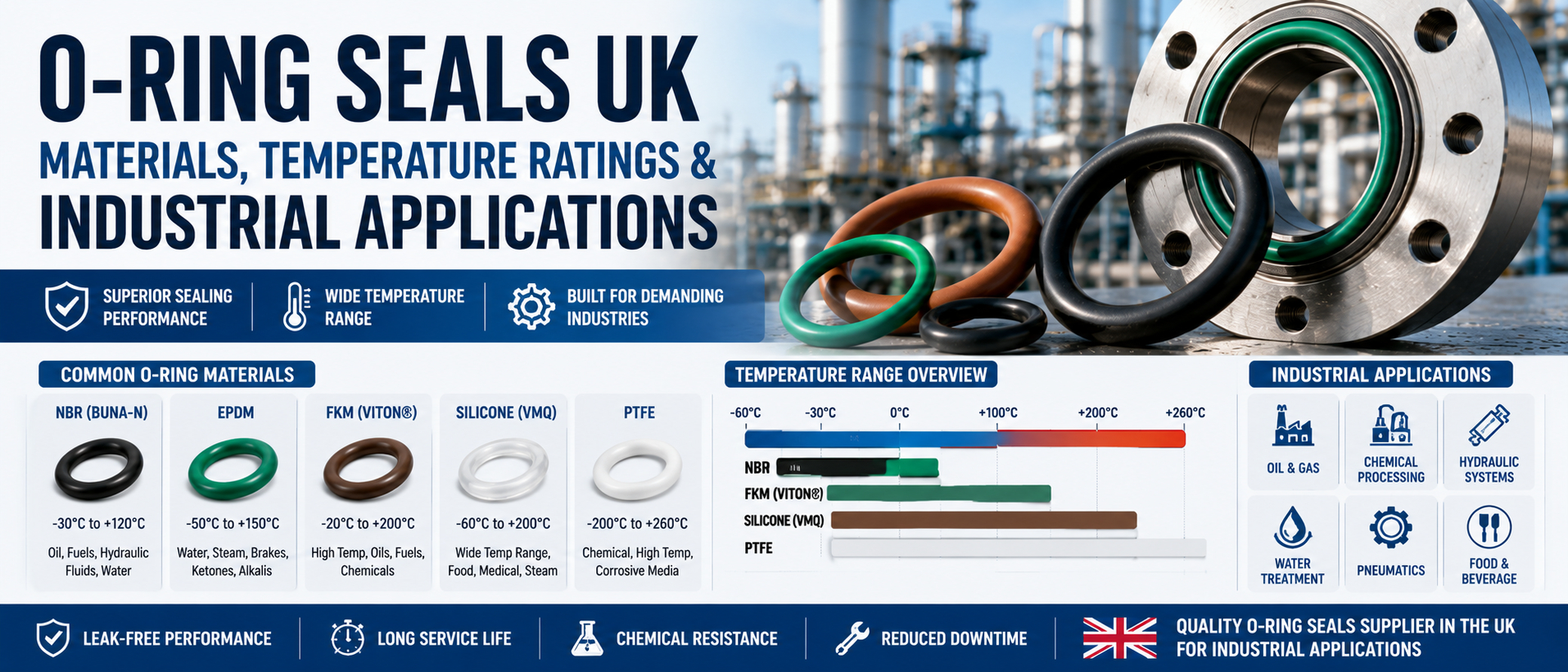
NBR is everywhere. Walk through any UK manufacturing plant, open up a hydraulic system, look inside a compressor — you'll find nitrile rubber. It handles petroleum-based oils, mineral hydraulic fluids, and fuels well, covers a temperature range of roughly -40°C to +120°C, and costs less than almost anything else on this list.
The catch? Put it near ketones, ozone, aromatic hydrocarbons, or strong acids and it degrades fast. NBR hydraulic O-rings are excellent for general-purpose work, but don't push them beyond their limits.
Viton (FKM) — High Performance for Demanding Environments
If NBR is the workhorse, Viton is the specialist. FKM fluorocarbon elastomers operate up to +200°C continuously, with some grades pushing to +230°C. Chemical resistance is significantly better — fuels, acids, many solvents, weathering — it handles what NBR cannot.
Here's what most buyers want to know: what's the actual difference between NBR and Viton O-rings in practice? Cost and performance. NBR works well and costs less. Viton costs more and survives conditions that would destroy nitrile in days. For O-ring seals in oil and gas equipment across the UK, particularly North Sea subsea and topside applications, Viton or FFKM is almost always the specified material. Parker Hannifin supply FKM grades widely used by UK operators.
EPDM — Ideal for Water and Steam Applications
EPDM O-rings are the preferred choice for water based systems. Regularly specified by water treatment plants in Teesside, Grangemouth and across Scotland and England, EPDM performs in hot and cold water, steam and outdoor weathering conditions. It is also WRAS approved for use in potable water systems, a compliance issue that many UK water utilities cannot ignore.
One major limitation, EPDM and petroleum based fluids don’t mix well. EPDM is not the answer if your system has any oil contamination.
Silicone Rubber — Food, Pharmaceutical, and High-Temperature Use
Silicone O-rings are not the strongest material mechanically but they do offer something else – a temperature range from -60 °C up to +200 °C, great biocompatibility and compliance with food-grade standards. They are a staple in food manufacturing, dairy processing, beverage lines, and pharmaceutical equipment.
UK suppliers of FDA approved silicone O-rings include James Walker and ERIKS. If your process uses CIP cleaning chemicals, always check compatibility – silicone handles some aggressive cleaners better than others.
PTFE Encapsulated O-Rings — Chemical Resistance Without Compromise
Some chemical environments are simply too aggressive for any elastomer on its own. That's where PTFE encapsulated O-rings come in. A silicone or Viton core wrapped in a PTFE jacket gives you near-universal chemical resistance while keeping the flexibility you need for effective sealing.
For pharmaceutical manufacturers and chemical processing plants dealing with strong acids, chlorinated solvents, or oxidizing agents, this is often the right call.
Perfluoro-elastomer (FFKM) — Maximum Performance
Perfluoro-elastomers are the top of the performance tree. FFKM O-rings from specialist elastomer manufacturers can withstand temperatures up to +300°C and are resistant to virtually all industrial chemicals. They work in semiconductor manufacturing, specialist chemical processing and high performance oil and gas equipment.
And they’re expensive. In my experience, FFKM is only worth specifying when you have really exhausted the other options and the cost of seal failure still outweighs the material premium.
O-Ring Material Comparison Table
Material | Temp Range | Oil/Fuel | Water/Steam | Chemical Resistance | Where It's Used |
NBR | -40°C to +120°C | Excellent | Poor | Moderate | Hydraulics, pneumatics, fuel systems |
Viton (FKM) | -20°C to +200°C | Excellent | Moderate | Very Good | Oil & gas, chemical processing |
EPDM | -50°C to +150°C | Poor | Excellent | Good | Water treatment, steam, HVAC |
Silicone | -60°C to +200°C | Poor | Poor | Moderate | Food, pharma, high-temp |
PTFE Encapsulated | -60°C to +200°C | Good | Good | Excellent | Chemical processing, pharma |
FFKM | -20°C to +300°C | Excellent | Good | Outstanding | Semiconductor, specialist industrial |
What Temperature Can Viton O-Rings Withstand?
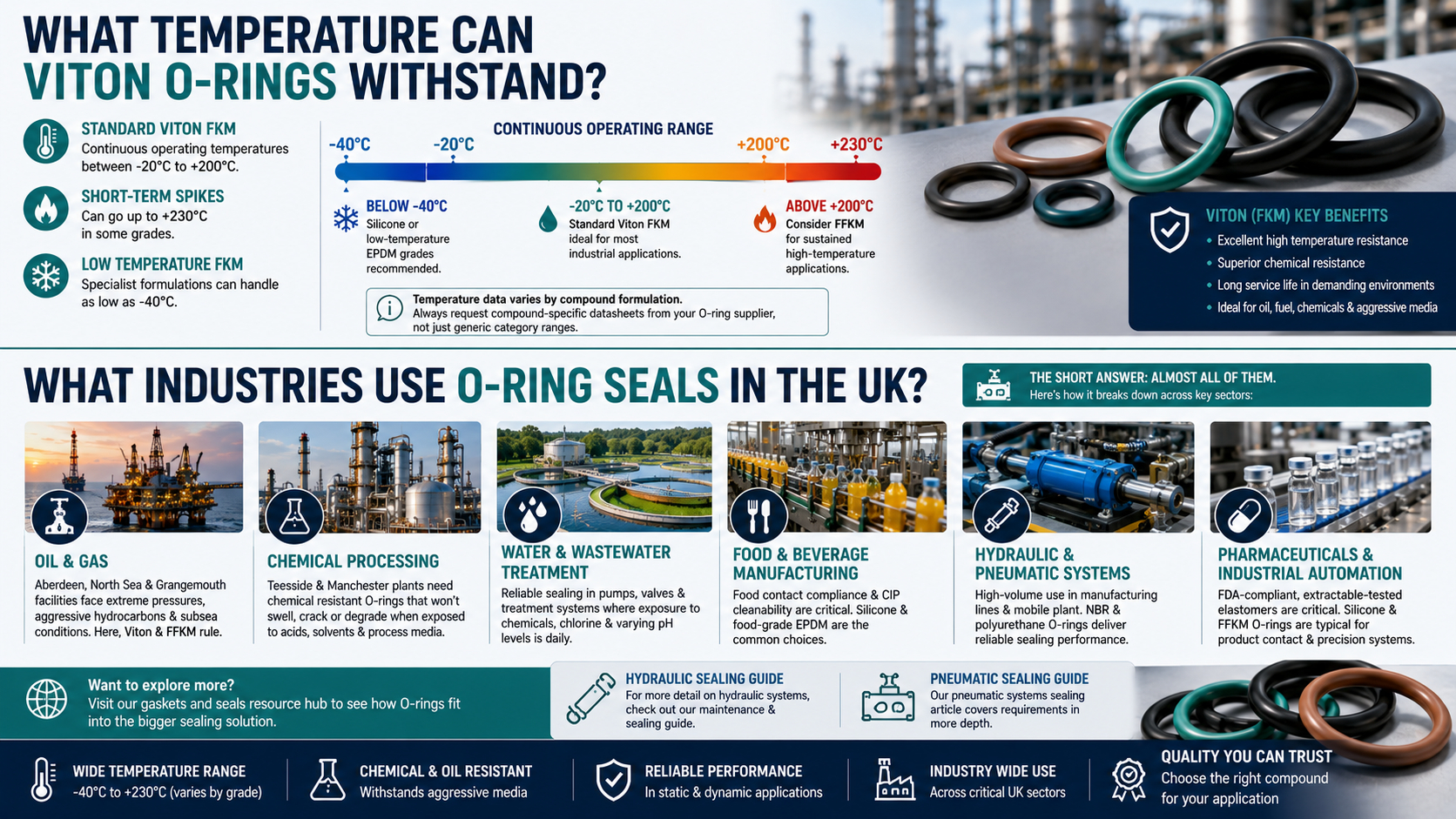
Standard Viton FKM compounds handle continuous operating temperatures between -20°C and +200°C. Short-term spikes can go to +230°C in some grades. Specialist low-temperature FKM formulations can push the lower limit down to -40°C if that's your concern.
Above +200°C sustained? Start looking at FFKM. Below -40°C? Silicone or low-temperature EPDM grades are worth evaluating. The bigger point here is that generic temperature data isn't always reliable — compound formulation varies between manufacturers, and your O-ring supplier should be able to provide compound-specific datasheets, not just category ranges.
What Industries Use O-Ring Seals in the UK?
The short answer is almost all of them. But here's how it breaks down across the sectors that see the highest demand.
Oil and Gas
This is the primary setting for specification. Aberdeen, North Sea and Grangemouth facilities are accustomed to extreme pressures, aggressive hydrocarbons and subsea conditions where a seal failure is never a minor issue. Here Viton and FFKM rule.
Chemical Processing
Teesside and Manchester chemical processing plants need chemical resistant O-rings that will not swell, crack or degrade when subjected to acids, solvents and process media which would rapidly destroy standard elastomers. Water and Wastewater Treatment
Food and Beverage Manufacturing
Compliance with food contact regulations is mandatory and the ability to be cleaned by CIP processes is an important design consideration. Silicone and food-grade EPDM are the usual suspects here.
Hydraulic and Pneumatic Systems
From manufacturing lines in Birmingham and Manchester to mobile plant across England and Wales, hydraulic O-rings and pneumatic seals represent one of the largest volume applications for NBR and polyurethane O-rings in the UK. For more detail on hydraulic-specific sealing, take a look at our hydraulic equipment maintenance and sealing guide. For pneumatic applications, our pneumatic systems sealing article covers the specific requirements in more depth.
Pharmaceuticals and Industrial Automation
FDA-compliant, extractable-tested elastomers are critical for pharmaceutical and biotech manufacturers. Silicone and FFKM O-rings are typical for product contact applications. Pneumatic actuators and solenoid valves also need precise NBR or polyurethane O-rings to maintain the systems efficient.
To see how O-rings fit into the bigger picture, check out our gaskets and seals resource hub.
O-Ring Standards in the UK: ISO 3601 Explained
Most UK engineers work to ISO 3601 when specifying O-ring dimensions. It establishes inside diameters, cross-section diameters and tolerances for both metric and inch-series sizes. It also includes requirements for surface finish and groove design.
In addition to dimensions, UK buyers sourcing seals for pressure equipment need to be aware of PSSR 2000 (Pressure Systems Safety Regulations) and Pressure Equipment Directive. The British Standards Institution (BSI) publishes matching BS EN standards. The British Fluid Power Association (BFPA) provides practical advice on hydraulic and pneumatic sealing for the UK market.
Always check your seal specification against HSE requirements for hazardous area applications. Getting this wrong can have consequences that go beyond breaking equipment.
What Causes O-Ring Seal Failure?
Here's what most people get wrong — they replace the failed seal with the same material and wonder why it fails again. The seal is a symptom. The failure mode is the actual problem.
Chemical Attack
The wrong elastomer in contact with an incompatible fluid swells, softens, and loses its sealing ability fast. The Parker O-Ring Engineering Handbook is a widely used compatibility reference, and it's worth consulting before you finalize any specification.
Excessive Temperature
Push any elastomer past its rated limit consistently and you're shortening its life significantly every time. Heat accelerates ageing and hardening in ways that aren't always visible until the seal has already started to fail.
Compression Set
This is what happens when an O-ring permanently deforms under sustained compression and can no longer spring back to maintain contact. Heat and incompatible fluids accelerate it. Once it sets, the seal is done regardless of how it looks externally.
Extrusion and Nibbling
In high-pressure systems, the ring gets forced into the clearance gap between components. Backup rings solve this problem in most hydraulic applications. If you're seeing nibbled or chewed seal edges, extrusion is almost certainly the cause.
Installation Damage
A cut from a sharp thread, a twist during fitting, installing dry without lubrication — all of these create immediate or early-life failures that look like material problems until you inspect closely. Installation damage accounts for more failures than most people admit.
Size and Groove Mismatch
Undersized or oversized O-rings, or incorrectly machined grooves, lead to inadequate compression or excessive squeeze. Either way, you get leakage. Verify groove dimensions are within ISO 3601 tolerances before assuming the seal itself is at fault.
Contamination
Particles in the process fluid can score the sealing surface or embed in the elastomer, creating leak paths over time. Contamination-related failures are often misdiagnosed as material failures until the surface damage becomes visible on inspection.
How Do I Select the Right O-Ring?
Start with your operating conditions. What are the actual temperature extremes, not just the normal running temperature? What's the maximum pressure, and is it cyclic? These aren't optional details — they're the baseline for everything else.
Next, identify every fluid the seal will contact. Process fluid is obvious, but don't forget lubricants and cleaning agents. A seal that's compatible with the process fluid can still fail if the CIP chemical attacks it every week.
Once you know your conditions and fluids, material selection becomes much more logical. Static or dynamic application narrows it further. Regulatory requirements — FDA, WRAS, NSF — may eliminate options or confirm others. Size to ISO 3601 from the equipment drawing, and verify groove dimensions are within tolerance.
And honestly, if you're unsure between two materials, a good O-ring supplier should be able to help you narrow it down based on actual service data, not just generic charts.
How Often Should O-Rings Be Replaced?
There's no fixed answer. A static seal in clean water at ambient temperature can last a decade. A dynamic seal in a high-pressure hydraulic system at elevated temperature might need replacement every few thousand cycles. The application determines the interval.
What good maintenance practice looks like is including O-ring inspection in your planned preventive maintenance schedule, replacing seals at defined intervals, and documenting failure patterns so you can spot recurring issues. The Institution of Mechanical Engineers (IMechE) and the Energy Industries Council (EIC) both support reliability-centered maintenance approaches where replacement timing is driven by condition data, not just calendar schedules.
Sourcing Industrial O-Ring Seals in the UK
The UK supply chain for industrial sealing products is well developed. Your main choices are:
ERIKS – Stock-list of O-ring kits and wide range of materials nationwide.
James Walker – UK manufacturer with deep O-ring expertise across sectors.
Parker Hannifin – global manufacturer. Parker O-Ring Handbook is a standard reference tool.
Trelleborg – hydraulic and industrial sealing components widely used in UK industry.
Freudenberg Sealing Technologies – high-performance elastomer compounds for demanding applications.
Greene Tweed — specialists in high-performance FFKM and engineered polymers.
Precision Polymer Engineering (PPE) — UK manufacturer of perfluoro elastomers.
When assessing supplier look at more than price. When you specify critical sealing components, material certifications, traceability documentation, technical support and realistic lead times all matter.
Summary: Key Takeaways for O-Ring Selection
What does all this mean for you in practical terms? If you choose the wrong material, you'll find yourself replacing seals more often than you should, dealing with leaks that can damage equipment, and possibly facing compliance issues in regulated applications. Choose well and a few pounds on a seal will do its work quietly for years.
O-ring seals The UK industrial market is not a one-size-fits-all segment. NBR for hydraulics and general use, Viton for oil and gas and chemical environments, EPDM for water treatment, silicone for food and pharmaceutical applications and PTFE or FFKM when the chemistry gets really nasty. Know your conditions, check chemical compatibility, size to ISO 3601 and get your supplier to support the specification with proper documentation.
If you need help specifying industrial O-ring seals for a specific application, our technical team is available to advise. Sealing components are available across industrial supply chains in the UK across oil and gas, water treatment, chemical processing, and manufacturing.
Disclaimer
Z&F Corporation is not affiliated with, authorized by, endorsed by, or acting as an official representative of any manufacturer, brand, or trademark owner referenced on this website. All product names, trademarks, brand names, logos, and manufacturer references are the property of their respective owners and are used solely for identification, reference, and compatibility purposes.