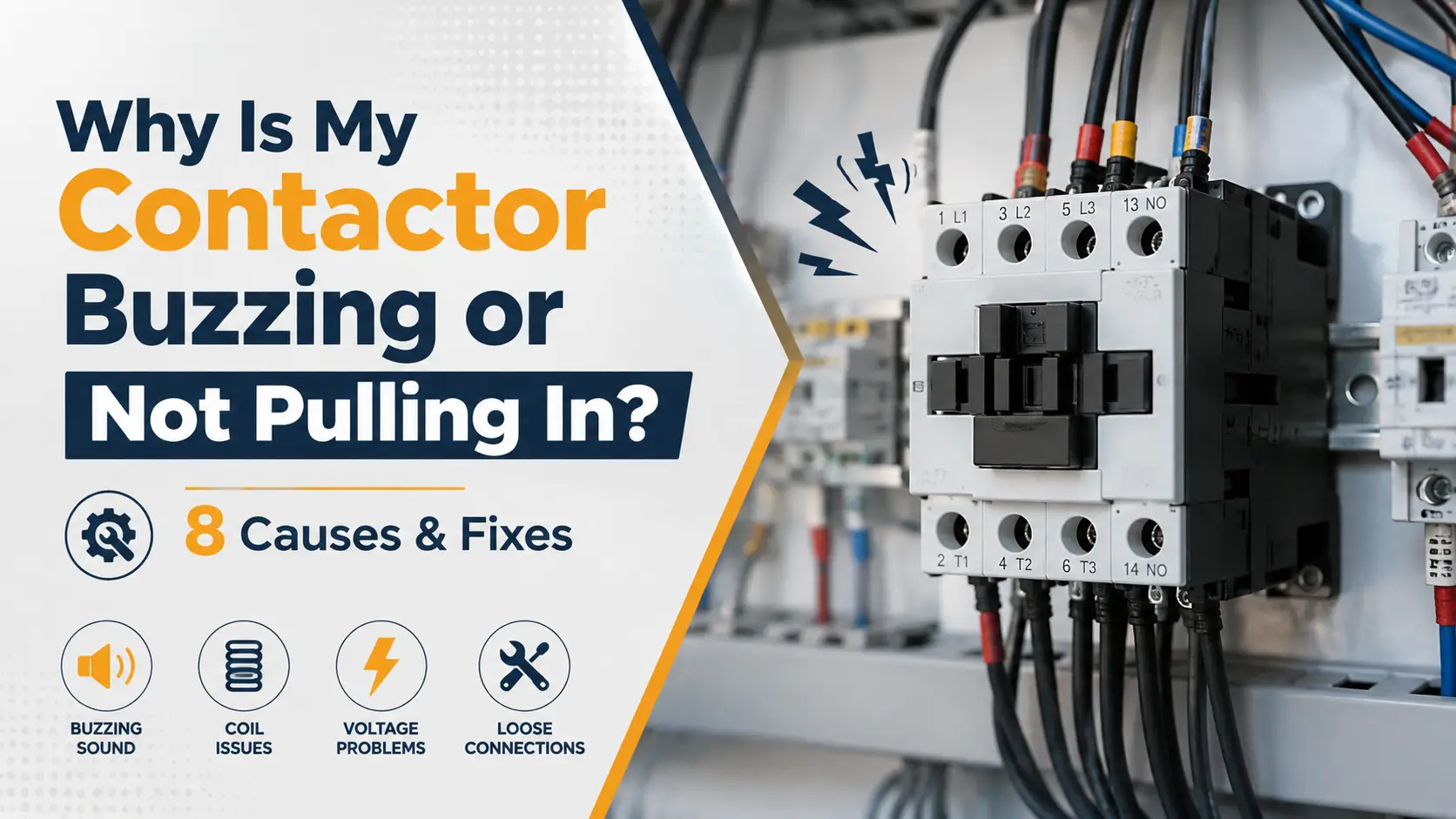
Why Is My Contactor Buzzing or Not Pulling In? 8 Causes & Fixes
A contactor that buzzes, hums loudly, or won't pull in at all is almost never a case of "the contactor is faulty." In the vast majority of call-outs, a contactor not working comes down to one of a handful of causes: low voltage reaching the coil, a worn or dirty magnet face, an armature that's mechanically stuck, or a coil that's simply the wrong voltage for the circuit it's wired into. Swapping the whole contactor without checking these first wastes money and, more often than not, the buzz comes right back on the replacement.
This guide walks through the eight most common reasons a contactor buzzes or fails to pull in, how to check each one safely, and what to do about it — whether you're a maintenance electrician on a call-out or a facilities engineer trying to diagnose a nuisance fault before it strands a line.
Isolate before you touch anything. Every check below assumes the circuit has been isolated, proved dead where you're working on wiring, and that any live measurements (coil voltage under load) are taken by a competent person following your site's safe isolation procedure.
How a Contactor Actually Pulls In
Strip away the contacts and enclosure and a contactor is really just an electromagnet with a spring-loaded mechanical linkage. Energise the coil and it magnetises a fixed E-shaped core; the core pulls a movable armature across a small air gap, and that same armature carries the main contacts, snapping them closed. Cut the coil supply and a return spring pulls everything back open. The buzz you hear on a healthy contactor pulling in is completely normal — it's the brief moment before the armature seats fully home. A buzz that continues, or a unit that hums without ever pulling in, means the magnetic circuit isn't completing properly or isn't getting the pull it needs.
Contactor Anatomy at a Glance
| Component | Role in Pull-In |
|---|---|
| Coil | Generates the magnetic field when energised |
| Fixed core | The stationary E-shaped iron core the coil magnetises |
| Armature | The moving part pulled toward the core, carrying the main contacts |
| Air gap | The distance the armature must close to fully seat |
| Return spring | Pulls the armature back open once the coil is de-energised |
| Main contacts | Close on pull-in to switch the load circuit |
8 Causes of a Contactor Buzzing or Failing to Pull In
Low Coil Voltage
By far the most common cause. If the voltage arriving at the coil terminals is more than about 15% below its rated value, the magnetic pull is too weak to fully close the air gap — the armature gets partway there, chatters, and buzzes instead of seating. This is especially common on long cable runs to remote starters, where volt-drop under load pulls the supply down right at the moment the motor's inrush current is highest. Measure voltage directly at the coil terminals while it's trying to energise, not back at the distribution board — a healthy reading at the board means nothing if it's dropped 20V by the time it reaches the coil.
Loose or High-Resistance Coil Wiring
A loose ferrule, a corroded terminal, or a connection that's backed off after years of vibration all add resistance in series with the coil. The symptom looks identical to low supply voltage because, electrically, it is the same thing — voltage is being dropped across a bad joint instead of reaching the coil. Check every termination in the coil circuit, including the auxiliary contacts of any interlocking relay, before you condemn the contactor itself.
Worn or Pitted Magnet Faces (Shading Ring Damage)
AC contactors use a small copper shading ring embedded in the pole face to keep the magnetic pull smooth across each cycle of the AC waveform — without it, the armature would chatter audibly 100 or 120 times a second. Once a magnet face pits, corrodes, or the shading ring cracks, that classic loud buzz comes back even with perfectly good supply voltage. This is a wear item on high-cycling applications and is usually only fixable by replacing the coil/magnet assembly or the contactor.
Armature Stuck or Binding Mechanically
Dust, oil mist, or corrosion can bind the armature's guide pins just enough that the coil's magnetic pull can't fully overcome the friction. With the contactor isolated and de-energised, you can usually feel this by pressing the armature in by hand — it should move freely and spring back crisply. Sluggish or gritty movement points to a mechanical fault, not an electrical one, and cleaning or replacement is the fix rather than chasing voltage readings.
Wrong Coil Voltage for the Control Circuit
Easy to overlook on a like-for-like swap: a 110V AC coil fitted where the control circuit actually delivers 230V, or a 24V DC coil wired onto an AC control transformer output, will buzz and refuse to seat properly even though every connection is technically correct. Multi-tap coils (common on 400/230/110V-rated contactors) are also a frequent culprit if the tap selector was left on the wrong setting after a previous repair. Always confirm the coil's rated voltage against a multimeter reading of the actual control voltage before assuming either part is defective.
An Interlock Is Blocking Full Pull-In
Mechanically or electrically interlocked contactors (common in reversing starters and automatic transfer switches) are deliberately built so one unit can't fully close while the other is engaged. A mistimed or maladjusted interlock can let the coil energise while the mechanical linkage still partially blocks the armature — producing a buzz that looks electrical but is actually the interlock doing its job at the wrong moment. Check the interlock's mechanical adjustment and the state of any interlocking auxiliary contacts before condemning the coil.
Open or Failed Coil
Less common than the causes above, but straightforward to confirm: an open-circuit coil (from an internal winding failure, often after a prolonged overvoltage or a previous partial pull-in event that overheated it) will show as infinite resistance on a multimeter and won't energise at all — no buzz, no attempt to pull in. A shorted coil, by contrast, usually trips its protective device or blows a fuse in the control circuit almost immediately. Either way, coil resistance measured with the unit isolated and disconnected is a quick way to rule this in or out.
Weak or Failing Control Transformer / PLC Output
Where the coil is powered from a control transformer or a PLC output card rather than directly from the supply, a transformer that's overloaded, wired to the wrong tap, or simply undersized for the number of coils it's feeding can sag under load exactly the way a long cable run does. The same applies to a PLC digital output driving a coil through an interposing relay — a tired relay or a marginal 24V supply on the output card produces the same low-voltage buzz as any other weak source. Load-test the transformer or supply while the coil is actually trying to pull in, not on open circuit.
Quick Reference: Symptom, Likely Cause & What to Check
| Symptom | Most Likely Cause | Quick Check |
|---|---|---|
| Loud, continuous buzz; armature never fully seats | Low coil voltage or high-resistance wiring | Measure voltage directly at coil terminals under load |
| Buzz has developed gradually over months/years | Worn magnet face or damaged shading ring | Inspect pole faces for pitting; listen for pitch change |
| Coil energises (you can hear/feel a click attempt) but contacts don't fully close | Mechanically stuck or binding armature | De-energise, isolate, and check armature moves freely by hand |
| No sound or movement at all when commanded | Open coil, or no voltage reaching the coil circuit at all | Coil resistance check with multimeter; confirm upstream supply |
| Works fine alone, fails only when a second contactor is also commanded | Interlock timing or maladjustment | Check mechanical interlock adjustment and interlock aux contacts |
| Intermittent buzz that comes and goes with plant load | Control transformer or shared 24V supply sagging | Load-test the transformer/PSU while the coil is energised |
Fault-Finding Flow: From Buzz to Fix
Is coil voltage at the terminals in spec while it's trying to energise?
NoCheck upstream wiring, terminals, transformer or PLC output loading.
YesMove to step 2.
Does the armature move freely by hand when de-energised?
NoClean/free the mechanism; check for corrosion or weld debris.
YesMove to step 3.
Final check
Inspect the magnet face & shading ring, and confirm the coil's voltage rating matches the circuit.
Frequently Asked Questions
Is a buzzing contactor dangerous, or can I leave it running?
A contactor that's chattering rather than fully seating is running its contacts hot and wearing its magnet face faster than normal — left long enough, it can weld the contacts closed or fail to drop out on demand, which is a genuine safety issue on a motor circuit. Treat a persistent buzz as a fault to fix promptly, not background noise to tolerate.
Why does my contactor buzz only when the motor starts, not at other times?
This points strongly at voltage sag under load rather than a contactor defect — motor starting current pulls the supply down right when the coil most needs full voltage to complete pull-in. Check cable sizing and connections on the run feeding the starter, and load-test the control transformer if one is used.
Can I just replace the coil instead of the whole contactor?
On most industrial contactors, yes — coils are a standard replaceable part and it's the far cheaper fix if the coil itself has failed or is the wrong voltage. It only solves the problem if the coil was actually the fault; if the real cause is a worn magnet face or upstream voltage drop, a new coil will buzz too.
What's a normal contactor sound versus a fault?
A brief, single "clunk" or short buzz lasting a fraction of a second as the armature seats is completely normal. A continuous hum, a buzz that repeats or chatters, or one that's noticeably louder than when the unit was new are all signs worth investigating.
Does contactor size (AC1 vs AC3 rating) affect how likely this is to happen?
Not directly — buzzing and pull-in problems are almost always about the coil circuit and magnetic mechanism, not the contact rating. However, contactors selected too close to their AC3 rating for a heavy motor-starting duty do see faster magnet face wear from more frequent, harder pull-ins, which brings cause #3 forward sooner in the unit's life.
How do I know if it's the control transformer and not the contactor?
Measure the transformer's secondary voltage with the coil load connected and actually trying to energise, not on open circuit — a transformer that reads correctly unloaded but sags once the coil (and any others sharing it) draw current is the giveaway, and the fix is upsizing the transformer or reducing the number of coils it feeds.
Related Reading
Contactors are rarely specified in isolation — a motor starter circuit typically pairs a contactor with an overload relay and an upstream circuit breaker, so it's worth checking those components too if a "contactor fault" doesn't resolve cleanly:
Shop the Parts
| Product | Use | Link |
|---|---|---|
| ABB B6 Contactor, 24V DC coil, 3-pole, 9A | Direct replacement for small motor starters and control circuits | View product → |
| ABB AF09 Contactor, 230V AC coil, 4-pole | General-purpose switching and small motor loads | View product → |
| ABB AF16 Contactor, 250V AC/DC coil, 3-pole, 105A | Heavier motor starting duty (up to 75kW) | View product → |
| Full contactor range | Browse by coil voltage, pole count and AC3 rating | Browse contactors → |
| Contactor relays & auxiliaries | Interposing relays and auxiliary contact blocks for interlocking | Browse contactor relays → |
| All genuine ABB products | Contactors, MCBs, drives and switchgear from the same manufacturer | View all ABB products → |
Note: a labelled photo of a real removed contactor (magnet face and armature visible) would strengthen this article further — happy to add one from your own stock photography if you have a suitable shot.
Disclaimer: ABB, and any other manufacturer or brand names referenced in this article, are used solely for identification and compatibility purposes. Z&F Corporation is not affiliated with, authorised by, or an official representative of these manufacturers; all trademarks are the property of their respective owners.