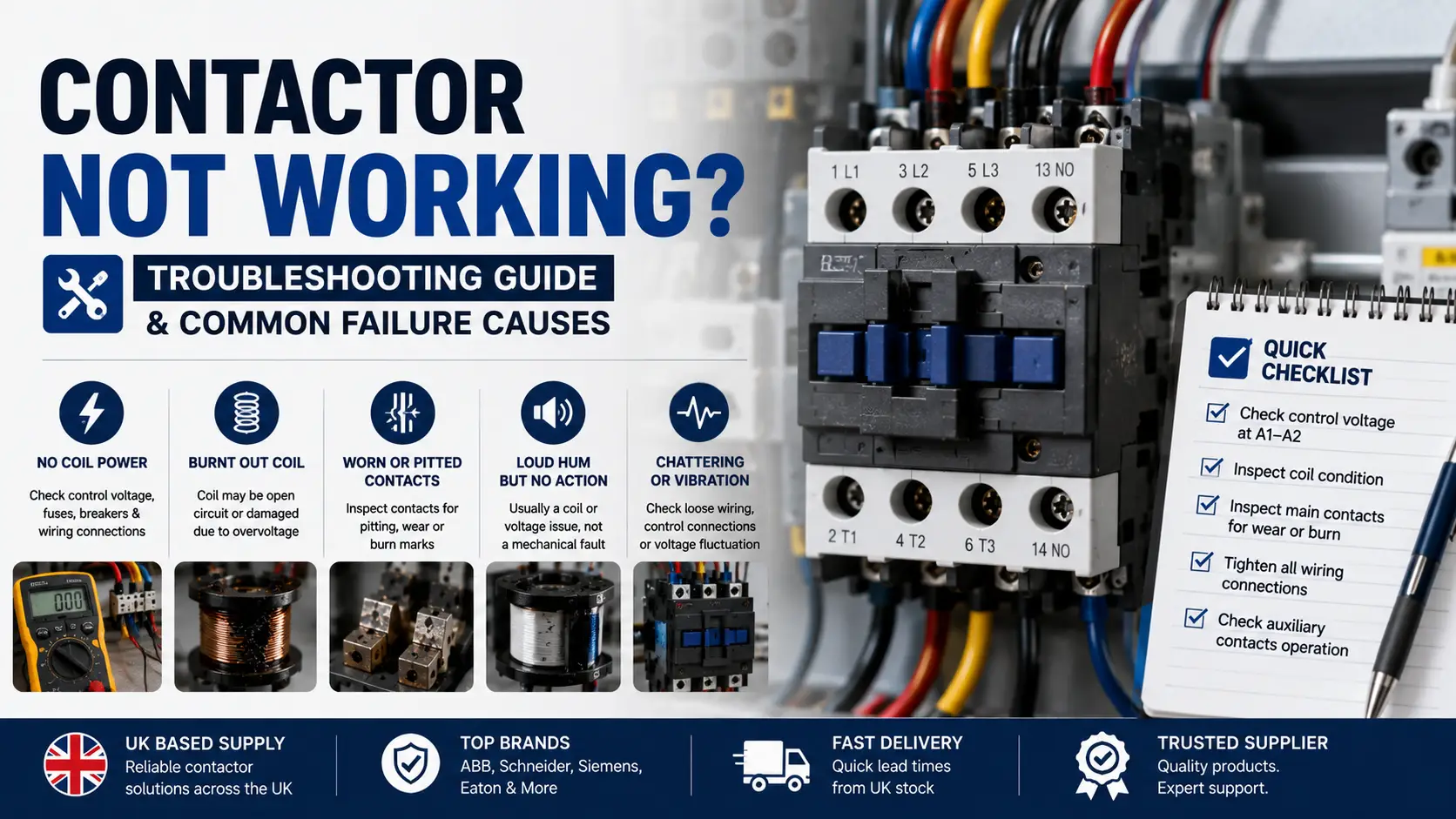
Contactor Not Working? Troubleshooting Guide & Common Failure Causes
A contactor that won't pull in, won't drop out, or trips its overload without an obvious reason is one of the most common electrical call-outs on a UK production line. Because a contactor sits between the control circuit and the motor or load it's switching, a fault can look electrical, mechanical, or thermal depending on where in the device it actually originates. This guide walks through the most common failure symptoms, how to diagnose the root cause safely, and when it's more cost-effective to replace the unit than repair it.
Need help specifying or sourcing a replacement contactor for your site?
ZF Corporation Supplies
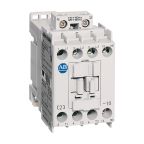
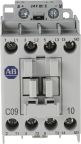
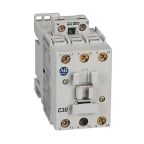
Allen-Bradley 100-C Series Contactors — In Stock for UK Delivery
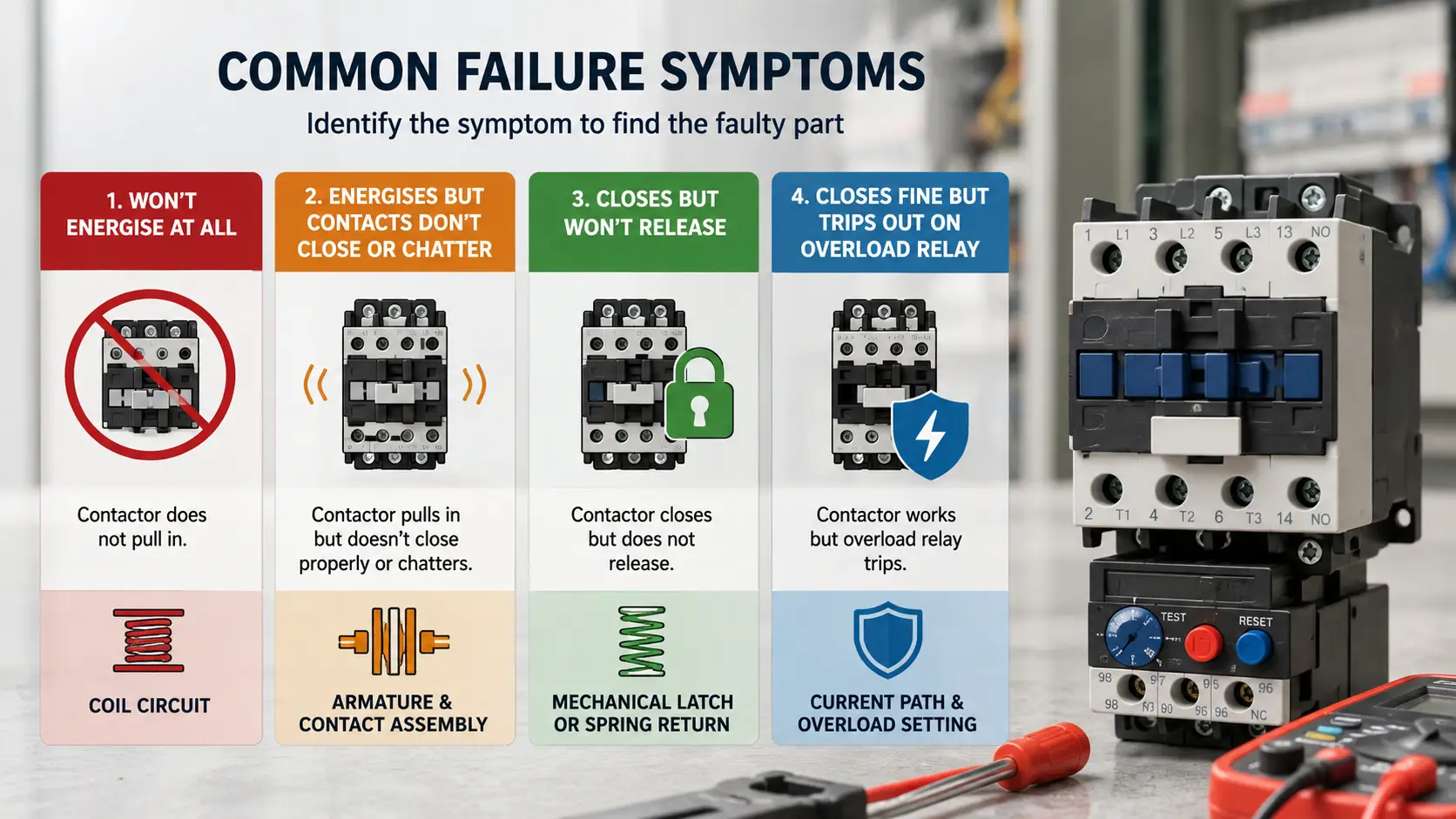
Common Failure Symptoms
Most contactor faults reported by maintenance teams fall into one of four buckets: the contactor won't energise at all, it energises but the contacts don't close (or close and immediately chatter), it closes but won't release, or it closes fine but trips out downstream on the associated thermal overload relay. Each of these points to a different part of the device — the coil circuit, the armature and contact assembly, the mechanical latch or spring return, or the current path and overload setting — so the first job is narrowing down which bucket you're actually in before reaching for a multimeter.
Root Cause Diagnosis
Chattering or buzzing on pull-in is almost always a coil voltage problem: either the supply voltage sagging under load (common on long control cable runs), a coil rated for the wrong voltage, or a worn magnet face that no longer seats flush. A contactor that doesn't pull in at all should be checked in this order: confirm control voltage is present at the coil terminals, check the coil itself for continuity (an open coil reads infinite resistance), then check any interlocking auxiliary contacts or safety circuit that may be holding the coil circuit open. Contacts that are pitted, burnt, or welded together are usually caused by repeated switching of an inrush current that exceeds the contactor's rated making capacity — motor starting current can be six to eight times full-load current, so a contactor sized on running current alone will wear its contacts far faster than one sized correctly for AC-3 motor duty. A contactor that closes but won't drop out is most often a mechanically welded contact from sustained overcurrent, or a return spring that has fatigued after years of cycling.
Symptom | Likely Cause | Recommended Fix |
|---|---|---|
Contactor won't energise | No coil voltage, open coil, or interlock holding circuit open | Verify control voltage at coil, test coil continuity, check interlocks/E-stops |
Loud buzzing or chatter on pull-in | Low coil voltage, worn magnet face, wrong coil rating | Check supply voltage under load, inspect magnet face, confirm coil voltage matches control supply |
Contacts pitted or burnt | Contactor undersized for motor starting (AC-3) duty | Re-size to correct AC-3/AC-4 utilisation category and rated operational current |
Contacts welded shut | Sustained overcurrent, undersized contactor, or repeated inching duty | Replace contactor; review overload relay setting and duty cycle |
Won't drop out after de-energising | Welded contacts or fatigued return spring | Isolate and replace; do not attempt to free welded contacts live |
Trips associated thermal overload relay | Overload relay mis-set, genuine motor overload, or single-phasing | Verify overload setting against motor FLC, check all three phases for balance |
Excessive coil heat or humming | Coil voltage above rated tolerance, or shorted turns | Measure actual coil voltage, replace coil/contactor if outside ±10% rating |
Step-by-Step Fix
Before opening any contactor, isolate and lock off both the control supply and the load-side supply — contactors switch line voltage on one side and control voltage on the other, and both need to be dead. Once isolated, visually inspect the main contacts for pitting, discolouration, or welding; light pitting is normal wear and doesn't need action, but any contact that is visibly welded or has lost significant material should be replaced rather than filed down, since filing changes the contact geometry and accelerates further wear. Check the coil resistance against the datasheet value with a multimeter — an open circuit or a reading well outside tolerance confirms a failed coil. If the mechanical assembly (armature, springs, contact carrier) looks intact and the coil tests correctly, re-energise briefly with the load isolated to check for correct armature travel and a clean, single pull-in — any hesitation or double-tap on pull-in indicates the unit should still be replaced even if it "works," since it's a sign the magnet face or spring tension is already degrading.
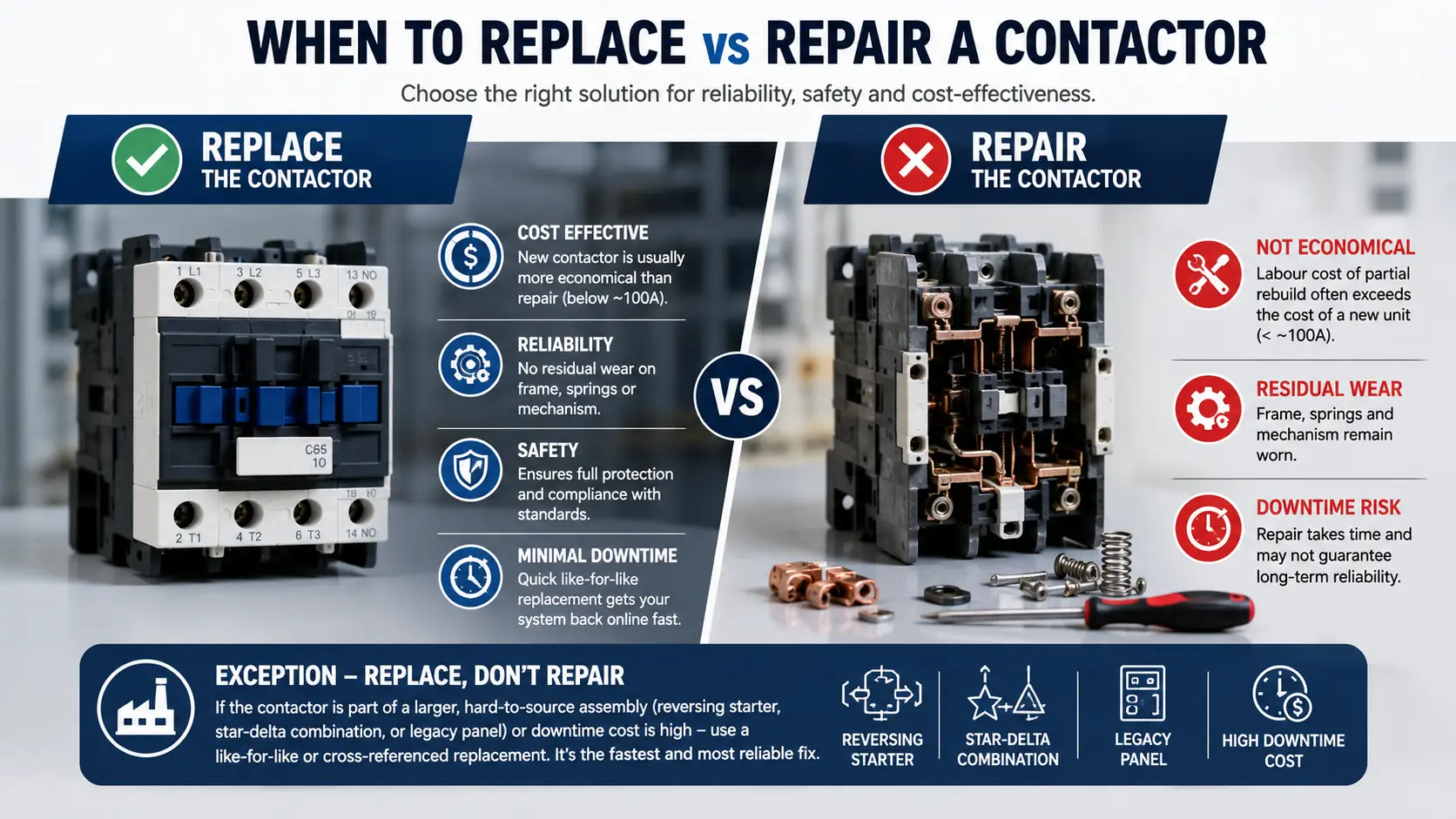
When to Replace vs Repair
Contactors are not generally economical to repair in an industrial setting — replacement contact kits exist for some larger frame sizes, but the labour cost of a partial rebuild, plus the residual mechanical wear on the frame and spring assembly, usually exceeds the cost of a new unit for anything below around 100A. The exception is where a contactor is part of a larger, harder-to-source assembly (a reversing starter, a star-delta combination, or a legacy panel where downtime cost is high) — in those cases a like-for-like or cross-referenced replacement contactor is normally the fastest and most reliable fix.
Category | Typical Use With Contactors | Link |
Contactors | Full range of AC/DC coil, pole count and rated current combinations | |
Thermal Overload Relays | Paired with a contactor to form a direct-on-line motor starter | |
Auxiliary Contacts | Add extra NO/NC contacts for interlocking and indication | |
Busbars | Distribution ahead of contactor banks in MCC and panel builds |
Frequently Asked Questions
What is a contactor used for?
A contactor is an electrically controlled switch used to switch a motor or other load on and off, typically many times a day, using a low-power control signal to switch a much higher-power circuit.
How do I choose between Allen-Bradley and ABB contactors?
Both are widely used in UK industrial installations; the practical decision usually comes down to matching the existing panel's other components (many sites standardise on one brand for spares commonality), coil voltage availability, and rated operational current for AC-3 motor duty.
What standards apply to contactors (UL 489)?
Industrial contactors are typically tested to IEC 60947-4-1 for utilisation categories such as AC-3 (motor starting/stopping) and AC-4 (plugging/inching); UL 489 applies more specifically to circuit breakers used in North American installations and is referenced here mainly for cross-border equipment specifications.
Can ZF Corporation source obsolete or discontinued contactors?
Yes — we regularly cross-reference discontinued contactor part numbers, including legacy Allen-Bradley and ABB frame sizes, to current equivalents for panel repairs where the original unit is no longer manufactured.
What is the typical lead time for a contactor in the UK?
Common frame sizes and coil voltages are typically available from stock; less common ratings or cross-referenced obsolete equivalents may carry a short lead time — contact us with the exact part number or specification for a quote.
Conclusion
Most contactor failures trace back to one of three things: a coil circuit fault, contacts worn by an inrush current the unit wasn't sized for, or a mechanical assembly that's simply reached the end of its cycle life. Diagnose methodically, isolate before you inspect, and replace rather than repair once contacts show real wear.
Need a quote or help cross-referencing an existing contactor?
Talk to Our Technical Support Team
DISCLAIMER: Z&F Corporation is not affiliated with, authorized by, endorsed by, or acting as an official representative of any manufacturer, brand, or trademark owner referenced on this website. All product names, trademarks, brand names, logos, and manufacturer references are the property of their respective owners and are used solely for identification, reference, and compatibility purposes.