Industrial Flow Meters and Pressure Gauges for Libya Industries
Whether they are in the oil fields of the Sirte Basin, the refineries at Ras Lanuf or water treatment plants throughout Tripoli and Benghazi, an accurate flow meter pressure gauge can depend on Libya Sudan suppliers to ensure safe and efficient process operations. From crude oil custody transfer to plant pressure management to pipeline pressure monitoring and desalination flow monitoring, it's the flow meters pressure gauges Libya Sudan buyers that determines the accuracy, safety, and reliability of the plant. This guide provides an overview of flow meter and pressure gauge technologies, international standards, applications, calibration practices and how to objectively assess suppliers using specification-based criteria.
Looking for a price quote for a flow meter or pressure gauge at your site?
What Are Industrial Flow Meters and Pressure Gauges?
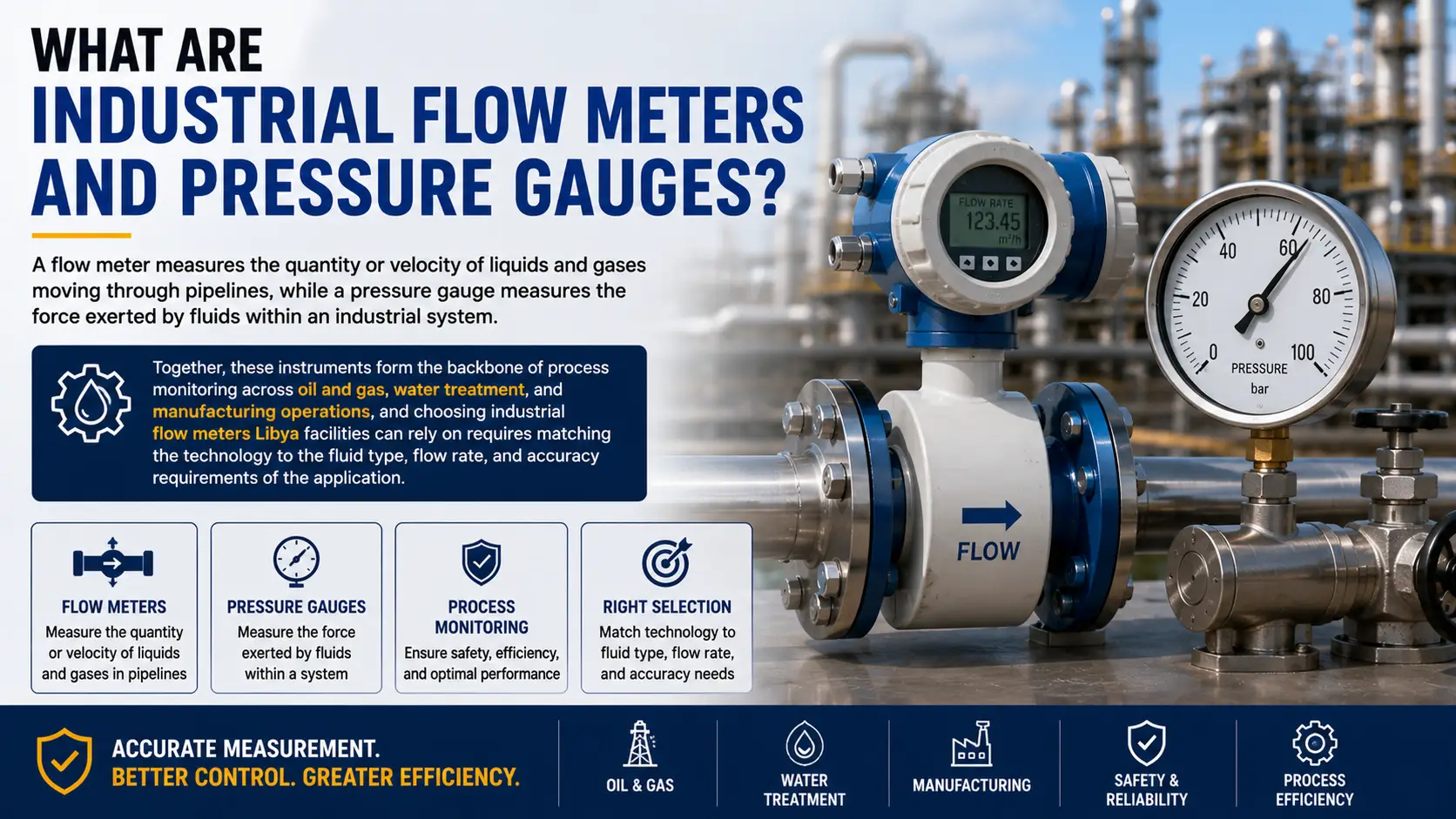
The flow meter is used for measuring the amount or speed of liquids and gases passing through a pipeline, and the pressure gauge is used to measure the force that the liquids put against a pipeline in an industrial system. These instruments are the backbone of process monitoring in the oil and gas industry, water treatment and manufacturing processes, and appropriate selection of industrial flow meters Libya for use in these facilities involves matching the type of fluid, flow rate, and accuracy required to the type of fluid meter.
Why Accurate Process Measurement Matters
Misreading flow or pressure can cause product loss, safety issues, non-compliance with regulations and expensive unplanned shutdowns. Even in the smallest of measurement applications, the operators of flow meters and pressure gauges in custody transfer applications ensure that the equipment is chosen and calibrated on recognized international standards, not on convenience or cost.
Types of Industrial Flow Meters
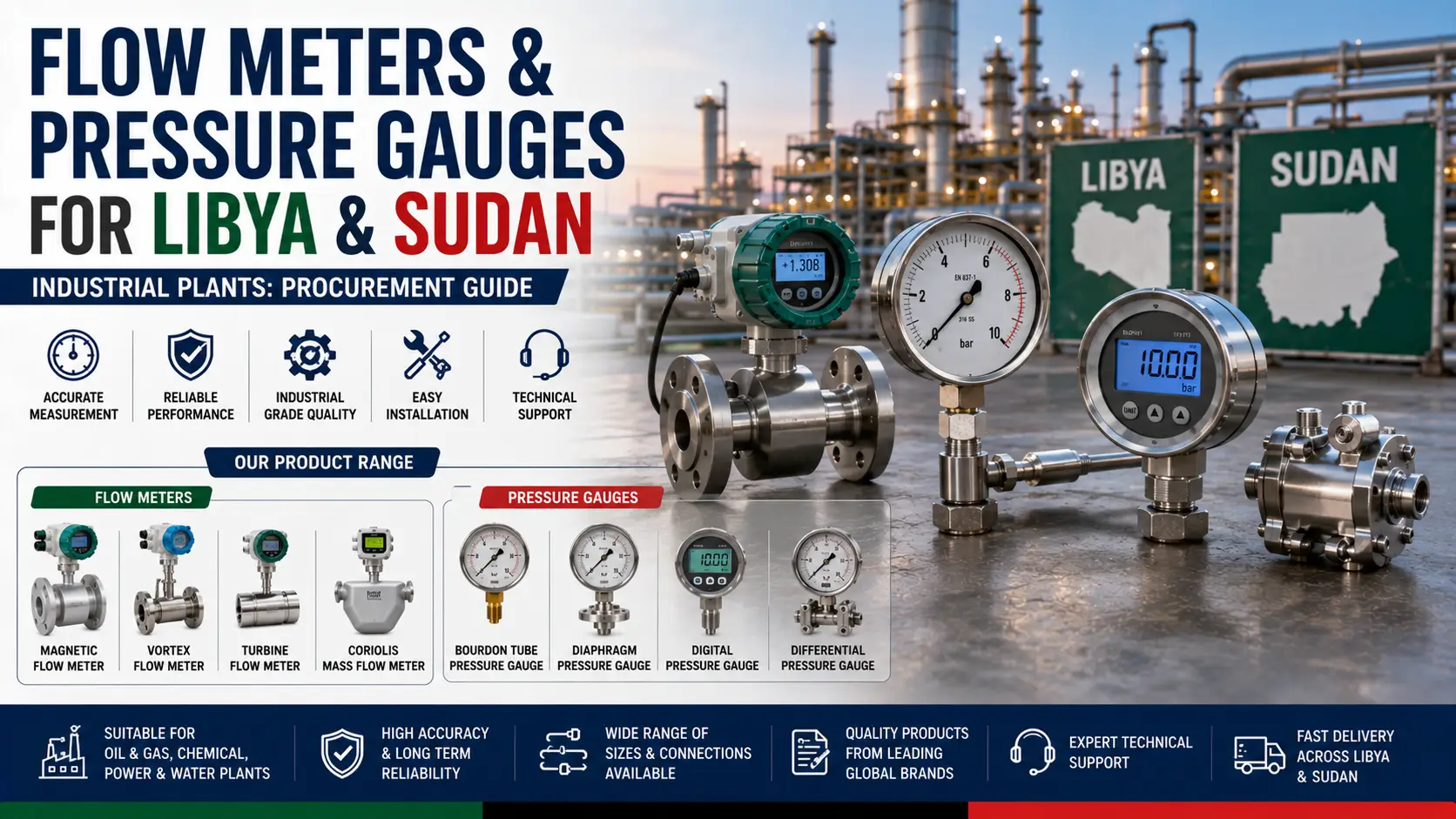
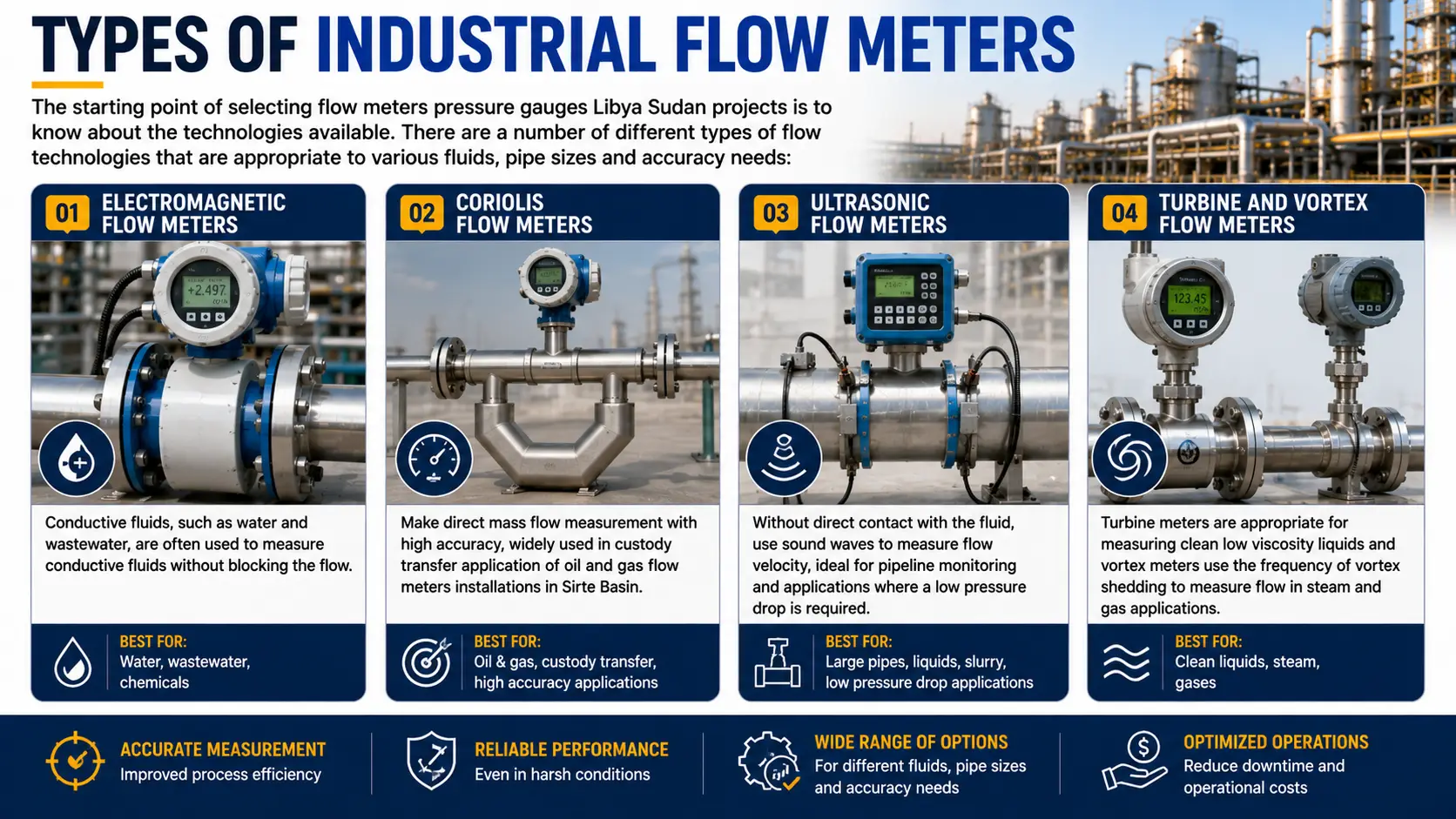
The starting point of selecting flow meters pressure gauges Libya Sudan projects is to know about the technologies available. There are a number of different types of flow technologies that are appropriate to various fluids, pipe sizes and accuracy needs:
Electromagnetic Flow Meters
Conductive fluids, such as water and wastewater, are often used to measure conductive fluids without blocking the flow.
Coriolis Flow Meters
Make direct mass flow measurement with high accuracy, widely used in custody transfer application of oil and gas flow meters installations in Sirte Basin.
Ultrasonic Flow Meters
Without direct contact with the fluid, use sound waves to measure flow velocity, ideal for pipeline monitoring and applications where a low pressure drop is required.
Turbine and Vortex Flow Meters
Turbine meters are appropriate for measuring clean low viscosity liquids and vortex meters use the frequency of vortex shedding to measure flow in steam and gas applications.
Types of Pressure Gauges
There are various factors that influence the choice of pressure gauge, such as type of process fluid, the accuracy required and whether a local indication or remote data integration is needed:
Bourdon Tube Pressure Gauges
This is the most common mechanical gauge design, working on the principle that pressure causes the curved tube to bend in a predictable manner and it is reliable, inexpensive and has been used in a wide range of general industrial uses.
Digital Pressure Gauges
Compared to analog designs, higher accuracy, data logging and diagnostics are offered with digital pressure gauges, plus remote communication protocols that make them easy to integrate with SCADA and process control systems.
Differential Pressure Gauges
In refineries, calculate pressure difference between two points, typically for flow measurement, filter monitoring and tank level measurement applications in a differential pressure gauge.
Applications Across Libya's Industries
The need for flow meters pressure gauges Libya Sudan facilities extends across multiple industry and energy industries that are vital to the economy in the region:
The oil basin of Sirte includes oil production and custody transfer metering.
Pressure monitoring in re-refinery pipelines in Ras Lanuf & Zawiya
The meter is used to measure the flow of water desalination and water distribution to towns and is used for water desalination flow measurements and urban water flow measurement.
Process control for petrochemical processes
Pressure monitoring systems for power generation and utilities.
Field instrumentation for oilfield wells and pipelines
How to Select the Right Instrument
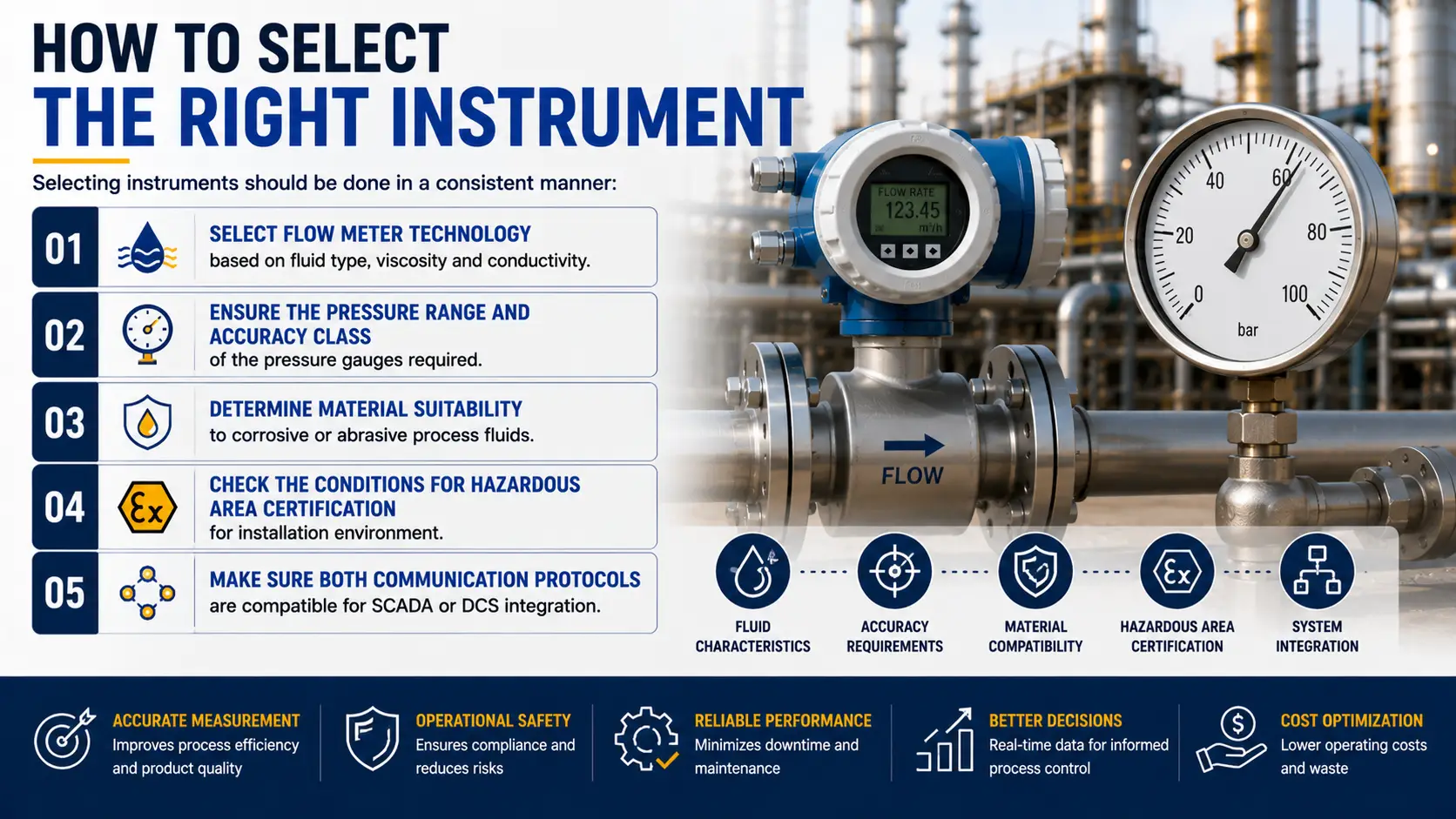
Selecting instruments should be done in a consistent manner:
Select flow meter technology based on fluid type, viscosity and conductivity.
Ensure the pressure range and accuracy class of the pressure gauges required
Determine material suitability to corrosive or abrasive process fluids
Check the conditions for hazardous area certification for installation environment.
Make sure both communication protocols are compatible for SCADA or DCS integration
International Standards and Certifications
When selecting the best pressure gauge suppliers Libya and flow meter, buyers need to check that they adhere to accepted standards. General instrumentation performance is quantified according to ISO and IEC standards, while API Recommended Practices are used for the custody transfer and oil and gas measurement processes. IECEx or ATEX certification confirms suitability in hazardous and explosive environments typical in upstream and refinery applications.
Standard / Certification | Relevance |
ISO / IEC | General instrumentation performance and testing standards |
API Recommended Practices | Custody transfer and oil & gas flow measurement accuracy |
ASME | Pressure measurement device design and safety standards |
IECEx / ATEX | Hazardous area and explosion-proof equipment certification |
OIML | Legal metrology requirements for custody transfer applications |
Installation Best Practices
Flowmeters pressure gauges are installed in Libya Sudan facilities, which directly influence long term accuracy of the measurement:
Install flow meters with good straight pipe runs before and after flow meter installation.
To position pressure gauges away from areas of high vibration, if possible.
Use isolation valves and snubbers to prevent pressure spikes to gauges
Check orientation and grounding requirements of electromagnetic flow meters
Before commissioning, check wiring and communication protocol compatibility.
Calibration and Preventive Maintenance
Most manufacturers indicate that calibration should be performed every 6-12 months, depending on the operating environment, but in harsh desert conditions where there is dust, heat and vibration the frequency of calibration may be increased to, for example, once every 6 months.
Perform regular calibration with traceable reference standards
Check for corrosion, clogging and mechanical wear at service inspections
Record calibration records for regulatory and quality assurance purposes
Replace any worn seals, diaphragms and sensing elements in advance.
Common Instrumentation Problems
Damage due to overpressure caused by lack of or inadequate pressure snubbers
The measurement drift due to inadequate routine calibration
Abradable or corrosive fluids can cause corrosion or clogging in gauges.
The mechanical wear in the Bourdon tube gauge caused by vibration.
Problems with communication due to incompatible SCADA protocol set up
Choosing an Industrial Instrumentation Supplier
When choosing a reliable industrial instrumentation Libya projects can rely on, it's not enough to just consider catalog price. Consider certifications, calibration, engineering support, stock, and warranties when you buy. Flow and pressure instruments are often used with control valves, so our Valves Article addresses the selection of valves for use with compatible process control, and our complete Instrumentation Pillar resource provides information about the sensor technologies and standards for all types of measurement. If you need to understand more about sourcing for the oil and gas sector, our Oil & Gas Page has a range of oil and gas sector sourcing considerations.
Frequently Asked Questions
Which Flow meter is suitable for crude oil?
A Coriolis flow meter is used to measure crude oil and is an excellent choice for measurement accuracy in custody transfer applications.
In a high pressure system which pressure gauge is suitable?
High pressure industrial systems typically make use of Bourdon tube gauges rated for the pressure class of the specific system, usually in conjunction with a snubber.
How often must an industrial instrument be calibrated?
Typically, calibration is recommended every 6-12 months, depending on the manufacturer's instructions, but more often if operating conditions are severe.
How can flow meters fit into SCADA?
Yes, the majority of modern industrial flow meters are modular and can communicate with SCADA via Modbus, HART, Profibus or Ethernet.
What are the necessary qualifications?
Depending on the application, hazardous area classification, and other factors, it is common to find these certifications: ISO, ASME, API, ATEX and IECEx.
What factors contribute to the inaccuracies in flow measurements?
Inaccurate readings are often due to improper installation, insufficient straight pipe runs, calibration drift and changes in fluid properties.
What benefits do digital pressure gauges offer when it comes to maintenance?
Digital gauges provide the ability to log data, diagnose faults and provide remote monitoring, allowing for predictive maintenance instead of reactive maintenance.
Which materials are anti-corrosion?
Common materials used for corrosive fluid applications include 316 stainless steel, Hastelloy, Monel and PTFE lined parts.
Seek Instrumentation Sourcing Assistance
Looking for pressure gauges and flow meters for your oil and gas, water treatment, or industrial process control applications in need of in Libya, Sudan? The team is an independent sourcing team that can assist you in choosing instrumentation from various manufacturers that meets all your fluid types, accuracy needs and certification needs and is standards compliant. For related procurement resources, check our Instrumentation Pillar, Valves Article and Oil & Gas Page.
Have professional advice on choosing instruments for your facility.
Discuss the issue with Our Specialist.
DISCLAIMER: Z&F Corporation is not affiliated with, authorized by, endorsed by, or acting as an official representative of any manufacturer, brand, or trademark owner referenced on this website. All product names, trademarks, brand names, logos, and manufacturer references are the property of their respective owners and are used solely for identification, reference, and compatibility purposes.