Gear Pump vs Diaphragm Pump for Chemicals: Which is Better?
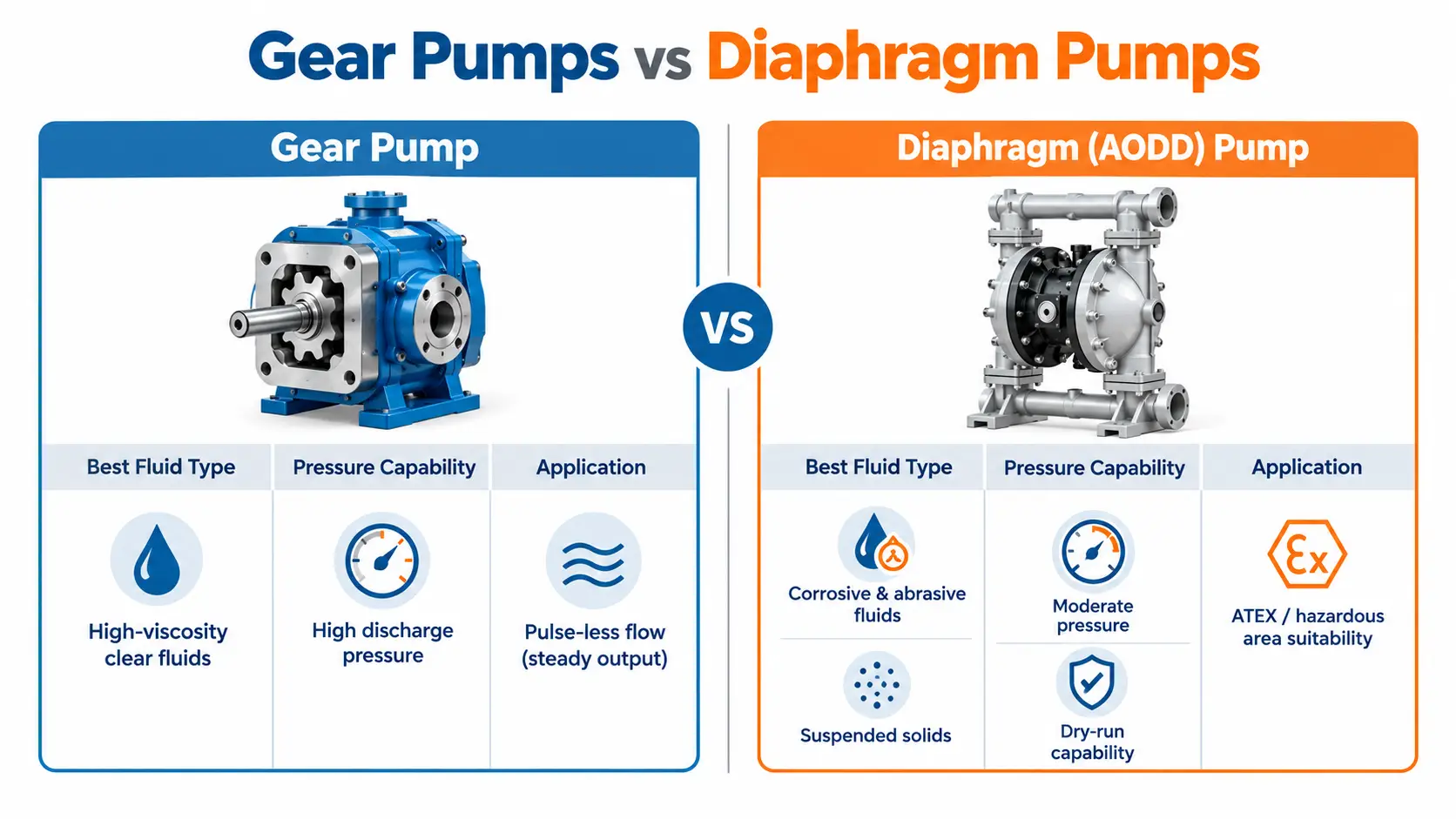
Which is better for chemical transfer? No single pump is the clear winner on all jobs. Thick viscous liquids such as resins and polymers are pushed smoothly and without pulsations with the aid of gear pumps. Diaphragm pumps (particularly AODD type) are more suitable for aggressive acids, shear sensitive fluids and abrasive slurries due to the seal-less construction that avoids the risk of dry running and shaft leakage.
Looking for positive displacement pumps for your chemical process line? Get a technical quote that is custom-made for your specific chemical, viscosity and flow needs.
Gear Pump vs Diaphragm Pump for Chemicals: The Engineering Reality
When three plant engineers at a chemical plant on Teesside or Grangemouth are asked which pump architecture is better, they will probably give three different answers. It all revolves around fluid mechanics. The decision of whether to use a gear pump vs diaphragm pump for chemicals is not one of the "best pump" but rather one of "best fluid selection to mechanical design.
Both designs fall under the family of positive displacement pumps, meaning they displace a set volume of fluid with every revolution or stroke. However, how they deal with fluid viscosity, internal shearing and harsh fluids can be vastly different. To keep the tolerances of a gear pump in an abrasive slurry intact, it takes days, and an un-dampened diaphragm pump will ensure that the resin is not metered with consistent dosing pulses. Let's see how they compare side-by-side.
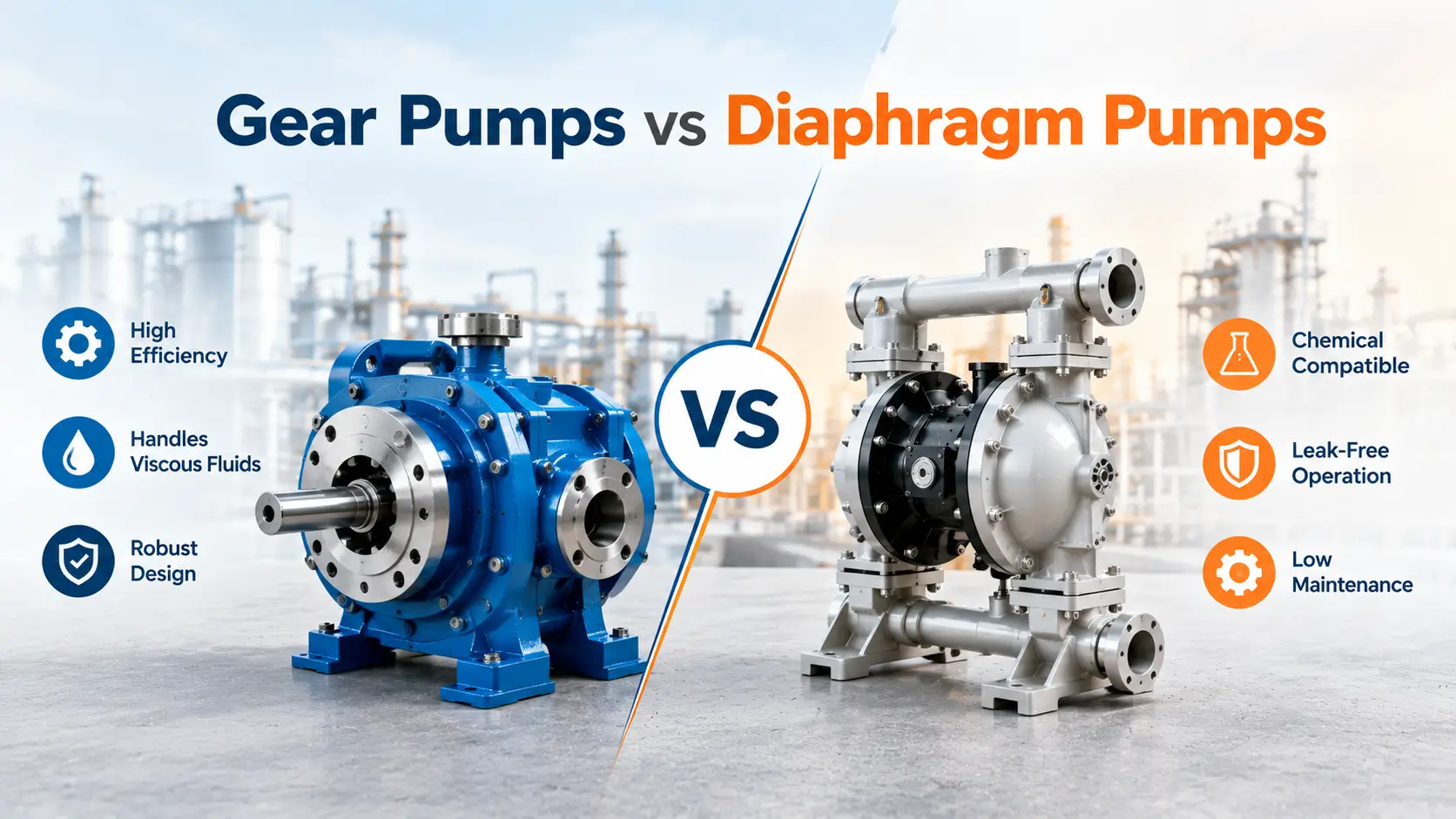
Quick Comparison: Gear Pumps vs Diaphragm Pumps
In the absence of individual mechanical designs, here is how the two technologies operate with respect to some key chemical process parameters:
Parameter | Gear Pump (Internal / External) | Diaphragm Pump (AODD / Electric) | Best Technology Choice |
|---|---|---|---|
Flow Profile | Smooth, continuous, pulse-free | Pulsating (requires pulsation dampener) | Gear Pump for metering |
Viscosity Range | Exceptional (up to 1,000,000+ cSt) | Moderate (up to 20,000 cSt) | Gear Pump for thick media |
Shear Sensitivity | High shear (interlocking teeth) | Low shear (gentle fluid displacement) | Diaphragm Pump for polymers |
Dry Running | Cannot run dry (gear wear / seal failure) | Can run dry indefinitely without damage | Diaphragm Pump for reliability |
Solids & Slurries | Clean fluids only (particles jam gears) | Handles solids, grit, and abrasives easily | Diaphragm Pump for slurries |
Leak Containment | Requires mechanical seals or magnetic drive | Seal-less design (zero dynamic shaft seals) | Diaphragm Pump for toxic acids |
If you're evaluating complete skid setups, browse our catalog of industrial chemical pumps engineered for heavy process plant service.
How Gear Pumps Excel in Chemical Transfer
Gear pumps are explained by the fact that gears, whether internal or external, are connected in a tight tolerance casing. When the teeth of the gears on the suction side unmesh they form a vacuum which sucks the liquid in. The fluid circulates around the outside of gears between the grooves on the output side of the gears, being pressed out by the gears.
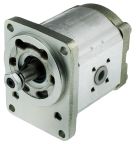
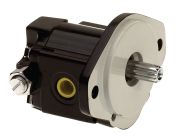
No check valves or reciprocating diaphragms mean that the output flow is completely smooth and linear. This makes gear pumps the preferred option for additive dosing, pumping of thick polymers and the pumping of very viscous oils and resins. When building compact hydraulic or chemical dosing skids, engineers often specify precision units like a Rexroth hydraulic gear pump or a compact Parker 8 cm³ gear pump for steady, repeatable fluid displacement.
Tight mechanical clearances, however, is a major weakness of gear pumps. Grit or abrasive particles in the fluid will cause the gear teeth and casing walls to be worn, which will result in slip and rapid pressure drop. In addition, if a gear pump is operated without a fluid for even brief periods, the internal bushings will overheat and mechanical seals will be damaged. For robust chemical processing lines, many UK operators rely on the proven Johnson Pumps range of internal gear and rotary lobe units.
Why Diaphragm Pumps (AODD) Lead in Hazardous Service
Air-Operated Double Diaphragm (AODD) pumps operate using an entirely different physical principle. The compressed air is alternately forced against two elastically mounted diaphragms connected to each other by a central shaft. While one diaphragm is pushing fluid out through a ball check valve, the other diaphragm is pulling new liquid in through the other check valve.
This is the main benefit, and that is “seal-less” made. No rotating shaft which passes through a stuffing box or mechanical seal, so there is no risk of chemical leakage onto the surrounding plant floor. The fluid will remain in the air section manifold if a diaphragm is worn out. Diaphragm pumps are suitable for the transfer of aggressive acids, solvents and volatile organic compounds (VOCs) that are not compatible with seals.
For low-volume, high-precision chemical dosing where air lines aren't available, an electric unit like the ProMinent electric diaphragm pump delivers exact stroke metering. For larger bulk transfer jobs from IBCs or drums, a compressed-air driven ProMinent AODD diaphragm pump provides self-priming capability and safe dry-running protection.
Decision Framework: Which Pump Should You Choose?
When you need to choose between gear or diaphragm pump for your particular chemical skid, stick to this easy practical guideline:
Choose a Gear Pump if:
For inline chemical metering and/or coating lines, a steady, pulseless flow is required.
Your fluid is clear, free of solids and is of high viscosity (>500 cSt) such as resins, glues or heavy oils.
Accurate discharge pressure up to 20+ bar – without pulsation dampener.
Choose a Diaphragm Pump (AODD) if:
You're working with corrosive acids, bases or hazardous liquids where leakage of the seal is not tolerated.
The fluid in your system contains suspended solids, abrasive slurries, or shear sensitive polymers.
Pump may dry out or must pump from a buried tank or drum.
Working in a hazardous area (ATEX Zone 1 or 2) that requires intrinsically safe air power.
To see how these designs compare to dynamic centrifugal options, review our positive displacement pump guide.
UK Site Safety & ATEX Compliance
The chemical processing plants from Humber refineries to Ellesmere Port chemical complexes all have to follow strict environmental and safety requirements. Pump casings used at pressures greater than 0.5 bar are covered by Great Britain's Pressure Equipment (Safety) Regulations 2016 (PE(S)R).
In environments where flammable solvents or hazardous gas atmospheres are present, the natural choice for an effective pump is the AODD diaphragm pump which is powered by compressed air and has no risk of electrical sparking, thus ensuring ATEX compliance. If you're also running Site Drainage, Sumps or Waste Water Pits in addition to your process skids, check out our guide to submersible drainage pumps for heavy utility handling.
Frequently Asked Questions (FAQ)
Can a gear pump run dry?
No. Gear pumps use the fluid being pumped for lubrication of the internal gear teeth and shaft bushings. Friction heat, bushing seizure and mechanical seal failure occur any time a gear pump is run dry, even for a few minutes.
Why are diaphragm pumps better for shear-sensitive chemicals?
Diaphragm pumps gently force fluid to flow through a large internal chamber with a flexing membrane, and have low internal fluid shear. The high shear between the meshing teeth generated by gear pumps may introduce damage to the sensitive polymer chains.
Do diaphragm pumps require pulsation dampeners?
No, for a general transfer. If your piping system is vibration prone or if you need a constant flow for flowmeters located downstream in the system, then a pulsation dampener on the discharge line will dampen the reciprocating stroke pulse.
Which pump type handles higher viscosity?
Gear pumps are used for a significantly higher viscosity, up to 1,000,000+ cSt (heavy resins, molasses and polymers). When the fluid with which the diaphragm pumps operate has a viscosity above 20,000 cSt, the efficiency of the pumps will begin to decrease because of valve ball delay.
Are AODD pumps intrinsically safe for ATEX zones?
Yes. Standard AODD pumps are entirely compressed air, with no electrical connections, so no sparks are created, and are ideal for ATEX Zone 1 (Zone 2) hazardous locations with correct grounding.
How do I prevent chemical leaks on gear pumps?
State double mechanical seals with buffer fluid system, or use a magnetic drive (mag-drive) gear pump which eliminates the need for dynamic shaft seals by using a hermetic shell.
Can diaphragm pumps handle abrasive slurries?
Yes. No tightly-cleared, rotating parts come into contact with the fluid, which makes diaphragm pumps easily able to pass abrasive solids, lime slurry and ceramic slip without rapid wear.
Which pump type is easier to maintain on site?
On-site rebuild of a diaphragm pump is generally an easy and less expensive process. Diaphragms and valve balls can be replaced using some basic hand tools, but rebuilding a gear pump will involve precision clearance checks.
What materials are used for chemical diaphragm pumps?
Pump bodies can be made with PTFE, PVDF, polypropylene, 316 stainless steel and Hastelloy. Typical materials for diaphragms are PTFE (Teflon), Santoprene, or EPDM, depending on the chemical compatibility.
What regulations cover chemical transfer pumps in Great Britain?
The following are key regulations: Great Britain's Pressure Equipment (Safety) Regulations 2016 (PE(S)R), Dangerous Substances and Explosive Atmospheres Regulations (DSEAR) and appropriate ATEX equipment directives.
Wrapping Up
A gear pump vs diaphragm pump for chemicals depends on the physical characteristics of the fluid. For smooth metering grade flow of clean liquids of high viscosity use gear pumps. Use diaphragm pumps when dealing with harsh acids, shear sensitive fluids or abrasive slurries which require dry running safety and leak prevention.
Looking to choose the right chemical transfer pump or find materials that are compatible with an acid? Call our independent fluid handling specialists today to get technical advice and product matching.
DISCLAIMER: Z&F Corporation is not affiliated with, authorized by, endorsed by, or acting as an official representative of any manufacturer, brand, or trademark owner referenced on this website. All product names, trademarks, brand names, logos, and manufacturer references are the property of their respective owners and are used solely for identification, reference, and compatibility purposes.