High Tensile Bolts Libya : Complete Industrial Selection, Grades, Standards & Procurement Guide
All of these need to be fastened together – safely, effectively and as per the required standards – while ensuring optimal performance under load, vibration and thermal cycling, and certified high-strength fasteners are required for all of these. The selection of appropriate high tensile bolts Libya projects rely on the ability to identify the correct grade, standard, material, and corrosion protection, and to be able to obtain them from supply chains which offer traceable and certified products, not unmarked alternatives. This is a comprehensive reference for all the specifications, assessments and searching of high tensile bolts that are needed by a procurement manager, EPC contractor, and maintenance engineer for the industrial operation in Libya.
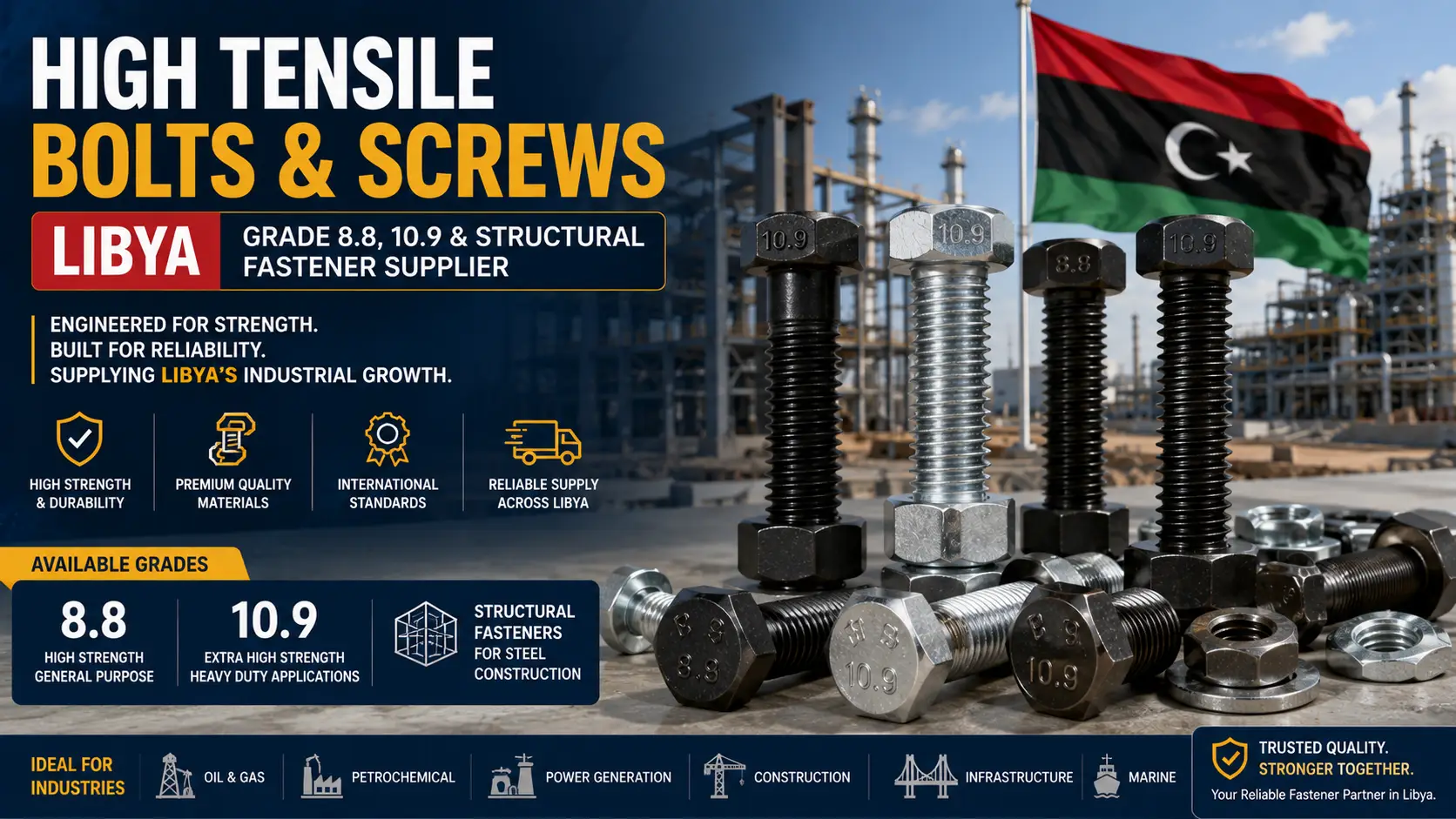
High tensile bolts are bolts of high-strength alloy or carbon steel, which have been heat-treated to give them higher tensile and yield strength than ordinary bolts. They come into use in structural steel connections, oil & gas flanges, heavy machinery and infrastructure where secure load bearing fastening is required.
Looking for certified high tensile bolts for Libya project? Send your grade, standard, size and quantity requirements for a quick and compliant quotation! → Request a Quote
Why High Tensile Bolts Matter for Industrial Projects in Libya
High tensile fasteners Libya engineers and maintenance teams use are those that are able to withstand high preload forces, which are the tensile stress applied to the fasteners when they are being tightened which results in the members of a joint being pulled close. The main reason for requiring a significant preload on the bolt is to ensure that the connection remains tight and leak-proof throughout the functional life of the structural steel, pipeline flanges, pressure vessel, and heavy machinery.
Well-specified high strength structural fasteners, as described in ISO 898-1 and ISO 4014/4017, are very effective at enhancing the reliability of joints, and minimizing maintenance failures in industrial infrastructure. The failure of the structural joint in the developing industrial markets is a major issue caused by under-specified and counterfeit bolts.
The challenges in Libya are:
High ambient temperature — Libya's summer temperatures are above 40°C in most parts of the country which cause a degradation of lubricants and thermal expansion effects on bolt preload
Coastal corrosion exposure — fasteners used in coastal facilities of Tripoli, Zawiya, Misrata and Brega are exposed to the marine atmosphere with high concentration of salt which rapidly corrodes the uncoated carbon steel.
Desert dust and sand — Abrasive contamination such as desert dust and sand increases the wear on the threads and damage to the seating surface on exposed connections.
Oil and gas service conditions — hydrocarbons, thermal cycling and sour gas corrosion are encountered by components such as refinery and pipeline fasteners in production and processing facilities.
For more detail on industrial fastening systems, such as anchor bolts, structural fasteners, threaded rods and specialty fasteners in use throughout Libya's construction, oil & gas and industrial sectors, refer to our Fasteners Pillar and our full range of fasteners solutions for industrial and structural applications.
Common Types of High Tensile Bolts
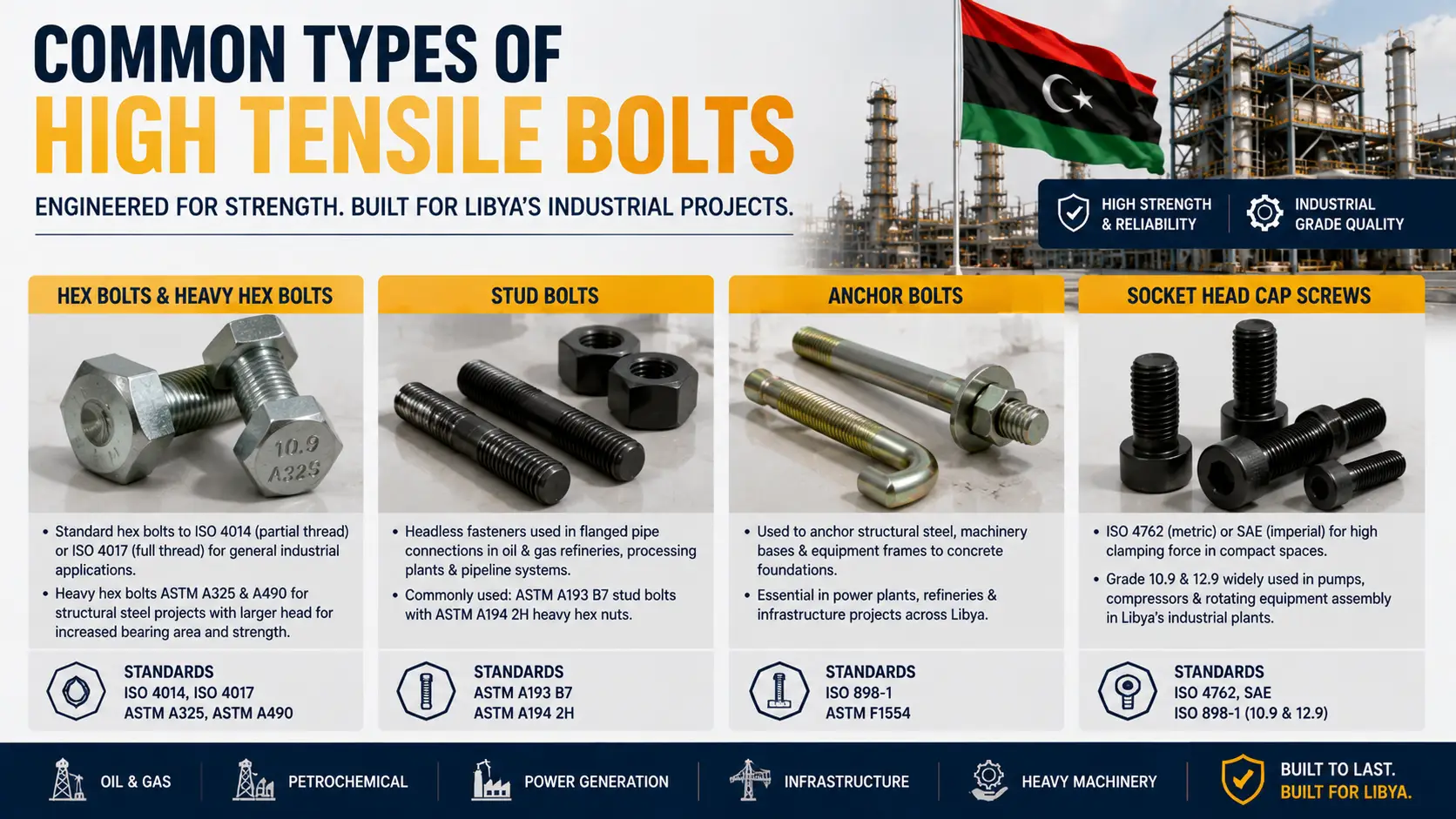
Hex Bolts and Heavy Hex Bolts
The standard hexagon bolts to ISO 4014 (partial thread) or ISO 4017 (full thread) are utilized in the construction, manufacturing and other industrial sectors in the entire region of Libya. Heavy hex bolts are required on Libya structural steel projects and come in ASTM A325 and A490 and have a larger, thicker head than traditional hex bolts, which increases the bearing area of the bolt head and the nut.
Stud Bolts
The oil and gas refineries, processing plants and pipeline systems in Libya are all joined together with stud bolts with no heads, which are the standard fastener used in Libya for all flanged pipe connections. Most of the hydrocarbon service flange connections at Ras Lanuf, and Brega are specified as ASTM A193 B7 stud bolts and ASTM A194 2H heavy hex nuts. Refer to our Stud Bolts Article for detailed guidance on selection of the grade of stud bolts, compliance with NACE requirements and oil & gas flange bolting practices, including the full specification framework for pressure-boundary fasteners.
Anchor Bolts
Concrete foundations are used to anchor structural steel columns, machinery bases and equipment frames. High tensile anchor bolts are used in all power station construction, refinery equipment installation and infrastructure projects in Libya to safely transfer equipment loads to reinforced concrete foundations.
Socket Head Cap Screws
Socket head cap screws (metal) - ISO 4762 metric or SAE imperial - are designed for high clamping forces in a compact head profile for machinery, instrumentation and equipment assemblies with restricted wrench clearance. The socket cap screws in grade 10.9 and 12.9 are widely used in pump, compressor and rotating equipment assembly in Libya's industrial plants.
Bolt Grades and International Standards
The most critical technical judgment made in any procurement for high tensile bolts Libya is the grade selection. Below is a table of the main grades applied in the various industrial sectors in Libya.
Grade | Min. UTS | Min. Yield | Material | Libya Industrial Application |
ISO 8.8 | 800 MPa | 640 MPa | Medium carbon alloy steel | General structural steel, machinery frames |
ISO 10.9 | 1040 MPa | 940 MPa | Alloy steel, quenched & tempered | Heavy machinery, automotive, pressure equipment |
ISO 12.9 | 1220 MPa | 1100 MPa | Alloy steel, high quench temper | Ultra high-load, tooling, precision machinery |
ASTM A325 | 830 MPa | 635 MPa | Medium carbon steel | Structural steel connections, bridges |
ASTM A490 | 1040 MPa | 896 MPa | Alloy steel | Heavy structural connections, pre-tensioned joints |
ASTM A193 B7 | 860 MPa+ | 725 MPa+ | Cr-Mo alloy steel | Oil & gas stud bolts, pressure vessel flanges |
EN 14399 HV 10.9 | 1040 MPa | 940 MPa | Alloy steel | Pre-loadable structural steel (European standard) |
ASTM vs ISO Standards
Factor | ASTM | ISO / DIN | Libya Project Notes |
Standard system | Imperial (inches, psi) | Metric (mm, MPa) | Libya projects may specify either; confirm with EPC drawings |
Grade designation | A325, A490, A193 B7 | 8.8, 10.9, 12.9 | ASTM grades dominate oil & gas; ISO in construction |
Strength basis | Minimum proof load and tensile | Tensile and yield classes | Equivalent strengths can be cross-referenced |
Thread form | UNC / UNF (unified inch threads) | Metric coarse / fine | Not interchangeable — confirm thread type before ordering |
Governing body | ASTM International | ISO Technical Committee TC2 | ASTM referenced by API / ASME; ISO in EU/global |
Common Libya application | Oil & gas flanges, pipelines | Steel structures, civil works | Many Libya projects specify ASTM for process; ISO for civil |
Oil and gas EPC projects in Libya usually include API piping standards and refer to ASTM standards and packages with civil and structural standards usually include ISO or DIN. Please check the governing standard on the project engineering datasheet before ordering! Although both have comparable strengths, ASTM A325 and ISO 10.9 are not interchangeable with each other and are not the same product.
Grade 8.8 vs 10.9 vs 12.9
The most commonly used grade of high tensile bolt in grade 8.8, which offers a balance of strength, ductility and economy, is used in the construction and general industrial sectors throughout Libya. Grade 10.9 is about 30% higher than the yield strength of 8.8, and is used for heavy duty applications, high load structural joints and where a smaller diameter bolt is required to withstand a specified load. Grade 12.9 M is the strongest precision metric grade for applications such as precision machines and tooling where weight and space limitations require maximum strength for the smallest diameter of bolt.
Grade 12.9 should be handled with care in applications where hydrogen embrittlement can be a problem, such as cathodic protection, electroplating or acid cleaning. Sour gas service should not be referenced in the standards unless it is specifically assessed by the engineer.
Materials Used in High Tensile Fasteners
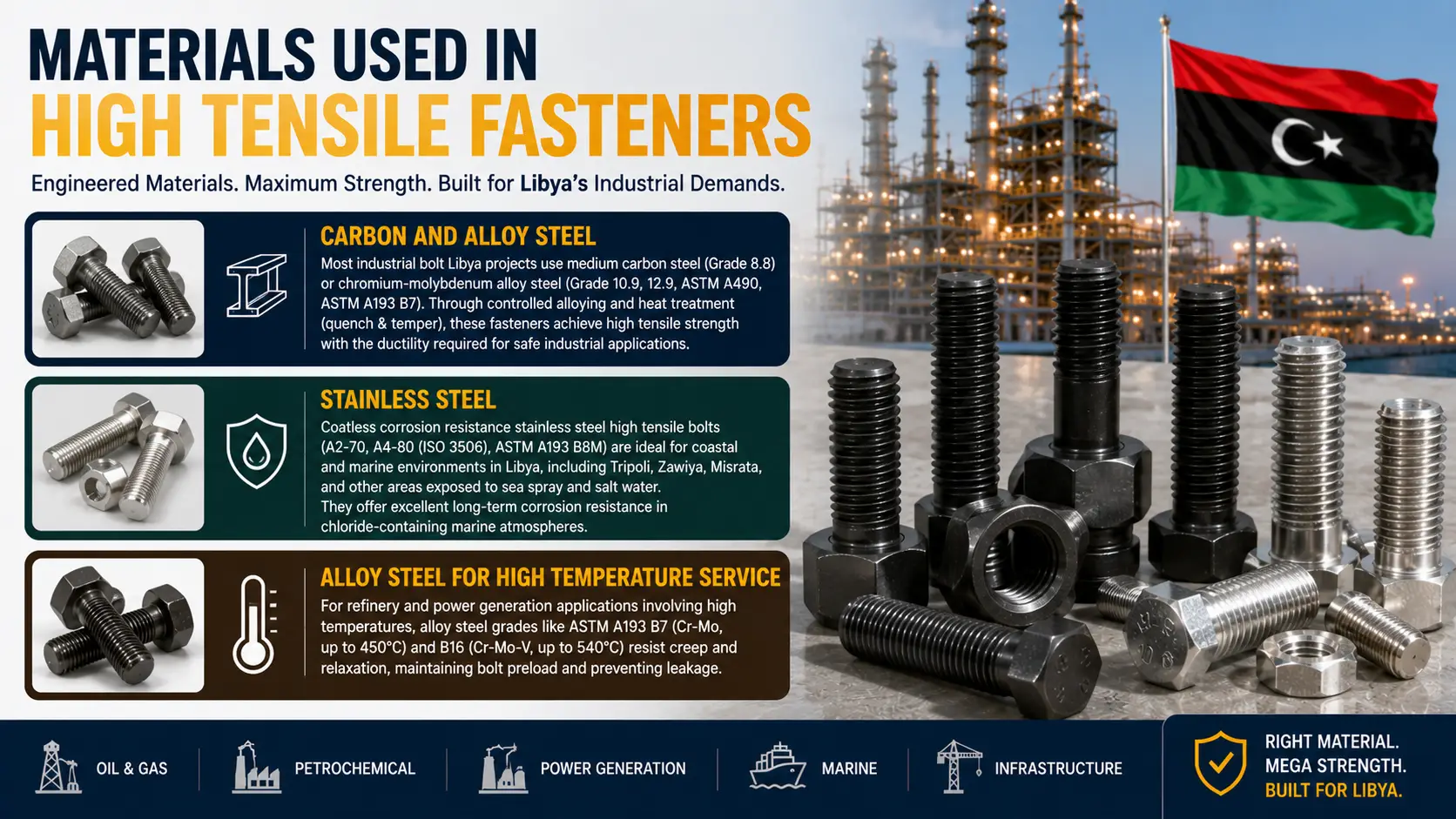
Carbon and Alloy Steel
Most of the industrial bolt Libya projects use are made of medium carbon steel (Grade 8.8) or chromium-molybdenum alloy steel (Grade 10.9, 12.9, ASTM A490, ASTM A193 B7). They are delivered by the combination of controlled alloying and heat treatment (quench and temper) which allows them to develop the combination of high tensile strength and acceptable ductility necessary for safe industrial use.
Stainless Steel
Coatless corrosion resistance stainless steel high tensile bolts (A2-70, A4-80 (ISO 3506), ASTM A193 B8M) are useful for applications in coastal and marine environments in Libya, in Tripoli, Zawiya, Misrata and other areas exposed to sea spray and salt water. They are not as good as alloy steels but have good long-term resistance to corrosion in chloride-containing marine air. atmospheres.
Alloy Steel for High Temperature Service
In applications such as refinery and power generation where high temperatures are involved, alloy steel grades like ASTM A193 B7 (Cr-Mo, up to 450°C) and B16 (Cr-Mo-V, up to 540°C) do not creep and relax at operating temperature and retain bolt preload to prevent leakage.
Corrosion Protection for Harsh Environments
The temperate, coastal climate in the north, and the desert environment in the Sirte Basin and southern oil fields result in two very different corrosion zones that require different types of coatings for high tensile bolts Libya projects use.
Coating / Finish | Corrosion Protection | Relative Cost | Libya Application Notes |
No coating (plain / BZP) | Minimal | Lowest | Indoor, dry, non-corrosive environments only |
Electro-zinc plated (EZP) | Low | Low | Light indoor service, sheltered applications |
Hot-dip galvanized (HDG) | Good | Moderate | Outdoor, coastal, construction, infrastructure |
Zinc-flake (Dacromet / Geomet) | High | Moderate | Offshore topsides, marine, high corrosion exposure |
PTFE / Xylan fluoropolymer | Very Good | Higher | Anti-galling on SS, subsea, and chemical environments |
Stainless steel (SS 316) | Excellent | Highest | Highly corrosive, coastal Libya, offshore, chemical |
Hot-Dip Galvanizing for Libya’s Coastal Facilities
The zinc coating on the bolt surface achieved by the hot dip galvanization process is 45-85 μm thick, which is enough to offer sacrificial cathodic protection for the bolt surface, particularly in marine and industrial atmospheric environments, which is much more effective than electroplated coatings. Galvanized high tensile bolts are the standard corrosion protection specification for outdoor structural steel connections, port infrastructure in Misrata and Tobruk or pipeline supports above ground in Libya construction projects.
Note: Hydrogen embrittlement risk management is important for hot-dip galvanizing of Grade 10.9 and 12.9 bolts. Hydrogen can be introduced into the high-hardness steel during the pickling process before galvanizing. To control this risk, pre-baking is necessary following galvanizing and the hardness limits are carefully specified (usually maximum 380HV for galvanized fastenings) according to ISO 10684. Grade 12.9 bolts should not be hot-dipped galvanized.
Applications Across Major Industries
Oil and Gas
The main industrial production users of certified high tensile fasteners in Libya are the Libyan National Oil Corporation (NOC) and its operating subsidiaries at Ras Lanuf, Brega and the Sirte Basin fields. They are used for flange stud bolts, pressure piping, steelwork on platforms and pipe-racks, vessel and equipment foundations, and high-temperature alloy bolts for furnace and heat exchanger service.
For Libya oil and gas industry, flange bolts Libya procurement should be in accordance with the project's piping material class (PMC) and bolting specification, which will normally include ASTM A193 B7 stud bolts and A194 2H nuts for normal hydrocarbon service and B7M and 7M nuts for sour service applications.
Construction and Infrastructure
Libya projects specify structural bolts, mostly ASTM A325, A490 or ISO 10.9 heavy hex bolts for main structural steel connections used in steel frame construction in Tripoli and Benghazi, bridge construction in Misrata and Benghazi as well as power plant construction and cement plant construction throughout the country. For high load connections of primary steel, such joints are normally pre-tensioned according to AISC and Eurocode recommendations.
Mining and Cement
Grade 10.9 and 12.9 high tensile bolts are used by the cement plants, mining and quarrying industries, and mineral processing plants in Libya for crushing frames, mill liner, conveyor structures and heavy rotating equipment used in construction projects to satisfy the local and regional demand for the construction industry. These applications require preloaded fastening systems that are resistant to locking due to the combination of vibration, abrasion and thermal cycling.
Power Generation
The need for high-temperature alloy bolting in power station construction and maintenance is for steam turbine casings, pressure parts for boilers and heat exchanger covers in Libya. The applications usually call for ASTM A193 B7 or B16 stud bolts that will retain their mechanical properties at high steam temperatures and not creep out of shape.
How to Select the Right High Tensile Bolt
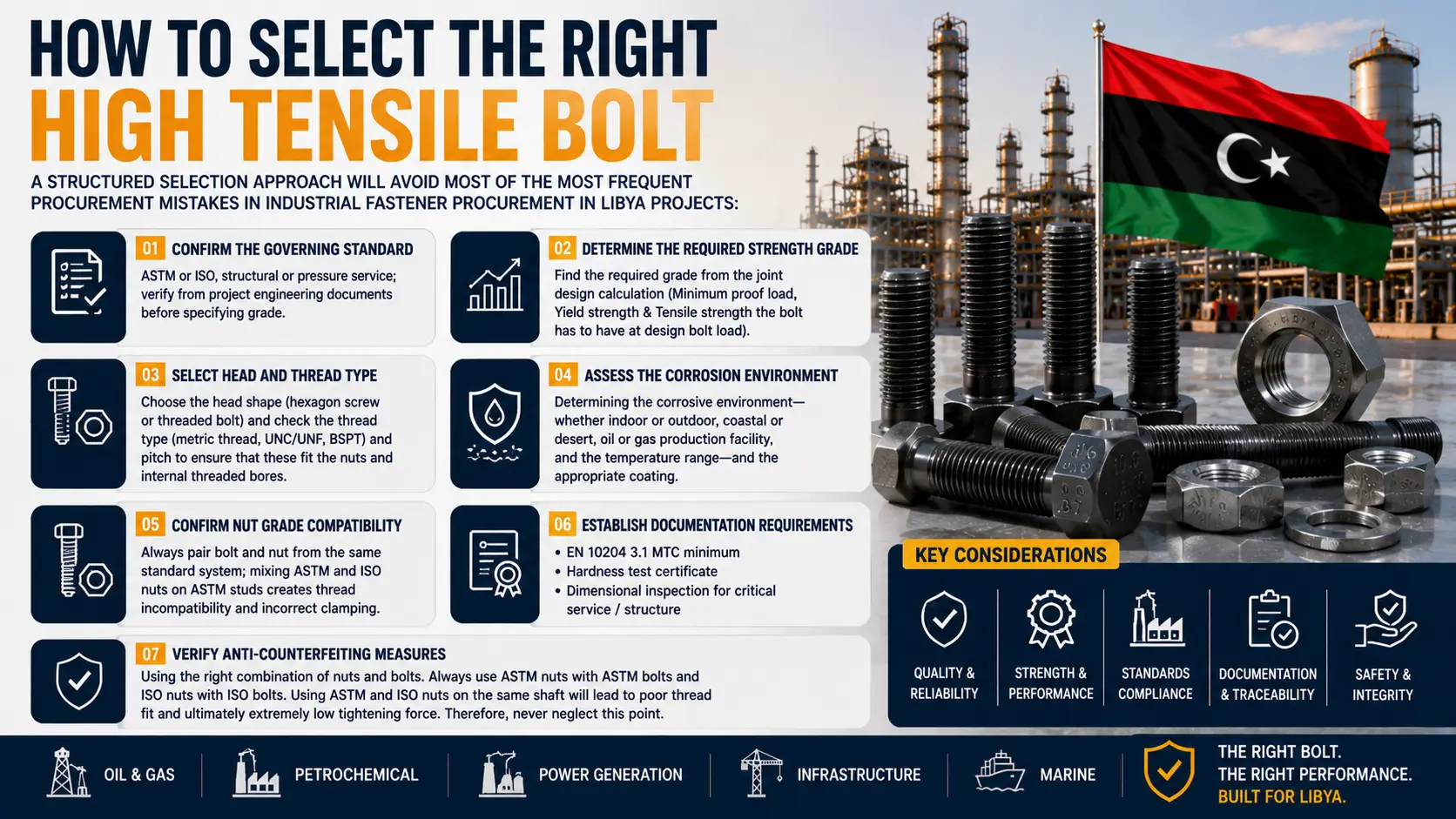
A structured selection approach will avoid most of the most frequent procurement mistakes in industrial fastener procurement in Libya projects:
Confirm the governing standard — ASTM or ISO, structural or pressure service; verify from project engineering documents before specifying grade.
Determine the required strength grade — Find the required grade from the joint design calculation (Minimum proof load, Yield strength & Tensile strength the bolt has to have at design bolt load).
Select head and thread type — Choose the head shape (hexagon screw or threaded bolt) and check the thread type (metric thread, UNC/UNF, BSPT) and check the thread type (metric thread, UNC/UNF) and pitch to ensure that these fit the nuts and internal threaded bores.
Assess the corrosion environment — Determining the corrosive environment-whether indoor or outdoor, coastal or desert, oil or gas production facility, and the temperature range-and the appropriate coating.
Confirm nut grade compatibility — always pair bolt and nut from the same standard system; mixing ASTM and ISO nuts on ASTM studs creates thread incompatibility and incorrect clamping.
Establish documentation requirements — EN 10204 3.1 MTC minimum; Hardness test certificate; Dimensional inspection for critical service / structure.
Verify anti-counterfeiting measures — Using the right combination of nuts and bolts. Always use ASTM nuts with ASTM bolts and ISO nuts with ISO bolts. Using ASTM and ISO nuts on the same shaft will lead to poor thread fit and ultimately extremely low tightening force. Therefore, never neglect this point.
Preventing Fastener Failure
Failure Cause | Symptoms | Root Cause | Prevention |
Over-tightening | Thread stripping, shank necking, fracture | Excessive torque, uncalibrated tools | Use torque wrench to engineer-specified values |
Under-tightening | Joint loosening, fatigue failure | Incorrect torque, missed bolts | Follow torque sequence; check all bolts after assembly |
Corrosion | Surface pitting, crevice corrosion, seizure | Wrong coating for environment | Specify HDG or zinc-flake for outdoor Libya conditions |
Hydrogen embrittlement | Delayed brittle fracture after loading | Electroplating, acid pickling, high hardness | Use diffusion-treated or mechanically applied coatings |
Fatigue | Thread-root crack propagation under cycling | Vibration, fluctuating load, low preload | Use grade 10.9 or ASTM A490; apply correct preload |
Incorrect grade | Early yielding, distortion, leaks | Wrong bolt specified or substituted | Verify grade marking against MTC on delivery |
Installation Best Practices
Use calibrated torque wrenches or hydraulic bolt tensioners — Always use calibrated torque wrenches or hydraulic bolt tensioners, never impact wrench or estimate torque on structural or pressure bearing connections.
Apply lubricant as specified — see ASTM A325 torque tables; preload is based on the assumption of a certain K-factor (nut factor) for each lubricant; a different lubricant, without recalculation, gives an incorrect preload
Tighten in a star or cross pattern — Tighten in a star or cross pattern, for multi-bolt flanges and base plates, progressive tightening in a pattern distributes the load evenly.
Check bolt grade markings before installation — make sure grade head markings are the same as on the MTC; do not install unmarked bolts on pressure and structural applications.
Do not reuse Grade 10.9 or 12.9 bolts on high-load joints — if the bolts are Grade 10.9 or 12.9, and have been tightened to near the proof load, they may have become elongated beyond their elastic limits and should always be replaced on critical joints with new bolts.
Procurement and Quality Verification in Libya
Documentation Requirements
All suitable procurement packages for high tensile bolts in Libya must contain:
EN 10204 3.1 Material Test Certificate — to verify the chemical composition and mechanical properties from the manufacturer's authorized inspector.
Dimensional inspection report — Confirming thread form, pitch, diameter, and length of thread are in accordance with the specified standard.
Hardness test certificate — especially in Grade 10.9 and 12.9 where the hardness limits are maximum and can be important for hydrogen embrittlement risk management.
Heat treatment certificate — This is a certificate confirming the alloy steel grade has been heat treated to include the quench and temper processing.
Coating test certificate — Formal test certificate of coating thickness and adhesion for galvanized or zinc-flaked coated products.
Counterfeit Fastener Identification
Note: The use of counterfeit high strength bolts stamped with fake grades is a well-known issue in the industrial supply chain from North Africa and the Middle East. Lower-quality steel bolts that are heat-treated incorrectly will not perform as expected under loading in the structure. An improperly tightened bolt in a crane, pressure vessel or bridge connection can be deadly. Avoid buying from unconfirmed traders who don't have MTC papers.
Respectively check the grade notation on the bolt head.
Check that heat numbers are on the product packaging or tags physically at the MTC.
Test hardness at point of receipt for critical grades in accordance with a portable Brinell or Rockwell tester.
Conduct spot PMI (XRF) testing of alloy Grade fasteners to verify elemental composition.
Do not accept any lot that has inconsistent markings, packaging or documentation that looks like it has been changed.
Libya-Specific Sourcing Considerations
Most of the oil and gas fasteners required by the operators of the oil and gas industry in Libya are imported through trading companies that stock the European, Asian, and Middle East markets that cater to the Libyan market. The lead time to Libya will vary according to logistics routes, normally via Malta, Tunisia or direct sea freight to Misrata or Tripoli port. When purchasing fasteners for Libya, the following are key points to keep in mind:
Ensure that import documentation meets requirements for Libyan Customs — origin certificates, and commercial invoices are routinely required.
Provide sufficient time for customs clearance, especially for large industrial goods consignments.
To avoid delays during a project due to import logistics, consider buying critical (essential) spare fasteners in advance of a turnaround maintenance window.
Ensure that the supplier's logistics chain is suitable for delivery to operational bases at Ras Lanuf, Brega, or offshore bases.
Frequently Asked Questions
What are high tensile bolts?
High tensile bolts used in Libyan construction and industrial projects are heat-treated alloy or carbon steel bolts with much higher tensile and yield strength than normal carbon steel bolts, which can be used to bear higher structural strength and mechanical power by using smaller bolts.
Which bolt grade is commonly used in Libya?
A metric grade of 8.8 is the most popular grade in the construction sector throughout Libya. For heavy machinery and high-load structural connections, it is specified as Grade 10.9. Oil and gas flange connections are usually connected with ASTM A193 B7 stud bolts.
What is ASTM A325 used for?
Medium carbon steel structural bolts, commonly used for primary steel connections in steel bridges, steel industrial structures, steel frames, and port constructions in Libya are described in conformance with the American standard ASTM A325.
Are ASTM and ISO bolts interchangeable?
Where the mechanical property requirements, head dimensions and thread forms are compatible and where the engineering specification so states. ASTM uses imperial thread forms (UNC/UNF) while ISO uses metric. They are not directly interchangeable, but can only be confirmed by engineering.
What coating should I specify for coastal Libya?
In Tripoli, Zawiya, Misrata and Brega, these hot dip galvanized high tensile bolts Structural teams in Libya as the most cost-effective way to provide corrosion protection for outdoor and coastal applications.
Can high tensile bolts be reused?
Normally it is possible to use grade 8.8 bolts again if they are not over-loaded past their elastic limits. Bolts that have been torqued in pre-tensioned structural connections must be replaced after each torquing cycle as yielding during initial torque will result in a loss of repeatable preload when re-torqued. Always follow the project specification’s reuse policy.
What certifications should suppliers provide?
A minimum of an EN 10204 3.1 Material Test Certificate, providing the chemical composition and mechanical properties. A dimensional inspection report is required for structural steel. A certificate of hardness and a statement of compliance with NACE Service. A record of heat treatments for critical applications.
How do I avoid counterfeit bolts when sourcing in Libya?
Use only suppliers who can offer full, dependable MTC documentation, including heat numbers that are traceable to the product. Check grade head markings when delivered. Think about independent hardness testing or PMI on critical pressure-boundary applications or structural applications for alloy grades. Avoid buying from a trader whose reputation has not been verified.
Summary
Discipline in the entire process of specification, selection of materials, sourcing of high tensile bolts for Libya projects, from the time of grade selection to the time of document verification from the supplier, is crucial. A structurally poor or fake bolt is not only a quality problem; in a structural steel connection, a pressure vessel, or a pipeline flange, it's a safety problem whose ramifications go well beyond mere quality concerns to legal and commercial issues.
The frameworks outlined in this guide (grade selection, conformance to standards, specification of the coatings, prevention of bolt failure, and procurement documents) help to make decisions that ensure the reliable and long-term performance of bolts in Libya's oil and gas maintenance trades and in various industrial applications, as well as in the specification for ASTM A325 bolts for use in steel construction projects.
If you need more technical advice, visit our Fasteners Pillar, which details our full range of industrial fasteners, and our Stud Bolts Article, which explains the various types of oil and gas stud bolt grades, NACE compliance, and flange bolting standards.
Looking for certified high tensile bolts for your project in Libya? Our personnel who are experts in procurement are there to offer guidance on grade selection, MTC verification, and delivery to any address in Libya.→ Talk to Our Specialist
DISCLAIMER: Z&F Corporation is not affiliated with, authorized by, endorsed by, or acting as an official representative of any manufacturer, brand, or trademark owner referenced on this website. All product names, trademarks, brand names, logos, and manufacturer references are the property of their respective owners and are used solely for identification, reference, and compatibility purposes.