How a Data Centre Solved Downtime with the Right Miniature Circuit Breaker (MCB)
Nuisance tripping on a distribution board sounds like a minor inconvenience until it happens inside a live data hall. For colocation and enterprise data centre operators across the UK, an MCB that trips unnecessarily — or fails to trip when it should — can mean minutes of unplanned downtime, an SLA breach, and an awkward call with a customer. This is a composite, anonymised account of how a UK colocation data centre operator worked through a recurring nuisance-tripping problem by re-specifying the miniature circuit breakers protecting its PDU distribution boards, and what other facilities teams can learn from it.
Need help specifying or sourcing miniature circuit breakers for your site?
The Challenge
The facility, a Tier III colocation site in the south of England, had been experiencing intermittent trips on several PDU circuits feeding server racks with a high concentration of switch-mode power supplies. The breakers involved were general-purpose Type B MCBs, originally specified for what the design brief assumed would be a fairly linear, resistive-leaning load profile. As rack density increased and more IT hardware with capacitive inrush characteristics was deployed, the site began recording several nuisance trips a month — each one triggering an incident ticket, a site visit, and in two cases a customer-facing SLA credit.
Root cause analysis on the affected circuits pointed to inrush current at power-on, and to the cumulative effect of several devices switching on in close succession — both of which a Type B curve is not well suited to tolerate without tripping, even though the steady-state load was comfortably within the breaker's rated current.
Diagnosing the issue took longer than the fix itself. The facilities team initially suspected a faulty batch of breakers, since the trips were intermittent rather than constant — a classic symptom that gets misread as a hardware defect. Power quality logging on the affected circuits over a two-week window told a different story: current spikes at roughly 8-12 times the steady-state load lasting only a few milliseconds, coinciding almost exactly with server power-on events and UPS-to-mains transfer tests. A Type B curve's magnetic trip element operates at 3-5 times rated current, which meant these entirely normal inrush events were being read by the breaker as a fault.
What made the problem harder to spot initially was that the trips weren't happening on every power-on — only when several devices in the same rack cycled within a short window of each other, which pushed the cumulative inrush high enough to cross the Type B threshold. This intermittency is exactly why trip-curve mismatches are so often misdiagnosed as random hardware failures rather than a specification issue.
The Solution
Working with their supply partner, the facilities team re-specified the affected circuits with ABB Type C miniature circuit breakers, which tolerate a higher instantaneous inrush multiple before the magnetic trip element operates, while keeping the same thermal (overload) characteristic appropriate for the cable and load. A small number of circuits feeding UPS-backed inductive loads were moved to Type K breakers for an even higher inrush tolerance. Pole count and breaking capacity were re-verified against an updated prospective fault current calculation for the board, since the original design figures pre-dated a transformer upgrade elsewhere on site.
Products Used
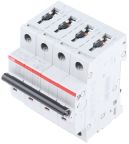
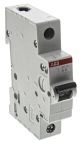
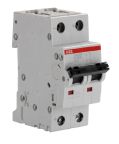
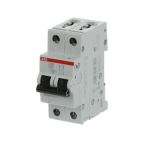
The re-specification used ABB System Pro M Compact S200 Type C breakers (4-pole, 16A, 6 kA breaking capacity) for the majority of PDU circuits, ABB ComPact Home SH200 Type B breakers (1-pole, 16A) retained where the load genuinely was resistive/linear, and ABB System Pro M Compact S200M UC Type K breakers (2-pole, 10A, 10 kA) for the highest-inrush circuits. All units were sourced with same-week UK delivery to minimise the change-window duration.
Selecting between Type B, C and K wasn't a blanket decision — each PDU circuit was assessed individually against its actual connected load, not the load the original design brief had assumed five years earlier. Circuits feeding lighting, general power outlets and other genuinely resistive loads were left on Type B, since there was no inrush problem to solve there and no reason to over-specify. Circuits feeding blade servers, storage arrays and network switches — where switch-mode power supplies produce a brief but sharp inrush at power-on — moved to Type C. The two circuits feeding UPS output boards, where transfer events could stack inrush from multiple downstream devices simultaneously, moved to Type K for the extra margin.
Trip Curve | Magnetic Trip Threshold | Typical Use Case |
|---|---|---|
Type B | 3-5x rated current | Resistive/lighting circuits, general power |
Type C | 5-10x rated current | Server PSUs, general IT/industrial inrush loads |
Type K | 8-12x rated current | Inductive loads, UPS transfer circuits, motor starting |
Results
Metric | Before | After |
|---|---|---|
Nuisance trips per month (affected circuits) | 4–6 | 0 |
Unplanned maintenance visits per quarter | 3 | 0 |
SLA credits issued (12 months) | 2 | 0 |
Breaker trip curve | Type B (mismatched to load) | Type C / Type K (matched to load) |
Verified prospective fault current margin | Not re-checked since transformer upgrade | Re-verified and documented |
Lessons Learned
The trip curve, not just the current rating, is usually the real culprit when a correctly-rated breaker keeps tripping under a load that "should" be fine. It's also worth re-checking prospective fault current whenever upstream infrastructure changes — a board rated correctly on day one can become under-specified after a transformer or generator upgrade elsewhere on the site. Finally, standardising on a small, well-understood range of trip curves across a data hall makes it much easier for on-site engineers to diagnose problems quickly during an incident.
Related Category | Why It Matters | Link |
|---|---|---|
Miniature Circuit Breakers | Full range of Type B, C and K MCBs for panel and PDU protection | |
Molded Case Circuit Breakers | Higher-current protection for upstream distribution boards | |
Residual Current Devices | Earth fault protection to pair with MCBs on critical circuits |
Frequently Asked Questions
What is a miniature circuit breaker (MCB) used for?
An MCB automatically disconnects a circuit when it detects overload or short-circuit current, protecting cabling and connected equipment, and can be reset once the fault is cleared rather than replaced like a fuse.
How do I choose between ABB and Allen-Bradley MCBs?
Both are used across UK industrial and data centre installations; the choice often comes down to what's already standardised on site, panel builder preference, and current stock availability — ZF Corporation can supply and cross-reference either.
What standards apply to MCBs (IEC 60947)?
Industrial-duty MCBs are typically tested to IEC 60947-2, while domestic and light commercial breakers are tested to BS EN 60898-1 — always confirm which standard your board design calls for.
Can ZF Corporation source obsolete or discontinued MCBs?
Yes — we regularly cross-reference discontinued part numbers to current equivalents for panel repairs and PDU board upgrades where the original breaker is no longer manufactured.
What is the typical lead time for an MCB in the UK?
Common Type B and Type C ratings are typically available from stock; Type K and less common ratings may carry a short lead time — contact us with the exact specification for a same-day quote.
Preventing Recurrence
Beyond the immediate fix, the site introduced two standing practices. First, any change to upstream transformer, generator or UPS capacity now triggers a mandatory review of downstream prospective fault current and breaker ratings, rather than leaving that assumption unchecked until the next incident. Second, new rack deployments are now assessed for load profile (resistive vs inrush-heavy) before a trip curve is assigned, instead of defaulting every new PDU circuit to Type B as had been the previous convention. Both changes cost nothing to implement and directly address the root cause rather than just the symptom.
Specifying for Future Load Growth
One point worth flagging for any facilities team reviewing a similar board: the fix above solved the immediate nuisance-tripping problem, but it is only durable if the site also plans for the next capacity increase, not just the current one. Data hall load profiles rarely stay static — rack density tends to climb year on year as older, lower-density equipment is replaced with denser compute and storage hardware, which generally means higher inrush current on the same circuits, not less. A trip curve and breaking capacity that comfortably cover today's load can become marginal within a relatively short refresh cycle if they were specified with no headroom at all.
A practical approach is to specify slightly above the current measured inrush and fault current figures, rather than exactly to them, and to build a note into the site's change-management process so that any planned increase in rack density triggers a re-check of the downstream protection devices before new equipment goes live — not after the first nuisance trip appears. This is a small amount of extra diligence at design time that avoids repeating the entire diagnosis-and-remediation cycle in another two or three years.
It is also worth keeping a simple record of which circuits were re-specified, to what curve and rating, and why — so that the next facilities engineer working on the board (who may not have been involved in the original incident) has the context immediately to hand rather than having to re-diagnose a problem that was already solved once.
Conclusion
This site's downtime problem wasn't a faulty breaker — it was a trip curve mismatched to a changing load profile, compounded by an out-of-date fault current calculation. Re-specifying to the right curve and re-verifying the board's fault current eliminated the nuisance trips entirely. If your data hall or plant room is seeing similar intermittent trips, it's worth reviewing the trip curve before assuming the breaker itself is at fault.
Need help specifying the right MCB for a critical load?
Talk to Our Sourcing Team
DISCLAIMER: Z&F Corporation is not affiliated with, authorized by, endorsed by, or acting as an official representative of any manufacturer, brand, or trademark owner referenced on this website. All product names, trademarks, brand names, logos, and manufacturer references are the property of their respective owners and are used solely for identification, reference, and compatibility purposes.