How to Select Bearings in Jordan: Complete Industrial Guide
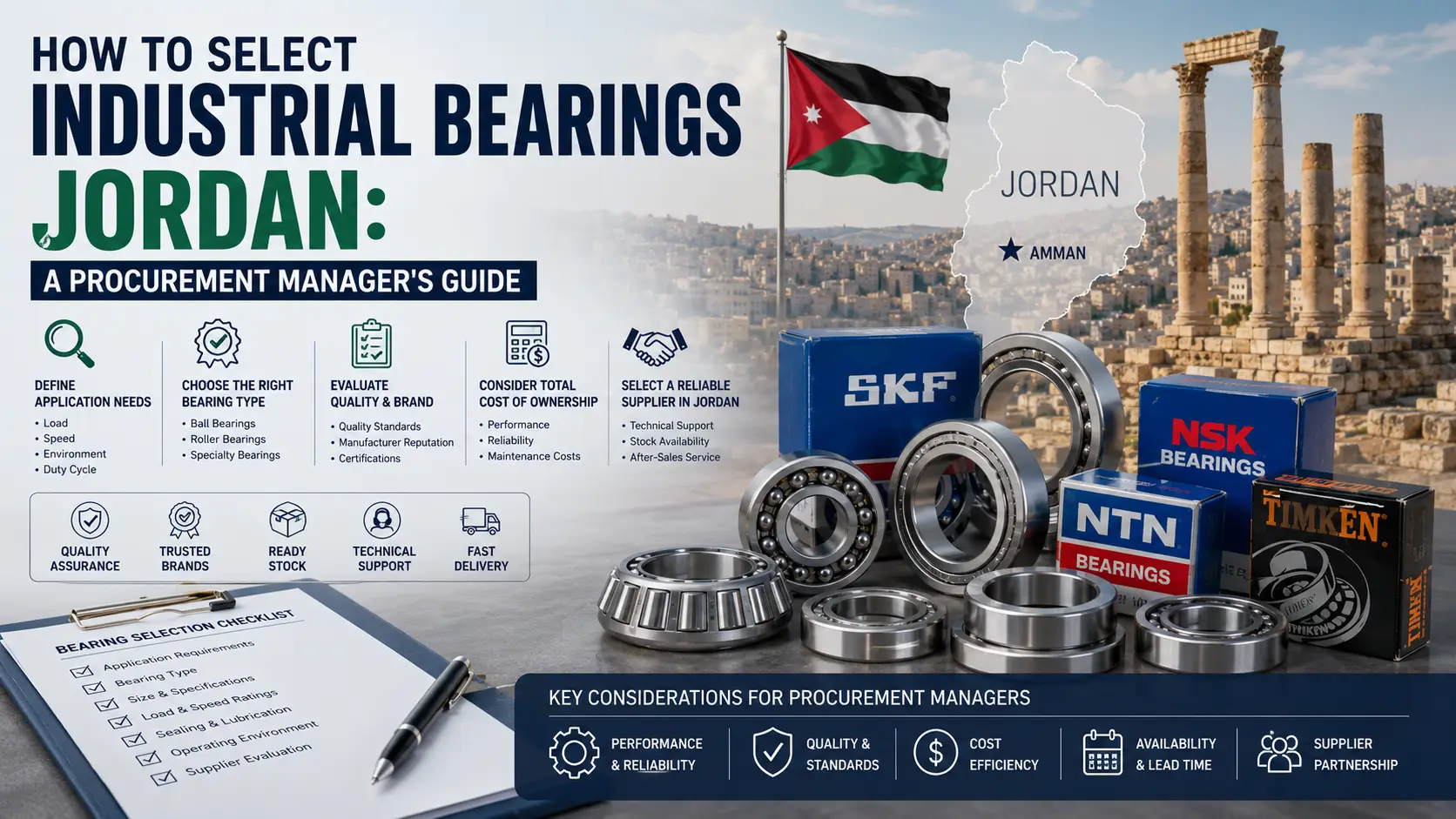
One of the most important engineering choices for a maintenance or procurement professional is selecting bearings in Jordan. A properly functioning right bearing ensures smooth operation of industrial equipment, minimizes downtime and saves on life cycle expenses. However, the wrong choice results in unnecessary downtime, expensive repairs and failures. When choosing the right bearing for your manufacturing plant in Sahab Industrial City, water treatment facility in Amman, or mining operation in the south of Jordan, it begins with a knowledge of the load, speed, environment and maintenance requirements for your application. This guide will provide you with all of the information you need — the types of bearings, how to select them, procurement tips, and industrial uses in Jordan.
Request a Quote — Get the Right Bearing for Your Application
Why Bearing Selection Matters
The bearings are one of the most critical (pun intended) components in the rotating machinery in terms of load bearing. A Bearing Selection Guide geared to your application helps you correlate your performance requirements with the appropriate product. An unduly large percentage of bearing failures—around 36%—can be attributed to improper lubrication, according to SKF engineering resources.
The cost of a bad choice quickly escalates when you throw in misalignment, overload and contamination. Reliability of equipment plays a direct role in the profitability and continuity of operations in the developing industrial sector in Jordan, ranging from the King Abdullah II Industrial Estate in Amman to the Al Hassan Industrial Estate in Irbid.
Correct bearing selection also helps to achieve adherence to international standards such as ISO, ABMA, and Jordan Standards and Metrology Organization (JSMO), which help you ensure that your equipment complies with safety and performance standards necessary for industrial operations.
Understanding Bearing Types
No, industrial bearings are not universal! Every type of bearing is designed to withstand different types of loads, speeds, and operating conditions. The key to proper bearing selection is to recognize the differences.
Deep Groove Ball Bearings
Deep groove ball bearings are the most popular bearings type in industries. They are capable of accepting high rotational speeds, low friction, both radially and moderately axially loaded. Their units are ideal for electric motors, pumps, fans and light industrial gearboxes. Their versatility and the wide selection of brands like SKF, FAG, NSK and NTN make them a popular item in MRO stocks throughout Jordan.
Spherical Roller Bearings
Spherical roller bearings excel in applications with heavy radial loads and moderate to high axial loads. They are self-aligning and are perfect for equipment that is susceptible to shaft misalignment, like conveyor systems, crushers and heavy industrial gearboxes. They are widely used in cement production and mining (which constitute a high percentage of the industrial production in Jordan).
Tapered Roller Bearings
Tapered roller bearings are used for combined radial and thrust loads and are especially suitable for bearings subjected to high thrust loads. They are used in the wheel hubs, gearboxes and heavy-duty drive systems. Tapered roller bearings are a popular type of bearing and the well-known manufacturers of these bearings are Timken and KOYO.
Bearing Types Comparison: Quick Reference
Bearing Type | Load Type | Speed Rating | Self-Aligning | Typical Applications |
Deep Groove Ball | Radial + Low Axial | High | No | Motors, Pumps, Fans |
Spherical Roller | High Radial + Axial | Medium | Yes | Conveyors, Crushers, Gearboxes |
Tapered Roller | Radial + Thrust | Medium | No | Wheel Hubs, Drive Systems |
Cylindrical Roller | Very High Radial | High | No | Machine Tools, Large Motors |
Key Factors to Consider When Selecting Bearings
A structured bearing selection process comprehensively considers several engineering parameters. All of these steps are common steps that can cause premature bearing failures in industrial applications.
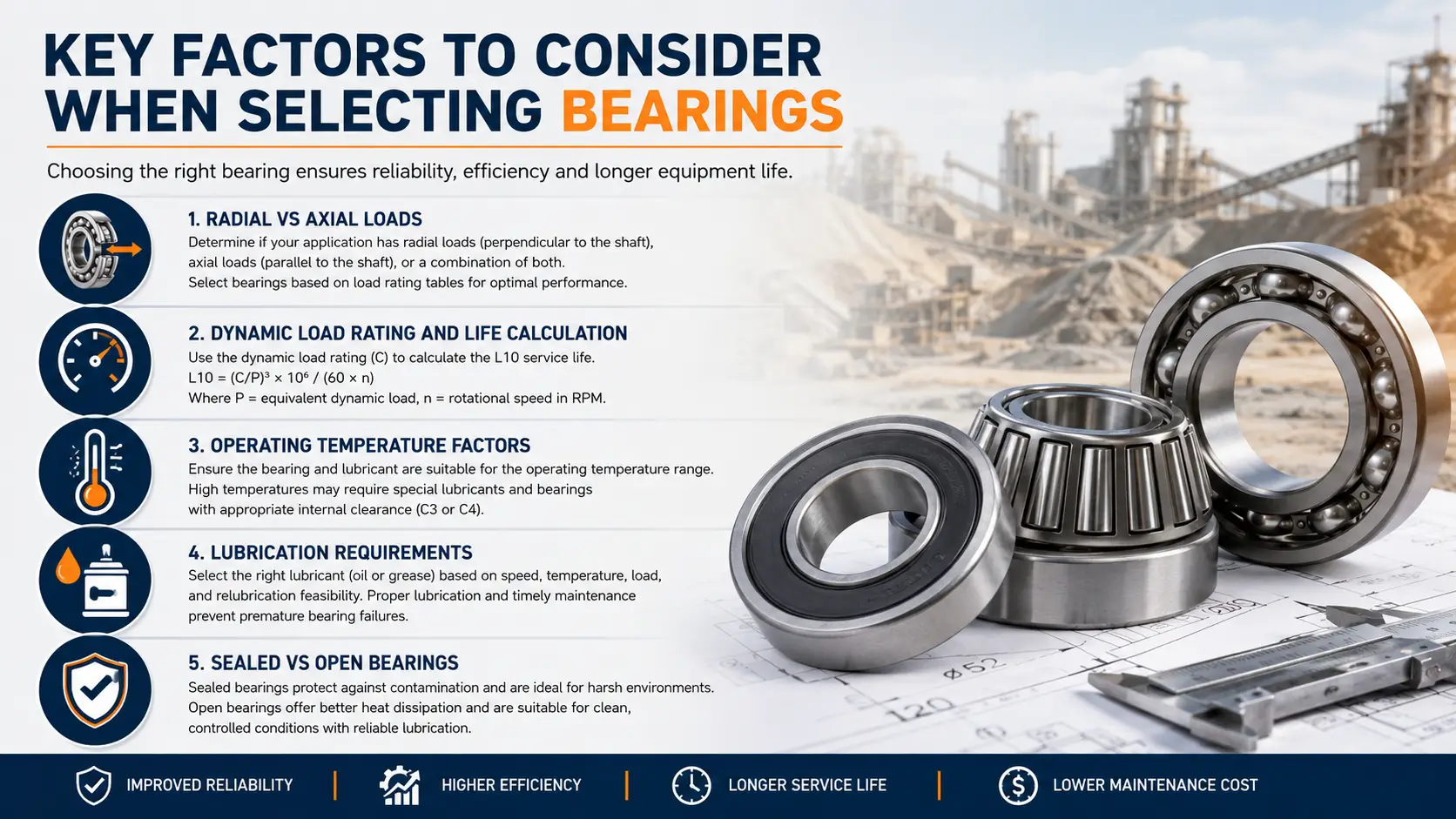
Radial vs Axial Loads
The first question you need to ask is, does your application have primarily a radial load (perpendicular to the shaft), an axial load (parallel to the shaft) or a combination of both? Ball bearings work well for moderate combined loads and are the preferred bearing for heavier loads or more significant radial loads. If your selection is based on the manufacturer's load rating tables, you can be sure that you are using the right bearings for the actual forces. These can be found in the Timken Engineering Manual or the SKF Bearing Select Tool.
Dynamic Load Rating and Life Calculation
There is a dynamic load rating (C) and a static load rating (C0) for each bearing. The dynamic rating is used to determine the L10 service life of the bearing (the time or number of revolutions at which 90% of an infinite number of identical bearings are expected to last). L10 = (C/P)³ × 10⁶ / (60 × n) is the formula used by the engineers that P equals the equivalent dynamic bearing load and n equals the rotational speed in RPM. For detailed load calculation information, refer to the Schaeffler Technical Library, or to the NSK Technical Journal.
Operating Temperature Factors
High ambient temperatures can be encountered by bearings in industrial environments such as in Jordan, particularly in the Aqaba area or in facilities located near desert areas. Oxidation and viscosity loss of lubricants increase with operating temperature, and can also change bearing clearance. Make sure the operating temperature range of the bearing and the lubricant are appropriate for the actual application. In high temperatures, grease formulations and bearings with suitable internal clearance (C3 or C4) might be needed.
Lubrication Requirements
The most important parameters for bearing selection and maintenance are lubrication. Bearings may be oiled or greased and the type of lubricant depends on the speed, temperature, load, and ease of relubrication. Sealed bearings are lubricated and ready to use when it is difficult to gain access for maintenance. Open bearings should be periodically lubricated by using prescribed lubrication fittings or housing. In industrial plants in Jordan, bearing failures are the result of improper selection of lubricant, or from failing to change it at the required interval.
Sealed vs Open Bearings
Sealed bearings provide the protection from contamination as if it were built in and are suitable for dusty, humid and chemically aggressive environments. Open bearings are designed for environments with cleanliness and controlled conditions where a reliable lubrication system is available, and has improved heat dissipation. Sealed or shielded bearing designs are commonly advised to control contamination risk in the quarrying, cement and food processing industry in the State of Jordan.
Environmental Conditions and Bearing Performance
Environmental factors play a significant role in choosing the bearing in industrial equipment in Jordan. There are varying challenges at each location around the country:
Dust and particulate contamination: Usually occurs in agricultural activities and cement and quarrying. Needs sealed bearings or good housing seals.
High ambient temperatures: lubricants that have a high temperature resistance are necessary in desert climates and process heat in energy and chemical plants, requiring greater internal clearances.
Moisture and humidity: Corrosion-resistant bearing materials and sealed bearings are required in moisture/humidity locations such as water treatment facilities, food processing plants, and coastal installations near Aqaba.
Chemical exposure: Petrochemicals and pharmaceuticals plants may need bearings that are stainless steel or ceramic coated to withstand the aggressive media.
Vibration: Vibration from heavy equipment in mining and cement factories may cause a quick bearing wear. Self-aligning bearings—the spherical roller type are well suited for these conditions.
Bearing Selection for Different Industries in Jordan
Jordan's industrial applications cover a variety of different sectors that have varying bearing needs. To be successful in bearing procurement, it is crucial to understand the specific application requirements.
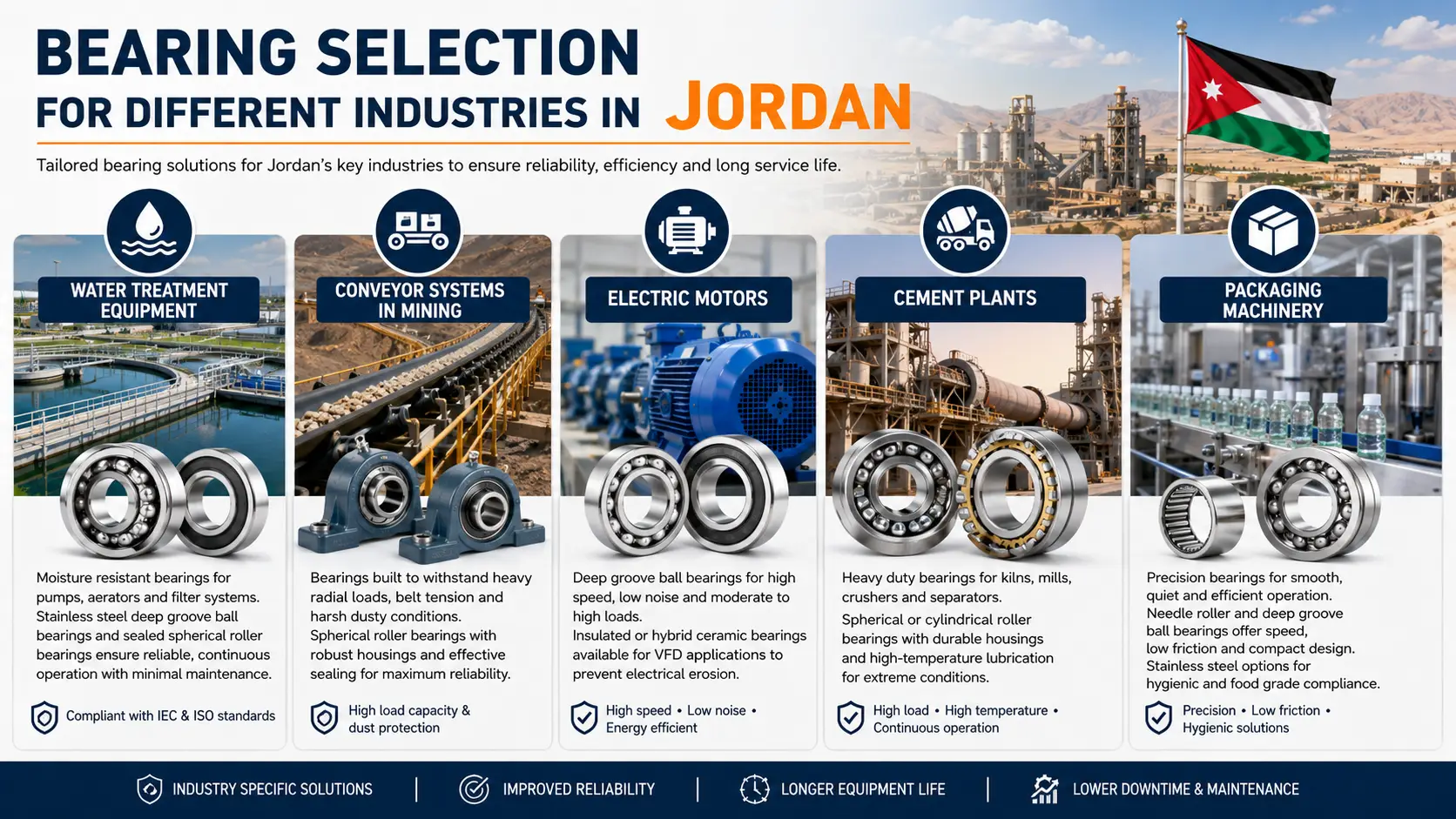
Bearings for Water Treatment Equipment
Jordan is one of the countries in the world with limited water resources and consequently, the need for water treatment facilities is of paramount importance. The bearings in water pumps, aerators, and filter systems need to be moisture resistant, capable of continuous operation, and require little maintenance. Typical bearings used for such applications are stainless steel deep groove ball bearings and sealed spherical roller bearings. The requirement of compliance with relevant IEC and ISO standards makes it suitable for use in utility grade equipment.
Bearings for Conveyor Systems in Mining
The phosphate, potash and cement companies of Jordan are reliant on large conveyor networks. Bearings used in conveyor systems should be able to withstand continuous heavy radial loads, belt tension forces and tolerate dusty, abrasive conditions. Common types of bearings that can be used in these applications include spherical roller bearings with plummer block housings from companies like SKF, FAG or Timken. The reliability of a conveyor is closely tied to the proper bearing housing and effective sealing system.
Bearings for Electric Motors
The majority of driven equipment in all industries in Jordan is electric motors. For high speed, low noise and moderately high load capacity, the standard recommendation for electric motor bearings is deep groove ball bearings. The size of the motor frame, power rating and duty cycle dictate the series and clearance of the bearings. Insulated bearings or hybrid ceramic bearings may be required to avoid electrical erosion damage to insulated bearings in variable frequency drive (VFD) applications, as well.
Bearings for Cement Plants
One of the most demanding bearing conditions exists in cement manufacturing, where high loads, high dust, high temperature and continuous operation are encountered. Heavy duty bearing solutions are required for any kiln, mill, crusher or separator. In this sector, the standard specification is spherical roller bearings or cylindrical roller bearings having a durable casing and high-temperature lubrication. This is a typical equipment profile used in plants at King Abdullah II Industrial Estate and Zarqa industrial zones.
Bearings for Packaging Machinery
Food, pharmaceutical and consumer goods manufacturers in Jordan need light manufacturing equipment and packaging systems with accurate, quiet bearings. Needle roller bearings and deep groove ball bearings are often chosen for their speed performance, low friction and compact size. For applications in food grade, there are stainless steel variants that provide hygienic compliance.
Industry Bearing Selection Quick Reference — Jordan
Industry / Application | Recommended Bearing Type | Key Requirement |
Electric Motors | Deep Groove Ball Bearing | High speed, low noise |
Conveyors (Mining) | Spherical Roller Bearing | Heavy load, misalignment tolerance |
Water Pumps | Deep Groove Ball / Spherical Roller | Moisture resistance, reliability |
Cement Plants | Spherical / Cylindrical Roller | Heavy load, high temperature |
Packaging Machinery | Deep Groove Ball / Needle Roller | Precision, compact size |
Industrial Gearboxes | Tapered Roller / Cylindrical Roller | Combined loads, rigidity |
Common Bearing Selection Mistakes
Knowing the reasons for bearing failure due to poor selection can save engineers from expensive mistakes. There are a number of errors that occur most frequently:
Ignoring load calculations: Under-specified bearings and failure due to using a bearing by habit or catalog part number without checking the load are caused by ignoring load calculations.
Choosing the wrong bearing type: A common mismatch is when the deep groove ball bearing is specified in an application that requires a tapered roller bearing.
Poor lubrication selection: The wrong grease type, viscosity or re-grease schedule are cited as a major contributing cause of bearing failures throughout the world.
Overlooking environmental conditions: Not considering environmental conditions: Choosing open bearings in contaminated conditions without the necessary environmental sealing increases wear rate.
Improper installation: An improper assembly method such as cold fitting, pounding on the inner rings or use of the wrong installation tools can cause damage to the raceways and rolling elements before the bearing actually goes into service.
Sourcing counterfeit bearings: Counterfeit or substandard bearings can be a real threat on the MENA procurement market. Use only reputable suppliers and traceable supply chains.
Bearing Selection Checklist
Step | Parameter | Action Required |
1 | Define load type | Determine radial, axial, or combined load |
2 | Calculate load magnitude | Use equipment data sheets and load formulas |
3 | Identify operating speed | Check shaft RPM and required speed rating |
4 | Assess environmental conditions | Evaluate temperature, dust, moisture, chemicals |
5 | Determine lubrication method | Select grease or oil; define relubrication interval |
6 | Choose bearing type | Match bearing to load, speed, and environment profile |
7 | Select bearing size | Use ISO dimensions matching shaft and housing |
8 | Evaluate sealing requirements | Choose sealed, shielded, or open design |
9 | Verify standards compliance | Confirm ISO, ABMA, and JSMO requirements |
10 | Source from verified supplier | Ensure traceable supply chain and authenticity |
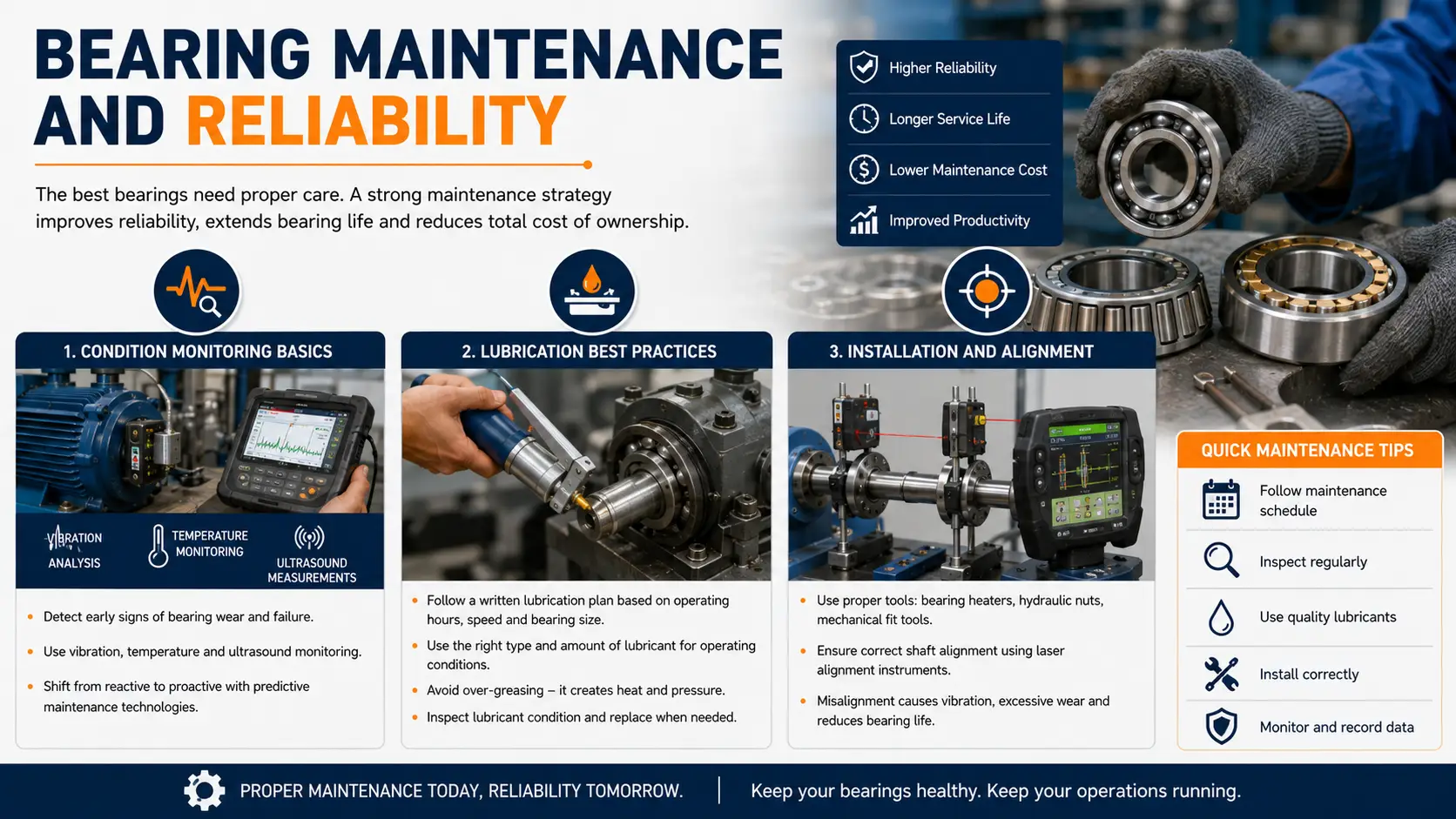
Bearing Maintenance and Reliability
The best of the best bearings will not last long if not well-maintained. By incorporating bearing maintenance into the overall equipment reliability strategy, the bearing's service life can be extended and the total cost of ownership (TCO) can be lowered.
Condition Monitoring Basics
Condition monitoring systems are being used in modern industrial plants to a greater extent to detect the early signs of deterioration in the bearings. Maintenance teams can use vibration analysis, temperature monitoring and ultrasound measurements to uncover potential problems before they become a failure. Predictive maintenance program developed with technologies from platforms by Schaeffler, SKF and others are changing the approach from a reactive to a proactive one.
Lubrication Best Practices
Have a written Lubrication Plan based on operating hours, speed and bearing size. Apply the proper amount of lubricant in the appropriate type for the operating temperature and load conditions. Don't over-grase, this will create heat and pressure in the bearing housing. During inspections, inspect lubricant and replace worn lubricant immediately.
Installation and Alignment
Avoid damaging bearing surfaces when installing the bearings by using proper installation equipment such as bearing heaters, hydraulic mounting equipment or mechanical fitting tools. Use laser alignment instruments to check for acceptable shaft alignment. When a bearing is misaligned, it will cause a substantial reduction in its service life, and will generate vibration throughout the connected equipment.
Bearing Procurement Considerations in Jordan
It is as critical to choose the correct bearing as it is to choose it. When it comes to industrial bearing procurement in Jordan, supplier reliability is a crucial factor, as is product authenticity, lead times, and total cost of ownership.
Supplier Verification: Assess the capability of suppliers to supply bearings from reputable manufacturers with traceability and certification. Request product documentation and compliance.
Lead Time and Stock Availability: Local availability of critical equipment bearings in Jordan or the availability of fast regional supply chain via GCC and MENA distribution network is important.
Technical Support: A competent procurement partner should provide you with technical advice on which bearings to use and not only on ordering bearings.
Counterfeit Risk Management: Global, including MENA, bearing market has documented risks of counterfeit products (Counterfeit Risk Management). This risk can be reduced if you work with sourcing services that have an established supply chain.
Standards Compliance: Make sure bearings included in equipment used in regulatory environment conform to ISO dimensional requirements and the criteria recognized by Jordan Chamber of Industry and JSMO.
Supplier Evaluation Checklist
Criteria | What to Verify |
Product Traceability | Manufacturer certification and batch documentation |
ISO Compliance | ISO 15:2017 (radial bearings) and relevant dimensional standards |
Technical Capability | Engineering support for selection and troubleshooting |
Stock & Lead Times | Local or regional inventory availability |
Pricing Transparency | Clear pricing without hidden import or logistics charges |
After-Sales Support | Warranty handling and replacement procedures |
Future Trends in Bearing Technology
The industry of bearings is progressing rapidly, and smart Jordan procurement and engineering teams should know about the new technologies that will affect bearings for the coming years:
IoT-Enabled Smart Bearings: The IoT-Enabled Smart Bearings are designed to enable a technologic shift from reactive to predictive maintenance by allowing the monitoring of temperature, vibration and load without the need for external monitoring equipment.
AI-Based Predictive Maintenance: Using vibration and performance data to forecast bearing failures, weeks in advance, through machine learning algorithms.
Hybrid Ceramic Bearings: Bearings with a steel ring and ceramic rolling elements that offer lighter weight, higher speed technology, electrical insulation and longer service life.
Energy-Efficient Bearing Designs: Low friction coatings, optimized internal bearing designs for energy efficiency in motor and pump applications – in tune with Jordan's sustainability and energy-saving goals.
Digital Procurement Platforms: Online sourcing platforms that allow users to instantly access bearing specifications, cross-references, availability and pricing — simplifying the MRO procurement process.
Frequently Asked Questions
What size bearings do I need?
Match the Bearing bore diameter with the Shaft diameter and the outer diameter of the bearing with the housing bore. Use the correct designation for bore by referring to ISO dimensional tables. The load capacity should always be checked in relation to the load requirement for your application.
What bearing is best for heavy industrial loads?
Typically, spherical roller bearings and cylindrical roller bearings are recommended for heavy radial loads. Tapered roller bearings are used for combined radial and thrust loads. The type depends on the magnitude and direction of the load.
How do the temperatures in the operation influence the choice of bearings?
High temperatures can cause dimensional changes of bearing materials, may cause the lubricant to lose its effectiveness and may necessitate wider internal clearances (C3 or C4 designation) for bearings. Always check the lubricant and bearing for their maximum operating temperature.
What are the distinction between sealed bearings and open bearings?
Sealed bearings are those with incorporated seals or shields to keep the lubricant in and dirt out. Are low maintenance but can be difficult to relubricate. Without the seals, open bearings need to be lubricated frequently from the outside, and would work best in clean and controlled environments where reliable lubrication programs are maintained.
What measures can be taken to avoid issues with bearings?
The Five Pillars of Bearing Failure Prevention are: Selecting the right bearing for the job, installing it with the right tools, following the proper lubrication schedule, monitoring the bearings, and taking action when risks are detected.
What type of bearings are used in an electric motor?
Deep groove ball bearings are widely used because they offer high design flexibility, are robust at high speeds and have quiet operation. However, for inverter-controlled motors, the use of Hybrid ceramic bearings is recommended to avoid damage to the insulated bearings.
What should be the requirements for bearings?
All bearings must comply with ISO standards and ABMA specifications, as well as the quality standards set by the Jordan Organization for Standardization (JSMO). The World Bearing Association (WBA) and the Schaeffler Technical Academy also provide helpful guidelines.
What is the frequency of bearing inspection?
Depending on the criticality of the equipment, operating conditions, and duty cycle, the frequency of inspections might vary. Inspection of high-speed, heavily loaded, or mission critical bearings will generally be monthly and/or quarterly. Condition monitoring can be used to optimize inspection times depending on the condition of the bearings and not only on time schedules.
Related Resources If you're looking for more technical advice, check out our in-depth Industrial Bearings Jordan article, which serves as your one-stop resource for Jordanian bearings types, sizes, and uses. For top-to-top coverage, check out our Bearings Pillar Page, which runs from the basics of bearings to advanced bearing reliability.
Conclusion
The right bearing selection in Jordan must be done using a systematic engineering process, where the type of load, speed of operation, operating environment, lubrication, and maintenance are taken into account. From a bearing in a conveyor for a phosphate mine to a bearing in a pump for a water treatment plant to a bearing in a motor in a packaging line, the bearing selection process described here will give you the framework for making informed and reliable decisions.
Jordan's industrial bearing market is a dynamic one that is continually reshaping itself with various new supplier choices, digital solutions, and smart bearings: By keeping up to date, and collaborating with informed sourcing partners, your operations will always have the right bearing solution at the right value.
Talk to Our Specialist — Get Expert Bearing Guidance for Your Application
Note: Brand names referenced in this guide (SKF, FAG, INA, NSK, NTN, Timken, KOYO, Nachi, IKO, RBC Bearings, and others) are mentioned for informational and educational purposes only. We operate as an independent sourcing and procurement service. We do not manufacture, private-label, or endorse any specific brand, and no commercial relationship or partnership with any manufacturer is implied.