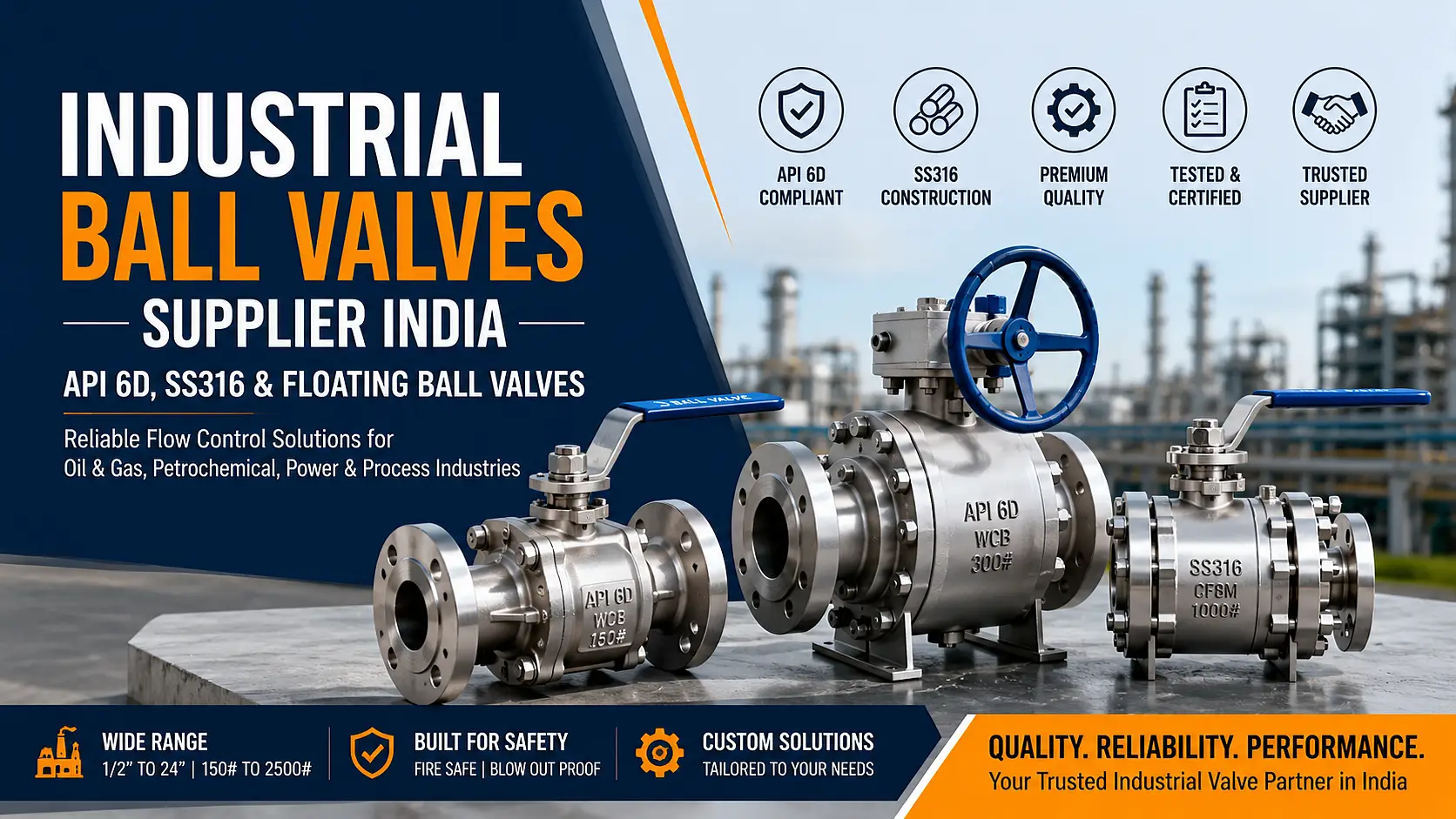
Industrial Ball Valves Supplier India: Complete Procurement Guide for Industrial Buyers
It is not a paperwork issue if the wrong valve is used at an isolation point in a refinery or at a chemical transfer line. It is a process safety issue that presents itself months after the commissioning, typically at inappropriate times. For a procurement manager, EPC contractor and plant engineer who evaluates an industrial ball valves supplier india project on which to rely on, it isn't just about ordering the price of a valve from a catalogue that appears on their screen: it's about confirming the authenticity of a certificate, material traceability, and testing documentation before an order is even raised.
The demand for valves is growing at a fast pace in India's industrial sector. The current target of the Ministry of Petroleum & Natural Gas for a significant increase in the national refining capacity to more than 309 MMTPA by 2028 is also creating a constant demand for certified flow control equipment, in addition to the continuous investment in petrochemicals in Gujarat and Maharashtra. In this demand, ball valves are the most commonly specified type of valve used on oil and gas, petrochemical, water treatment, and power plant piping.
The guide is designed for technical buyers who know something about valves and want a clear and reliable framework to help them assess an industrial ball valves supplier in india project team: valve types, materials, the standards that really matter, pressure classes, testing requirements, and a procurement checklist that allows him to see through a vendor's certificate to a credible supplier.
What Are Industrial Ball Valves?
An industrial ball valve is a type of quarter-turn valve designed with a ball that has a hole in the middle, which is used to start, stop or control the flow of fluid in a pipe. When the valve is 90° from the bore, the bore is in line with the pipe and the valve is open, providing fast, reliable on-off isolation with minimal pressure loss when the valve is fully open, and the bore is "aligned" with the pipe.
In many industrial pipe applications, ball valves are preferred over other types of isolation valves for tight shut-off, low operating torque and long service life. This Ball Valve procurement guide is part of industrial valves guide, which offers a broader overview of all types of industrial valves.
Types of Industrial Ball Valves
The first step in any sourcing decision for an industrial ball valve india manufacturer is to make an accurate choice. Each design have different pressure, size and service requirements.
Industrial Ball Valve Type Overview
Valve Type | Body Construction | Typical Size Range | Best Application |
Two-Piece Ball Valve | Split body, forged or cast | 1/4" - 4" | General isolation, instrumentation, utility lines |
Three-Piece Ball Valve | Bolted three-piece body | 1/2" - 12" | Easy maintenance, frequent inline servicing |
Trunnion Mounted Ball Valve | Mechanically supported ball | 2" - 48"+ | High-pressure pipeline and process isolation |
Floating Ball Valve | Ball supported by seats | 1/4" - 12" | Low to medium pressure general service |
Fully Welded Ball Valve | Welded body, no gasket joints | 1/2" - 42" | Cross-country pipeline, leak-critical service |
Cryogenic Ball Valve | Extended bonnet design | 1/2" - 24" | LNG, liquid nitrogen, low-temperature service |
Floating Ball Valves
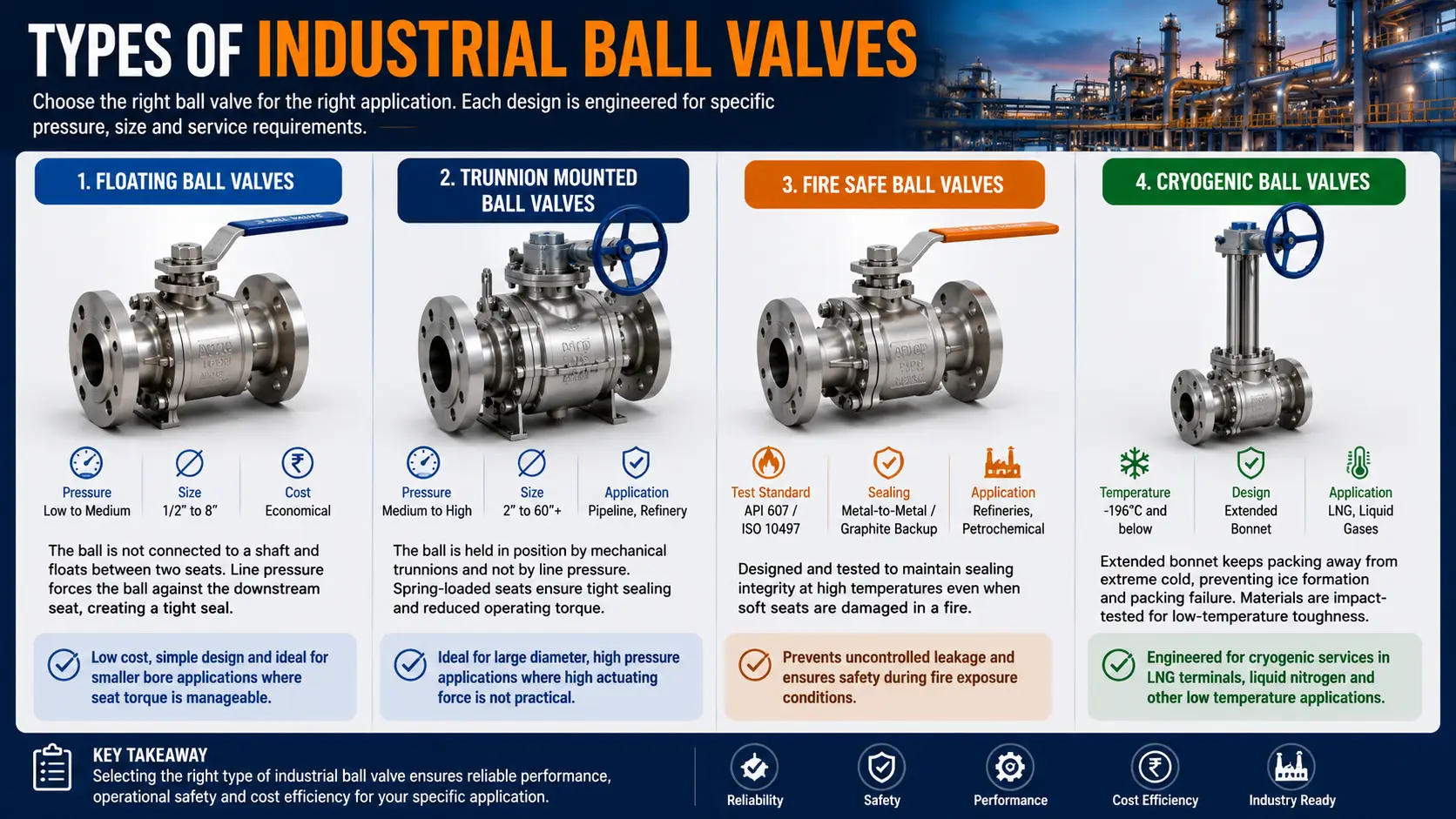
For low to medium pressure service a floating ball valves india is commonly specified, in this case, the ball is not connected to a shaft, but simply floats between two seats with line pressure forcing the ball against the downstream seat and causing the sealing. The design is low cost, straightforward and suitable for smaller bores where torque that is imposed on seats is manageable.
Trunnion Mounted Ball Valves
For refinery and pipeline applications, a mechanical trunnions mounted ball valves india is used in a project where the ball is not held in place by line pressure, but by spring loaded seats. This substantially lowers the operating torque required for larger valves and results in the use of trunnion designs being the norm for large diameter pipeline isolation valves in high pressure applications where a floating design would require an impractical amount of actuating force.
Fire Safe Ball Valves
A fire safe ball valves india refineries and petrochemical plants are designed and tested to provide an acceptable degree of sealing at high temperatures even when the main (usually PTFE) ball seat is damaged by the heat of a fire. Fire safe testing to API 607 or ISO 10497 tests to ensure that a second metal-to-metal or graphite seal is in place when the soft seal fails to ensure a fire cannot be fed by an uncontrolled valve leak.
Cryogenic Ball Valves
Cryogenic valves are used at LNG terminals, liquid nitrogen handling and in all applications that handle fluids at very low temperatures. The extended bonnet design ensures that the stem packing is kept away from the cold process fluid, thereby avoiding ice formation and packing failure; the valve body materials have been chosen and impact-tested for toughness at the specified low-temperature rating, which is relevant in the context of the growth of LNG import terminal infrastructure in the Indian market.
Floating vs Trunnion Ball Valves: Head-to-Head Comparison
Floating vs Trunnion Mounted Ball Valve Comparison
Factor | Floating Ball Valve | Trunnion Mounted Ball Valve |
Sealing mechanism | Line pressure pushes ball onto seat | Spring-loaded seats; ball position fixed |
Operating torque | Increases significantly with size/pressure | Lower and more consistent across sizes |
Typical pressure class | Up to Class 600 (general service) | Class 600 to 2500+ (high pressure) |
Typical size range | Smaller bore, up to approximately 12" | Larger bore, 2" up to 48"+ |
Best application | General isolation, instrumentation | Pipeline, high-pressure process isolation |
Relative cost | Lower for equivalent size | Higher due to trunnion and bearing components |
Industrial Ball Valve Materials
The materials for an industrial ball valves supplier india sources must be perfectly matched to the process fluid, pressure and temperature — one of the most common and expensive procurement errors in industrial valve sourcing is to try to source a similar looking grade of material.
Carbon Steel Valves
Generally, Carbon Steel (cast & forged) is used for the body material for hydrocarbon, water, and non-corrosive process service. These are used extensively in India's refinery and pipeline industry and have good mechanical properties at a lower cost than alloy or stainless grades.
Stainless Steel Valves
Where corrosion resistance is needed, cast 316 equivalent (CF8M) and forged 316 stainless steel are specified as in chemical processing, food and pharmaceutical service, and anytime exposed to chlorides or mild acids. For chemical plants, the body and trim are usually specified as CF8M stainless steel ball valves, which offer a good combination of corrosion resistance and cost compared to other alloys.
Duplex and Forged Steel Valves
Duplex and super duplex stainless grades are used for offshore, seawater and high chloride process applications due to their high resistance to chloride stress-corrosion cracking and higher strength. Forged steel ball valves buyers are used in smaller bore sizes for high pressure applications, as they will have a denser, more homogeneous grain structure than cast steel valves, making them sometimes required for critical isolation points up to about 4” in high pressure applications.
API 6D and Valve Standards
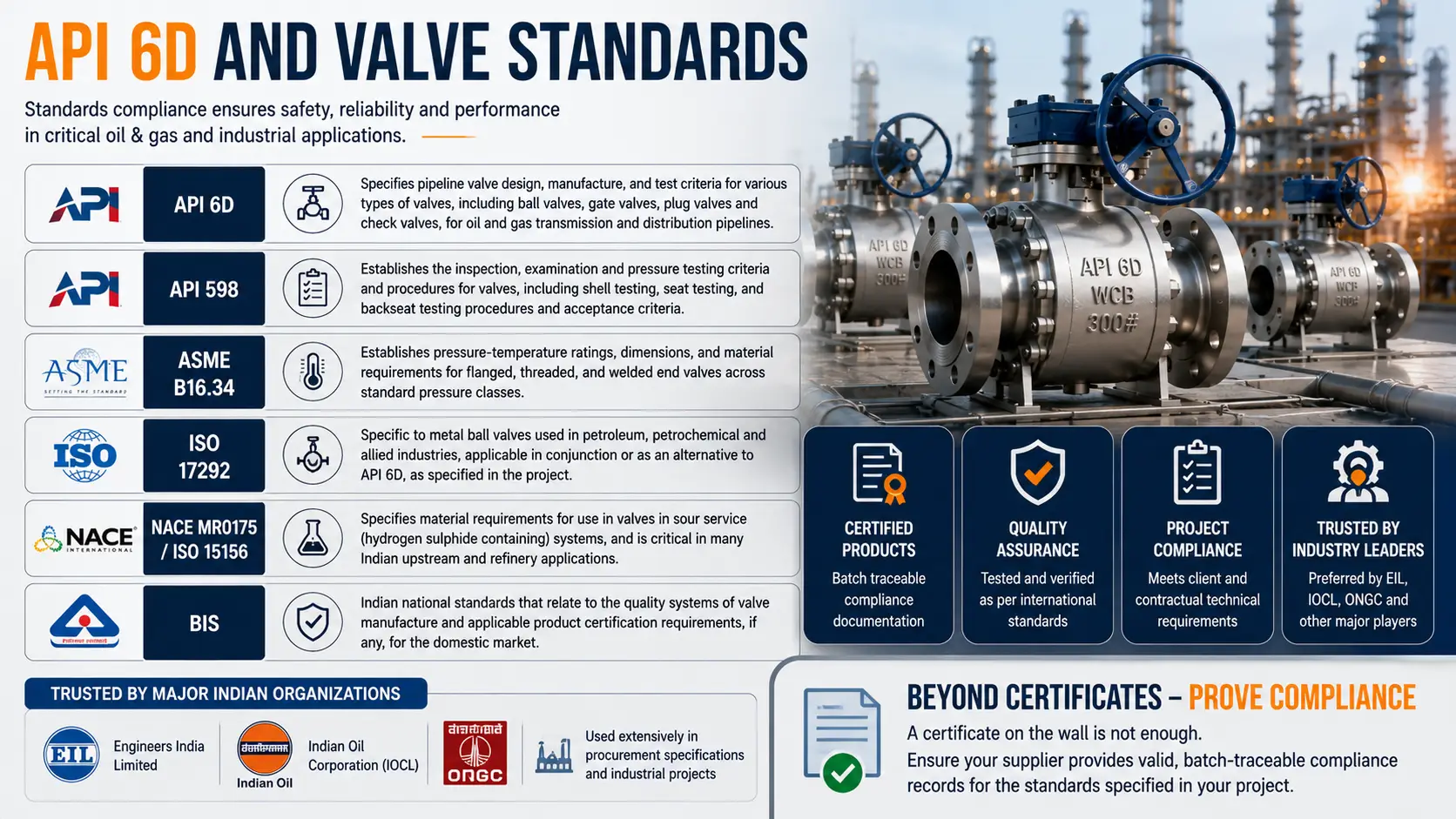
The most crucial verification is the standards compliance in the documentation provided by an api 6d ball valves india supplier. The certificate displayed on the wall is not a valid current current batch-traceable compliance record.
API 6D: Specifies pipeline valve design, manufacture, and test criteria for various types of valves, including ball valves, gate valves, plug valves and check valves, for oil and gas transmission and distribution pipelines.
API 598: Establishes the inspection, examination and pressure testing criteria and procedures for valves, including shell testing, seat testing, and backseat testing procedures and acceptance criteria.
ASME B16.34: Establishes pressure-temperature ratings, dimensions, and material requirements for flanged, threaded, and welded end valves across standard pressure classes.
ISO 17292: API Standard 6D specifically for metal ball valves used in petroleum, petrochemical and allied industries, which is applicable in conjunction or as an alternative to ISO 17292, as specified in the project.
NACE MR0175 / ISO 15156: Specifies material specifications for use in valves in sour service (hydrogen sulphide containing) systems, and is critical in many Indian upstream and refinery applications.
Bureau of Indian Standards (BIS): Indian national standards that relate to the quality systems of valve manufacture and applicable product certification requirements, if any, for the domestic market.
Engineering firms like Engineers India Limited (EIL), Indian Oil Corporation (IOCL) and ONGC use these standards extensively in their specifications for procurement of industrial valves and projects in which they are involved, therefore, a credible projects with national oil company involvement projects depend on industrial valve suppliers in India must be able to prove that its products meet the particular standard specified in the project's material requisition and not just that they are “API certified”.
Pressure Classes Explained
Industrial Ball Valve Pressure Class Reference (ASME B16.34)
Pressure Class | Approx. Rating (CWP, psi) | Typical Application |
Class 150 | 275 psi (carbon steel, ambient) | General service, utility, low-pressure water |
Class 300 | 720 psi (carbon steel, ambient) | Process plant piping, moderate pressure service |
Class 600 | 1,440 psi (carbon steel, ambient) | Refinery process units, higher pressure service |
Class 900 | 2,160 psi (carbon steel, ambient) | High-pressure process and pipeline applications |
Class 1500 | 3,600 psi (carbon steel, ambient) | Wellhead, high-pressure transmission service |
Class 2500 | 6,000 psi (carbon steel, ambient) | Extreme high-pressure, upstream applications |
Pressure ratings are for cold working pressure (CWP) at ambient temperature, and may be less at higher temperatures, so should always be checked against the valve's actual material and process operating temperature, and should not be interpreted as a constant value as per ASME B16.34.
Industrial Applications
Oil and Gas: Trunnion and floating ball valves are widely used in many pressure ranges and are critical in many applications such as wellhead isolation and pipeline sectionalizing as well as process unit isolation on oil and gas facilities, including those in Jamnagar and Hazira industrial area.
Petrochemical: Valves in petrochemicals are selected based on the chemical compatibility of the process stream and these valves are used to block or transfer chemicals, to provide a reactor medium isolation and to isolate utility systems at the Dahej petrochemical zone.
Power Generation: A combination of carbon steel and stainless ball valves are used for the type of power generation application, such as boiler feedwater, cooling water and steam isolation, depending on the temperature and pressure profile of the specific application.
Water and Wastewater Treatment: The growing demand for water and wastewater treatment is creating a significant demand for ball valves in treatment plant process lines and distribution network isolation points through initiatives like Jal Jeevan Mission and AMRUT 2.0.
LNG and Cryogenic Service: LNG and Cryogenic Service: India is increasingly implementing LNG import terminals, which need cryogenic-rated ball valves that are specially developed for low-temperature applications, a niche category in the industrial valves market.
Testing and Inspection Requirements
Qualified valve testing documentation is what distinguishes a real qualified valve from a valve that appears to be qualified on a datasheet.
Hydrostatic Testing
Hydrostatic testing of the valve body according to API 598 assures that the valve is capable of holding the rated pressure without leakage and the valve seat assures the specified leakage class when closed. Test pressure, test duration and acceptable leakage rates are all specified in the standard and must be recorded on a traceable test certificate, not only for a sample of the production batch.
Fire Safe Testing
Fire safe testing, conforming to API 607 or ISO 10497, is performed to ensure that the valve will continue to perform its sealing function during a simulated fire and after cool down and that the backup sealing function works as specified.
Material Traceability
The EN 10204 3.1 or 3.2 material certificates show where the valve body, ball, and trim materials have come from, and the chemical and mechanical results on the material from that batch. For critical service applications, 3.2 certification (which is independently witnessed and verified) should be used, not the less stringent 3.1.
How to Choose a Supplier
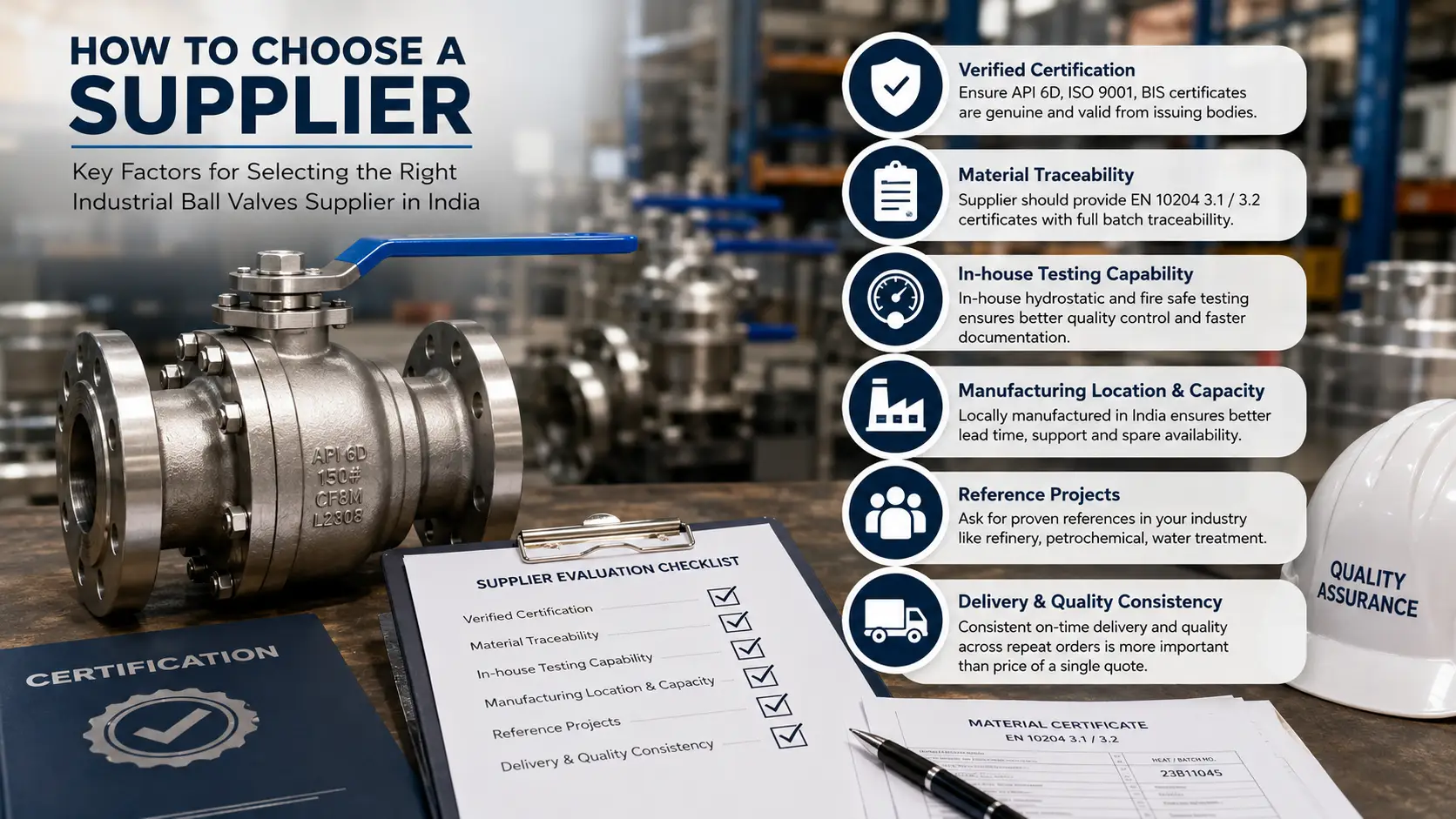
Choosing the correct industrial ball valves supplier india project involves ensuring the supplier's capability claims are backed by proven documentation, rather than simply taking their word for granted.
Verified certification: Ask for the actual certificate (API 6D monogram license, ISO 9001, BIS if applicable) and ask the issuing body whether it is valid or not (not just by a logo on the supplier's website).
Material traceability: Ensure that the supplier can supply material certificates to conform to EN 10204 3.1 or 3.2 with full batch traceability of each valve body, ball and trim component supplied.
In-house testing capability: A supplier that has the ability to internally test in hydrostatic and fire safe test facilities, rather than fully-outsourcing testing, will likely have better quality control and a faster turn around for documentation.
Manufacturing location and capacity: If the valve is manufactured in India (common in the industrial belts of Gujarat and Maharashtra), it's a local product; However, if it's sourced from abroad and re-badged then it does have a significant implication on lead time, after-sales support, and spare parts availability.
Reference projects: Request concrete references from projects you can map to your particular industry (refinery, petrochemical, water treatment), instead of general references for industry experience.
Delivery and quality consistency: If you need to place repeat orders or multi-valve orders, you should take into account the supplier's history of delivering on schedule and consistent quality from one batch to the next – more important than the price of a single quotation.
In cases of procurement of other process equipment, along with valves, our oil and gas equipment guide has a broader scope of valves and material standards for upstream, midstream and downstream Indian projects.
Procurement Checklist
Ensure the correct valve type is specified (floating, trunnion mounted, fully welded and cryogenic)
Verify body/trim material with full process fluid specification, not a general category
Verify Pressure Class and Temperature Rating to actual operating conditions, including transients
Indicate precise standard to be followed: API 6D, ISO 17292 or project specific equivalent.
Request fire safe certification (API 607/ISO 10497) for hydrocarbon or flammable service
Verify NACE MR0175 compliance in case of sour service conditions
Ask for Material certificate according EN 10204 3.1 or 3.2, along with full batch traceability
Check hydrostatic and seat leakage test certificates for the item of valves being supplied
If to be automated (pneumatic or electric), confirm the compatibility of the actuator.
Review timelines of delivery with project schedule and ensure the penalty/quality clauses in the Purchase Order are in place
Frequently Asked Questions
Question | Answer |
What is an industrial ball valve? | Valves with a rotating ball that have a hole in the center and are used to open, close or adjust flow in industrial piping systems, with tight shut-off and low operating torque. |
What industries use industrial ball valves? | Ball valves are used in various industries for flow isolation and control, including oil and gas, petrochemical, power generation, water, wastewater treatment, chemical processing and general industrial manufacturing. |
What is API 6D certification? | API 6D is the American Petroleum Institute specification for design, manufacture and test requirements for ball, gate, plug and check valves for oil and gas transmission pipelines. |
What is the difference between floating and trunnion ball valves? | The ball is held up by the seats on a floating ball valve and the line pressure pushes the ball against the downstream seat to close the ball valve. The trunnion mounted ball valve utilizes mechanical supports to hold the ball in place and spring loaded seats to create the sealing force and consequently less operating torque for larger or higher pressure valves. |
What is a fire safe ball valve? | A valve that has been designed and tested to provide an acceptable level of sealing after the soft seat is destroyed by fire, as a result of the fire or heat, and operates with a secondary metal-to-metal sealing component. |
What is a cryogenic ball valve? | A valve designed for very low temperature use, including LNG, liquid nitrogen and other applications using cryogenic fluids, built with materials that are impact tested for these applications. |
How do I choose an industrial ball valve supplier in India? | Check certification against the certifying authority, confirm the material traceability documentation, verify in-house testing, know the manufacturing site, and ask for verifiable project references on your industry segment. |
Which material is best for ball valves? | The selection of materials is based on process fluid, pressure, and temperature. For general hydrocarbon and water service, use carbon steel (WCB); for corrosive and chemical service, use stainless steel (CF8M) and for high-chloride and offshore service use duplex grades. |
What is NACE MR0175? | NACE MR0175 (in accordance with the ISO 15156) establishes material considerations for equipment operating in sour service applications that have hydrogen sulphide present in the environment, which has significance for many applications in the upstream oil and gas industry in India. |
What is a DBB (Double Block and Bleed) valve? | Two independent seals for isolation with a bleed point in between for checking that both seals are holding without being removed from the line. |
How are industrial ball valves tested? | Using the hydrostatic shell and seat testing as per API 598, the fire safe testing as per API 607 or ISO 10497 for hydrocarbon service and the material verification as per EN 10204 traceable certificates. |
Conclusion
The exercise of choosing an industrial ball valves supplier india project depends on is as much a documentation exercise as technical. The valve type, material and pressure class should be exactly matched to the process conditions; the referenced standard in the project specification (API 6D, ISO 17292 or equivalent) must be verifiably current; and the test and trace documentation must be batch-specific and not generic.
Procurement teams that consider verified certification, confirmed material traceability, and documented testing, which are just a few of the many attributes to look for in product verification, rather than catalogue claims alone, can avoid the compliance and reliability issues that arise in a project later in the lifecycle. The cautious evaluation method is even more useful than ever as the need to upgrade India's refining capacity and invest in water infrastructure continues to grow.
This guide is intended as an independent sourcing and procurement guide to ensure that technical buyers have a valid reference to examine, assess and compare industrial ball valves supplier india options. Request a Technical Consultation to discuss project needs, pressure, temperature, compliance.
Need a reliable industrial ball valves supplier in India? Submit your requirements and get a free quote from verified suppliers.
DISCLAIMER: ZFC Corporation is not affiliated with, authorized by, endorsed by, or acting as an official representative of any manufacturer, brand, or trademark owner referenced on this website. All product names, trademarks, brand names, logos, and manufacturer references are the property of their respective owners and are used solely for identification, reference, and compatibility purposes.