Industrial Electrical Cables in Bangladesh: Complete Industrial Buying & Selection Guide
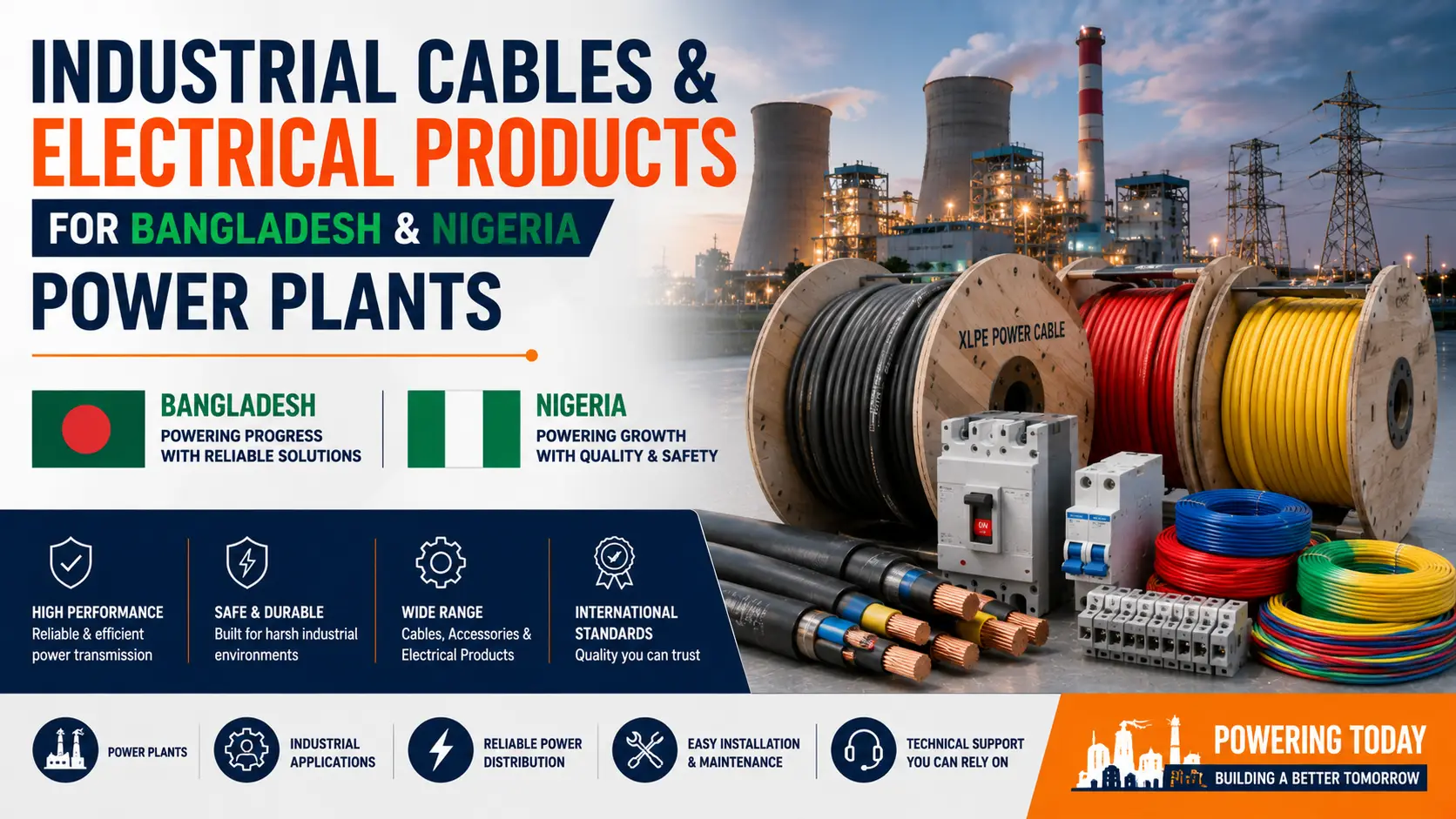
Whether it's the textile industry in Gazipur or manufacturing in Narayanganj, or infrastructure works in Chattogram, industrial cables electrical Bangladesh Nigeria suppliers play a crucial role in ensuring the safe and reliable transmission of electricity. From the wiring from a new manufacturing facility to the upgrading of control systems in automation equipment, sourcing industrial cable electrical Bangladesh Nigeria projects is not just dependent on prices. This guide introduces the various types of cables available, IEC standards, applications, cable criteria, and how objective and based on the cable specification, one would evaluate the suppliers.
Looking for a price quote for industrial electrical cables for your project?
What Are Industrial Electrical Cables?
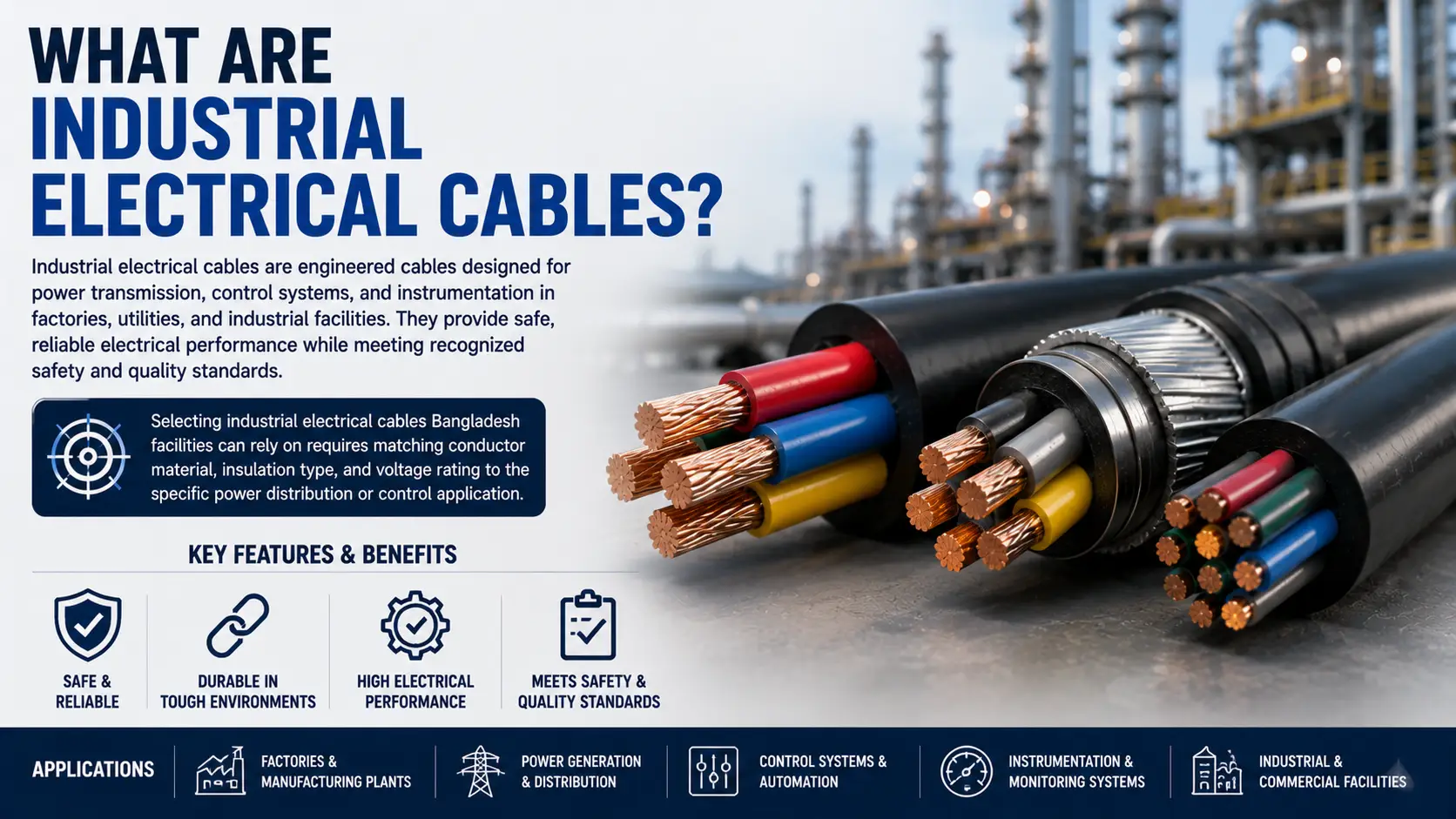
Industrial electrical cables are designed cables used for power transmission, control and instrumentation of industrial factories, utilities and industrial facilities. They offer safe and reliable electrical performance, as well as acknowledged safety and quality requirements. The choice of industrial electrical cables Bangladesh facilities need to rely on depends on the conductor material, insulation type and voltage rating for the power distribution or control application.
Types of Industrial Electrical Cables
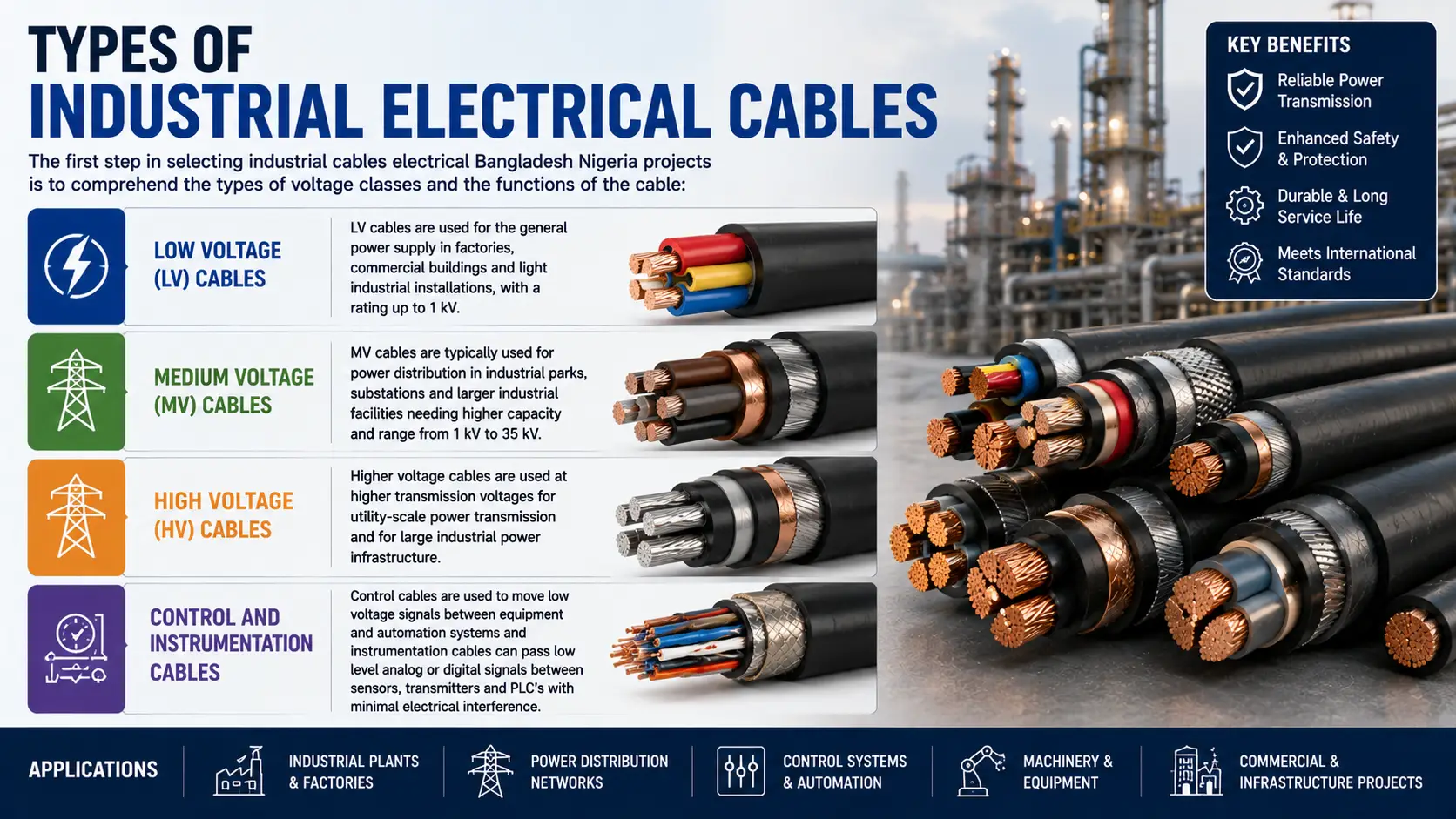
The first step in selecting industrial cables electrical Bangladesh Nigeria projects is to comprehend the types of voltage classes and the functions of the cable:
Low Voltage (LV) Cables
LV cables are used for the general power supply in factories, commercial buildings and light industrial installations, with a rating up to 1 kV.
Medium Voltage (MV) Cables
MV cables are typically used for power distribution in industrial parks, substations and larger industrial facilities needing higher capacity and range from 1 kV to 35 kV.
High Voltage (HV) Cables
Higher voltage cables are used at higher transmission voltages for utility-scale power transmission and for large industrial power infrastructure.
Control and Instrumentation Cables
Control cables are used to move low voltage signals between equipment and automation systems and instrumentation cable supplier companies usually have cables that can pass low level analog or digital signals between sensors, transmitters and PLC's with minimal electrical interference.
Power Cables vs Control Cables vs Instrumentation Cables
Cable Type | Function | Typical Application |
Power cables | Transmit electrical energy | Motors, distribution panels, main feeders |
Control cables | Carry low-voltage control signals | Automation systems, equipment interlocks |
Instrumentation cables | Transmit analog/digital signals | Sensors, transmitters, PLC connections |
XLPE vs PVC Cable Comparison
Cables have a strong dependence on the type of insulation used. For such applications as medium-voltage power, XLPE cable Bangladesh buyers choose it because it provides higher temperature resistance, better electrical properties, higher mechanical strength, and reduced dielectric losses compared to conventional PVC insulation.
Factor | XLPE Insulation | PVC Insulation |
Temperature resistance | Higher, suited to demanding environments | Lower, general-purpose applications |
Mechanical strength | Greater durability under stress | Moderate durability |
Dielectric losses | Lower losses, better efficiency | Higher losses at high voltage |
Typical use | MV/HV power distribution, industrial plants | LV wiring, general commercial use |
Armored vs Unarmored Cable Selection
Armored Electrical Cable Bangladesh provides an extra layer of metal that gives it mechanical protection, which is suitable for underground, outdoor and extreme industrial environments. Unarmored cables are less expensive and are recommended for use in protected installations indoors where the likelihood of mechanical damage is low.
Industrial Applications Across Bangladesh
Demand for industrial cables in Bangladesh Nigeria facilities is across a range of sectors that are important to manufacturing and infrastructure in the country:
Power distribution systems in textile and garment manufacturing plants
Automation and control cabling with connections in the industrial zone of Gazipur. Automation and control cabling connectivity in the manufacturing zone of Gazipur.
Electrical wiring in Food Processing and pharmaceutical plants.
Medium-voltage power cables for renewable energy installations
The electrical infrastructure for the commercial high-rise buildings in Dhaka city is discussed. Electrical infrastructure in commercial high-rise buildings in Dhaka city is being discussed.
Industrial distribution networks in the vicinity of Mongla and Payra Ports
International Standards for Industrial Cables
When selecting a power cable supplier in Bangladesh, customers should ensure that the supplier is certified to meet the standards. The IEC standards are used globally for cable design, testing and performance, and there are many other standards which are commonly used in project specification, such as IEEE and BS standards, in addition to the BSI requirements by Bangladesh Standards and Testing Institution (BSTI) for local compliance.
Standard / Organization | Relevance |
IEC (International Electrotechnical Commission) | Core international cable design and testing standards |
IEEE | Engineering standards referenced in power system specifications |
BS (British Standards Institution) | Commonly referenced alongside IEC in project specs |
BSTI | Bangladesh Standards and Testing Institution local compliance |
How to Select the Right Industrial Cable
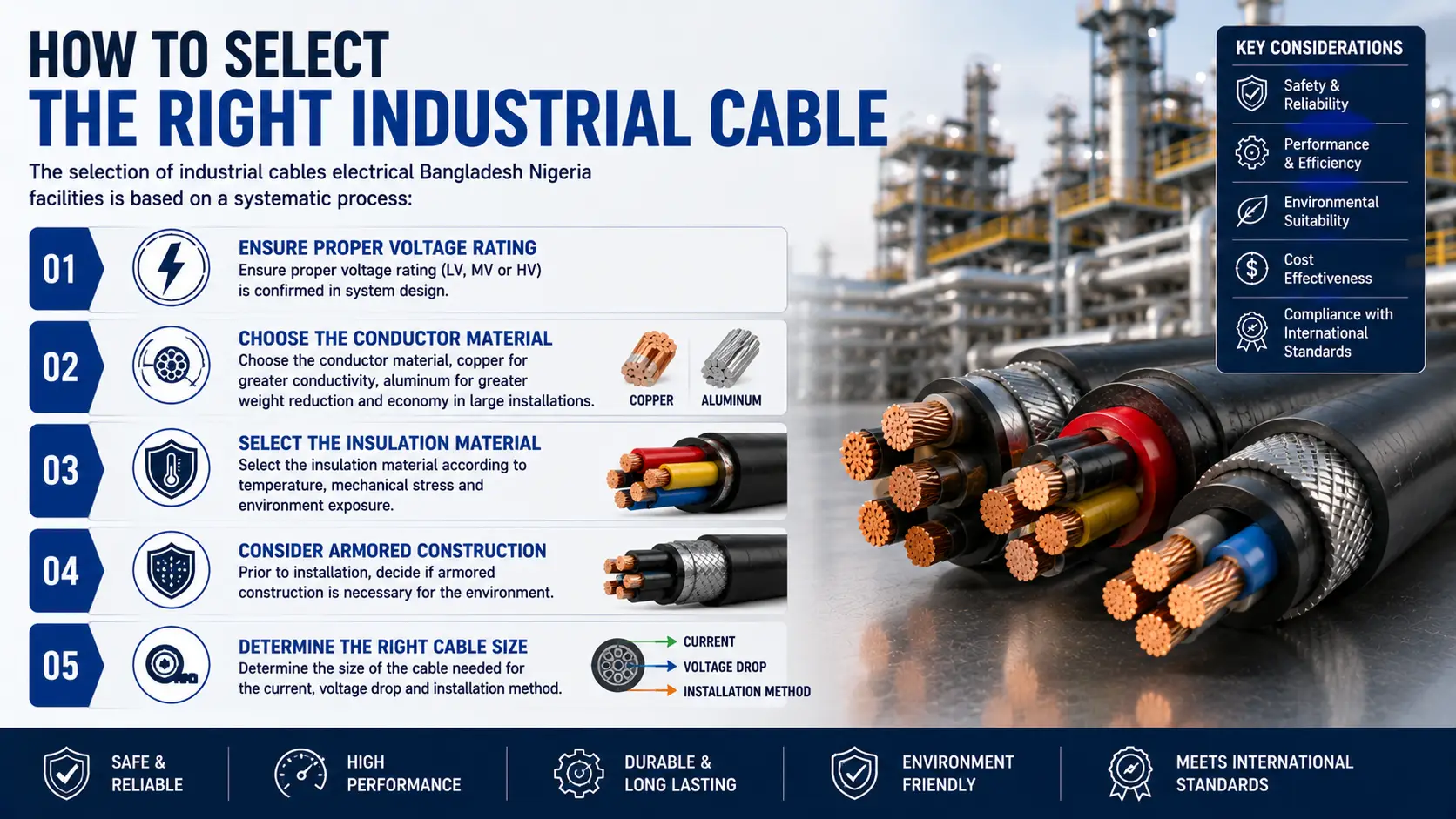
The selection of industrial cables electrical Bangladesh Nigeria facilities is based on a systematic process:
Ensure proper voltage rating (LV, MV or HV) is confirmed in system design
Choose the conductor material, copper for greater conductivity, aluminum for greater weight reduction and economy in large installations.
Select the insulation material according to temperature, mechanical stress and environment exposure.
Prior to installation, decide if armored construction is necessary for the environment.
Determine the size of the cable needed for the current, voltage drop and installation method.
Factors Affecting Cable Performance
The current-carrying capacity will be affected by the ambient temperature and installation manner.
The total length of the circuit and the voltage drop across the length of the circuit.
Mechanical stress, due to routing during installation and exposure to the environment
Future load growth needs for cable sizing decisions
Cable Installation Best Practices
The reliability and safety of industrial cable electrical Bangladesh Nigeria installations hinges on the direct effects of proper installation.
Be sure to bend and install according to the manufacturer's bend radius specifications to prevent damage to the insulation.
Ensure proper cable glands and cable termination kits are used for the installation environment
Carefully avoid running cables near heat and mechanical stress points.
Check correct grounding and shielding of instrumentation cables to minimize interference
Industrial Cable Procurement Checklist
When it comes to industrial cable distributors in Bangladesh, you should not rely on the price details in a catalog. Buyers are advised to check the compliance certificates, IEC testing certificates, conductor specification and third party certifications prior to making bulk purchases. Cable installations are normally used in conjunction with some type of distribution equipment, so our Power & Distribution Page outlines panels and switchgear selection, and our Safety Article discusses personnel safety around live cables. The Electrical Pillar resource provides a more in-depth look at cable types, standards and accessories for all industrial electrical uses.
Frequently Asked Questions
Which is the best industrial electrical cable in factories?
The armored cables with XLPE insulation are generally employed in the severe industrial applications because they offer temperature rating and mechanical protection.
What size cable should I use?
The size of the cable is determined by the size of the current, the amount of voltage drop, how the cable is installed, ambient temperature, and the distance of the circuit.
Which is better: XLPE or PVC cable?
Compared to the traditional PVC insulation, XLPE insulation has higher temperature resistance, good electrical properties and long service life.
What are armored cables used for?
Armored cables offer extra protection from mechanical damage for underground, outdoor and rough industrial environments.
What are the standards for cables in industrial projects?
Industrial cables should be based on IEC, IEEE, ISO, BS or other country standards as per the requirement of the project.
What are the applications of instrumentation cables?
Any facility employing PLC, sensors and automated control systems or ones involved in oil and gas, pharmaceuticals, food processing and manufacturing.
How many years do industrial cables last?
Well installed, quality industrial cables can endure 20-40 years with proper working and maintenance conditions.
What are the certifications that industrial cables should have?
Consult IEC Testing Reports, conductor specification, quality of insulation, and third-party testing certifications.
Request Industrial Cable Sourcing Assistance
Are you in need of industrial cables electrical Bangladesh Nigeria projects require for production, infrastructure or distribution of power? Our team is an independent sourcing partner, assisting you in finding power, control and instrumentation cables that meet the standards, are matched to your voltage rating, insulation and certification needs and are sourced from a number of manufacturers. Visit our Electrical Pillar, Power & Distribution Page and our Safety Article for other procurement resources.
Seek professional advice on cable specifications and ordering your cable for your project.
DISCLAIMER: Z&F Corporation is not affiliated with, authorized by, endorsed by, or acting as an official representative of any manufacturer, brand, or trademark owner referenced on this website. All product names, trademarks, brand names, logos, and manufacturer references are the property of their respective owners and are used solely for identification, reference, and compatibility purposes.