Industrial Fasteners Supplier in GCC: Complete Guide for Industrial Procurement
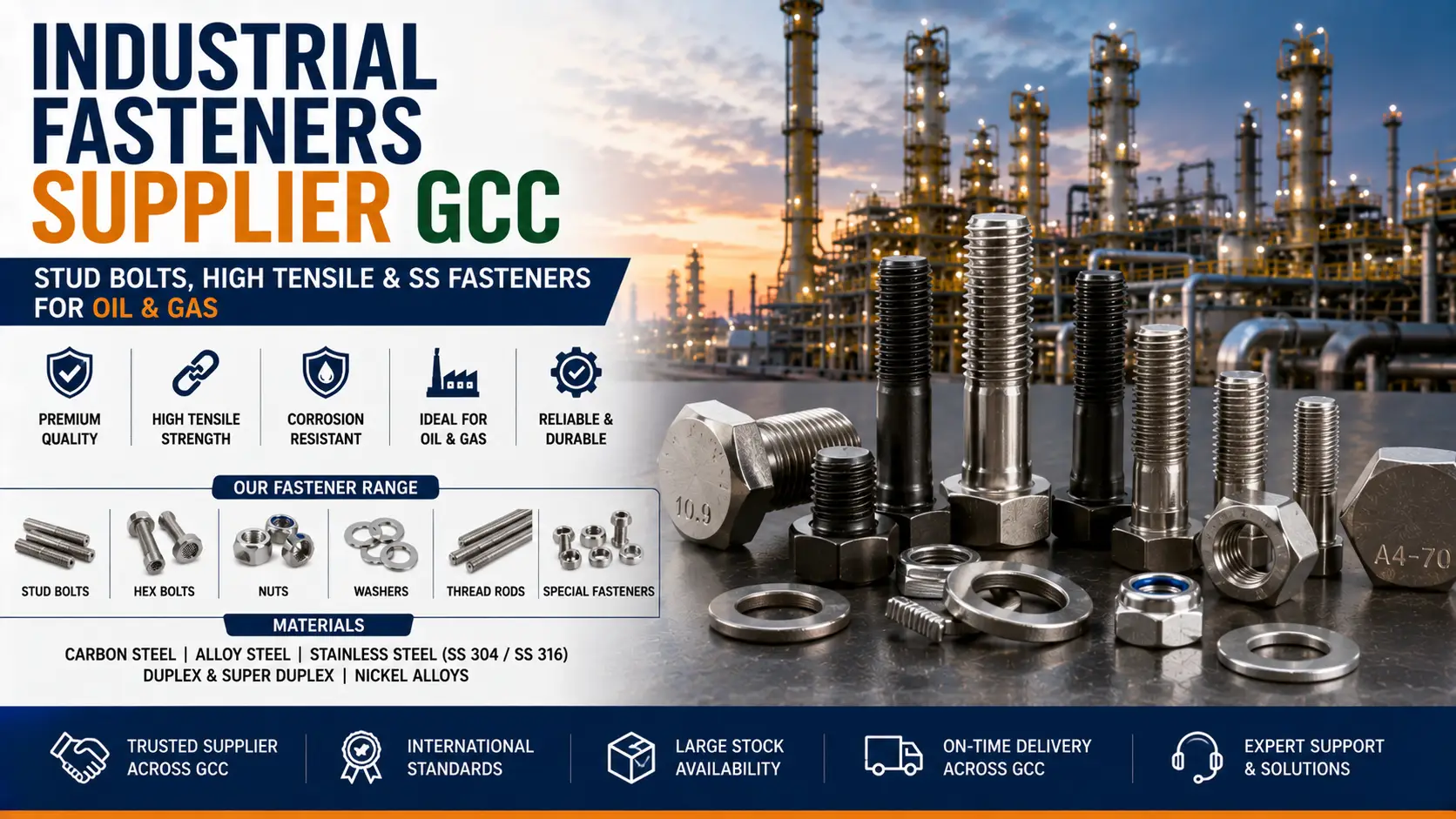
Whether it's for refineries, construction sites, or manufacturing plants, a dependable industrial fasteners supplier in the GCC region can ensure that projects are completed on time and equipment is operating safely. In the fields of petrochemical turnarounds in Jubail, construction in Dubai, or infrastructure in Doha, selecting the right industrial fasteners supplier is a direct decision that impacts not just on safety standards and compliance, but also on overall project costs. This guide explains the different types of fasteners, fasteners materials, international standards, applications and how to assess the suppliers based on objective and specification criteria.
Looking for certified industrial fasteners quotes for your project?
What Are Industrial Fasteners?
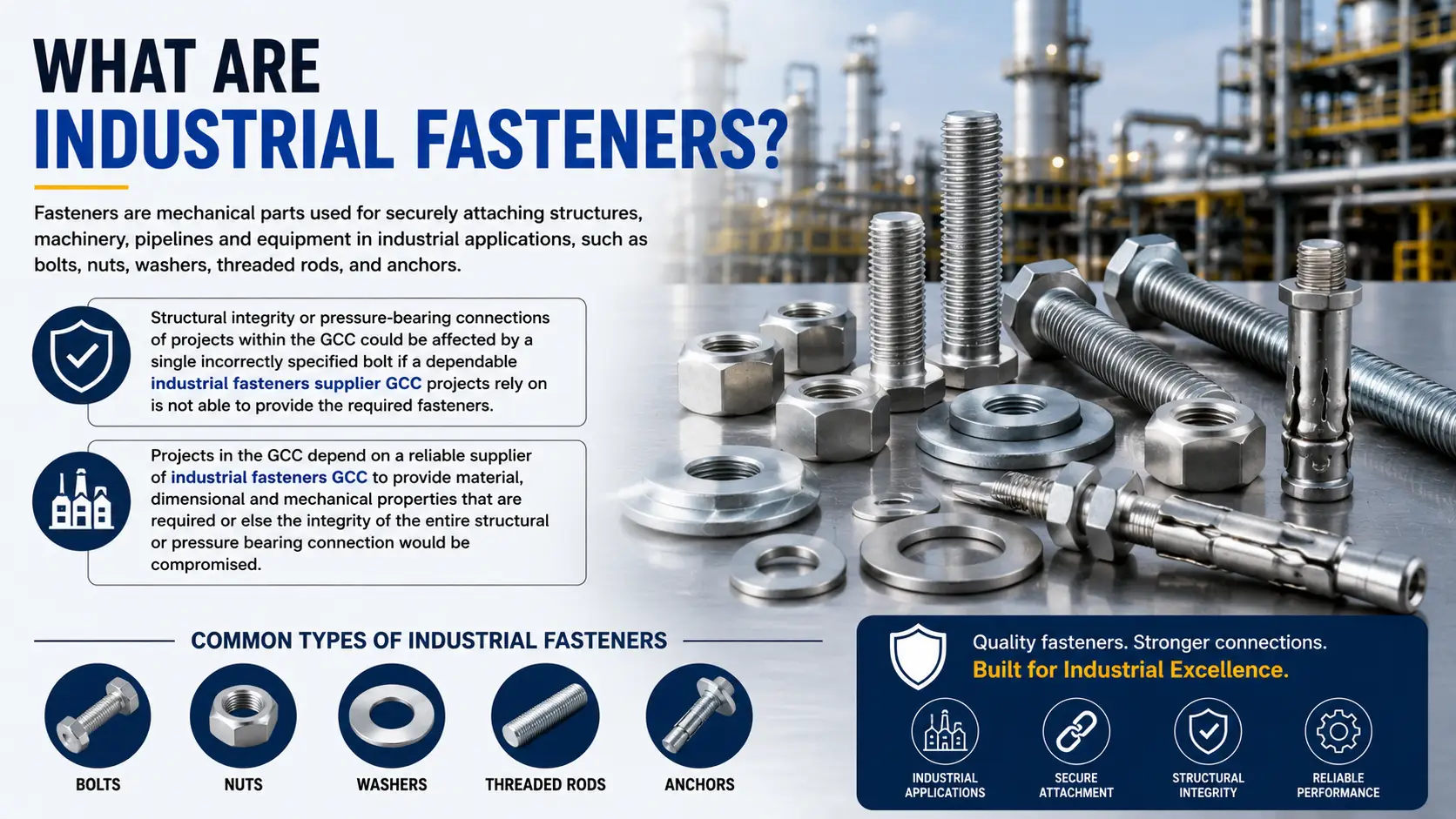
Fasteners are mechanical parts used for securely attaching structures, machinery, pipelines and equipment in industrial applications, such as bolts, nuts, washers, threaded rods, and anchors. Structural integrity or pressure-bearing connections of projects within the GCC could be affected by a single incorrectly specified bolt if a dependable industrial fasteners supplier GCC projects rely on is not able to provide the required fasteners.Projects in the GCC depend on a reliable supplier of industrial fasteners GCC to provide material, dimensional and mechanical properties that are required or else the integrity of the entire structural or pressure bearing connection would be compromised.
Types of Industrial Fasteners
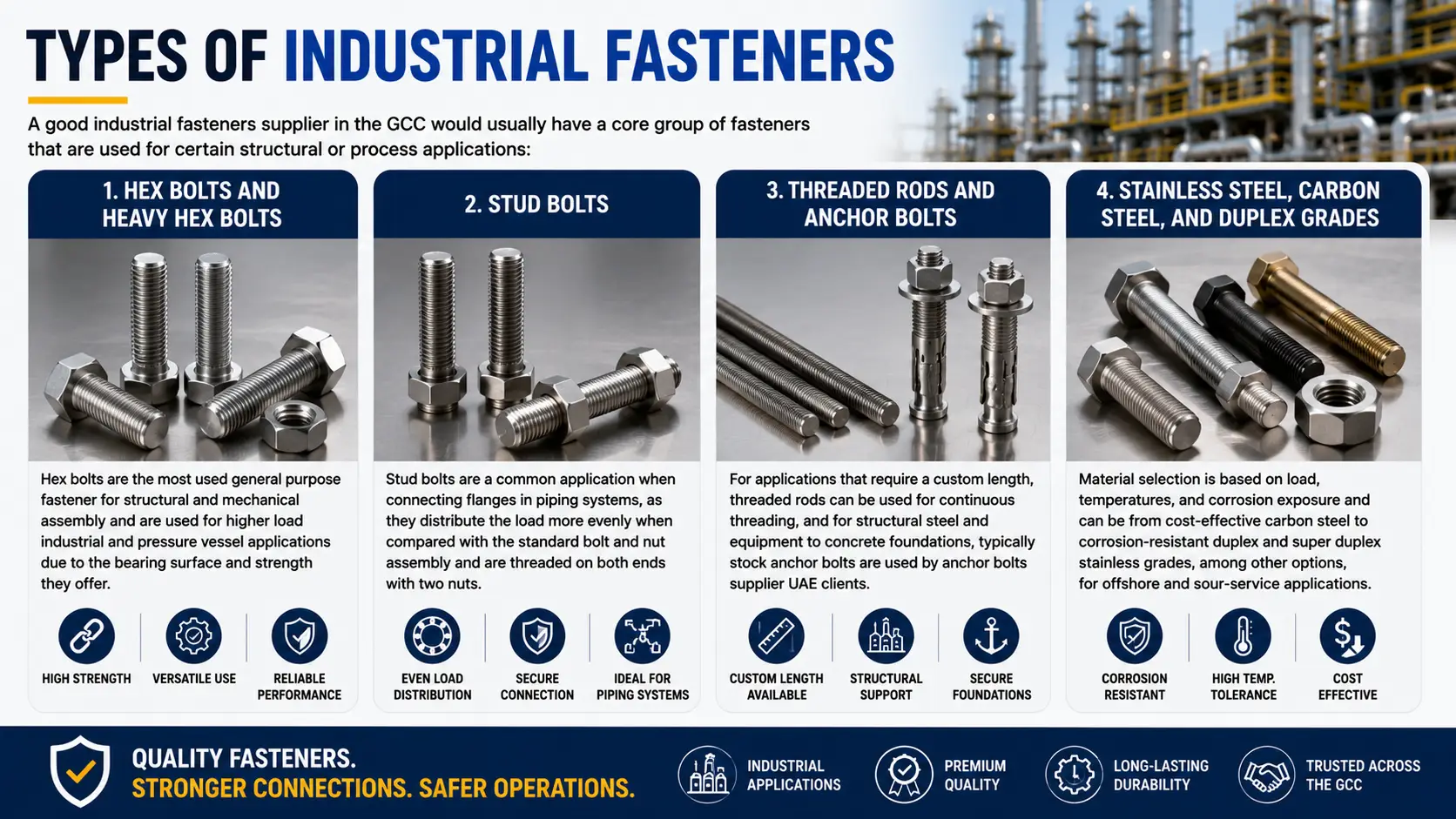
A good industrial fasteners supplier in the GCC would usually have a core group of fasteners that are used for certain structural or process applications:
Hex Bolts and Heavy Hex Bolts
Hex bolts are the most used general purpose fastener for structural and mechanical assembly and are used for higher load industrial and pressure vessel applications due to the bearing surface and strength they offer.
Stud Bolts
Stud bolts are a common application when connecting flanges in piping systems, as they distribute the load more evenly when compared with the standard bolt and nut assembly and are threaded on both ends with two nuts.
Threaded Rods and Anchor Bolts
For applications that require a custom length, threaded rods can be used for continuous threading, and for structural steel and equipment to concrete foundations, typically stock anchor bolts are used by anchor bolts supplier UAE clients.
Stainless Steel, Carbon Steel, and Duplex Grades
Material selection is based on load, temperatures, and corrosion exposure and can be from cost-effective carbon steel to corrosion-resistant duplex and super duplex stainless grades, among other options, for offshore and sour-service applications.
Materials Used in Industrial Fasteners
Material | Typical Standard | Best Suited For |
Carbon steel | ASTM A193 Gr. B7 / ASTM F3125 | General structural and mechanical assembly |
Stainless steel | ASTM A193 Gr. B8/B8M | Moderate corrosion resistance, process piping |
Duplex stainless steel | ASTM A182 / A479 equivalents | Sour service, chloride-rich, offshore environments |
Alloy steel (high temp) | ASTM A193 Gr. B16 | High-temperature bolting in refinery and power service |
International Fastener Standards
For a buyer who is looking for ASTM fasteners projects in GCC, it is imperative to verify compliance with recognized frameworks. The ASTM A193 standard applies to the alloy and stainless steel bolting materials used in high-temperature and high-pressure applications, and ASTM A194 applies to matching carbon and alloy steel nuts. Both ISO 898-1 and ISO 3506 offer an identical mechanical property classification applicable worldwide and ASME B18.2 also specifies standard bolt and screw sizes applicable to the GCC procurement specifications.
Standard | Scope |
ASTM A193 / A194 | Alloy and stainless bolting materials and matching nuts for high-temp/pressure service |
ASTM F3125 | Structural bolting for steel-to-steel connections |
ISO 898-1 | Mechanical properties of carbon and alloy steel fasteners |
ISO 3506 | Mechanical properties of stainless steel fasteners |
ASME B18.2 | Standard dimensions for bolts, screws, and nuts |
Industrial Applications Across GCC
Demand for industrial fasteners GCC-wide cuts across various industries that are key to the industrial and infrastructure development of the region:
Oil refineries and petrochemical plants in Jubail, Ras Al Khair and Sohar.
Work continues on the structural steel for projects in Dubai, Abu Dhabi, and Doha. Structural steel projects in Dubai, Abu Dhabi and Doha continue to make progress.
Equipment for power generation and desalination plants.
Fastening of Marine/Offshore platforms;
Manufacturing and heavy equipment assembly
Upstream and downstream pipeline and flange connections with the projects
Choosing the Right Fastener Supplier
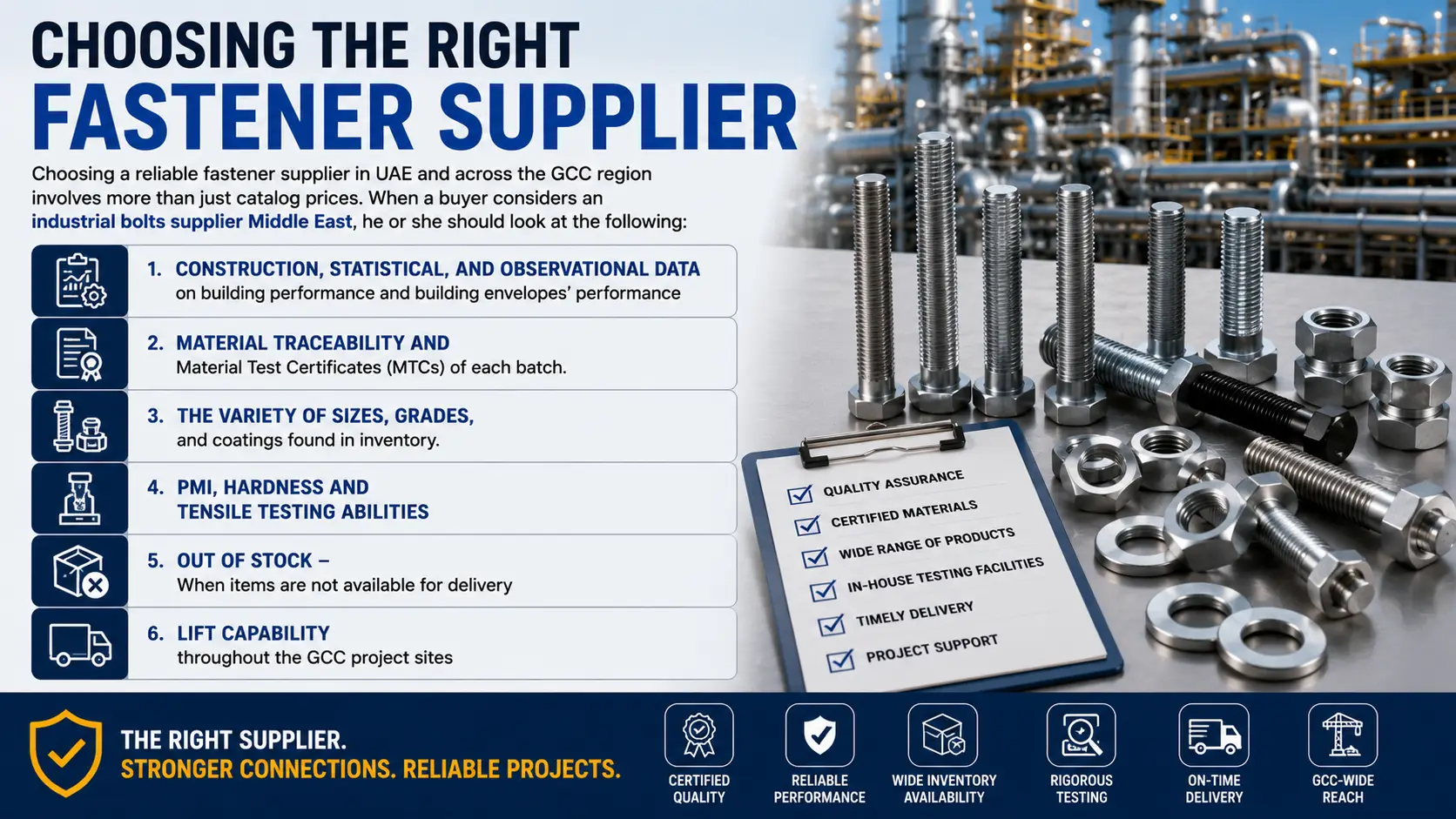
Choosing a reliable fastener supplier in UAE and across the GCC region involves more than just catalog prices. When a buyer considers an industrial bolts supplier Middle East, he or she should look at the following:
Construction, statistical, and observational data on building performance and building envelopes’ performance
Material traceability and Material Test Certificates (MTCs) of each batch.
The variety of sizes, grades, and coatings found in inventory.
PMI, hardness and tensile testing abilities
Out of Stock - When items are not available for delivery
Lift capability throughout the GCC project sites
Quality Assurance & Certifications
A reliable industrial fasteners supplier for GCC projects are dependent on for structural or pressure-critical applications, ought to be able to offer the following documentation:
Material Test Certificates (MTCs) are certificates of chemical composition and mechanical properties.
Positive Material Identification (PMI) testing to verify alloy grade
Dimensional inspection reports that certify compliance with ASME B18.2
Inspection of coatings, such as hot-dip galvanized or corrosion-resistant coatings
Inspecting the thread and checking its performance under load corrosion-resistant
Procurement Considerations
The underlying due diligence is the same when sourcing stainless steel fasteners for projects in the Middle East and Gulf Cooperation Council (GCC) region, or standard carbon steel fasteners for general construction work. The correct pairing of flanges is also a key part of a complete piping connection; our Flanges Article covers pressure classes and material grades for flange bolting, and our extensive Fasteners Pillar resource outlines the basics of flanges, fasteners, and the role of flange torque. Our Oil & Gas Page has specifics on sector sourcing considerations for refinery and pipeline projects.
Common Buying Mistakes
Even seasoned procurement teams collaborating with a trusted industrial fasteners supplier GCC wide find themselves in trouble with avoidable problems:
Using the wrong material grades for the application.
Failure to consider corrosion requirements when ordering carbon steel over stainless or duplex grades.
The certification requirements for the item(s) were overlooked when an order was placed.
Installing metals that are incompatible in the same system, causing galvanic corrosion
Failing to use the right bolt size for the load
Buying without checking the traceability documentation
Frequently Asked Questions
What are industrial fasteners?
Industrial fasteners include bolts, nuts, washers and threaded rods. These components are used to securely fasten buildings, facilities, pipelines and machinery.
Which industrial fasteners are used in oil & gas projects?
Stud bolts, hex bolts and fasteners made of high-strength alloys are commonly used in oil refineries and Pipeline sites. They meet standards such as ASTM A193 and A194.
What is the difference between ASTM and ISO fasteners?
ASTM is considered the Standard in North America and the Middle East, ISO 898-1 and ISO 3506 are internationally recognized as equivalent standards.
Which fastener material is best for marine environments?
In environments such as Offshore installations, fasteners made of Duplex stainless steel or Super duplex stainless steel are extremely reliable due to their resistance to chloride corrosion.
Why is material traceability important?
Traceability means that it can be used to trace the origin of the product, compliance and quality in the supply chain, which is critical in safety-related structural or pressure applications.
What certifications should industrial fasteners have?
For projects that are critical, standard requirements are Material Test Certificates (MTCs), PMI testing reports, and dimensional inspection documentation.
Which industry is the use of high tensile bolts?
High tensile bolting is a traditional specification for many heavy structural applications, pressure vessels, bridges or energy infrastructure projects.
How to select an industrial fastener supplier in the GCC region?
Assess and compare certifications, material traceability, inventories, testing, lead times and delivery capability at project sites.
Request Industrial Fastener Sourcing Assistance
Looking for a supplier for industrial fasteners for Oil & Gas, Construction, Manufacturing or Infrastructure projects in GCC? We are an independent industrial sourcing team that can source the right bolt, nut and fastening system for your material grade, certification and project timeframe requirements from a variety of manufacturers. See our Fasteners Pillar, Flanges Article and Oil & Gas Page for related procurement resources.
Learn from the experts about fastener specifications and GCC procurement.
DISCLAIMER: Z&F Corporation is not affiliated with, authorized by, endorsed by, or acting as an official representative of any manufacturer, brand, or trademark owner referenced on this website. All product names, trademarks, brand names, logos, and manufacturer references are the property of their respective owners and are used solely for identification, reference, and compatibility purposes.