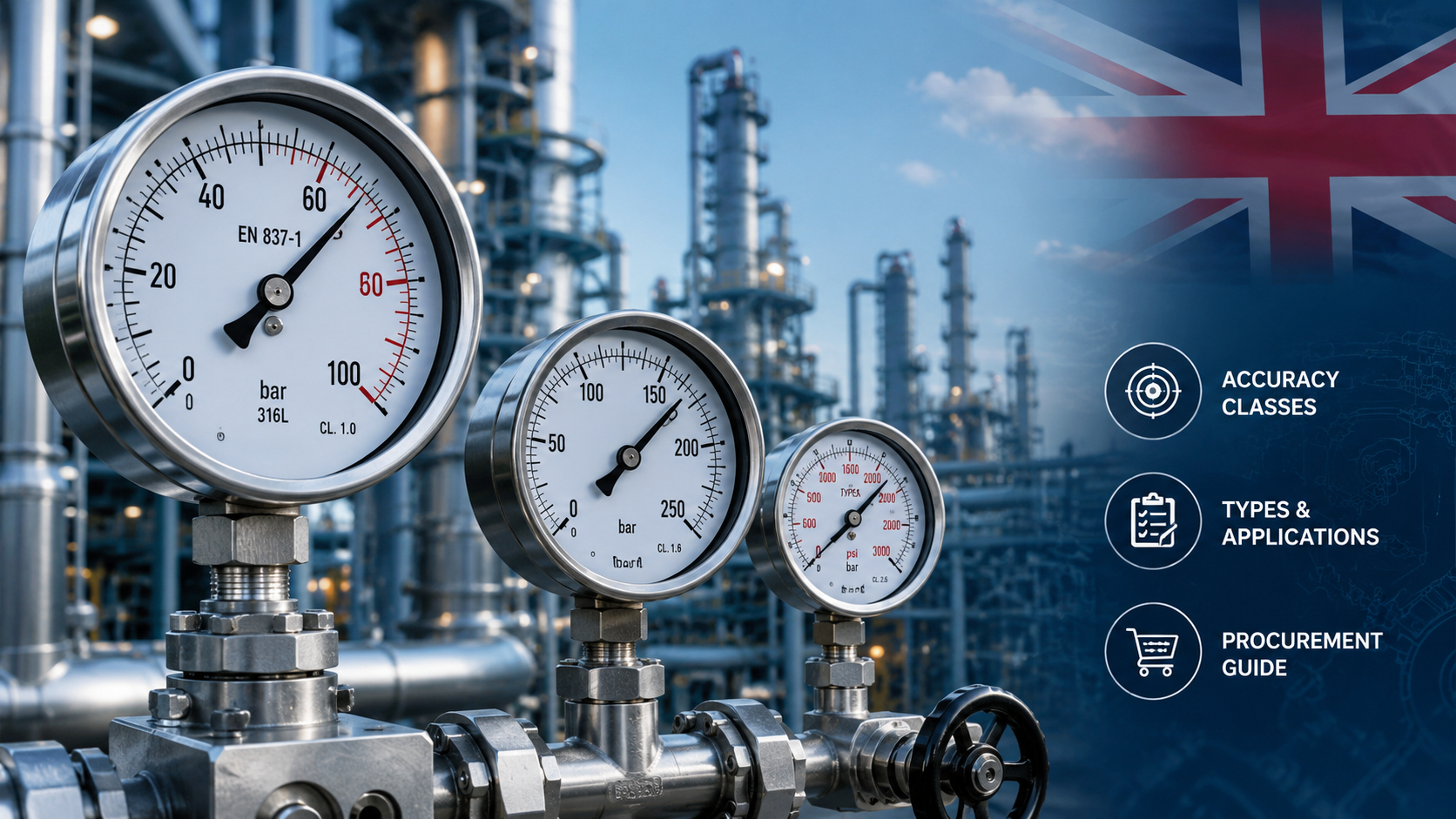
Industrial Pressure Gauges UK: Types, Accuracy Classes & Industrial Applications
Industrial pressure gauges UK are one of the most essential instruments on any plant for process safety, plant reliability and regulatory compliance UK. The choice of pressure measurement equipment is not something to be taken lightly, especially when it's used in a chemical processing plant, water treatment facility or offshore oil and gas installation. From the types of gauges and accuracy classes to selection of materials, calibration, and application in various industries, this guide covers it all that an instrumentation engineer, maintenance manager and procurement specialist needs to know.
What Are Industrial Pressure Gauges?
Industrial pressure gauge is mechanical or electronic device that measures and displays the pressure in a process system, pipeline, vessel, pump, compressor or hydraulic equipment. They are an integral component of any instrumentation and process control system which enables an operator to have real-time knowledge of the system pressure to ensure safe and efficient operation.
Typical industrial pressure gauges used in plants and processing facilities in the UK are designed such that they can be used in harsh environment, extreme temperatures, vibration, corrosive media or at high pressure and can withstand such conditions for many years while providing repeatable and accurate readings.
How Pressure Gauges Work
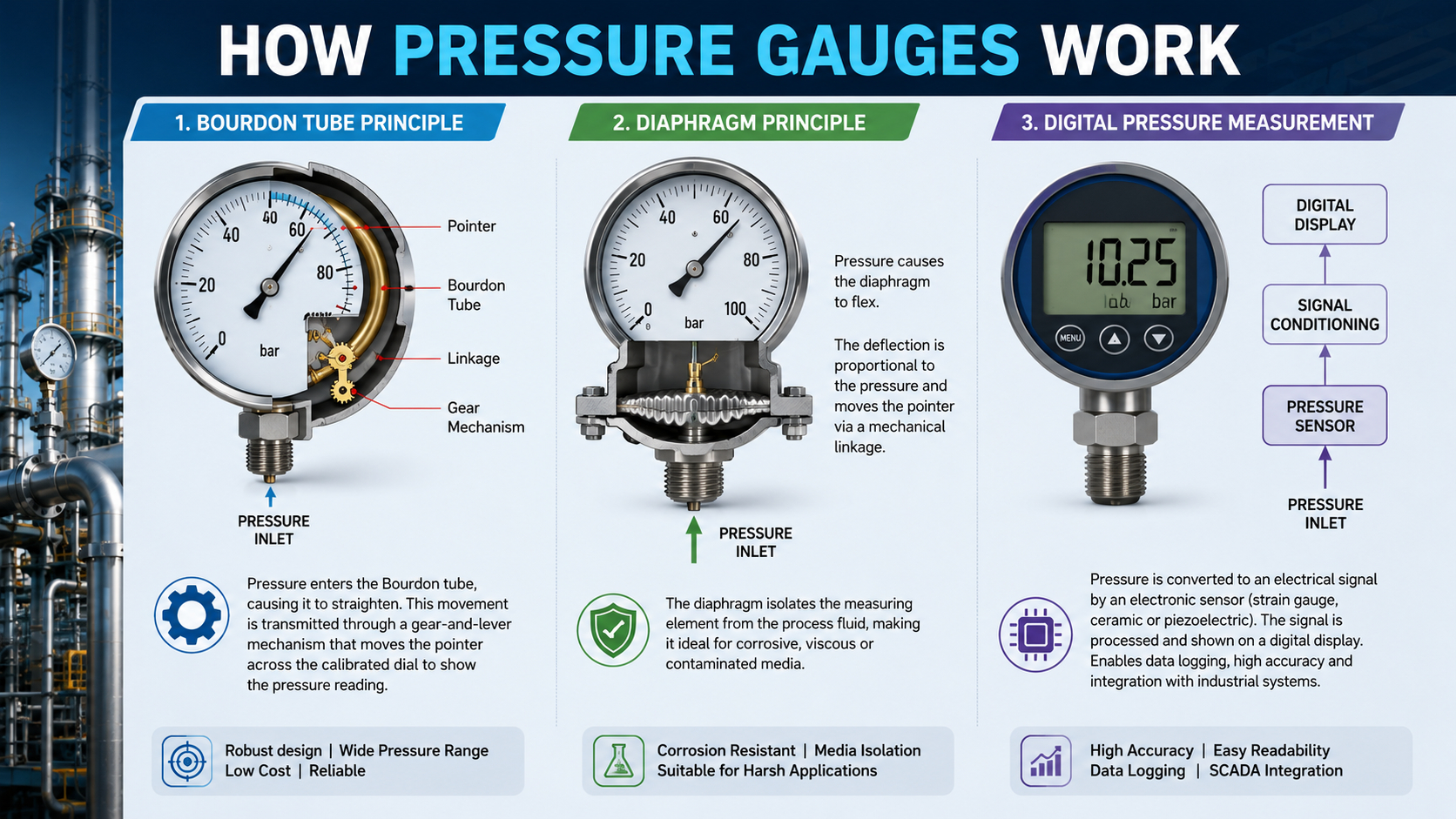
Bourdon Tube Principle
In industrial applications, the Bourdon tube pressure gauge is the most commonly used pressure gauge. A curved or helical tube of brass, stainless steel or alloy is attached to the process inlet inside the gauge. The tube when subjected to pressure tries to straighten out in proportion to the applied pressure. This movement is used by a gear-and-lever system to move a pointer over a calibrated dial, providing a direct pressure reading.
The Bourdon tube design is found in a large number of industrial pressure measurement applications thanks to its robustness, wide pressure range – from a few bar to thousands of bar and low cost.
Diaphragm Measurement Principle
Diaphragm pressure gauges work with a flexible membrane that bends when subjected to a pressure. The deflection is proportional to the pressure and it is mechanically connected with the pointer. This design can separate the measuring element from the process fluid and thus is suitable for corrosive, viscous or contaminated media.
Digital Pressure Measurement
Digital pressure gauges convert pressure to an electrical signal via an electronic pressure sensor (usually a strain gauge, ceramic or piezoelectric element) which is then displayed digitally. They provide better readability, data log, and industrial monitoring and SCADA integration.
Main Types of Industrial Pressure Gauges
Bourdon Tube Pressure Gauges
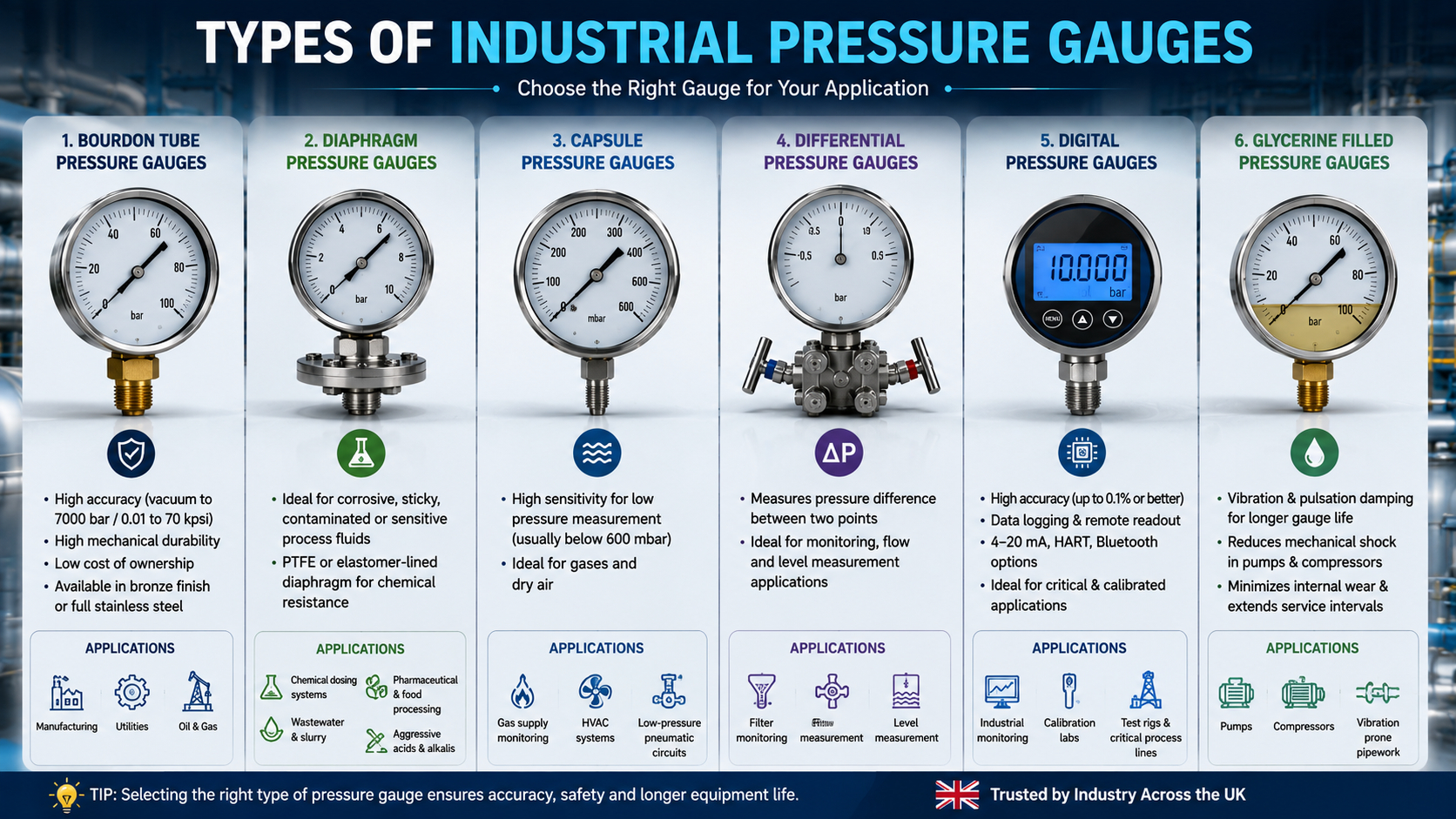
The Bourdon tube pressure gauge is still the backbone of the industry. These gauges come in three types: C-type, spiral, and helical and can be used with most non-corrosive gases and liquids. They are commonly used in various pressure gauge applications in the manufacturing, utilities, and oil and gas sectors.
Key advantages:
High operating pressure accuracy (vacuum to 7000 bar/0.01 to 70 kpsi)
High mechanical durability
Low cost of ownership
Features a bronze finish in both models and comes in full stainless steel as well
Diaphragm Pressure Gauges
When the process fluid is corrosive, sticky, highly contaminated, or must not be in contact with the pressure gauge's internal parts, the diaphragm pressure gauge is the preferred type of gauge. They are typically used to describe:
Chemical dosing systems
Applications involve the use of wastewater and slurry.
These processes can be used to prepare pharmaceutical and food products.
Aggressive acids and alkalis
Diaphragm gauges are frequently furnished with a PTFE or elastomer-lined diaphragm that is resistant to chemical attack.
Capsule Pressure Gauges
Capsule gauges are constructed of two corrugated diaphragms joined together and sealed into a capsule. They have a high sensitivity and are appropriate for measuring low pressures (usually below 600 mbar) in gases and dry air. They are commonly used in gas supply monitoring, HVAC systems and low-pressure pneumatic circuits.
Differential Pressure Gauges
Differential pressure gauges measure the pressure difference between two process points, rather than pressure relative to atmosphere. They are commonly employed in monitoring filter changes, flow measurements through an orifice plate and level measurement in closed vessels.
Digital Pressure Gauges
In situations where high accuracy, data-logging or remote readout are involved, digital pressure gauges for industrial monitoring have many advantages over mechanical types. Today's digital gauges offer accuracy of 0.1% or higher, and can be equipped with 4–20 mA outputs, HART protocol or Bluetooth for wireless data collection. Traceability and data capture are key requirements in calibration laboratories, test rigs and critical process lines, where they are becoming more and more specified.
Glycerine Filled Pressure Gauges
Glycerine filled pressure gauges are the standard mechanical (usually Bourdon type) pressure gauges filled with the liquid glycerine (glycerol). There are two important benefits of the glycerine filling:
Vibration and pulsation damping: the liquid damps vibration and pulsation from mechanical shock, provides longer gauge life for pump and compressor applications.
LUBRICATION: Glycerine minimizes internal wear to further prolong service intervals.
Across most of the UK industrial sites in this country with pumps, compressors or pipework vibration, the standard pressure gauge specification is glycerine filled pressure gauges in vibration.
Understanding Pressure Gauge Accuracy Classes
EN 837 Accuracy Standards
EN 837 is the European standard that specifies the design, safety and performance of industrial pressure gauges. It comprises three parts:
Bourdon tube pressure gauges to EN 837-1.
The recommendations for selection and installation are provided in EN 837-2.
Cap and Diaphragm pressure gauges are covered by this standard.
These standard covers capsule and diaphragm pressure gauges.
Compliance with EN 837 pressure gauge standards UK sites must meet ensures that pressure gauges conform to a series of accuracy, safety, and construction requirements. For procurement teams and instrumentation engineers, the need to identify EN 837 compliant gauges is critical for applications in ATEX zones and regulatory compliance.
Accuracy Class Comparison
Accuracy Class | Tolerance (% of Full Scale) | Typical Application |
Class 0.1 | ±0.1% | Precision laboratory and calibration |
Class 0.25 | ±0.25% | Test and reference instrumentation |
Class 0.6 | ±0.6% | High-accuracy process monitoring |
Class 1.0 | ±1.0% | General process instrumentation |
Class 1.6 | ±1.6% | Commercial and HVAC applications |
Class 2.5 | ±2.5% | Indication only / non-critical monitoring |
Calibration Requirements
Gages should be calibrated against a traceable reference standard on a regular basis to ensure that they are accurate. UKAS accredited calibration laboratories in the UK offer ISO 9001 and industry specific certificated calibration services. Most sites have an annual cycle of calibration of critical instruments and extended risk-based calibrations for non-critical monitoring points.
Pressure Gauge Materials and Construction
Brass Components
Typical industrial pressure gauges are made using brass Bourdon tubes, brass sockets and die-cast aluminium or ABS cases. Brass-wetted gauges are good for use on non-corrosive media, water, air, oil and most neutral gases. These are the least expensive for regular industrial use.
Stainless Steel Pressure Gauges
Stainless steel pressure gauges UK equipment’s are used for more demanding applications. It is comprised of a full stainless steel case, Bourdon tube, socket and movement to provide:
Corrosion resistance in corrosive atmosphere and washdown environment.
The ability to use a broader set of process media.
The suitability for food, pharmaceutical and offshore applications.
Grade 316L stainless steel is standard for wetted components in chemical process pressure gauges and stainless-steel pressure gauges for chemical applications where resistance to chlorides and acids is required.
Monel and Special Alloy Materials
Highly aggressive media such as chlorine, hydrofluoric acid or concentrated sulphuric acid require special alloy materials such as Monel, Hastelloy, and Inconel. These are frequently found in chemical process pressure gauges in specialty chemical and petrochemical plants.
Pressure Gauge Selection Guide
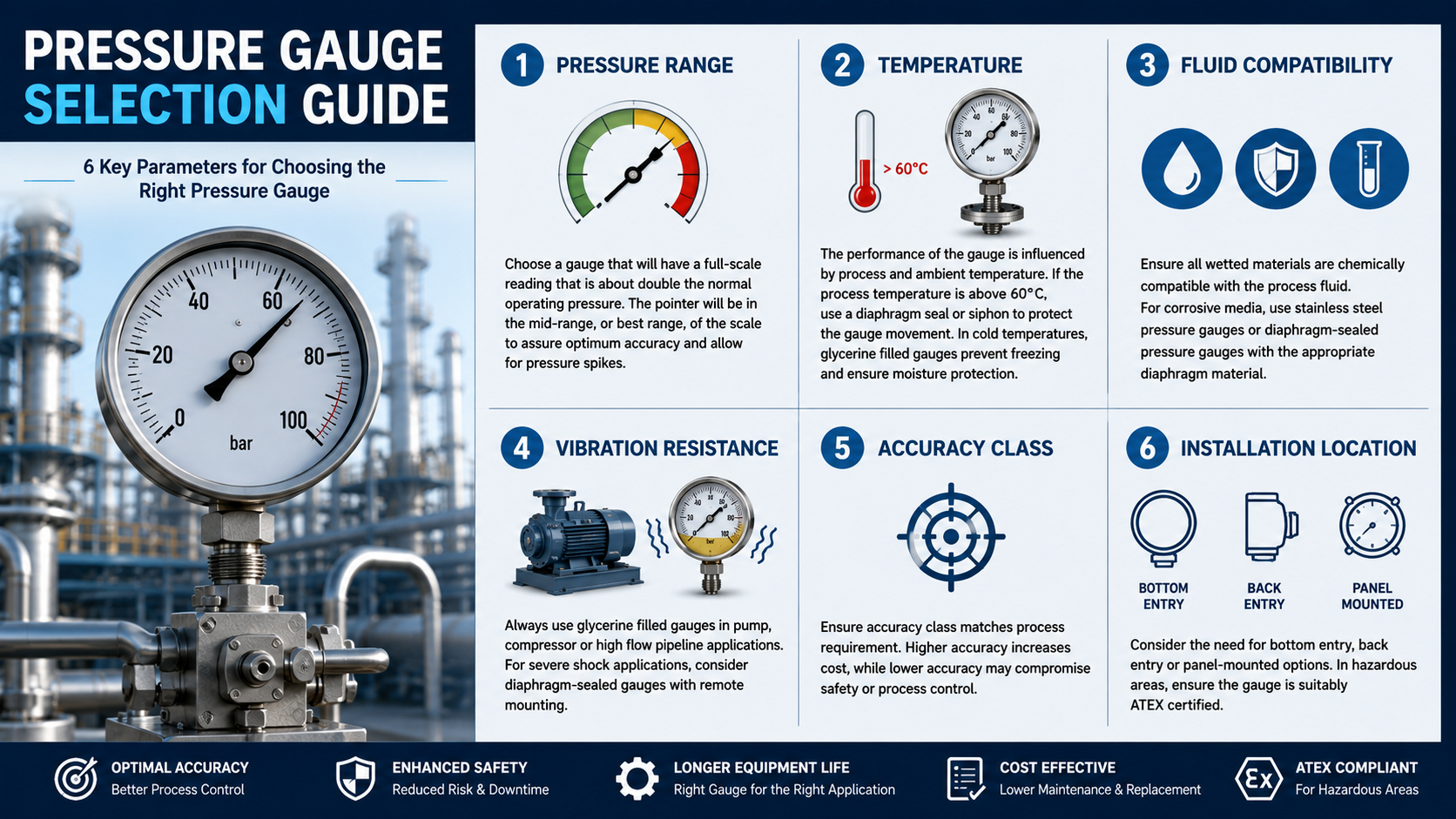
Six parameters are important to consider when selecting the appropriate gauge:
1. Pressure Range
Choose a gauge that will have a full-scale reading that is about double the normal operating pressure. The pointer will be in the mid-range, or best range, of the scale to assure optimum accuracy and allow for pressure spikes.
2. Temperature
The performance of the gauge is influenced by whatever process temperature and ambient temperature. If the process temperature is above 60°C, a diaphragm seal or siphon should be used to protect the gauge movement. In cold temperatures, moisture proofing is ensured and freezing is prevented by glycerine filled gauges.
3. Fluid Compatibility
Make sure that all wetted materials are chemically compatible with the process fluid. If the media to be measured is corrosive, use stainless steel pressure gauges or diaphragm-sealed pressure gauges that are equipped with the right diaphragm material.
4. Vibration Resistance
Always use glycerine filled gauges in pump, compressor or high flow pipeline applications. If this is a severe shock application, consider using diaphragm-sealed gauges with remote mounting.
5. Accuracy Class
Ensure accuracy class matches process requirement. The more accurately you specify, the more expensive the process will be, and the less accurate you specify, the less safe or controlled the process will be.
6. Installation Location
Think about the need for bottom entry, back entry or panel-mounted options. In hazardous area appliances, make sure that the gauge is suitably ATEX certified.
Dry vs Glycerine Filled Pressure Gauges
Feature | Dry Gauge | Glycerine Filled Gauge |
Vibration resistance | Poor | Excellent |
Readability in vibration | Poor | Good |
Service life in vibration | Short | Extended |
Operating temperature range | Wider | Limited by glycerine viscosity |
Cost | Lower | Slightly higher |
Maintenance | Low | Low |
Recommended for | Static, clean environments | Pumps, compressors, pipework |
For the vast majority of UK industrial sites, glycerine filled pressure gauges are the default specification wherever rotating equipment or pipework vibration is present.
Pressure Gauges for Oil & Gas Applications
Pressure instrumentation has some of the most stringent demands placed upon it in the oil and gas industry. Gauges should be able to be relied upon to perform in:
Offshore and onshore wellheads and pipelines.
Compression trains for high-pressure gases.
The operation of crude oil processing and separation systems.
Subsea and topside installations.
The most common specification for oil and gas pressure gauges is full 316L stainless steel construction, glycerine-filled cases and conforming to both the EN 837 and relevant ATEX directives. Many operators also have sour service requirements involving hydrogen sulphide (H₂S) and require NACE MR0175/ISO 15156 compliance.
For additional information on instrumentation requirements in upstream and downstream operations, refer to industry guidance and relevant technical standards.
Pressure Gauges for Petrochemical Plants
Petrochemical plant process pressure gauges are required to withstand aggressive hydrocarbons, high temperatures and sometimes toxic materials. Key considerations include:
All wetted items are stainless steel or Hastelloy for corrosive streams.
For high-viscosity or polymerising fluids, diaphragm seals are used.
If you need to fill in a location that is prone to vibration, it should be filled with either glycerine or silicone.
ATEX Zone 1 or Zone 2 hazardous area installations.
Use isolation valves to safely remove for in-service.
In many applications, such as for petrochemical processes, where it is important that the process fluid not enter the gauge body, either for safety reasons or to prevent blockage of the Bourdon tube, diaphragm seals are especially significant.
Pressure Gauges for Water Treatment Systems
Water treatment plants, ranging from municipal waterworks to industrial effluent dosing systems, have a wide range of industrial pressure gauges in use for filter pressures, pump discharge heads, pipeline pressures and dosing system pressures. For clean water uses, a standard brass or stainless steel gauge can be used. When using chemistry for chlorine or sodium hypochlorite or acids pressure gauges UK water treatment facilities should use with PTFE-lined diaphragm seals.
Pressure Gauges for Hydraulic and Pneumatic Systems
Hydraulic systems in the UK will need high pressure gauges that are capable of handling a dynamic pressure which can exceed the normal working pressure of the system. Key requirements include:
Filling with glycerine to reduce hydraulic pulsation.
Pressure range: 0 – 250 bar up to 0 – 1,000 bar or more.
Fatigue resistant stainless steel or chrome steel bourdon tubes.
A snubbers or pulsation dampeners to protect gauge internals.
Capsule or Bourdon tube gauges, with an accuracy class of 1.6 in brass or stainless steel, are usually satisfactory for pneumatic systems using lower pressures. For critical pneumatic control systems, Class 1.0 or better is recommended.
Pressure Gauge Calibration and Maintenance
Industrial pressure gauges need to be maintained and calibrated by a structured program to keep them in an accurate and reliable condition.
Best Practices for Calibration:
Traceable to UKAS reference standard calibration.
Keep calibration records and certificates.
Definition of calibration frequency based on application criticality (usually 6-24 months).
Remove and replace gauges using proper isolation valves—NEVER calibrate in-line without isolation.
Maintenance inspections:
Check for cracked lens, case damage and moisture ingress
Check pointer zero with process isolated
Inspect the case seal for glycerin leakage
Check process connections for leaks and corrosion
See the related Industrial Valves guide for additional information on isolation valve selection.
Common Pressure Gauge Failures and Troubleshooting
Failure Mode | Likely Cause | Remedy |
Pointer not returning to zero | Overrange damage or worn movement | Replace gauge |
Erratic or vibrating pointer | Vibration / pulsation | Specify glycerine-filled gauge or add snubber |
Moisture inside case | Seal failure or temperature cycling | Replace with sealed IP65 or glycerine-filled gauge |
Corrosion of Bourdon tube | Wrong material selection | Upgrade to stainless steel or diaphragm seal |
Blocked Bourdon tube | Viscous or crystallising fluid | Specify diaphragm seal |
Glycerine discolouration | Overtemperature or UV exposure | Replace gauge; consider silicone-filled alternative |
EN 837 Standards Explained
EN 837 specifies the requirements for industrial pressure gauges manufactured and sold in the European and UK markets. The standard addresses:
Allowable pressure ranges and overrange capability
Definitions and tolerances of accuracy classes
Material requirements for wetted and non-wetted parts
Blowout back provisions and other safety requirements
Marking and labelling requirements
Temperature compensation requirements
Specifying EN 837 pressure gauges provides peace of mind for procurement teams that gauges have been designed, manufactured and tested to a recognized European standard, supporting both quality management systems and HSE compliance obligations.
Procurement Guide: Buying Pressure Gauges in the UK
Things to consider when purchasing industrial pressure gauges for UK industrial sites:
Essential supplier criteria:
Compliant with EN 837 full range
ATEX-approved models for hazardous area environments
UKAS calibration services or certificates of calibration, traceable to the UKAS
Full range of sizes, ranges and materials in stock
Technical support from qualified instrumentation engineers
Rapid delivery of maintenance critical replacements
UK procurement teams engaging with industrial pressure gauge suppliers include specialist instrumentation distributors, process equipment wholesalers and direct manufacturer representatives. Framework agreements with UK accredited industrial instrumentation suppliers provide consistent specification and traceability for large capital projects.
Look for industrial pressure gauge suppliers that support with technical datasheet support, hazardous area documentation and application engineering advice, rather than just catalogue supply, when evaluating them for UK procurement frameworks.
Frequently Asked Questions
What are Industrial Pressure Gauges?
Simply put, they measure the system pressure in pipes, Tanks, pumps, compressors, etc. There are mechanical and digital pressure gauges, both of which comply with the industry standard EN 837.
How does a Bourdon tube pressure gauge work?
When pressure is applied, the curved Bourdon tube stretches, causing the pointer to move and point to the scale quite simply
What is EN 837?
This is a European standard that defines the design, safety, accuracy and construction of industrial pressure gauges. It is widely used in various industries in the United Kingdom.
What is the difference between dry and glycerine-filled gauges?
Glycerine-filled gauges dampen vibration and pulsation, extending gauge life and improving pointer readability in dynamic applications such as pump and compressor installations.
When should diaphragm pressure gauges be used?
Glycerol-filled pressure gauges dampen vibrations and pulsations in high-motion environments, such as in pumps and compressors, extending the life of the pressure gauge and improving the readability of the scale. They are suitable for handling corrosive, viscous, dirty or hygienic liquids It is useful when the measuring area needs to be protected from the liquid inside
How accurate are industrial pressure gauges?
The accuracy depends on the class. It varies between ± 0. 25 % and ± 2. 5 % of the full scale value, with classes 10 and 16 being common.
How often should pressure gauges be calibrated?
This depends on the criticality of the application and the legal regulations. For critical processes, an annual calibration is common, for less critical applications, the interval can be determined based on risk.
What industries use industrial pressure gauges?
They are used in the oil and gas industry, petrochemicals, manufacturing, water treatment, power generation, pharmaceuticals, food processing, hydraulics and many more.
Where can I buy industrial pressure gauges in the UK?
They are available from specialist equipment manufacturers, process equipment dealers and suppliers across the UK, with suppliers in Aberdeen, Teeside, Grangemouth, Humber and other key industrial areas.
Conclusion
Selecting industrial pressure gauges UK requires careful weighing of accuracy, material compatibility, environmental durability and regulatory compliance Bourdon tube pressure gauges continue to be the industry standard due to their reliability and cost-effectiveness Diaphragm and digital pressure gauges, on the other hand, are designed for specific requirements.
A comprehensive understanding of gauge types, accuracy standards and material specifications enables informed sourcing decisions that maximize device performance and increase safety Whether general pressure monitoring in factories, Controlling critical Offshore oil and gas assets or ensuring stable operation of water treatment systems-choosing the right pressure gauge is critical to industrial success.
For applications with high safety requirements or specialist fluid systems, advice from a reliable UK instrument manufacturer with extensive industry knowledge is recommended Maintaining accuracy through regular calibration program and investing in initially costly components such as Premium materials and Glycerine encapsulation will pay off in the long run with the benefits of extended service life and reduced maintenance. Further study of instrumentation systems, process measurement, and control architectures can provide additional technical context, which provides detailed explanations on pressure measurement, flow control, temperature monitoring, advanced process instrumentation and more.
For further support with pressure gauge selection, calibration, or procurement, contact our instrumentation team. Additional technical resources covering instrumentation, oil and gas applications, and valve selection may provide further guidance.