Industrial Pumps Supplier India : Complete Procurement Guide for Centrifugal, Chemical, Slurry & Process Pumps
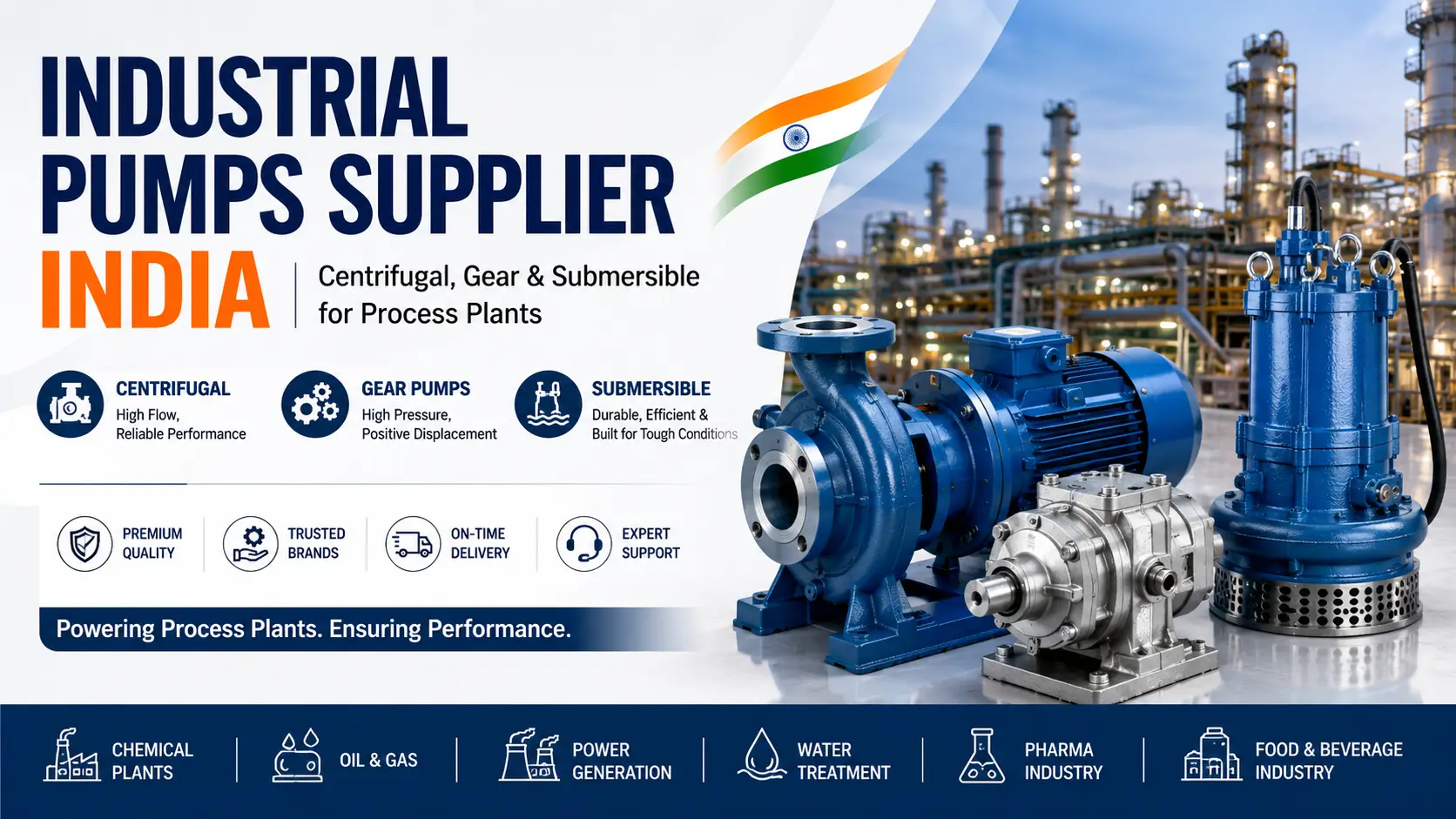
There is an ongoing and rising demand for dependable pumping apparatus in all the major industry sectors of the economy in India, owing to the rapidly expanding industrial activities in the fields of oil and gas industry, water treatment, chemicals, power generation and manufacturing. To any procurement manager, plant engineer or EPC contractor who is looking at any industrial pumps supplier India projects depend on, this is not just about product list; it is also about finding a supplier who not only provides a certified product matched for the application but also has technical support, spare parts availability as well as the ability to deliver it on time to meet the demanding project timelines. From types and standards of pumps to selection of material, evaluation of suppliers, maintenance planning and procurement best practices to industrial setting in India, this guide provides you with every detail related to pumps.
What Are Industrial Pumps?
An industrial pump is a mechanical device that conveys fluid, which may be a liquid, slurry, gas, or multiphase mixture, from a source such as a motor or engine to a target by converting mechanical energy into hydraulic energy in the fluid. Industrial pumps are specially designed to perform in hazardous applications and process fluids in the refinery, chemical plant, power station, water treatment plant, and factories that contain abrasive, corrosive, high temperature and high pressure process fluids and are expected to operate continuously.
There are several sub-types within each category that are optimized for certain applications, fluid properties, and performance needs. See our Pumps Pillar for a complete industrial overview of all types of pumps and the principles of pump selection, including the operation of impellers, volutes, mechanical seals, and pump curves.
Types of Industrial Pumps
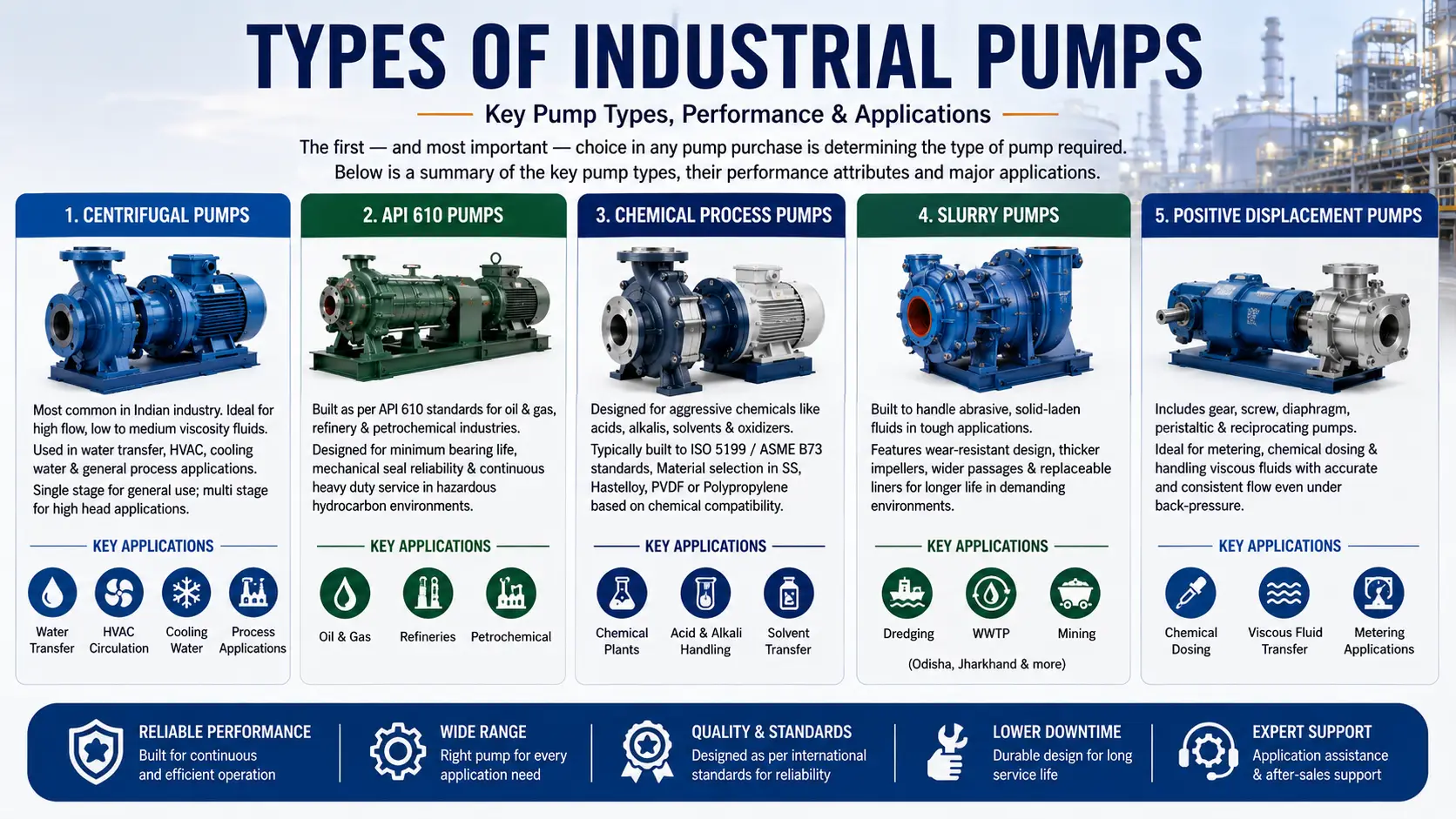
The first — and most important — choice in any pump purchase is determining the type of pump required. The table below is a summary of the key pump types offered by any reliable industrial pumps supplier in India, their performance attributes and major applications.
Pump Type | Flow Rate | Pressure Range | Typical Application |
Centrifugal | High | Low–High | Water transfer, HVAC, general process |
API 610 | High | Medium–Very High | Refineries, oil & gas, petrochemical |
Chemical Process | Low–High | Low–High | Acid/alkali handling, chemical plants |
Slurry | Medium | Low–Medium | Mining, dredging, wastewater |
Positive Displacement | Low–Medium | High–Very High | Dosing, viscous fluids, precise metering |
Submersible | Low–High | Low–Medium | Sewage, dewatering, groundwater |
Vertical Turbine | High | Medium–High | Deep wells, cooling towers, intakes |
Centrifugal Pumps
A big number of centrifugal pumps supplier India buyers are the most common category of pumps in Indian industry. They operate reliably with continuous duty in high flow, low to medium viscosity fluids, and are the preferred choice for water transfer, HVAC circulation, cooling water and process applications. Single stage centrifugal pumps are used in most general applications while multi stage centrifugal pumps are used for higher head applications such as boiler feed, reverse osmosis feed, and high rise building water supply applications.
API 610 Pumps
API 610 pump supplier India gets only a handful of queries from operators of oil and gas, refinery and petrochemical businesses that need centrifugal pumps that meet the rigorous API standard. API 610 pumps are designed to deliver minimum bearing life, mechanical seal design requirements, limited shaft deflection, and to be tested to prove by a third party for continuous, heavy duty service in the hazardous hydrocarbon environment. These are the benchmark for the procurement of pumps at Jamnagar, Hazira, Dahej and all over the industrial corridor of Gujarat, India.
Chemical Process Pumps
The suitability of the fluid is an important consideration for chemical process pumps India procurement, because chemicals used in chemical plants such as acids, alkalis, solvents and oxidizers tend to decompose the wrong material easily. Most of the horizontal process pump specification in chemical plants are controlled by the following standards: ISO 5199 and ASME B73. As critical as the hydraulic specification is, the selection of the material can be stainless steel, Hastelloy, PVDF or polypropylene depending on the specific chemical.
Slurry Pumps
Specialized queries from the slurry pumps supplier India come from dredging projects, wastewater treatment plants (WWTPs) that treat fluids containing abrasive solids, and mining activities in Odisha and Jharkhand. Slurry pump design is completely unlike the clean fluid centrifugal pumps – thicker impeller vanes, wider flow passages, rubber or hard metal liners, and replaceable wear parts increase service life of the pump in a material that would quickly wear it out in a standard pump.
Positive Displacement Pumps
Positive displacement pumps — gear, screw, diaphragm, peristaltic, and reciprocating — are used to meter, chemically dose or move viscous fluids with very consistent and accurate flow rates even in the face of back-pressure.
Industrial Pump Applications Across India
Oil and Gas and Refining
The refining and petrochemical industry, which is focused in Jamnagar, Kochi, Chennai and along Dahej-Hazira in Gujarat, depends on the supplier of India for API 610 compliant refinery process pumps for crude transfer, distillation column bottoms pumping, product transfer, and cooling water circulation. Quality, reliability of seals and maintenance support are critical considerations for pumps when it comes to service and the continuous duty requirements of a refinery.
To find detailed information on pump and equipment requirements according to India's oil and gas field, check our Oil & Gas Page for process system requirements, piping components and equipment standards for upstream and downstream operations.
Water Treatment and Municipal Infrastructure
The smart city water infrastructure, sewage treatment plants and irrigation canal pump stations are some of the biggest volume segments in the Indian pump market, with industrial water transfer pumps supplier India topping the list. Agencies like the National Mission for Clean Ganga (NMCG) and state utilities often specify a cleanliness requirement and use the BIS specifications and tender.
Chemical and Pharmaceutical Manufacturing
Industrial chemical pumps manufacturer India capabilities are needed to provide pumps that can handle acids, circulate reactants in reactors, and transfer solvents, all of which have to be corrosion-resistant and seal-proof, in chemical manufacturing plants that are clustered in Ahmedabad, Vadodara, Vapi and Hyderabad. Pharmaceutical uses include GMP compliance and hygienic design features, often requiring 316L stainless steel with electropolished wetted surfaces.
Power Generation
The most challenging applications for pumps in power plants India are those that operate continuously for a long time and have a high requirement for reliability of the plant, such as boiler feed pumps, cooling water circulation pumps, condensate extraction pumps, and ash handling slurry pumps.
Mining and Minerals
Heavy duty slurry pumps are used in the slurry or pump line to maintain continuous operation in the mining operations in the slurries, which are of high density and abrasive in nature across Odisha, Rajasthan and Chhattisgarh. Life and availability of spare liner and impeller kits are major purchasing factors.
Industrial Pump Materials Selection Guide
Therefore, the service life of pumps is directly dependent on the material used, either to obtain the design service life or to fail prematurely as a result of corrosion, erosion, or chemical attack. A handy reference to the most frequently used materials for stainless steel process pumps India and other pump purchasers.
Material | Corrosion Resistance | Relative Cost | Typical Use |
Cast Iron | Low | Lowest | Fresh water, non-corrosive general service |
Carbon Steel | Low-Moderate | Low | Hydrocarbon service, high pressure |
Stainless Steel (316L) | High | Moderate | Chemical, pharmaceutical, food grade |
Duplex Stainless Steel | Very High | High | Offshore, seawater, chloride service |
Hastelloy / Alloy Steel | Excellent | Highest | Aggressive acids, high-temperature process |
Engineered Plastics (PVDF/PP) | Excellent | Moderate | Concentrated acids, electroplating |
Pump Standards and Certifications
For oil and gas, power and public sector industrial pump projects in India, compliance with recognized international and national standards is a non-negotiable requirement, with third-party certification as a contractual requirement for many such projects.
Standard | Scope | Issuing Body | Typical Application |
API 610 | Centrifugal pumps for petroleum and petrochemical industry | API (American Petroleum Institute) | Refineries, oil & gas, petrochemical plants |
ISO 5199 | Technical specifications for centrifugal pumps, Class II | ISO | General industrial process applications |
ISO 2858 | End-suction centrifugal pumps — dimensions | ISO | General industrial water and process |
ISO 9906 | Hydraulic performance testing | ISO | Pump performance acceptance testing |
BIS / IS 5120 | Technical requirements for rotodynamic pumps | Bureau of Indian Standards | India-specific compliance requirement |
For EPC projects and public sector tenders in India, critical service pumps are often subject to third-party certification and testing from various organizations such as Bureau Veritas, TUV Rheinland and DNV. Both the Bureau of Indian Standards (BIS) and Indian Pump Manufacturers Association (IPMA) offer guidance products applicable to procurement of pumps in the Indian market.
How to Select the Right Industrial Pump
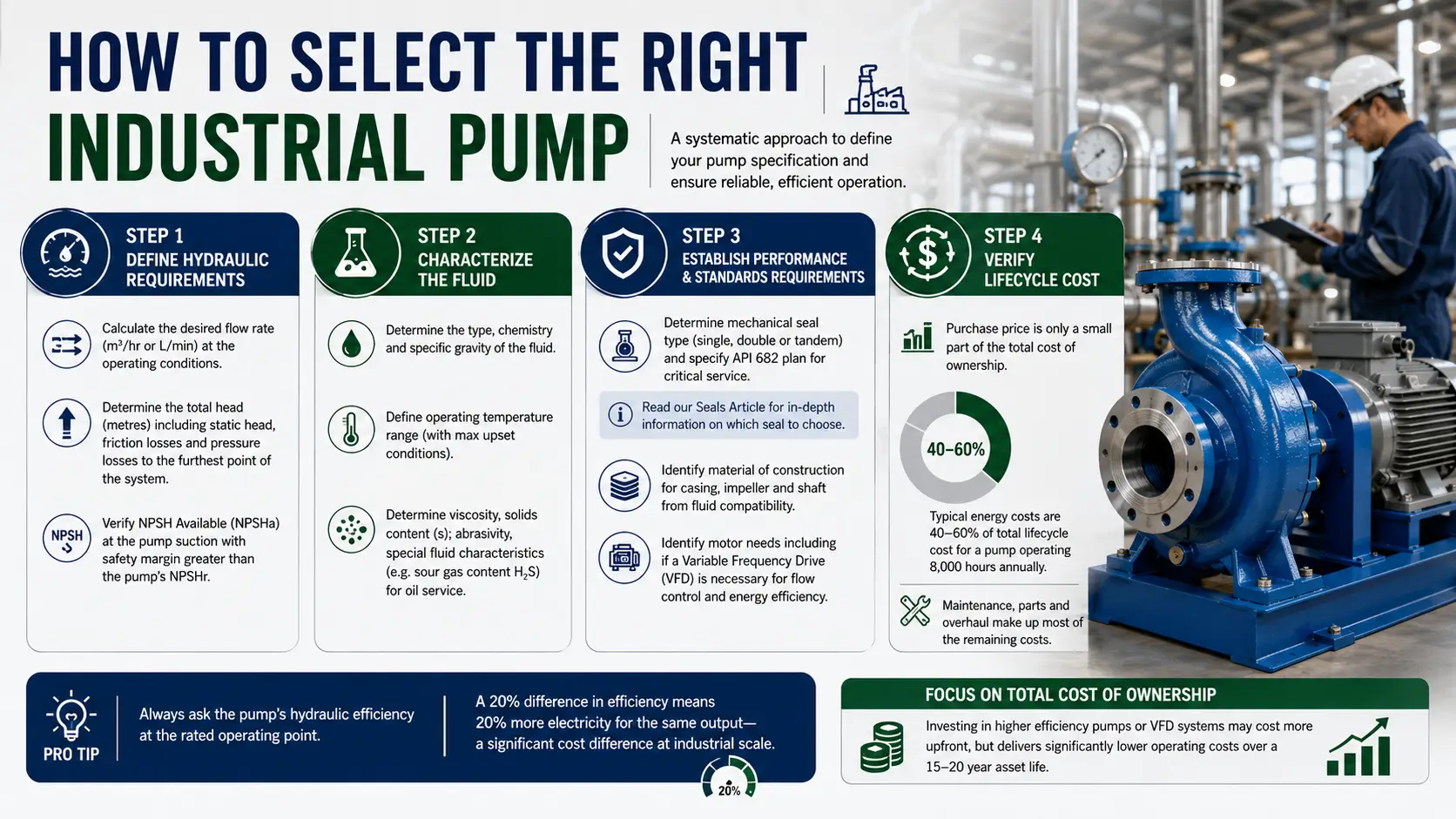
The first step in the selection of pumps is to understand the hydraulic system requirements and fluid properties. Before you start contacting any of the industrial pump distributors India, follow the following systematic approach to define your pump specification. Identify the hydraulic requirements.
Step 1: Define Hydraulic Requirements
Calculate the desired flow rate (m³/hr or L/min) at the operating conditions.
Determine the total head (metres) including the static head, friction losses and the pressure losses required at the pump discharge to the furthest point of the system.
Verify NPSH Available (NPSHa) at the pump suction, with a suitable safety margin to ensure that it is greater than the pump's NPSHr.
Step 2: Characterize the Fluid
Determine the type, chemistry and specific gravity of the fluid
Define operating temperature range (with max upset conditions)
Determine viscosity, solids content (s); abrasivity, special fluid characteristics (e.g. sour gas content H₂S) of oil service.
The next step is to define the Performance and Standards Requirements.
Step 3: Establish Performance and Standards Requirements
Determine whether a mechanical seal is a single, double or tandem mechanical seal, and specify API 682 plan for critical service.
To read our Seals Article for in-depth information on which seal to choose, see our Seals Article.
Identify material of construction for casing, impeller and shaft from the fluid compatibility
Identify motor needs including if a variable frequency drive (VFD) is necessary for flow control and energy efficiency
Step 4: Verify Lifecycle Cost
The purchase price is only a small part of the cost of ownership of the pump. Typical energy costs are in the range of 40-60% of the total life cycle cost for a pump operating at 8000 hours annually, with maintenance, parts and overhaul costing the majority of the remaining costs. The use of a higher efficiency pump or VFD system can cost more up front, but can mean significantly less operating cost over a 15–20 year asset life.
When communicating quotations, Pro Tip: always ask the pump's hydraulic efficiency at the rated operating point. At a 20% difference in efficiency, the pump running at the lesser efficiency uses 20% more electricity to produce the same output; and at an industrial scale, this is a significant difference in cost.
Industrial Pump Maintenance
The maintenance strategy for a pump directly impacts equipment uptime, life cycle cost and long-term reliability. As the maturity of industrial facilities with critical process pumps in India increase, they should continue to transition from reactive to predictive maintenance.
Routine Maintenance Checklist
Daily: Monitor Seal leakage, Bearing temperature, Pump discharge pressure and vibration levels
Weekly: Check lubrication level, check coupling condition, inspect gland packing, check gland packing or seal flushing system.
Monthly: Vibration analysis trending, alignment verification, performance parameters review against baseline
Annual: Shutdown: Full mechanical inspection of Impeller, wear rings, bearings, seals and shaft; hydraulic performance test.
Common Failure Modes and Prevention
Cavitation — avoid by providing a sufficient NPSHA, proper pump selection, and care of throttled suction valves
Mechanical Seal Failure — most frequent reason for pump down; prevented by proper selection of seal plan, clean flush fluid, and seal face cooling
Monitor vibration analysis for bearing failure due to lubrication failure, contamination, or excessive loading for prolonged periods of time.
Correct Material Selection to minimize impeller wear/erosion, accelerated by abrasive slurry or cavitation; Control operating point to minimize erosion.
Shaft misalignment — results in vibration, bearing wear, and damage to the seals; check after maintenance work is performed; check with dial indicator or laser alignment equipment.
Predictive Maintenance and Industry 4.0
Smart pumping technologies, such as those that use IoT vibration sensors and temperature monitoring, and cloud-based analytics, enable maintenance teams to identify developing faults weeks in advance, even before they fail. VFD-based pump monitoring systems can warn about odd draw, poor efficiency or flow variation, which allows for condition based maintenance, minimizing unplanned downtime and extending overhaul cycles for critical pumping systems in India facilities.
Looking to buy industrial pumps in India? Sharing your application needs with us will help you find the pump solution that is right for you. → Request a Quote
How to Evaluate Industrial Pump Suppliers in India
When evaluating industrial pumps supplier India options, the supplier evaluation process needs to be as stringent as the technical specification. A supplier, no matter the price, who does not have the ability to provide certifications, material traceability, service and delivery capabilities is a risk item for the project.
Evaluation Criterion | Green Flags | Red Flags |
Technical capability | Pump range covers your application | Limited catalog, no custom designs |
Standards certifications | API 610, ISO, BIS, third-party test reports | No certifications or self-declared only |
Material traceability | MTC to EN 10204 3.1 or 3.2 | No material certificates offered |
Spare parts availability | Local stock, fast lead time | Imported parts only, long lead times |
After-sales support | Field service, commissioning, warranty | No service team in your region |
References | Similar installations in your industry | No references or case studies available |
Delivery reliability | Documented on-time delivery track record | Repeated delivery delays or excuses |
Key Supplier Locations Across India
The base of industrial pumps in India is in a few main manufacturing and distribution hubs:
Mumbai and Pune — key trading and distribution points for industrial equipment, with well established MRO supplier base
Ahmedabad and Vadodara — Gujarat's chemical/ petrochemical equipment suppliers, near Dahej and Hazira industrial area.
Coimbatore is one of the biggest hubs of pump manufacturing in India, especially centrifugal and agricultural pumps.
Indian pump brands are also having a healthy presence in Chennai with manufacturing and service centers.
Hyderabad and Bengaluru are both engineering and process equipment suppliers to the pharmaceutical and manufacturing industries.
Common Brands Available in the Indian Market
The Indian industrial pump industry comprises both local brand pumps and international brand pumps which are supplied through authorized distributors. The following is a list of brand names that may be seen in the Indian market and it is provided for information purposes only and does not imply any partnership or endorsement of the brand. Kirloskar Brothers Limited (KBL), Flowserve, KSB, Grundfos, Sulzer, Wilo, Ebara, Xylem, Ruhrpumpen and Weir Minerals. Frequently the availability of brands and coverage of authorized distributors depends upon the product type and area.
Industry Trends in Pump Technology
Variable Frequency Drives (VFD) and Energy Efficiency
With the increased cost of electricity and the government's emphasis on energy efficiency program, VFD-controlled pump systems are becoming the norm in the industrial sector of India. A pump working at 80% of its capacity consumes only 51% of the power it consumes when it is working at full capacity, which is quite significant under the industrial electricity tariff in India. Energy-efficient pumping systems are encouraged through various programs of energy conservation in industries by the Ministry of Heavy Industries India, and the Bureau of Energy Efficiency (BEE).
Smart Pump Monitoring and Industry 4.0
Incorporating vibration sensors with temperature transmitters, flow meters, and cloud-based analytics, IoT-based pump monitoring systems enable remote monitoring and predictive maintenance for critical pumps that are growing in popularity as a component of new installations for industrial pump procurement guide buyers in India. Digital twins of pump systems allow engineers to simulate operating scenarios and design and optimize the performance without the need for physical intervention.
Sustainability and ESG Considerations
The regulatory and financial institutions and overseas buyers are increasingly pushing India's industries to cut energy consumption and curb their environmental footprint. Industrial operators are increasingly using high-efficiency pumps, VFD systems and plan optimization to reduce water consumption in the seal-flush as part of ESG reporting.
Procurement Checklist for Industrial Pump Buyers
To get an accurate and comparable quotation in the process of making a pump purchase enquiry, the following information should be included:
Pump type — centrifugal, API 610, chemical, slurry, positive displacement.
Flow rate and total head — at normal and maximum operating conditions
Fluid description — type, concentration, temperature, specific gravity, viscosity, solids content
NPSH available — at the pump suction under worst conditions
Material of construction — no higher than 70 degrees Celsius
Standard — API 610, ISO 5199, BIS, or project-specific piping class
Mechanical seal specification — API 682 Plan, single, double, or tandem
Motor requirements — power, frame, enclosure, voltage and VFD compatibility
Material certificates — : EN 10204 3.1 or 3.2, PMI requirements
Third-party testing — performance acceptance test (ISO 9906 Grade 1 or 2)
Delivery location and timeline — site address, Incoterms, and required delivery date
Spare parts — commissioning spares, first-year operational spares list.
Frequently Asked Questions
What industries use industrial pumps in India?
The major industries that utilize industrial pump solutions India throughout the country are oil and gas, petrochemical, water treatment, power generation, chemical manufacturing, mining, pharmaceutical, food processing and construction.
What is an API 610 pump?
An API 610 pump is a centrifugal pump designed and manufactured to the American Petroleum Institute standard for petroleum, petrochemical, and natural gas service, specifying minimum requirements for performance, mechanical design, materials, testing, and documentation.
What is the difference between centrifugal and positive displacement pumps?
Centrifugal pumps are driven by a rotating impeller to create high flow at variable pressure, ideal for high volume fluid transfer. Positive displacement pumps will discharge a known volume each cycle, irrespective of back pressure, which is good for dosing, viscous fluids and accurate metering.
What causes pump cavitation?
Cavitation develops when the pressure at the pump suction is below the vapour pressure of the fluid, causing vapour bubbles to form and violently collapse as soon as they are subjected to higher pressures. To prevent, NPSHa must be equal to or larger than NPSHr, with a sufficient safety margin, and throttled suction valves or high suction lift must be avoided.
How long do industrial pumps last?
With the use of the right materials and proper maintenance and operation within the pump's design range, 10 to 25 years is the typical life expectancy. Reduced life due to abrasive slurries, poor installation or aggressive fluids.
Why is lifecycle cost important when buying pumps?
The total energy cost over 15 years will be many multiples of the cost of the pump for an 8,000-hour operating year. A more efficient pump, properly sized VFD and proper seal plan can provide much lower total cost of ownership than buying based on just the pump cost.
What certifications should industrial pumps have?
As per the application: API 610 for oil and gas service, ISO 5199 or ISO 2858 for general process application, BIS / IS 5120 for compliance in India and third-party certification of the performance of Bureau Veritas / TUV Rheinland / DNV for critical service applications.
Can industrial pumps be automated?
Yes. New industrial installations are increasingly specified to ensure fully automated pump operation with the help of VFD integration, pressure transmitters, flow meters and smart monitoring systems and to enable real-time monitoring of pump performance.
Summary
When you're considering an industrial pumps supplier India project, there's more at play than just the price sheet. The right supplier has the technical expertise across multiple pump types — centrifugal pumps, API 610 pumps, chemical process pumps and slurry pumps — plus the ability to certify, know the material, be able to provide after-sales service and supply reliable spare parts.
From sourcing industrial pumps for oil and gas operations in India to specifying stainless steel process pumps in India for a chemical plant, to procurement of water transfer pumps for smart city infrastructure projects, the structured approach outlined in this guide — including pump type selection, specifying materials, meeting standards, analyzing life cycle and a thorough supplier evaluation — will help you make procurement decisions that yield long-term value instead of short-term cost savings.
If technical advice is required, visit our Pumps Pillar for detailed pump technology advice, our Oil & Gas Page for sector-specific process equipment advice, and our Mechanical Seals Article for mechanical seal selection and maintenance advice.
Not certain what pump to use for your application? Your centrifugal, API 610 chemical or slurry pump needs may require a different solution; our engineering team can review those requirements and determine the best solution for you.
DISCLAIMER: Z&F Corporation is not affiliated with, authorized by, endorsed by, or acting as an official representative of any manufacturer, brand, or trademark owner referenced on this website. All product names, trademarks, brand names, logos, and manufacturer references are the property of their respective owners and are used solely for identification, reference, and compatibility purposes.