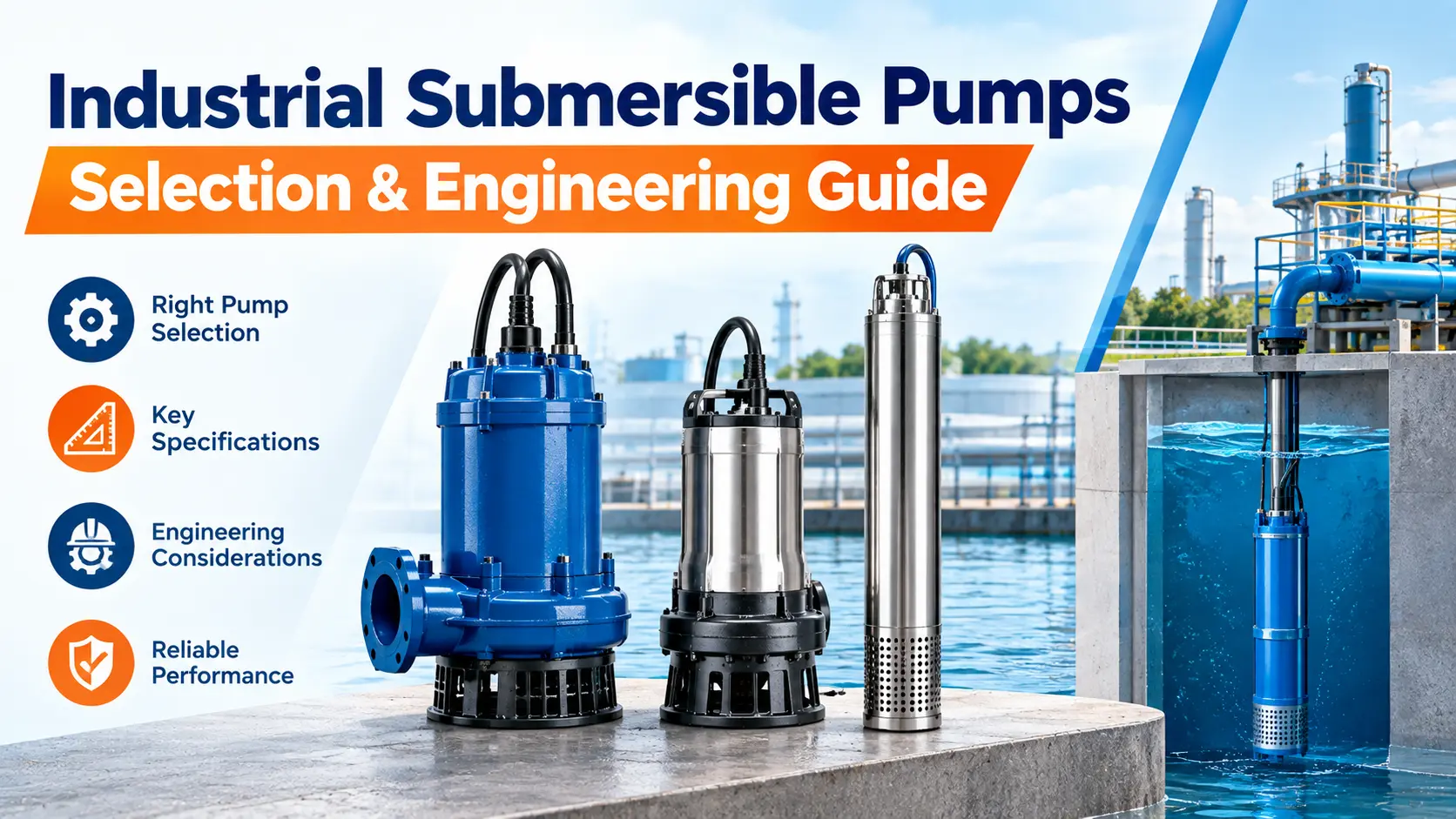
Industrial Submersible Pumps: Selection & Engineering Guide
What are industrial submersible pumps? Industrial submersible pumps are the electrically powered pumps that can be operated in liquid mediums. They are extensively used for wastewater, sewage, dewatering, slurry, boreholes, and process water because they eliminate the suction issues and can be easily installed inside of pits, tanks, wells and wet wells.
This is the one easy reason that people make the wrong choice of pumps when the need arises in industrial applications: they tend to purchase by the size of their motor rather than by their duty. This can be dangerous with industrial submersible pumps as all types of wastewater, clean drainage water, sludge, slurry and corrosive process liquid act very differently. If you want to compare broader equipment categories first, you can review our full pump range.
How Do Industrial Submersible Pumps Work?
Working principle is simple. The impeller, attached to a shaft within the casing, is powered by a submersible motor. The liquid enters through the intake, the impeller increases the velocity of the liquid and the casing or diffuser changes that velocity into discharge pressure. The inlet is already submerged in the liquid, so the pump does not require a long suction connection, as a surface pump would require.
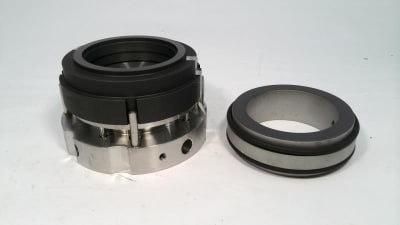
Hence, when people are looking for how industrial submersible pumps work, they like to choose them for deep pits, flooded chambers, wet wells etc. A standard assembly consists of a hermetically-sealed motor, a mechanical seal, bearings, power cable, intake screen and discharge outlet. If you want a wider comparison between submerged, centrifugal, and rotary designs, this pump overview is a useful reference.
Types of Industrial Submersible Pumps
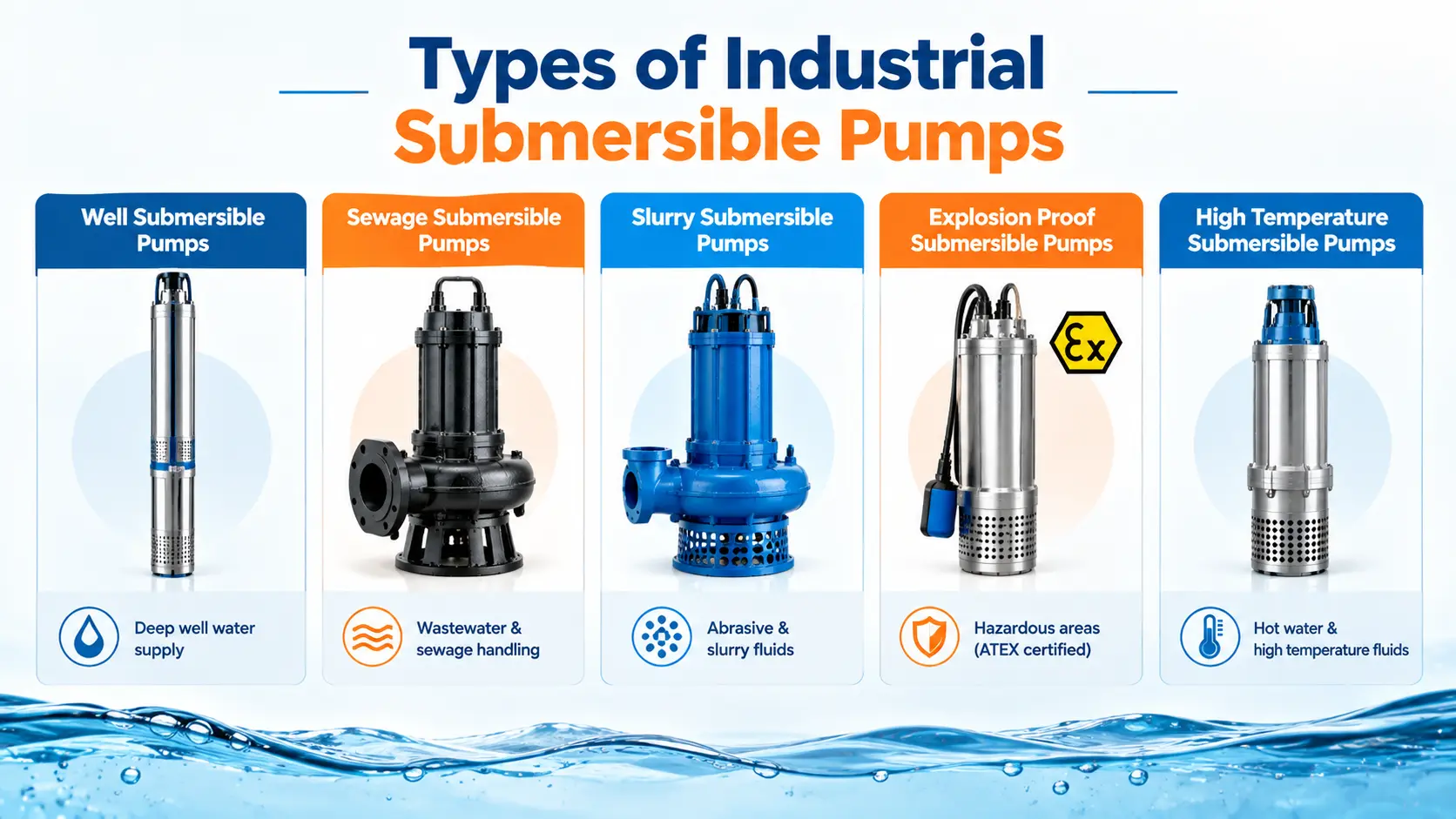
Not every industrial submersible pump design can be used for a particular service. There are types that are optimized for clean drainage water, and there are types that are optimized for sludge, solids handling or abrasive slurry. It is best to see the difference by application and not appearance.
Pump Type | Typical Service | Solids Handling | Main Selection Point |
|---|---|---|---|
Submersible wastewater pumps | Industrial effluent, washdown water | Moderate | Fibres, suspended matter, clogging risk |
Submersible sewage pumps | Raw sewage, lift stations, treatment plants | High | Free passage and non-clog impeller design |
Industrial dewatering pumps | Construction, mines, drainage wells | Low to moderate | Higher head and portable deployment |
Submersible slurry pumps | Abrasive sludge, sand, tailings | High | Wear resistance and solids concentration |
Submersible borehole pumps | Deep wells, groundwater, process water | Low | Depth, multistage head, water quality |
This is why search terms like industrial submersible pumps for wastewater, industrial submersible pumps for dewatering, industrial submersible pumps for slurry and industrial submersible pumps for sewage treatment yield very different product matches. You can also browse our wider industrial pumps category to compare adjacent pump technologies.
Applications, Advantages, and Practical Limits
Industrial submersible pumps used for mining in the field are for dirty water removal, pit dewatering and underground drainage. Industrial submersible pumps are used on civil projects to pump out water during excavation or to pump out water from the trench and stormwater. They are frequently selected in factories as submersible pumps for transporting process water or wastewater in which the water sits below the factory floor.
The main advantage is the simplicity of the system they're in, they don't need as much priming as many surface pumps, and they save floor space. They can also be used under poor suction conditions. However, there are boundaries. Retrieval may be more difficult, access to the maintenance is not as convenient as for a dry mounted pump, and some models cannot safely operate dry. When a duty requires exact chemical metering, rather than bulk transfer, a technology that is discussed in this chemical transfer guide may be more appropriate than a submerged centrifugal design.
The key benefits are: compact installation, low suction concerns, good wet-well utilization, excellent drainage and solids-handling capabilities.
Main restrictions: access for services, risk of failing seals, protection of cables and limitations of dry-run.
How to Select an Industrial Submersible Pump
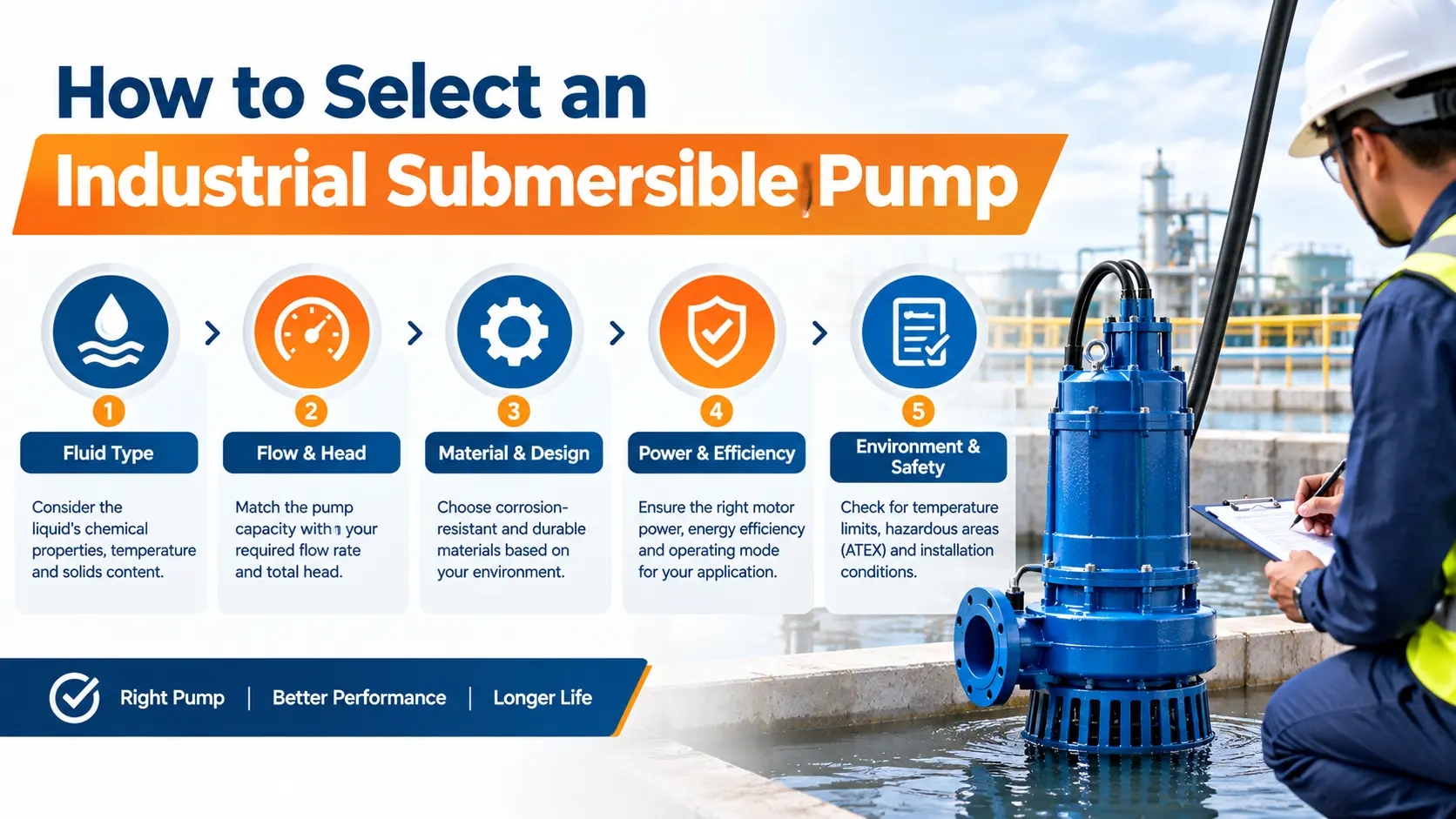
The safest method to choose an industrial submersible pump is to start from the duty point. Use the required flow rate, then determine total dynamic head, fluid property, solids concentration, fluid temperature, and installation method. Next, examine the pump curve, duty point and if the pump will run close to the best point or far from the best point in its pump curve.
This is important because the selection of flow and head for an industrial submersible pump is not simply "how much water" will the pump move. Even with a high capacity pump rating, it may be a complete mismatch for your system resistance. Likewise, anyone seeking an industrial submersible pump sizing guide shouldn't overlook the following factors: solids size, fluid temperature, immersion depth, and motor starting method. Variable demand can be controlled with a Variable Frequency Drive (VFD) and can sometimes save energy.
Explain the concept of pumped liquid content and solids content.
Compute the flow and the total dynamic head.
Choose the pump type and impeller style.
Verify compatibility, power supply and protection properties.
In other mixed hydraulic systems, the engineer might also consider other equipment, such as a compact hydraulic gear unit to perform separate pressure operations, but this is not the same as a submersible drainage or wastewater pumping system.
Materials, Protection, and Maintenance Requirements
The next question for many buyers may not be which pump type but what is that pump made of. Industrial submersible pumps that are used with corrosive fluids can be constructed of stainless steel 316 or duplex materials rather than cast iron. Hardened wear components are sometimes required for abrasive applications. Thermal switches, leakage detection and moisture monitoring are all components of a proper motor protection package. These information have a direct impact on service life.
Selection Factor | What to Check | Why It Matters |
|---|---|---|
Material | Cast iron, stainless, duplex, abrasion-resistant alloys | Corrosion and wear resistance |
Impeller | Channel, vortex, non-clog, grinder | Solids handling and clogging control |
Protection | Thermal sensors, leakage probes, motor protection | Prevents hidden failures |
Installation | Guide rail, wet-well, portable, fixed well | Affects maintenance access and retrieval |
Maintenance | Seal condition, bearings, cables, performance drop | Improves reliability and lifecycle cost |
There is no universal answer to industrial submersible pump maintenance requirements. A lightly used drainage unit and a continuously running solids-handling pump will not have the same inspection cycle. During service work, supporting tools such as a hand pump, an RS hand pump, or a separate dosing pump may be used elsewhere on site, but those do not replace correct maintenance planning for the submersible unit itself.
Standards, Testing, and Energy Context
The selection of a good pump isn't only a matter of nameplates. It also is useful to comprehend the criteria for the performance claims. The ISO 9906 is for acceptance testing of hydraulic performance for rotodynamic pumps. ISO 9908 gives technical specifications for centrifugal pumps and ISO/ASME 14414 is for energy assessment of a pump system. The U.S. Department of Energy (DOE) and the Hydraulic Institute (HI) both emphasize that it is important to improve system efficiency rather than pump efficiency.
Also it is helpful to distinguish between general industrial submersible pumps and the specialized type of API related submersible pumps, known as oilfield Electric Submersible Pump (ESP) systems. Brands like Grundfos, Xylem Flygt, Sulzer, KSB, Tsurumi, Wilo, Ebara, Franklin Electric, Gorman-Rupp and others may be found in various applications across the market, but ultimately it will come down to duty point, solids handling, maintenance access and lifecycle cost, not brand. Rotary brands like Viking Pump might be thought of for different uses in viscous-transfer environments.
Frequently Asked Questions (FAQ)
Do industrial submersible pumps need priming?
No, not like the surface pumps. Typically, the hydraulic inlet would already be damp, so there is no need for the standard priming process of a suction line.
Can submersible pumps handle solids and sludge?
Some can but not necessarily all. Solids handling is affected by impeller design, free passage, solids concentrations and whether the pump is constructed as a wastewater, sewage or slurry pump.
What is the difference between a submersible pump and a surface pump?
The submersible pump is inserted in the fluid medium, while the surface pump is placed above the fluid medium and is connected to a suction mechanism.
Can industrial submersible pumps run dry?
Some models allow short periods of dry running while many require liquid in the surrounding area to cool the model. Dry run capabilities should be verified with manufacturer's information.
Are industrial submersible pumps energy efficient?
They have the potential to be, but only when the match occurs in the proper sequence with the system. The efficiency is dependent on the pump/motor/controls/pipework and operating point.
Conclusion
Industrial submersible pumps are chosen out of actual operating conditions, and not from general catalogues. Flow, head, solids, fluid chemistry, and access for maintenance are all important. Once the above are well understood, the decision between wastewater systems, sewage systems, dewatering systems, borehole systems and slurry systems becomes more obvious.
When considering options for a live industrial duty, start with the real system duty point and fluid conditions. That's a much more sound method than selecting solely on motor power.
DISCLAIMER: Z&F Corporation is not affiliated with, authorized by, endorsed by, or acting as an official representative of any manufacturer, brand, or trademark owner referenced on this website. All product names, trademarks, brand names, logos, and manufacturer references are the property of their respective owners and are used solely for identification, reference, and compatibility purposes.